CPT Code 26410: Hand extensor tendon repair billing guide
CPT code 26410: Official descriptor and procedure overview CPT code 26410 report...

Last Updated: Nov 24, 2026
73650 is the CPT code for radiologic examination, calcaneus; minimum 2 views. It covers plain-film X-rays of the heel bone alone, usually an axial and a lateral view. The code is billed once, however many extra views are taken.
A complete foot study takes 73630 instead, and ankle films take 73600 or 73610. A clean 73650 claim states the view count in the radiology report, pairs a lateralized ICD-10-CM diagnosis, and carries -LT or -RT for each heel.
Let Pabau's smart automation suggest the right codes, reduce claim denials, and keep your practice compliant—effortlessly.
Automate repetitive tasks and focus on what matters most—your patients.
Reduce coding errors and ensure compliance with the latest regulations.
Clean claims, fewer denials, and faster reimbursements.
Powerful insights and reporting to help your practice thrive.
HIPAA compliant SOC 2 certified GDPR-compliant Trusted by 4,000+ clinics worldwide

CPT code 73650 covers a calcaneus (heel bone) X-ray with at least two views, while a complete foot study takes 73630.
The radiology report has to state the number of views, and a report without it is the first denial trigger to check.
Use -26 or -TC when the read and the equipment are billed separately, and put -LT or -RT on every heel imaged.
Medicare’s 2026 national rate is $28.39 for global billing, split into $7.68 for the read and $20.71 for the technical component.
Pabau’s claims management software checks eligibility before the visit and sends each 73650 claim through the Claim.MD clearinghouse.
CPT code 73650 is the procedure code for a radiologic examination of the calcaneus, with a minimum of 2 views. CMS’s 2026 relative value files list it as an active, payable heel X-ray, split into professional and technical components.
The code set is maintained by the American Medical Association (AMA), whose descriptor reads Radiologic examination, calcaneus; minimum 2 views. The anatomical subject is the calcaneus alone, the largest tarsal bone, also called the heel bone or os calcis. The code sits in the Diagnostic Radiology (Diagnostic Imaging) section, in the lower extremity range (73501-73725).
CPT 73650 is deliberately narrow. It covers the calcaneus alone, imaged as a plain-film X-ray with at least two views. Using it for any foot pain imaging leads to claim downgrades or denials.
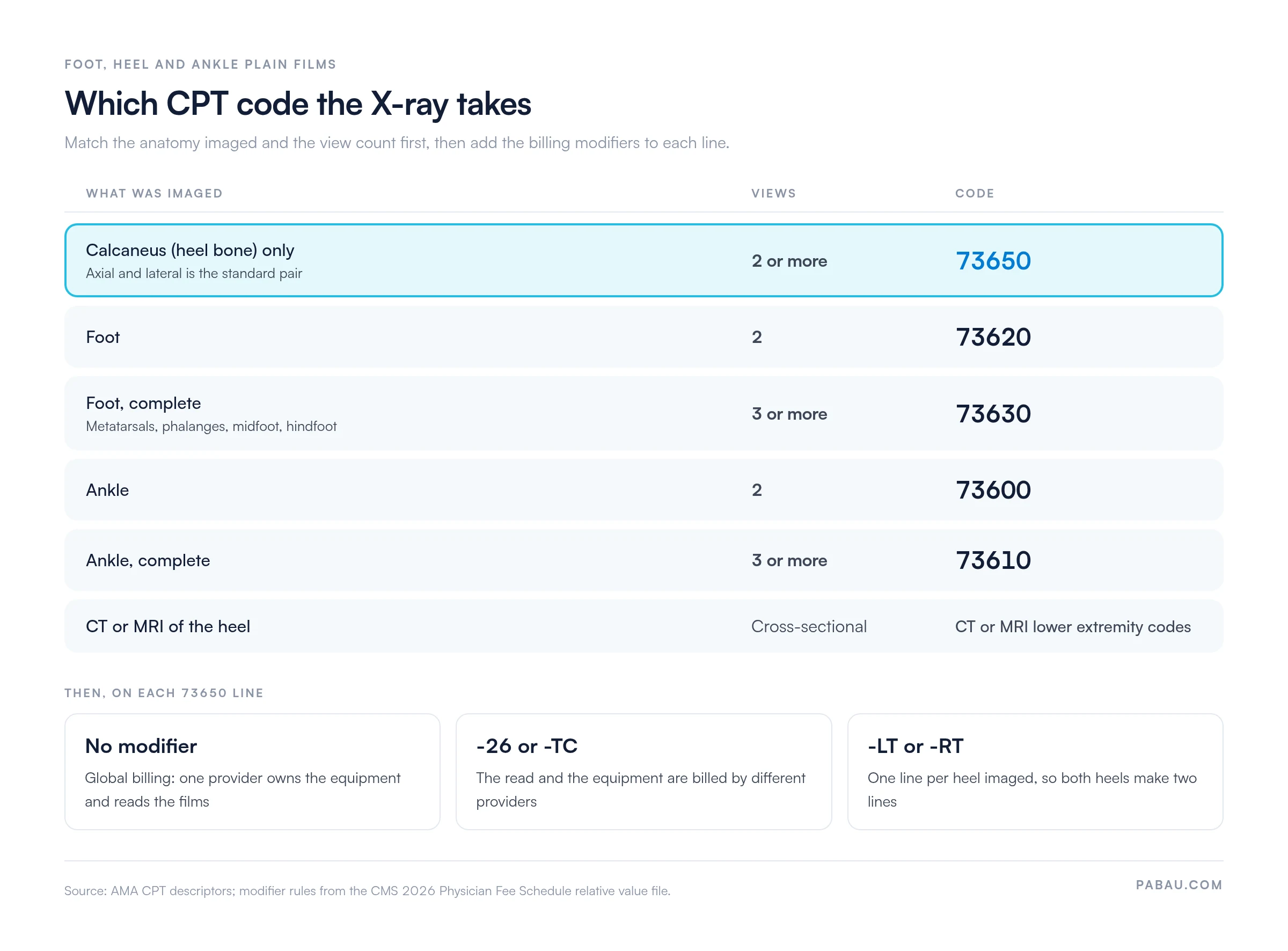
Five plain-film codes share the foot, heel and ankle. The anatomy imaged and the number of views decide which one a study takes, as the chart below sets out.
Two views is the minimum CPT 73650 allows. Payers reject claims where the radiology report records a single view, however good that image is.
The ordering provider’s chart note must separately document the clinical reason for the study. A radiology order with no visit note describing heel pain, the mechanism of injury, or relevant history won’t establish medical necessity in a payer audit.
Generating a superbill that links the visit note, the order, and the study keeps this documentation chain intact at the point of billing.
Run a weekly audit of your radiology claims, filtered for CPT 73650. Check that every claim has a linked radiology report that states the view count as a number. A report that says ‘calcaneus X-ray performed’ with no number is the first-pass denial to catch. Flag it for an addendum before submission.
A frequent error in foot and ankle radiology is billing CPT 73630 when only the calcaneus was imaged, or 73650 when the whole foot was. The two codes differ in anatomical scope and in the minimum number of views.
A podiatrist may order “heel and foot X-rays” for the same foot at one visit. The coder then reviews the images and the report, not only the order. If the radiologist imaged and interpreted only the calcaneus in two views, bill 73650. If a three-view foot study captured the calcaneus as part of the complete foot, bill 73630.
Billing both for the same foot on the same date creates a bundling exposure under the National Correct Coding Initiative (NCCI) edits.
CPT code 73650 takes both component modifiers and laterality modifiers. Applying the wrong one, or leaving out a required one, leads to a denial or an underpayment. Running insurance eligibility verification before the study also surfaces any payer-specific modifier rules before the claim is built.
Bilateral billing note: Medicare’s fee schedule gives 73650 a bilateral indicator of 3. The bilateral payment reduction doesn’t apply, and each heel is paid in full whether the claim uses -50 or two lines with -LT and -RT.
Commercial payers set their own rules, and many accept only the -LT and -RT lines, so check the payer’s radiology policy before you submit.
Every CPT code 73650 claim must carry an ICD-10-CM diagnosis code that justifies the imaging. The diagnosis must match the clinical picture the ordering provider documented, and a non-specific or mismatched code is a leading cause of payer denials.
Payers do not guarantee coverage on ICD-10 code selection alone. The code must match the clinical picture in the ordering provider’s chart. Submitting M77.31 (right calcaneal spur) for a visit note that describes left heel pain is a documentation mismatch. It creates both a denial risk and a compliance exposure.
Medicare reimbursement for CPT code 73650 is published each year in the CMS Physician Fee Schedule lookup tool. Rates vary by Medicare payment locality, through the Geographic Practice Cost Index, and by which component is billed. The national figures below use the 2026 relative value units and the standard conversion factor of $33.4009.
The work RVU for the read is 0.16, which is why the professional component pays so much less than the technical one. Always check the current rate for your locality before you quote patients or set fee schedules.
Use the FastRVU 2026 RVU lookup tool to pull the work, practice expense, and malpractice RVUs for 73650 and calculate your locality-adjusted rate. For revenue cycle management benchmarking, compare your average collected rate with the Medicare national rate to spot payer contracts that underpay.
Prior authorization: Medicare generally does not require prior authorization for plain-film X-ray codes, 73650 included. Commercial payers differ widely, and some require it for any musculoskeletal imaging while others exempt plain films. Check payer policy when the study is scheduled, not when the claim is submitted.
Most CPT code 73650 denials can be prevented at the documentation stage, long before an appeal. A denial management workflow that catches these patterns before submission saves more money than a strong appeals process.
When a denial does arrive, the remittance carries a claim adjustment reason code that names the problem. Our guide to denial codes in medical billing explains what each common code means and how to correct the claim.
Following the habits behind submitting a clean claim keeps most of these errors from reaching the payer in the first place.
Set up a pre-submission check for 73650 that confirms three details. A laterality modifier is present, the ICD-10-CM code is as specific as the chart allows, and the radiology report states the view count.
Yes, with conditions. CPT code 73650 can be billed with other services on the same date, but each code pairing carries its own bundling rules.
When an ordering provider performs an evaluation and management (E/M) visit and orders a heel X-ray on the same date, both codes are generally billable. Medicare does not normally require modifier -25 on the E/M for a diagnostic X-ray, which carries no global period. Some commercial payers do ask for it, so check their policy before you drop it.
Billing CPT 73650 and CPT 73630 for the same foot on the same date creates a significant NCCI bundling exposure. The AAPC coding guidelines and CMS NCCI edits address overlapping imaging of one anatomical region. Because the calcaneus is part of the foot, payers may treat a same-day 73650 and 73630 on that foot as a component and composite pair.
If a complete foot study also included dedicated calcaneal views, bill the more comprehensive code (73630) and not both. Bill 73650 for the opposite foot only if that heel was imaged separately.
Bilateral calcaneus X-rays on the same date are billable for both sides, most often as two line items (73650-LT and 73650-RT). Each foot needs its own documented clinical indication. One order for “bilateral calcaneus X-rays” is enough, provided the radiologist reports each side separately.
Most 73650 denials start with a detail that never reached the claim. It might be a missing laterality modifier, a vague diagnosis, or a coverage problem nobody checked. Billing teams often catch these only when the remittance comes back.
Pabau’s claims management software keeps the visit note, the order and the claim on one patient record. Coders build the claim from the documentation itself, so the diagnosis and the side imaged carry straight onto it.
Eligibility checks run before the visit, and claims go out through the Claim.MD clearinghouse, which reaches thousands of US payers. Remittances come back against the same patient record, so a rejected heel X-ray claim shows up within days.


Pabau checks patient eligibility before the visit and sends CPT 73650 claims through the Claim.MD clearinghouse. Remittances post back to the patient record, so podiatry, orthopedic and radiology practices see denials early.

CPT code 73650 is simple to choose and easy to lose on documentation. The radiology report has to state the view count, the diagnosis has to match the side imaged, and every line needs its laterality modifier. Get those three right before submission and most of this code’s denials never happen.
The payment is small, at $28.39 nationally for a global claim, so rework costs more than the claim is worth. A practice that bills plain films in volume should build these checks into its workflow, not into its appeals queue.
If you are still choosing a system, our comparison of the best medical billing software sets out the options for US practices. Book a demo to see how Pabau keeps radiology claims accurate from order to remittance.

Imaging the ankle instead of the heel? CPT code 73610 covers the complete ankle study with a minimum of three views.
Coding a plantar fasciitis workup? ICD-10 code M72.2 explains the plantar fascial fibromatosis code that often supports a heel X-ray.
Struggling with claim denial patterns across your practice? Denial management in healthcare covers the workflow strategies that reduce rework and speed up collections.
Want to understand the full revenue cycle behind radiology billing? What is revenue cycle management explains the end-to-end process from eligibility check to payment posting.
CPT code 73650 covers a radiologic examination of the calcaneus (heel bone) with a minimum of two views. The usual pair is an axial (Harris-Beath) view and a lateral view. It applies only to the calcaneus. A foot study, ankle films, and CT or MRI of the heel all take other codes.
A minimum of two views is required. The radiology report must state the number of views obtained. Most payers deny a claim whose report leaves out the view count, citing insufficient documentation.
CPT 73650 covers only the calcaneus in a study of at least two views. CPT 73630 covers a complete foot study, including the metatarsals, phalanges and hindfoot, with at least three views. If only the heel bone was imaged, use 73650, and if the whole foot was imaged, use 73630.
Modifier -26 applies when you bill the professional (interpretation) component only, and -TC applies to the technical component only. Global billing takes no component modifier. For laterality, add -LT or -RT. Medicare accepts -50 or two per-side lines for bilateral imaging, while many commercial payers want the two lines.
The 2026 national rate is $28.39 for global billing, based on 0.85 total RVUs and a conversion factor of $33.4009. The professional component (-26) pays $7.68 and the technical component (-TC) pays $20.71. Rates vary by locality, so check yours in the CMS Physician Fee Schedule lookup tool.
Yes. Both codes are generally billable when the provider sees the patient and orders the heel X-ray on the same date. Medicare does not normally require modifier -25 for a diagnostic X-ray, but some commercial payers ask for it on the E/M.
Commonly paired codes include M79.671 and M79.672 (pain in right or left foot), and M77.31 and M77.32 (calcaneal spur, right or left foot). Others are S92.001A and S92.002A (calcaneus fracture, initial encounter), and M72.2 (plantar fasciitis). Always use the most specific, lateralized code the documentation supports.
The radiology report may not state the view count, or 73630 and 73650 may be swapped for the anatomy imaged. Other common causes are a non-specific or mismatched ICD-10 code, a missing laterality modifier, and a chart that doesn’t document medical necessity.