

CCSD code G5100: Bypass of duodenum billing guide
CCSD code G5100 bills a bypass that leaves the duodenum in place CCSD code G5100...

Last Updated: Oct 16, 2026
73501 is the CPT code for radiologic examination, hip, unilateral, with pelvis when performed; 1 view. It covers a single image of one hip, usually an anteroposterior (AP) projection. When a pelvis view is taken, it counts as that one image.
Two errors drive most 73501 denials: a missing RT or LT laterality modifier, and the wrong view-count code. If the signed report shows two or three views, the claim belongs under 73502 instead.
Let Pabau's smart automation suggest the right codes, reduce claim denials, and keep your practice compliant—effortlessly.
Automate repetitive tasks and focus on what matters most—your patients.
Reduce coding errors and ensure compliance with the latest regulations.
Clean claims, fewer denials, and faster reimbursements.
Powerful insights and reporting to help your practice thrive.
HIPAA compliant SOC 2 certified GDPR-compliant Trusted by 4,000+ clinics worldwide

CPT code 73501 reports one view of one hip, and a pelvis view counts as that view when it’s taken.
Every 73501 line needs an RT or LT modifier, and a missing side is the most common denial trigger.
Medicare’s 2026 national non-facility rate for the global service is about $33 to $34, based on 1.01 total RVUs.
A pelvis view counts toward the hip code’s view total, so 72170 isn’t reported with 73501 for the same series.
Code from the signed report, not the order, because two or three views taken means 73502.
CPT code 73501 reports a single X-ray view of one hip. The American Medical Association’s CPT code set gives the full descriptor as “Radiologic examination, hip, unilateral, with pelvis when performed; 1 view.” So if a pelvis view is taken, it counts as that one view.
The code opens the 73501 to 73503 unilateral hip family, where only the view count changes. 73501 is one view, 73502 is two or three, and 73503 is four or more. Billing 73502 when only one image was taken is upcoding, and auditors look for it in radiology claims.
In practice, the single view is almost always an anteroposterior (AP) projection. It shows the femoral head, the acetabulum and the proximal femur. Typical orders include follow-up after hip arthroplasty, osteoarthritis surveillance and a low-energy trauma screen.
Every 73501 claim needs a complete record before it reaches the payer. Miss one of these items and the claim comes back for manual resubmission.
Missing laterality is the most common denial trigger for unilateral hip codes. Payers flag any 73501 line that carries no RT or LT modifier. The fix sits upstream: make the side a required field on the order, so nobody codes it from memory.
A single-view hip X-ray needs an ICD-10 code that shows why it was ordered. The table below lists the diagnoses most often paired with 73501, with the typical scenario for each.
Pain codes such as M25.551 suit an initial work-up. Once the report confirms a diagnosis, switch to that code on follow-up studies. Also match the code’s side to the RT or LT modifier, because a mismatch invites a denial.
Check your MAC’s local coverage determination (LCD) for hip imaging too. Payer policies may limit which diagnoses qualify, and when. The CDC/NCHS ICD-10-CM web tool is the authoritative source for current descriptors and effective dates.
Four modifiers apply routinely to CPT code 73501. Which ones you use depends on who owns the equipment and who reads the images.
Global billing applies when one physician or group owns the equipment, employs the technologist and reads the study. In that case, bill 73501-RT (or LT) with no component modifier. The allowed amount covers both the technical and professional work.
Split billing is common in hospital outpatient departments and freestanding imaging centers. There, the radiologist often works for a physician group rather than the facility.
The facility bills 73501-TC for equipment and staffing, and the radiologist’s group bills 73501-26 for the signed interpretation. Payers reject duplicate global claims in these settings, so match the modifier set to the setting.
Before you submit any 73501 claim, confirm the billing scenario: global, professional only, or technical only. Then check that RT or LT sits on every line next to any component modifier.
Medicare sets the 73501 rate through the annual Physician Fee Schedule. For 2026, the global service carries 1.01 total RVUs in a non-facility setting. At the 2026 conversion factor of $33.4009, that’s about $33.73 nationally, before your locality adjustment.
The -26 and -TC amounts shift with each locality, so pull them from the CMS Physician Fee Schedule Look-Up Tool before you quote them. Commercial payers often pay a multiple of the Medicare rate, though contracts vary. Medicare Advantage plans set their own fee schedules, and each state sets its Medicaid rates.
Code selection in the hip X-ray series turns on two counts: how many hips, and how many views. If the signed report shows two or three views of the same hip, the code is 73502, not 73501.
The chart below walks through the choice, sides first and views second.
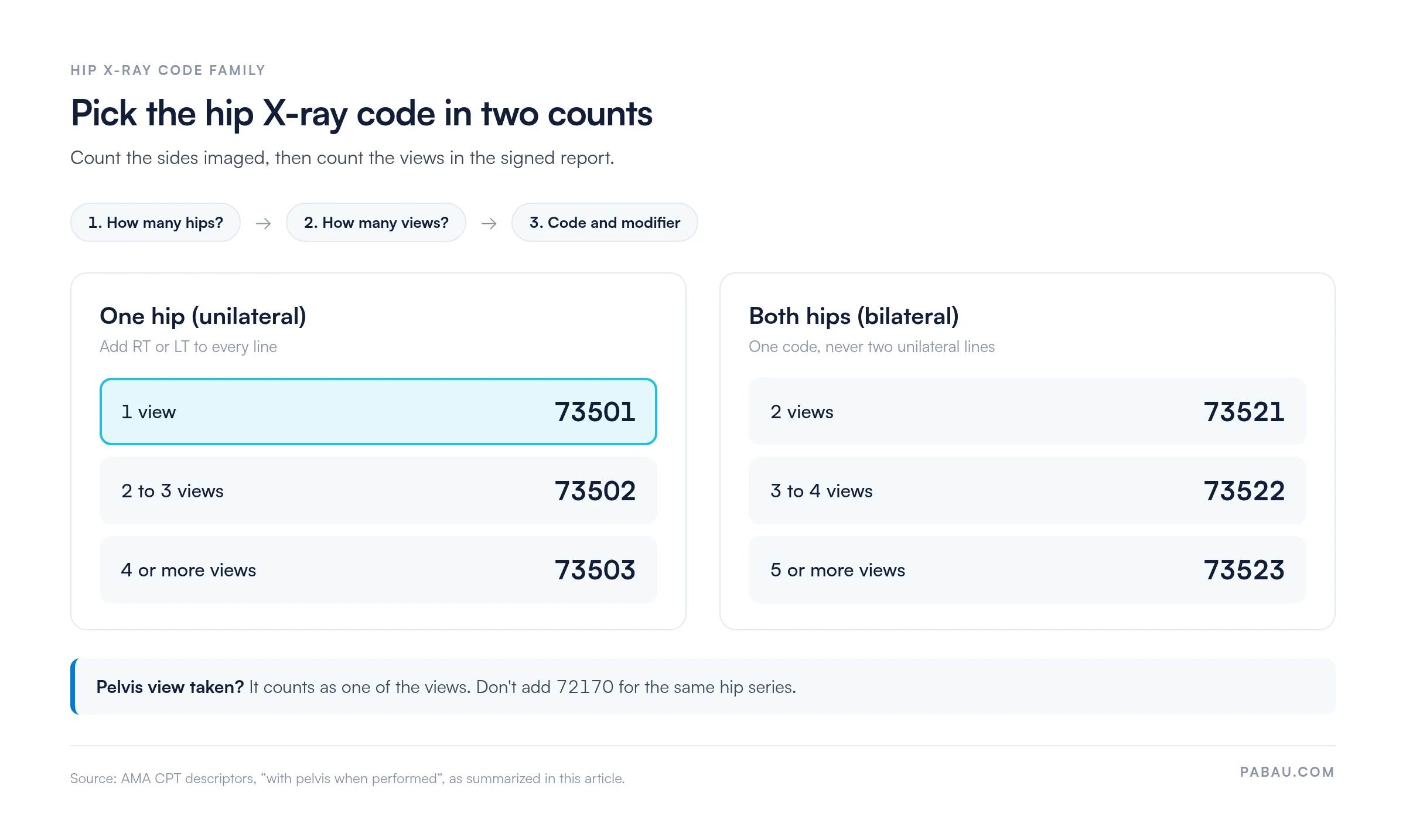
The classic error in this family is a bilateral study billed as two 73501 lines, one RT and one LT. Payers read that as duplicate billing and deny the second line. Bill 73521 instead, or 73522 or 73523 when more views were taken.
CPT 72170 covers a pelvis X-ray of one or two views. It comes up often in emergency and orthopedic settings, where providers order “hip and pelvis” films together.
The 73501 descriptor already includes the pelvis when performed. A pelvis view taken with a unilateral hip study therefore counts as one of its views. So 72170 isn’t reported on top for the same hip series. Count the pelvis toward 73502 or 73503 instead, or use 73521 to 73523 if both hips were imaged.
Here’s how that plays out on three common orders:
Traditional Medicare doesn’t require prior authorization for standard diagnostic X-rays, 73501 included. Other payers set their own rules, so the exemption doesn’t carry over automatically.
Medicare Advantage plans each set their own authorization policies, and some require approval for musculoskeletal imaging. Commercial payers vary widely. Some exempt plain films below a cost threshold. Others want approval for imaging tied to workers’ compensation, personal injury or post-surgical monitoring.
So check each payer’s policy before scheduling, and write the clinical indication clearly on the order. If a retrospective medical necessity review follows, the record then supports the decision to image. A solid insurance eligibility verification routine catches most authorization surprises before the patient arrives.
Most 73501 denials fall into one of six patterns. Each one is easy to fix before submission and slow to fix after a denial.
A clearinghouse with claim edits catches several of these before the payer sees them. When a denial still lands, a denial management routine sends it back to the biller with its reason code. Our guide to denial codes explains what each of those codes means.
Run a monthly denial report filtered to CPT 73501. If missing-modifier denials show up more than twice in 30 days, look at charge capture first. Audit the order template or superbill so laterality must be filled in before a charge posts.
A 73501 claim passes through four sets of hands: the ordering provider, the technologist, the radiologist and the biller. Each handoff is a chance for the side or the view count to drift.
Run this quick check at charge entry, while the encounter is still fresh.
Most 73501 errors start at charge entry, when someone keys a side or a view count from memory. Pabau, the practice management platform we build, pre-fills each claim from the patient record instead. The CPT code attached to the service lands on the charge line, and the ICD-10 slots are seeded from the recorded problem list.

Before a claim leaves, Pabau’s claims management software checks that required fields are complete, such as membership numbers and authorization codes. The Send button stays disabled until they are. Payer-level claim edits, including modifier and diagnosis checks, then run at the Claim.MD clearinghouse that US claims pass through.
From the same Claims dashboard, US practices run real-time eligibility checks, track each claim’s status and post ERA remittances. That means fewer resubmissions and less time chasing a low-value imaging claim through the denial queue.

Pabau pre-fills each claim from the patient record and holds it until required fields are complete. US claims then go through Claim.MD for payer edits, eligibility checks and ERA posting.

Coding 73501 comes down to counting. Count the hips imaged, count the views in the signed report, and count any pelvis view among them. Get those numbers right and the code and modifier follow.
The trade-off is a minute of checking at charge entry. That minute costs far less than weeks of rework on a claim worth about $34. Make laterality a required field on the order, and your most common 73501 denial becomes rare.
Want to see how Pabau pre-fills hip X-ray claims and tracks them through to payment? Book a demo with our team.

Need guidance on medical billing fundamentals? What is medical billing explains the end-to-end revenue cycle from charge capture through payment posting.
Looking to reduce claim rejections systematically? Denial management in healthcare covers how to build a denial-tracking workflow that reduces rework.
Want to understand how clearinghouse submissions work? 837 file format guide walks through the EDI transaction standard used for electronic claim submission to payers.
Building a charge-capture template? What is a superbill? shows which fields to make mandatory so codes and modifiers are captured at the visit.
Yes. Under 42 CFR 410.32, diagnostic X-rays must be ordered by the physician or practitioner treating the patient. Keep the signed order, with the side and the clinical reason, in the record.
Report 73501 again with modifier 76 if the same physician repeats the study, or 77 if a different physician does. Document the time and the clinical reason, such as a check after a reduction.
For Medicare, portable X-ray suppliers can bill transport separately with HCPCS R0070 for one patient, or R0075 for more than one. Coverage depends on the setting, so check your MAC’s rules.
Issue an Advance Beneficiary Notice (ABN) when you expect Medicare may deny the X-ray as not medically necessary. Get it signed before the service, then add modifier GA to the claim.
Yes, usually. The X-ray and the evaluation and management (E/M) visit are separate services. If you report the X-ray’s interpretation yourself, don’t also count it toward the visit’s level.



