

ICD-10 Code R63.4: Abnormal weight loss
ICD-10 code R63.4: Definition, billability and code structure ICD-10 code R63.4 ...

Last Updated: Nov 13, 2026
Billable Code Specific Code
M54.12 is the billable ICD-10-CM code for radiculopathy, cervical region. It reports arm pain, numbness, or weakness caused by a compressed or irritated cervical nerve root, as documented by the treating physician.
The code sits under subcategory M54.1 (Radiculopathy) in category M54 (Dorsalgia), chapter 13 of the ICD-10-CM tabular list. Neck pain without nerve root findings is coded M54.2 instead. Radiculopathy caused by a cervical disc disorder or spondylosis takes a combination code from M50.12- or M47.22.
Let Pabau's smart automation suggest the right codes, reduce claim denials, and keep your practice compliant—effortlessly.
Automate repetitive tasks and focus on what matters most—your patients.
Reduce coding errors and ensure compliance with the latest regulations.
Clean claims, fewer denials, and faster reimbursements.
Powerful insights and reporting to help your practice thrive.
HIPAA compliant SOC 2 certified GDPR-compliant Trusted by 4,000+ clinics worldwide

M54.12 reports cervical radiculopathy: arm pain, numbness, or weakness caused by a compressed or irritated cervical nerve root. Neck pain alone does not qualify.
ICD-10-CM M54.12 carries no laterality subdivision: a single code covers both unilateral and bilateral cervical nerve root involvement.
Claims billed with M54.12 are denied most often when the note lacks a physician-confirmed radiculopathy diagnosis backed by exam findings or imaging.
A cervical disc disorder or spondylosis with radiculopathy takes its own combination code (M50.120–M50.123 or M47.22), so M54.12 comes off the claim.
Pabau’s claims management software sends M54.12 claims through the Claim.MD clearinghouse, runs eligibility checks, and tracks prior authorizations on the patient’s case.
ICD-10 Code M54.12 is the billable ICD-10-CM code for radiculopathy in the cervical region. Coders assign it when the physician documents cervical nerve root involvement, not neck pain alone.
The table sets out the facts to check first, and the CDC/NCHS ICD-10-CM web tool confirms validity each fiscal year.
M54.12 covers radiculopathy that starts at a cervical spinal nerve root. Irritation or compression of the root produces symptoms that radiate beyond the neck, into the shoulder, arm, or hand. The code applies when the treating physician has documented a clinical diagnosis of cervical radiculopathy, not simply neck discomfort.
Clinically, cervical radiculopathy follows a dermatome. A C6 root lesion typically sends pain and numbness down the lateral forearm to the thumb. A C7 lesion affects the middle finger, and a C8 lesion tracks to the fourth and fifth digits. Weakness, diminished deep tendon reflexes, and a positive Spurling’s test support the diagnosis.
Four causes produce most cervical radiculopathy, and two of them change the code.
Documented foraminal stenosis or a post-traumatic cause is coded alongside M54.12. A disc disorder or spondylosis works differently. Its combination code already carries the radiculopathy, so M54.12 comes off the claim.
M54.12 carries coding exclusions that restrict what may be assigned alongside it or instead of it. These are defined at the M54.1 subcategory level in the ICD-10-CM tabular and apply to every code under M54.1, including M54.12.
In practice, the physician’s wording decides it. If the note documents radiculopathy explicitly, with supporting clinical evidence, M54.12 is appropriate. If it says “neck pain” or “cervical pain” without nerve root findings, default to M54.2.
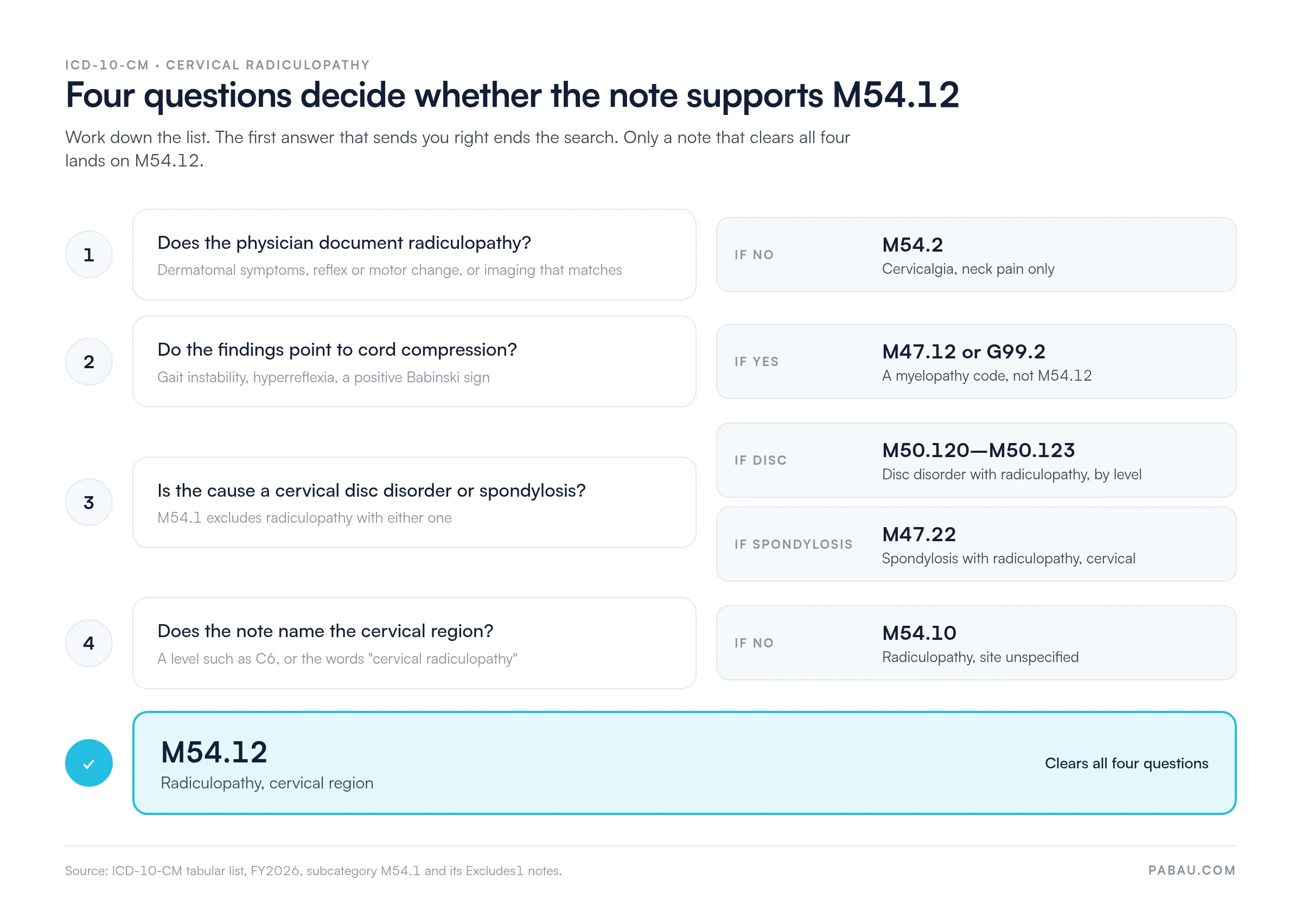
Run the checks in order and each neighbor code drops out before M54.12 is assigned. The chart below sets out the four questions.
M54.12 is a site-specific code within the M54.1 radiculopathy subcategory. Selecting the wrong site-specific code is a correctness error that may trigger a payer audit. The table below covers the M54.1x options most commonly encountered alongside M54.12.
When a patient has documented radiculopathy at both cervical and lumbar levels, assign both M54.12 and M54.17 as separate codes. They represent different anatomical sites and are not mutually exclusive.
M54.2 is the most commonly confused neighbor of M54.12. It covers cervicalgia, which is non-specific neck pain without radicular features. M54.12 requires documented nerve root involvement.
An encounter that begins as cervicalgia and later confirms radiculopathy should be updated to M54.12, but only after the physician documents the radiculopathy diagnosis. Coders should not make that clinical determination independently.
Run a quarterly audit of encounters coded M54.2 where the visit note also documents arm pain, numbness, or Spurling’s test results. These encounters frequently meet the threshold for M54.12 but were coded conservatively at the time. Recode where the physician’s documentation supports radiculopathy and resubmit as corrected claims.
Cervical myelopathy is spinal cord compression, not nerve root compression. The two conditions have overlapping symptoms but require different ICD-10-CM codes. Confusing them is a material coding error that can trigger payer audits.
A patient with cervical spondylosis can have myelopathy and radiculopathy at the same time. Assign the myelopathy code, then confirm with the treating physician how the radiculopathy is documented.
When spondylosis causes it, the radiculopathy belongs to a spondylosis code (M47.2-) rather than M54.12, because M54.1 excludes it. The note must support each diagnosis on its own.
Most M54.12 denials trace back to the clinical note. Thorough medical billing documentation starts there, and the note must support the radiculopathy diagnosis before the code is assigned. Keep those notes retained and retrievable, because payers ask for them on review.
The clinical note must include each of the following elements to establish medical necessity.
When a cervical disc disorder with radiculopathy is confirmed, report the level-specific code from M50.120–M50.123 in place of M54.12. Those codes already carry the radiculopathy, so adding M54.12 is redundant. The same applies to cervical spondylosis with radiculopathy, which is M47.22.
Pairing the right CPT codes with M54.12 keeps claims clean. The table lists the procedures most often billed alongside it, with the medical necessity context each one needs. Pabau’s claims management software sends these claims through the Claim.MD clearinghouse and checks eligibility before the visit.
Medicare coverage for procedures paired with M54.12 is governed by Local Coverage Determinations (LCDs). LCD requirements change, so verify the current policy before citing a specific LCD number in a coverage appeal.
For a cervical epidural steroid injection billed as 62321, most LCDs require conservative care documentation and imaging correlation.
That imaging is usually a cervical MRI, reported as 72141. Commercial payers set their own pre-authorization triggers by plan year, so confirm them with each payer.
Cervical radiculopathy carries a clinical threshold that notes often fail to show clearly. The table maps the most common denial triggers to their root causes and fixes.
Practices with structured denial management workflows catch these patterns before they become write-offs. Knowing the medical billing denial codes behind each rejection makes appeals faster to prepare.
ICD-10 Code M54.12 is active and billable for FY2026 without descriptor or guideline changes. No modifications to the M54.12 code entry were made in either annual ICD-10-CM update cycle.
Coders can verify current validity directly in the AAPC Codify ICD-10-CM lookup or the official WHO ICD-10 browser for international context.
CMS publishes the updated ICD-10-CM code files each October for the new fiscal year. Any code-level changes to the M54 chapter would appear in the CMS update summary.
As of the FY2026 release, M54.12 remains unchanged in descriptor, hierarchy, and exclusion notes. Practices should subscribe to the annual CMS update notification to catch any future revisions.
Coders sometimes search for “M54.12 2025” or “M54.12 2026” to confirm the code has not been retired or reconfigured. It has been stable since the ICD-10-CM transition in 2015. A medical claims clearinghouse with a current ICD-10-CM catalog flags a retired or invalid code before the claim reaches the payer.
Most M54.12 denials start before the claim is built. The physician documents radiculopathy in one system, the coder rebuilds it in another, and the ESI authorization sits in an email thread.
In Pabau, the treatment note, the diagnosis code and the claim share one patient record. US claims go out as CMS-1500/837P files through the Claim.MD clearinghouse, with eligibility checked before the visit. ERA remittances post back to that record, so a denial appears next to the note behind it.
Prior authorizations are tracked on the patient’s case, with the auth code, dates and sessions. Pabau warns your team when one is missing, before an ESI or a cervical MRI ordered under M54.12 is billed.


Pabau sends M54.12 claims through the Claim.MD clearinghouse, checks eligibility before the visit, and tracks prior authorizations. Your ESI and imaging claims go out complete.

M54.12 is a narrow code, and that narrowness protects the claim. It belongs on the claim only when the physician has named cervical radiculopathy and backed it with exam or imaging findings. A disc disorder, spondylosis or myelopathy diagnosis sends the claim to a different code.
So the fix for most M54.12 denials sits with documentation. Ask for the dermatome, the reflex change and the imaging level in the note, and the code choice follows. Book a demo to see how Pabau keeps the note, the authorization and the claim on one patient record.

Need a clean-claim checklist for spine billing encounters? Understanding what makes a clean claim walks through the data elements payers validate before processing payment.
Want to understand how the clearinghouse validates your ICD-10 codes? The 837 electronic claim file explained covers how diagnosis and procedure codes are transmitted to payers.
Dealing with repeated eligibility denials on radiculopathy encounters? Insurance eligibility verification outlines how real-time checks before the visit prevent downstream claim rejections.
ICD-10 Code M54.12 is the billable diagnosis code for radiculopathy of the cervical region. It is used when a physician has documented nerve root irritation or compression in the cervical spine. It captures the classic presentation of cervical radiculopathy: Dermatomal arm pain, numbness, weakness, and possible reflex changes caused by pressure on a cervical nerve root. It does not apply to non-specific neck pain without confirmed nerve root involvement.
Use M54.12 when the physician has documented cervical radiculopathy with supporting neurological findings (dermatomal pain, reflex changes, motor weakness, or a positive Spurling’s test). Use M54.2 (Cervicalgia) when the note documents neck pain without confirmed nerve root involvement. Assigning M54.12 based on neck pain alone, without radiculopathy findings, is a medical necessity violation and a common claim denial trigger.
M54.10 is radiculopathy at an unspecified site, assigned only when the spinal region is not documented. M54.12 specifies the cervical region. When the treating provider’s note documents cervical radiculopathy or identifies cervical nerve root involvement, M54.12 is the correct code. M54.10 should not be used when a more specific site code is available.
Yes. ICD-10 Code M54.12 is active and billable for both FY2025 and FY2026. No descriptor or guideline changes were applied to this code in either annual ICD-10-CM update cycle. Its status can be verified at the CDC/NCHS ICD-10-CM web tool or the CMS annual code files released each October.
The clinical note must include a physician-stated diagnosis of cervical radiculopathy and exam findings showing the dermatomal distribution of symptoms. It also needs correlating imaging, such as an MRI or X-ray confirming disc herniation, foraminal stenosis, or osteophytic compression. EMG/NCS results strengthen the medical necessity case for interventional procedures. Payer-specific conservative care requirements must also be documented before interventional authorization.
Cervical radiculopathy (M54.12) involves nerve root compression, producing dermatomal arm pain and unilateral neurological deficits. Cervical myelopathy involves spinal cord compression, producing bilateral leg weakness, gait instability, and upper motor neuron signs (hyperreflexia, Babinski). Myelopathy is coded with M47.11-M47.12 or G99.2, not M54.12. Applying M54.12 to a myelopathy presentation is a material coding error that payers may flag in audit.



