HCPCS Code J1110: Dihydroergotamine mesylate injection billing guide
HCPCS Code J1110: Official descriptor and drug overview HCPCS Code J1110 is the ...

Last Updated: Oct 29, 2026
72198 is the CPT code for magnetic resonance angiography, pelvis; with or without contrast material(s). One code covers every contrast protocol, so the radiology report must state which one was used.
Unlike the MRI pelvis codes 72195, 72196 and 72197, which image soft-tissue anatomy, 72198 covers angiographic imaging of the pelvic blood vessels. The anatomy overlaps, but the procedure type does not: 72198 maps to MRA, not MRI. Confusing the two families can lead to denials or downcoding.
Let Pabau's smart automation suggest the right codes, reduce claim denials, and keep your practice compliant—effortlessly.
Automate repetitive tasks and focus on what matters most—your patients.
Reduce coding errors and ensure compliance with the latest regulations.
Clean claims, fewer denials, and faster reimbursements.
Powerful insights and reporting to help your practice thrive.
HIPAA compliant SOC 2 certified GDPR-compliant Trusted by 4,000+ clinics worldwide

CPT 72198 covers MRA of the pelvis only, a different procedure from the MRI pelvis codes 72195, 72196 and 72197.
One code covers every contrast protocol, so the radiology report must state which protocol was used.
Medicare coverage follows each MAC’s own policy, such as Novitas LCD L34865 and its billing and coding article A56805.
Many commercial plans manage imaging authorization through Carelon Medical Benefits Management, formerly AIM Specialty Health.
MRA codes include 3D rendering, so 76376 and 76377 are not reported with 72198.
CPT code 72198 reports magnetic resonance angiography (MRA) of the pelvis, with or without contrast material. The American Medical Association (AMA) maintains it in the Diagnostic Radiology subsection for imaging of the spine and pelvis (72020-72295).
The “with or without contrast material(s)” phrasing is intentional. It means 72198 is a single code regardless of whether gadolinium was administered. That design simplifies code selection but shifts the documentation burden. The radiology report must state which contrast protocol was used, or the claim is unlikely to survive a payer audit.
The four pelvis codes share an anatomic region but describe two different procedures. Payers treat MRI and MRA as distinct services with different coverage rules.
Codes 72195 through 72197 image soft-tissue anatomy such as organs, masses and ligaments. CPT code 72198 images the pelvic vasculature, producing angiographic sequences that evaluate arterial or venous flow. Billing 72198 for a routine pelvic MRI of the uterus is upcoding. Billing 72197 for a pelvic MRA ordered to evaluate iliac artery stenosis is downcoding.
Magnetic resonance venography (MRV) of the pelvis uses the same scanner but targets venous anatomy. No dedicated CPT code exists for pelvic MRV. Coders typically report 72198 with documentation specifying a venous protocol, or use the unlisted MRI code 76498, depending on payer policy. Confirm with the ordering radiologist before selecting the code.
Pelvic MRA sometimes captures anatomy that bleeds into adjacent code territories. The anatomic boundaries matter because payers apply different coverage rules and reimbursement rates to each region.
When a single exam covers both the abdominal aorta and the pelvic iliac vessels, code each region separately (74185 and 72198). That holds only if the ordering physician documented a distinct clinical indication for each territory. Do not code both unless the radiologist report explicitly addresses both anatomic zones with separate impressions.
The chart below puts both decisions in order: procedure type first, then vascular territory.
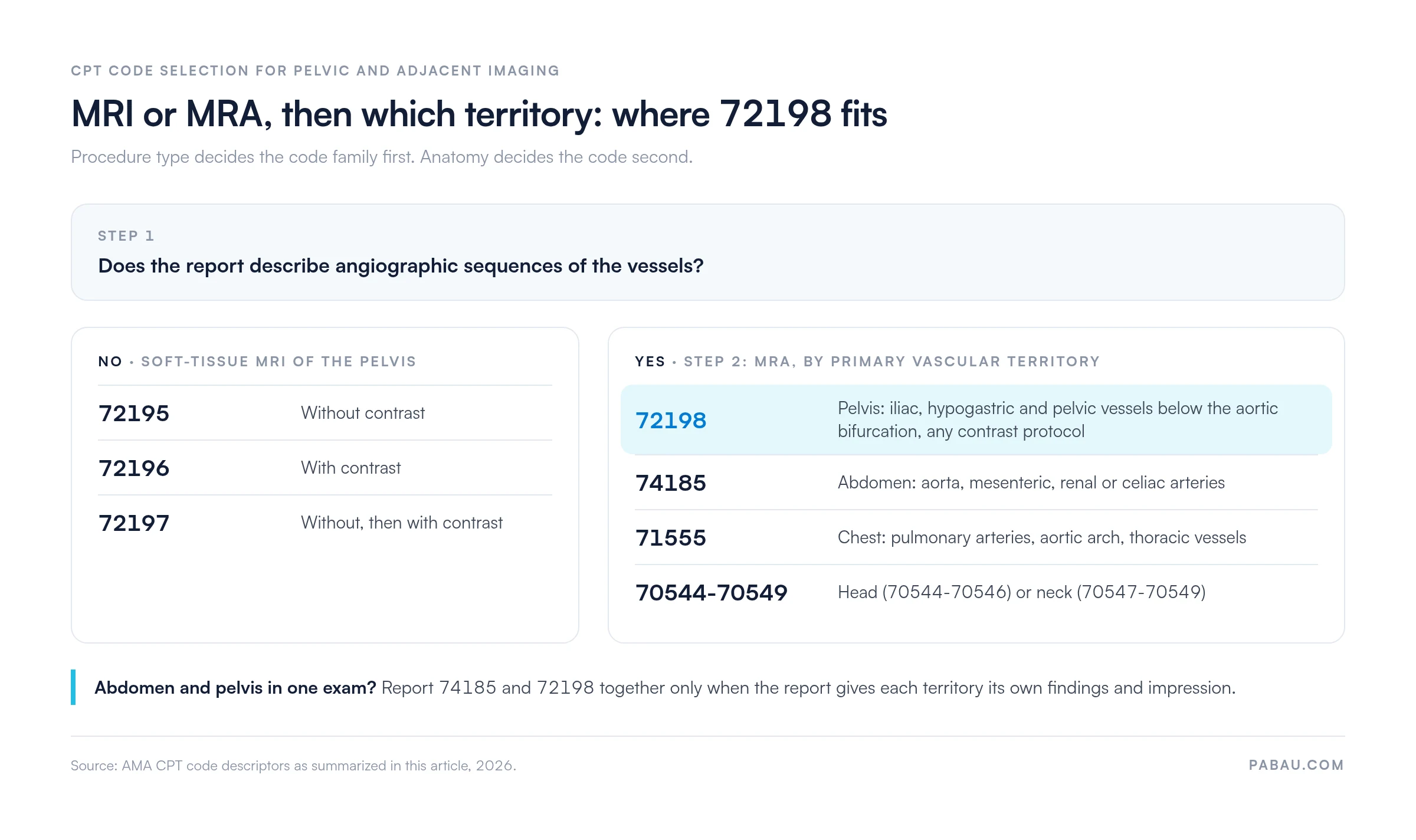
Run a crosswalk check before submitting multi-region MRA claims. Report both 74185 and CPT code 72198 only when the radiology report contains distinct findings and impressions for each anatomic territory. A single impression covering “abdominal and pelvic vasculature” is not sufficient to justify separate billing.
Modifier selection for 72198 follows standard radiology global billing rules. The five modifiers coders encounter most often are below.
Laterality modifiers (LT/RT) do not apply to 72198. The pelvis is a single midline anatomic region, not a bilateral paired structure. Appending LT or RT to a pelvic MRA claim can trigger a rejection at the clearinghouse or payer.
CPT 76377 is a standalone code, not a “+” add-on, and it is not reported with 72198. MRA codes already include the 3D rendering that produces angiographic images. CPT instructs coders not to report 76376 or 76377 with MRA codes, 72198 included.
The CMS Physician Fee Schedule lookup tool is the authoritative source for 72198 national payment rates. Rates vary by geographic adjustment factor, facility type, and whether the claim is submitted globally or split-billed. Confirm the amounts in your Medicare Administrative Contractor (MAC) jurisdiction before quoting patients.
For RVU breakdown detail, the FastRVU 2026 lookup tool provides work, practice expense, and malpractice RVU components for 72198. 72198 and 74185 carry the same 2026 work RVU (1.76); confirm in the CMS RVU file. Practices that run Pabau as their practice software can submit and track 72198 claims through its Claim.MD integration, part of its streamlined claims management.
In Novitas jurisdictions, Medicare coverage of CPT code 72198 follows Billing and Coding Article A56805, which supports Novitas LCD L34865 (MRA). Other MACs use their own LCDs, so check the policy for your jurisdiction. Coverage is not automatic. The ordering physician must document a covered indication, and the radiology report must confirm the clinical context.
Covered indications under the Novitas policy typically include:
Non-covered scenarios include routine screening in asymptomatic patients and repeat imaging at a clinically inappropriate interval without documented disease progression. Pelvic MRA ordered in place of a more appropriate first-line study, without clinical justification, is also not covered. Check the current LCD and article text on the CMS Medicare Coverage Database before submitting, because both are updated periodically.
Prior authorization requirements for 72198 vary by payer and plan year. No blanket rule applies, so radiology practices should treat prior auth as the default for commercial plans.
Running insurance eligibility verification at scheduling confirms active coverage and the plan type. That tells the front desk whether a prior auth request for 72198 is needed before the exam, which avoids denials for missing authorizations.
Medical necessity for CPT code 72198 must be supported by an ICD-10 diagnosis code that matches a covered indication. The table below lists the most common pairings; coverage status reflects general Medicare and commercial payer guidance and may vary by MAC jurisdiction.
The CrossCoder CPT-to-ICD crosswalk tool helps verify which ICD-10 codes payers accept as medical necessity pairings for 72198. Keeping a curated list of validated 72198 and ICD-10 pairs cuts the manual lookup for each claim. A searchable ICD-10-CM code library lets coders confirm each code’s exact title and billable status before it goes on the claim.
Pelvic MRA denials tend to trace back to five causes. Each one below comes with a prevention step and an appeal route.
Pabau’s claims management helps teams track claim denials. When a claim is rejected, Pabau shows the reason, so coders can correct it and resubmit. For a full appeals process, see this guide to denial management in healthcare.
A complete radiology report and referral package heads off each denial cause above. Use this checklist before submitting.
A clean claim submission checklist embedded in the billing workflow catches these items at creation rather than during denial review. For patients who file with their insurer themselves, Pabau can produce a downloadable superbill from the visit.
Build the ICD-10 pairing check into your referral intake form. When the ordering physician selects 72198 at the scheduling stage, prompt them to confirm the vascular indication and document it in the referral. Catching a weak medical necessity justification before the exam is scheduled is far less costly than appealing a denial after the claim is submitted.
A pelvic MRA claim passes through several hands. The front desk checks coverage, the radiologist reports the study, and a coder builds the claim from the report and the referral. Each handoff can drop an authorization number or swap in an MRI code.
Pabau keeps those steps in one system. Insurance eligibility runs through Claim.MD before the visit. Each claim is scrubbed for missing or invalid details before it leaves Pabau, then submitted and tracked through the same integration.
The claims dashboard shows each claim’s status and how many days it is overdue. US practices can also post payments straight from ERA files. Your billing team spends less time chasing claims and more time fixing the few that need attention.

Pabau scrubs each claim for missing or invalid details, then submits and tracks it through Claim.MD. See how it fits your radiology billing workflow.

The decision that protects a 72198 claim happens before the scanner runs. Confirm at ordering that the study is angiographic and pelvic, and the code, the diagnosis pairing and the authorization tend to follow.
The trade-off is front-loaded work. A few minutes on the referral and the contrast field cost far less than an appeal, which takes longer and pays later.
Pabau’s claims management helps teams submit and track claims through Claim.MD, so a clean 72198 claim reaches the payer without re-keying. Book a demo to see how it fits a radiology or multi-specialty practice.

Need a guide to denial codes in medical billing? Denial codes in medical billing covers the most common CARC and RARC reason codes and how to action each one.
Want to understand how claims clearinghouses work? Medical claims clearinghouse guide explains the role of clearinghouses in the US claims submission pipeline.
Looking for guidance on revenue cycle management? What is revenue cycle management covers the end-to-end workflow from patient registration through payment posting.
Sending US claims electronically? Claim.MD clearinghouse guide explains what the clearinghouse does and how practices connect to it.
CPT code 72198 covers magnetic resonance angiography of the pelvis, reported with or without contrast material under a single code that captures all contrast protocols. It is specific to vascular imaging of pelvic arteries and veins, and does not apply to standard MRI of pelvic soft tissues.
CPT 72195, 72196, and 72197 are MRI codes for pelvic soft-tissue imaging, differentiated by contrast protocol (without, with, and with-and-without contrast respectively). CPT 72198 is an MRA code for pelvic vascular imaging and is a different procedure type entirely, regardless of contrast use.
Modifier 26 (professional component) applies when the radiologist interprets but does not own the equipment. Modifier TC (technical component) applies when the facility bills scanner use separately. Modifiers 59, 76, and 77 apply in specific same-day or repeat-service scenarios. Laterality modifiers LT and RT do not apply to pelvic MRA.
No dedicated CPT code exists for pelvic MRV. Coders typically report CPT 72198 with documentation specifying the venous protocol, or use unlisted MRI code 76498 depending on payer policy. Confirm the approach with the ordering radiologist and check payer-specific guidance before submitting.