CPT code 63081: Vertebral corpectomy, cervical spine
CPT code 63081: official descriptor and procedure overview CPT code 63081 descri...

Last Updated: Oct 6, 2026
61510 is the CPT code for craniectomy, trephination, bone flap craniotomy; for excision of brain tumor, supratentorial, except meningioma. It covers opening the skull to remove a tumor above the tentorium, from bone flap to closure.
A meningioma at the same site bills as 61512, and tumors below the tentorium move to 61518 through 61521. In 2026 the code carries 64.71 total RVUs and a 90-day global period.
Let Pabau's smart automation suggest the right codes, reduce claim denials, and keep your practice compliant—effortlessly.
Automate repetitive tasks and focus on what matters most—your patients.
Reduce coding errors and ensure compliance with the latest regulations.
Clean claims, fewer denials, and faster reimbursements.
Powerful insights and reporting to help your practice thrive.
HIPAA compliant SOC 2 certified GDPR-compliant Trusted by 4,000+ clinics worldwide

CPT Code 61510 covers craniectomy or craniotomy to excise a supratentorial brain tumor, except meningioma, which bills as 61512.
The code carries a 90-day global surgical period, so routine post-op visits in that window are bundled into the surgical payment.
Malignant C71 codes for supratentorial sites, D33.0 (benign) and D43.0 (uncertain behavior) are the main diagnosis pairings.
In 2026, 61510 carries 64.71 total RVUs, or roughly $2,161 at the national Medicare rate before geographic adjustment.
Pabau, the practice management platform we build, tracks prior-auth status and checks code combinations before a neurosurgery claim goes out.
CPT Code 61510 is defined by the American Medical Association as: Craniectomy, trephination, bone flap craniotomy; for excision of brain tumor, supratentorial, except meningioma.
In plain terms, it is the code for opening the skull to remove a tumor above the tentorium that is not a meningioma. Three words in that descriptor carry the most coding weight: “supratentorial,” “excision,” and “except meningioma.”
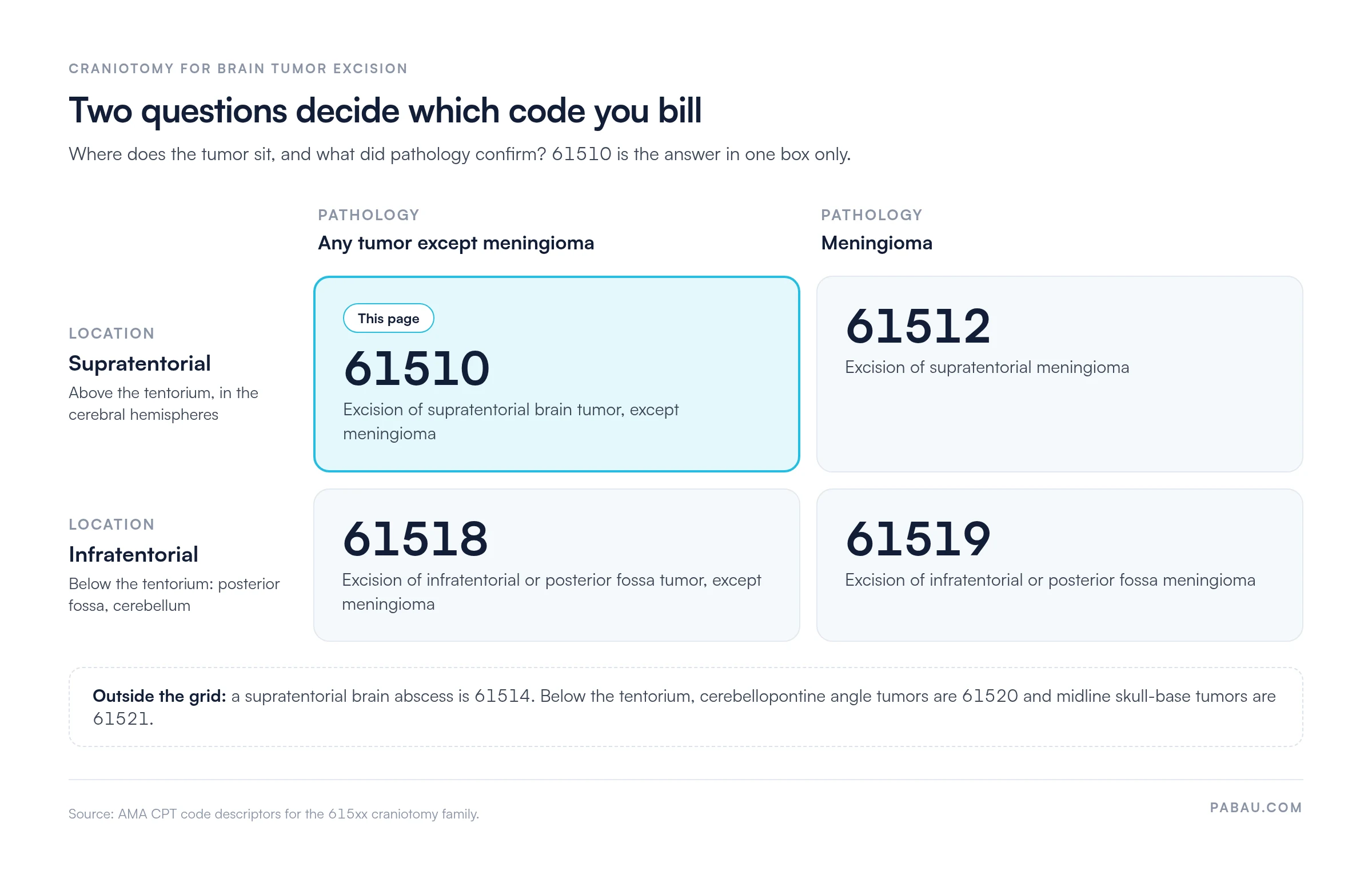
“Supratentorial” means the tumor sits above the tentorium cerebelli, within the cerebral hemispheres. Tumors below the tentorium (cerebellum, brainstem) route to 61518 through 61521 instead. “Excision” means the surgeon removes the tumor mass, not just biopsies it. And “except meningioma” is a hard exclusion: meningioma resection has its own code, 61512, even when the approach is otherwise identical.
Knowing the surgical sequence helps coders spot a missing detail in the operative note before the claim goes out. A typical 61510 case follows this operative path:
The operative note carries most of the weight on a 61510 claim. Submitting a clean claim for this code requires the note to address each of the following:
Use a superbill for neurosurgery services that prompts for each of these elements at point of care. Retrofitting documentation after denial is time-consuming and not always successful.
The 615xx neurosurgery family is tightly clustered by tumor type and anatomical region. Selecting the wrong code is one of the most common billing errors for this procedure family.
The most error-prone pairing is 61510 versus 61512. Meningiomas are the most common primary intracranial tumor and are often supratentorial, so coders sometimes default to 61510. The AMA descriptor’s “except meningioma” language is unambiguous. If the pathology report confirms meningioma, use 61512.
For the four main tumor codes, two questions settle the choice: where the tumor sits, and what pathology confirms.
Several add-on codes may be billed alongside 61510 when the services are documented and meet payer criteria. Confirm NCCI edit compatibility for the current quarter before billing any of them.
Billing 61781 without explicit operative documentation of navigation use is a denial trigger. Tumor excision under 61510 is intradural, so the extradural code 61782 rarely fits, and the two are never reported together. Payer acceptance of navigation add-ons varies, so confirm current policy before billing. CPT 69990 is generally well-accepted by Medicare and most commercial payers when the operative note documents microscope use.
Modifier selection for 61510 depends on the surgical team configuration and any billing complexity. These are the modifiers most relevant to neurosurgery craniotomy cases:
The correct ICD-10 pairing depends on the tumor’s histology and confirmed anatomical sub-site. Use the most specific code available after pathology confirmation.
Do not use C71.9 (unspecified) when the operative report and imaging confirm a specific lobe. Payers look hard at unspecified codes on high-cost procedures. The CDC/NCHS ICD-10-CM web tool allows free lookups to confirm the most specific available code for each case.
CPT 61510 carries 30.06 work RVUs in 2026, reflecting the complexity and duration of supratentorial tumor resection. The figures below are from the CMS Medicare Physician Fee Schedule. Rates are updated annually and adjusted by geographic practice cost index (GPCI). Always confirm current-year values before submitting claims.
Because 61510 is performed almost exclusively in a hospital operating room, the facility rate applies in virtually all cases. At the 2026 CMS national conversion factor of $33.4009, a facility claim generates roughly $2,161 before geographic adjustment.
Qualifying APM participants (QPs) use a slightly higher factor of $33.5675. Use the FastRVU lookup tool to calculate locality-adjusted figures. Note that co-surgeon billing (-62) reduces each surgeon’s allowed amount to approximately 62.5% of the facility total.
Run a payer-by-payer RVU reconciliation every quarter. Medicare updates the conversion factor and individual code RVUs each January, but commercial contracts pegged to Medicare update on their own schedules. Without that check, a payer still paying on last year’s factor can underpay every 61510 claim in a neurosurgery service line.
CPT 61510 carries a 90-day global surgical period, as confirmed by the CMS Medicare Physician Fee Schedule global days indicator. This means the following services are bundled into the primary surgical payment:
Four modifiers allow separate billing within the global window when the clinical situation warrants it:
A return to the operating room for a complication of the original craniotomy is billed with modifier -78. Medicare pays only the intraoperative portion, and no new global period starts. Complications managed outside the operating room stay bundled, so document the clinical distinction carefully.
Medicare does not currently require prior authorization for CPT 61510 in most jurisdictions, but commercial payers apply a range of preauthorization policies. Thorough insurance eligibility verification before scheduling is non-negotiable for a procedure at this cost level.
When commercial payers require authorization, they typically ask for:
Urgent or emergent craniotomies may bypass standard authorization workflows. The practice still needs retrospective authorization within the payer’s timeframe, often 24–72 hours after the procedure. On elective cases, an authorization that expires before the surgery date can sink the whole claim, so track each one against the scheduled date.
High-dollar neurosurgery claims attract close scrutiny. Understanding structured denial management workflows for 61510 starts with knowing the five most common triggers:
Sorting your denial codes by reason is the fastest way to see which of these patterns drives your 61510 denials.
High-complexity codes like 61510 only pay when the billing workflow keeps pace with surgical volume. A practice billing several craniotomies a week is tracking prior authorizations, add-on codes, co-surgeon notes, and 90-day global windows at once.
Pabau supports faster, cleaner claims management by checking code combinations and tracking prior-auth status against each case. For electronic submission, Pabau connects to Claim.MD, a clearinghouse that runs eligibility checks and routes 837P claims to thousands of US payers.
The result is less time chasing authorizations and resubmitting rejected claims. Mapping the wider medical billing workflows behind complex procedures also helps you design intake and documentation that stop denials before they happen.

Pabau’s billing tools help neurosurgery practices track prior-auth status, validate code combinations, and submit cleaner claims across complex high-value procedures. See how it works for your practice.

If you bill CPT Code 61510, put the effort into the operative note before the claim goes out, not into the appeal after it. Three details carry the most weight on review: the word “supratentorial,” the pathology result, and proof of every add-on you bill.
That costs a few extra minutes of documentation per case. Against a national Medicare payment of roughly $2,161, the time pays for itself the first time it prevents a denial.
Book a demo to see how Pabau keeps prior authorizations, code checks, and craniotomy claims in one billing workflow.

Confused about how medical billing fits the revenue cycle? What is revenue cycle management explains the end-to-end financial workflow from charge capture through payment posting.
Want to understand how clearinghouse submission works? Medical claims clearinghouse guide covers how 837P files reach payers and why clearinghouse routing matters for high-value claims.
Need the pre-op MRI on file for prior auth? CPT Code 70553: brain MRI with and without contrast explains how the imaging study that supports a craniotomy is coded.
CPT Code 61510 covers a craniotomy performed to excise a supratentorial brain tumor, excluding meningioma. The procedure includes the bone flap creation, dural opening, tumor resection, and closure. Meningioma resection routes to CPT 61512 even when the surgical approach is otherwise identical.
CPT 61510 covers all supratentorial brain tumors except meningioma; CPT 61512 covers supratentorial meningioma resection. The AMA descriptor for 61510 contains the phrase “except meningioma” explicitly. If pathology confirms meningioma, use 61512 regardless of how the case was coded pre-operatively.
CPT 61510 carries a 90-day global surgical period. Routine post-operative visits within 90 days of surgery are bundled into the surgical payment. Separately identifiable visits for unrelated conditions may be billed with modifier -24; unrelated procedures during the window use modifier -79.
Yes, CPT 69990 (operating microscope) may be billed with 61510. The operative note must document that a surgical microscope was deployed and was integral to the procedure. Medicare and most commercial payers allow this combination; confirm current NCCI edit status before billing.
Medicare does not routinely require prior authorization for CPT 61510, but many commercial payers do for elective craniotomies. Authorization requests typically require current imaging, an oncology consult note, and neurosurgery documentation of medical necessity. Confirm your specific payer’s policy before scheduling elective cases.
The most common trigger is billing 61510 without documentation that confirms a supratentorial site. Missing pathology when the ICD-10 code specifies malignancy and NCCI edit violations on add-on codes follow close behind. Payers also deny -62 claims without separate co-surgeon notes, and claims whose place of service doesn’t match the setting.