CPT Code 90960: ESRD monthly management billing guide
CPT code 90960: Official description and quick reference CPT code 90960 is publi...

Last Updated: Oct 5, 2026
92521 is the CPT code for evaluation of speech fluency (eg, stuttering, cluttering). It covers a speech-language pathologist's diagnostic assessment of the rate, rhythm and flow of connected speech. Treatment is billed separately.
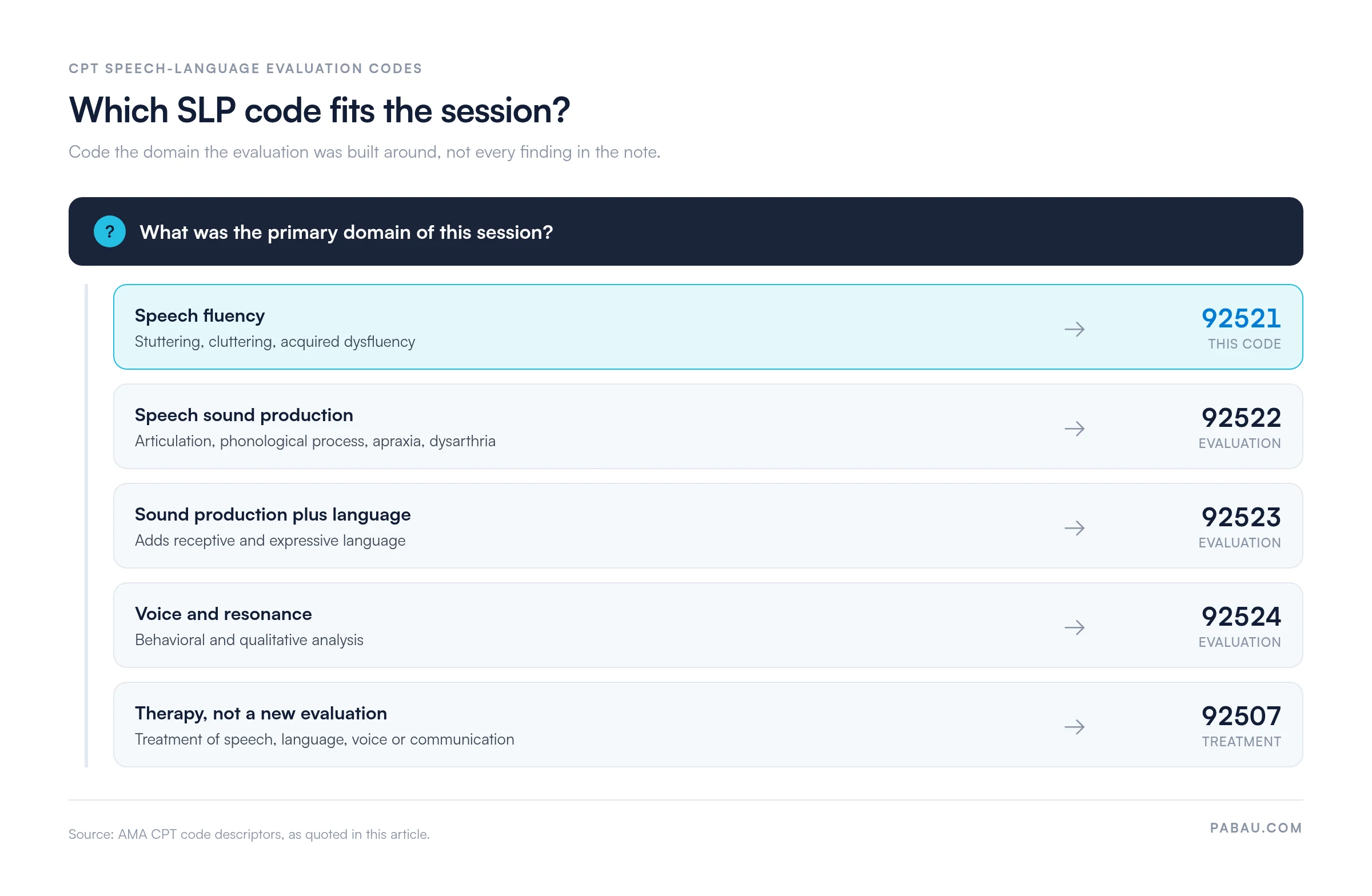
The code belongs to a family of four SLP evaluation codes, 92521 to 92524. Selecting the wrong one is a common source of denials and upcoding exposure. Sound production, apraxia and dysarthria belong to 92522, language to 92523, and voice and resonance to 92524.
Let Pabau's smart automation suggest the right codes, reduce claim denials, and keep your practice compliant—effortlessly.
Automate repetitive tasks and focus on what matters most—your patients.
Reduce coding errors and ensure compliance with the latest regulations.
Clean claims, fewer denials, and faster reimbursements.
Powerful insights and reporting to help your practice thrive.
HIPAA compliant SOC 2 certified GDPR-compliant Trusted by 4,000+ clinics worldwide

CPT code 92521 covers fluency evaluation only, such as stuttering and cluttering. Sound production, apraxia and dysarthria go to 92522, and language comprehension and expression to 92523.
Medicare Part B claims for 92521 need modifier GN when the SLP bills under a speech-language pathology plan of care. Leaving it off gets the claim denied.
Most 92521 denials come from weak medical necessity documentation, a wrong or missing ICD-10 code, or 92507 billed on the same date without a modifier.
Practice software such as Pabau checks insurance eligibility before the visit and flags denied claims for rework, so 92521 errors get caught early.
CPT code 92521 is defined by the American Medical Association as “Evaluation of speech fluency (eg, stuttering, cluttering).”
The examples in the descriptor are not exhaustive. The code also covers neurogenic and other acquired fluency disorders, such as dysfluency after a stroke or traumatic brain injury. Dysarthria is a motor speech disorder, and its evaluation belongs to 92522.
A qualifying evaluation assesses fluency across connected speech, not isolated sound production. Clinicians typically measure speech rate (syllables per minute), percentage of syllables stuttered, struggle behaviors, avoidance patterns, and the disorder’s impact on communication. A licensed speech-language pathologist (SLP) performs or directly supervises the assessment. It must end in a documented clinical interpretation, not just a score summary.
92521 sits in a four-code family (92521, 92522, 92523, 92524), and each code captures a distinct evaluation domain. Billing the wrong code because a chart contained mixed findings is a frequent source of upcoding exposure for SLP practices.
CPT 92521 covers the evaluation of fluency: the rate, rhythm and flow of connected speech. It does not cover sound production, motor speech disorders such as apraxia and dysarthria, language comprehension and expression, or voice. Each of those domains has its own code, and billing 92521 for them is a coding error.
Key exclusion rule: if the session addressed sound production accuracy as the primary clinical concern, 92522 or 92523 applies instead of 92521. Mixed fluency and sound production findings in one note justify 92521 only when fluency was the primary evaluation domain. The decision comes down to one question, mapped below.
A 92521 claim lives or dies on what the clinical note can prove. Payers conducting post-payment audits look for five elements, and missing any one of them is enough to trigger a recoupment demand.
Submitting a clean claim for 92521 starts in the clinical note, well before the claim is generated. When documentation review and billing review happen separately, note deficiencies only surface as denials weeks later.
Run a monthly audit of your 92521 notes before submitting claims. Pull five random charts and check each one for a named standardized instrument with scores and a quantified fluency measure (%SS or syllables per minute). Each should also carry a medical necessity rationale and a clinical interpretation. If any element is missing, fix the note before the claim goes out.
Every 92521 claim requires a supporting ICD-10-CM diagnosis code that establishes medical necessity. Pairing 92521 with an unrelated or overly vague diagnosis is a leading denial cause. The table below lists the principal codes accepted by most payers, verified against the CDC/NCHS ICD-10-CM tool.
Always confirm coverage under your payer’s applicable LCD before submitting. This list reflects commonly accepted ICD-10 codes but is not exhaustive, and payer LCDs vary by jurisdiction. Using the most specific code available reduces the chance of a medical necessity denial. For a child with developmental stuttering, that means F80.81 rather than R47.89.
Medicare reimburses 92521 under the Medicare Physician Fee Schedule (MPFS), which updates every January 1 and adjusts for geography. For 92521 the facility and non-facility RVUs are the same, so the national rate doesn’t change with the setting. Verify current-year amounts with the CMS MPFS lookup tool before building them into a fee schedule.
The 2026 national figure breaks down as 2.24 work RVUs, 1.74 practice expense RVUs and 0.01 malpractice RVUs. You can cross-check current values with the FastRVU lookup tool. Medicaid rates are set by each state and typically fall below Medicare. Commercial payer rates are negotiated separately and are not subject to the MPFS.
Modifier usage on 92521 claims is one of the most consequential billing decisions an SLP practice makes. Each modifier tells the payer how and where the service was delivered. Omitting a required one gets the claim denied by most Medicare and Medicaid payers.
GN is the most commonly missed modifier. Many SLP practices in private outpatient settings omit it because their billing software defaults to no modifier. Every Medicare Part B claim for 92521 from an SLP requires GN. Set it as a default in your billing workflow before claims go out.
Prior authorization (PA) requirements for CPT 92521 vary significantly by payer type. Conflating Medicare Part B rules with Medicare Advantage rules is a costly mistake.
Reviewing medical billing compliance requirements before your first 92521 submission to a new payer is worth the time. It prevents a completed evaluation going unbilled because PA was never obtained.
Sometimes, and National Correct Coding Initiative (NCCI) edits decide which same-date combinations pay. The edits update quarterly, so the guidance below reflects general payer policy. Verify the current edit status before billing any combination.
When in doubt, contact the payer’s provider services line before billing a multi-code combination. A five-minute call prevents a denial that takes thirty minutes to appeal.
Most 92521 denials fall into a predictable set of categories. The remittance advice names the category through claim adjustment reason codes (CARCs) and remittance advice remark codes (RARCs). Our guide to medical billing denial codes explains what each one means.
Systematic denial management workflows categorize each denial by reason code, trace it to its root cause, and fix the process behind it. Treat denials as one-off events instead, and the same error comes back claim after claim.
The place of service (POS) code on a 92521 claim tells the payer where the evaluation happened and which telehealth rules apply. The wrong POS code can make the claim price incorrectly or deny outright.
For telehealth evaluations, the superbill has to carry the right POS code, modifier 95 where the payer requires it, and the appropriate ICD-10 diagnosis. All three must agree for the telehealth claim to process.
Set POS codes as a required field in your billing intake workflow rather than letting billers select from memory. A dropdown that defaults to POS 11 will generate errors every time a telehealth 92521 is submitted without correction. Locking POS to the session type at scheduling prevents the error from reaching the claim at all.
Without integrated billing, an SLP practice checks coverage by phone and keys each claim into a payer portal. A missing GN modifier only shows up when the remittance arrives, weeks after the evaluation.
Pabau’s claims software for SLPs runs a real-time eligibility check before the evaluation and validates each claim before it sends. Claims go out as electronic CMS-1500 claims through the Claim.MD clearinghouse, using the practice’s own Claim.MD account.
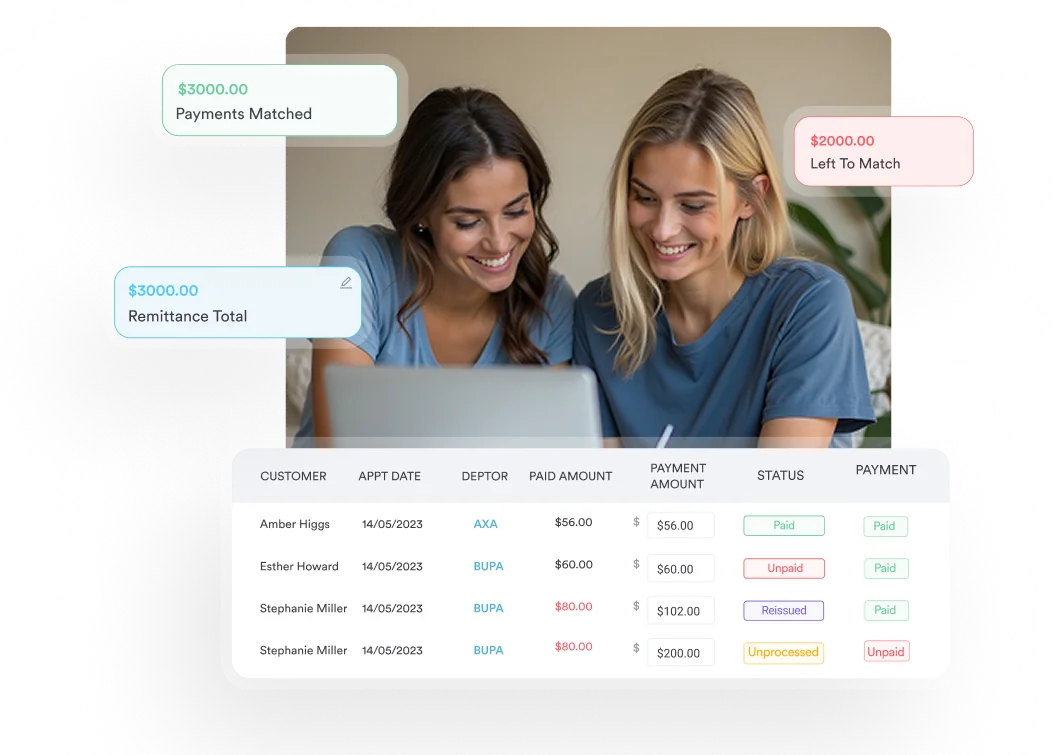
Claim status updates and electronic remittance advice (ERA) flow back into Pabau, and denied claims are flagged for rework. Your biller sees which 92521 claims need attention without logging into each payer portal.

Pabau checks eligibility in real time, validates each claim before it goes to Claim.MD, and flags denied claims for rework. Your 92521 claims go out right the first time.

Bill 92521 only when fluency was the domain you set out to evaluate, and make the note prove it. A chart with a named instrument, a %SS figure and a functional impact statement holds up in an audit. A chart with a score summary and no interpretation invites a recoupment demand.
The trade-off is a few extra minutes at the documentation stage. That costs far less than reworking a denied claim weeks later. Book a demo to see how Pabau catches eligibility problems and denied 92521 claims while they’re still quick to fix.

Want to reduce claim denials across your SLP practice? Denial management in healthcare covers how to categorize, track, and correct denial patterns before they repeat.
Billing a sound production or dysarthria evaluation? CPT code 92522 covers speech sound production, including apraxia and dysarthria.
Evaluating voice or resonance instead? CPT code 92524 explains the voice and resonance evaluation code in the same family.
Unsure which medical billing approach fits your practice model? What is medical billing explains the full revenue cycle from patient encounter to collected payment.
Ready to tighten your claims process? Submitting a clean claim walks through every element a claim must contain to pass payer edits on first submission.
CPT code 92521 covers evaluation of speech fluency, including stuttering, cluttering and acquired fluency disorders such as dysfluency after a stroke. It does not cover sound production or motor speech evaluation, including dysarthria (92522), language comprehension and expression (92523), or treatment (92507).
CPT 92521 evaluates speech fluency only: rate, rhythm and dysfluency patterns. CPT 92523 evaluates speech sound production plus language comprehension and expression in the same session. Use 92523 when the evaluation addresses both sound production and language, and 92521 when fluency is the primary evaluation domain.
Yes, Medicare Part B covers CPT code 92521 when medical necessity is documented and the GN modifier is appended to the claim. The 2026 national rate is about $133. Medicare Advantage plans may add prior authorization requirements, so verify with the specific plan before scheduling.
GN is required for Medicare Part B claims when the service is delivered under a speech-language pathology plan of care. Modifier 95 flags synchronous telehealth delivery where the payer requires it. Modifier 59 may be needed when 92521 and 92507 share a date, subject to payer policy.
Sometimes, but it requires caution. NCCI edits may bundle 92521 and 92507 without a modifier. If both services were separate and distinct on the same date, modifier 59 on 92507 may allow separate reimbursement. Some payers prohibit same-day evaluation and treatment entirely, so verify with each payer before scheduling both.
The clinical note must include the referral source and a medical necessity statement with functional impact. It also needs named standardized instruments with scores and normative comparison, quantified fluency measures (%SS or syllables per minute), and a clinical interpretation. Missing any of these elements creates audit exposure.