



CCSD code G5100: Bypass of duodenum billing guide
CCSD code G5100 bills a bypass that leaves the duodenum in place CCSD code G5100...

Last Updated: Oct 16, 2026

CPT code 70544 describes magnetic resonance angiography of the head without contrast material, used for non-contrast brain MRA studies.
The 2026 Medicare rate for CPT 70544 runs from roughly $180 to $220 by facility type and locality. Verify it against the CMS fee schedule lookup.
Selecting 70545 or 70546 when no contrast was given is an upcoding risk. The radiology report has to confirm contrast status first.
Pabau supports CPT code libraries, modifier tracking, and electronic claim submission via Claim.MD for radiology practices billing 70544.
CPT code 70544 is the billing code for magnetic resonance angiography of the head without contrast material. It applies when an MRA images the blood vessels of the brain and head, and no contrast agent is administered.
The official descriptor, as maintained by the American Medical Association (AMA), is: Magnetic resonance angiography, head; without contrast material(s). Contrast status is the entire distinction inside this code family, so the radiology report decides which code is billable.
The code sits in the Diagnostic Radiology section of the CPT code set. MRA is a non-invasive technique that visualizes blood vessels using magnetic resonance rather than ionizing radiation or injected dye. Clinicians order non-contrast head MRA when the question centers on vessel structure, stenosis, or aneurysm screening.
The most common coding error for head MRA is picking the wrong code from the 70544-70546 family. Each code maps to one contrast status. Selecting 70545 when no contrast was given is upcoding. Billing 70544 when contrast was administered creates an underpayment and a documentation mismatch.
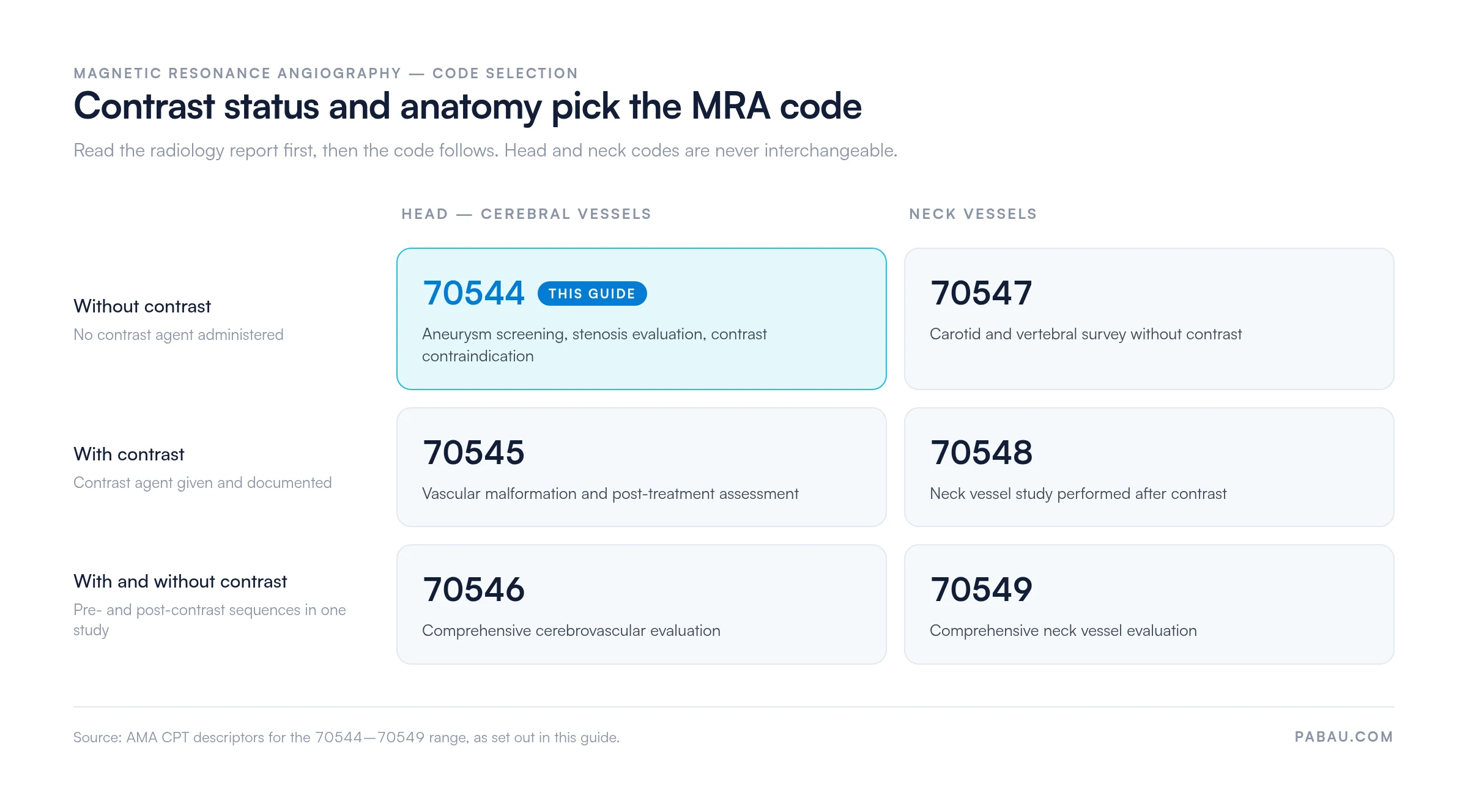
The MRA family extends to the neck with three parallel codes. These are distinct from the head codes and must not be used interchangeably. The non-contrast neck study is reported with 70547, the neck equivalent of 70544.
When a single study covers both the head and neck vasculature, billers report 70544 (or the appropriate contrast variant) alongside the matching neck code. For the neck study performed with and without contrast in one session, the matching code is 70549.
Confirm from the ordering physician’s documentation that both regions were imaged in separate sequences before billing both codes. Payer policies on bundling vary. The matrix below sets all six codes side by side.
Medicare payment for CPT code 70544 is calculated using the Resource-Based Relative Value Scale (RBRVS). Three components combine with the annual conversion factor to produce the final rate. For 2026, verify current figures using the CMS Physician Fee Schedule lookup tool.
These figures are estimates and shift with annual CMS rulemaking. Pull current values for your practice’s locality from the fee schedule lookup before you quote a rate. Always cite the CMS MPFS year when you document a reimbursement figure for compliance records.
Medicare reimburses CPT 70544 at different rates depending on where the service is performed. The place of service (POS) code on the claim drives this distinction.
Assigning the wrong POS code is a frequent source of payment discrepancies in radiology billing. Submitting a clean claim across mixed practice settings starts with getting the POS right on every 70544 line.
Commercial insurers usually negotiate rates as a percentage of Medicare, often 110-150% for diagnostic imaging. That range moves with the contract and the region. Private rates are not publicly disclosed, so practices have to read their own payer contracts to know what 70544 actually pays.
Run a quarterly reimbursement analysis on CPT 70544 across your top five payers. If any commercial rate falls below 100% of Medicare, flag it for contract renegotiation at the next renewal. Tracking by payer rather than by code gives you the leverage data you need.
Modifiers clarify the circumstances of service delivery and set the payment split. Applying the wrong modifier, or omitting a required one, is a leading cause of claim rejection for radiology procedures. Practice management software like Pabau tracks modifiers at the code level, and its claims management software flags a 70544 line that is missing one.

Modifiers 26 and TC are mutually exclusive on the same claim line. When a radiology group bills globally, covering both interpretation and technical work, no modifier is needed. Verify modifier requirements against each payer’s policy, because Medicare and commercial payers sometimes differ on TC and 26 split billing.
CPT 70544 carries a global period designation of XXX, meaning not applicable. There is no pre- or post-operative period attached to the code, which is standard for diagnostic imaging. No follow-up visits or related services are bundled into the payment.
That same-day bundling question also reaches a third brain MRI code. 70552 covers the contrast-only study, and it takes modifier 59 only when a same-date imaging study would otherwise bundle under NCCI edits.
Every claim for CPT code 70544 needs a supporting ICD-10-CM diagnosis code that establishes medical necessity. CMS and commercial payers apply local coverage determinations (LCDs) to head MRA. A diagnosis that does not appear on the payer’s covered-indication list is one of the fastest paths to denial.
Map the pairing before the claim leaves the practice, and check the wider ICD-10-CM code library when the indication is unusual.
For headache diagnoses (R51.9), document the clinical reasoning that drove the imaging decision. Payers increasingly want evidence of failed conservative management or neurological red flags before approving MRA for headache alone. Check the applicable LCD in the Medicare Coverage Database for your MAC jurisdiction.
Insufficient documentation is the second most common reason head MRA claims are denied. Payers expect the record to support every element of the claim, not only the diagnosis code. The ordering physician’s notes must justify why a non-contrast MRA was selected over other imaging options.
Required documentation elements for CPT 70544:
The superbill for an MRA encounter should cross-walk the ICD-10 diagnosis to the CPT code before submission. Capturing both codes together at charge entry stops a mismatch from ever reaching the claim.
Commercial payers commonly require prior authorization for head MRA, including CPT 70544. Medicare generally does not require it for outpatient MRA, though Medicare Advantage plans may. These requirements change often, so confirm them during eligibility checks rather than relying on memory from previous encounters.
Four coding errors account for the majority of denials and audits tied to CPT 70544. Address them at the front end and your clean claim rate improves measurably.
For practices transmitting electronically, the 837P claim file carries the structured data payers need to process 70544 correctly. Errors at that level are far harder to catch after submission than during pre-submission scrubbing. A wrong place-of-service segment and a missing modifier loop are the usual culprits.
After adjudication, read the electronic remittance advice for denial reason codes specific to 70544. Two come up most often. CO-50 means the payer does not deem the service a medical necessity. CO-4 means the procedure code is inconsistent with the modifier used, or a required modifier is missing.
Build a two-step pre-submission check for CPT 70544 claims. First, confirm the radiology report’s contrast status matches the CPT code. Second, confirm the diagnosis appears on the payer’s LCD for head MRA. Both checks take under two minutes and remove the two most common denial types.
Radiology practices billing CPT 70544 juggle split billing environments, modifier rules, prior authorization tracking, and multi-payer LCD requirements. Most carry that load across a scheduling system, a spreadsheet of payer rules, and a separate billing platform.
Pabau keeps the code, the modifier, the paired ICD-10 diagnosis, and the supporting documentation on one patient record. Claims go out through Claim.MD, our US clearinghouse partner, which submits CMS-1500 and 837P claims to thousands of US payers.
Eligibility verification, ERA and 835 remittance processing, and CARC denial code tracking sit in the same workflow. Coders stop rekeying the crosswalk between 70544 and its diagnosis code, which is where most pre-submission errors begin.

Pabau’s claims tools support CPT code libraries, modifier tracking, and electronic claim submission via Claim.MD for radiology and imaging practices. See how it works in a live demo.

Head MRA billing has a narrow margin for error. Contrast code selection, modifier application, and diagnosis linkage each have to be right before a CPT 70544 claim leaves the practice.
Get one wrong and you lose that reimbursement. Get the same one wrong repeatedly and you invite an audit. The check that prevents both is short: read the contrast status off the radiology report, then confirm the diagnosis sits on your payer’s covered-indication list.
Book a demo to see how Pabau keeps modifier rules, diagnosis crosswalks, and claim status for codes like 70544 in one place.

Need guidance on the full claims submission process? Understanding medical claims clearinghouses explains how claims move from practice to payer and where errors enter the pipeline.
Dealing with denials after submission? Denial codes in medical billing breaks down the most common CARC and RARC reason codes and how to resolve them.
Want to understand the broader revenue cycle? Revenue cycle management explained covers every stage from patient registration to payment reconciliation.
CPT code 70544 is the billing code for magnetic resonance angiography of the head without contrast material. It applies when an MRA images the cerebral vasculature and no contrast agent is administered. The code sits in the Diagnostic Radiology section of the AMA CPT code set.
The 2026 Medicare rate for CPT 70544 is roughly $180 to $220, depending on facility type and geographic location. Confirm the figure in the CMS Physician Fee Schedule lookup tool for your MAC locality and the current conversion factor.
CPT 70544 covers head MRA without contrast, 70545 covers head MRA with contrast, and 70546 covers a combined study with and without contrast. The radiology report must confirm which contrast approach was used, and the code you bill has to match that report exactly.
Common modifiers for CPT 70544 are 26 for the professional component and TC for the technical component. Modifier 52 covers reduced services. Modifier 59 marks a distinct procedural service billed the same day as another imaging code. Modifiers 76 and 77 cover repeat procedures by the same or a different physician.
Most commercial payers require prior authorization for CPT 70544. Medicare fee-for-service generally does not, but Medicare Advantage plans often do. Verify at the point of eligibility verification for each encounter, since requirements change frequently and vary by plan.
Commonly paired ICD-10 codes include I67.1 (cerebral aneurysm, nonruptured), G45.9 (transient ischemic attack), and I63.9 (cerebral infarction). I65.29 (carotid artery occlusion and stenosis) and Q28.3 (cerebral vascular malformation) are also used. The selected diagnosis must appear on the payer’s LCD for head MRA to support medical necessity.
Use CPT 70544 for magnetic resonance angiography of the head’s blood vessels without contrast. Use CPT 70553 for a brain MRI performed with and without contrast. MRA evaluates vessel structure while MRI evaluates brain tissue, so they are separate studies with separate indications.



