



CCSD code G5100: Bypass of duodenum billing guide
CCSD code G5100 bills a bypass that leaves the duodenum in place CCSD code G5100...

Last Updated: Oct 16, 2026
CPT code 70546 is the billing code for magnetic resonance angiography (MRA) of the head. The study runs without contrast materials, then with contrast materials, then through further sequences. It is the three-phase variant in the head MRA family. Medicare pays it at a national global rate of $327.66 for CY2026, while its two siblings, 70544 and 70545, each describe a single-phase study. This guide covers the descriptor, covered indications, CY2026 rates and RVUs, modifiers, the ICD-10 crosswalk, and the documentation a 70546 claim has to carry.
Almost all of that payment sits on the technical side of the study. In fact, practice expense accounts for 8.25 of the code’s 9.81 RVUs. On a split-billed claim, the 26 and TC split therefore decides where most of the money lands.

CPT code 70546 describes MRA of the head performed in three phases: without contrast, with contrast, and with further sequences.
It is distinct from CPT 70544 (without contrast only) and CPT 70545 (with contrast only). Picking the wrong sibling code is the most common billing error.
Medicare’s CY2026 national global rate is $327.66, built from 9.81 total RVUs and a conversion factor of $33.4009.
Practice expense carries 84% of that value, so the modifier 26 and TC split is where most of the payment is won or lost.
Pabau’s claims management software validates imaging claims before submission, which reduces first-submission denials on complex radiology codes.
The American Medical Association (AMA) descriptor for CPT code 70546 reads: Magnetic resonance angiography, head; without contrast material(s), followed by contrast material(s) and further sequences. That three-phase protocol is what makes 70546 the highest-acuity code in the head MRA group. The radiologist acquires a baseline non-contrast series, administers gadolinium-based contrast, then captures post-contrast and additional sequences in a single imaging session.
Three codes cover head MRA, and coders must select the one that matches what was actually performed. Billing 70545 when the study includes both pre- and post-contrast series understates the complexity of the study and underpays the provider. Likewise, billing 70546 when the study includes only one contrast phase constitutes upcoding. The table below makes the distinction clear.
The practical decision rule: if the radiology report documents both a pre-contrast and a post-contrast acquisition in a single session, the correct code is 70546. If only one phase was performed, use 70544 or 70545 based on whether contrast was given. This single check prevents the most common downcoding error seen on head MRA claims.
The contrast split does not carry across every MRA family. Chest MRA is reported with a single code, CPT 71555, for studies done without contrast, with contrast, or both.
CPT 70549 covers MRA of the neck without contrast, followed by contrast and further sequences. It is the true neck-anatomy parallel to 70546, and the two are frequently ordered together in combined cerebrovascular workups. In fact, billers sometimes name CPT 70543 in this slot by mistake. That code describes MRI, not MRA, of the orbit, face, and neck, so it has no place in a head and neck MRA pairing.
Billing 70546 and 70549 in the same session is generally supported when the order and the radiology report document separate head and neck acquisitions. National Correct Coding Initiative (NCCI) edits do not automatically bundle the pair. Coders should still check the current NCCI edit table for the billing year before submitting them together.
Medicare covers CPT code 70546 when medical necessity is established through documented clinical indications per applicable Local Coverage Determinations (LCDs). Specifically, Medicare Administrative Contractors (MACs) administer coverage. The LCD governing a practice’s jurisdiction may list indications that differ slightly from those in other regions. The CMS Medicare Coverage Database billing and coding article A56805 covers MRA and is the primary federal reference.
Commonly accepted covered indications include:
Non-covered indications typically include routine screening in asymptomatic patients without documented risk factors. Similarly, payers usually deny repeat imaging with no documented change in clinical status. Checking benefits before the study is scheduled surfaces an uncovered indication while the order can still be revised.
CPT code 70546 is a global service code. When an integrated radiology group both performs and reads the study, one billed unit covers the professional interpretation and the technical image acquisition. When the ordering physician, interpreting radiologist, and imaging facility are different entities, the global fee must be split using component modifiers.
Modifier 59 requires careful application. Billing 70546 and CPT 70553 (MRI brain with and without contrast) together with modifier 59 is sometimes clinically warranted in combined neuroradiology workups. However, this pairing draws payer scrutiny. The radiology report must clearly document separate clinical indications and separate acquisition series for each code. Coders should verify the current NCCI edit status for this pair before billing.
Confirm which brain MRI code the radiology report supports. A contrast-only study with no pre-contrast sequences belongs under 70552, a separate code from 70553.
Medicare reimburses CPT code 70546 under the Medicare Physician Fee Schedule (MPFS). The CY2026 national global rate is $327.66, which is 9.81 total RVUs multiplied by the $33.4009 conversion factor. Clinicians who reach qualifying APM participant status are paid on the higher $33.5675 factor, bringing the same code to $329.30.
Geographic Practice Cost Index (GPCI) adjustment then moves that amount up or down by locality. Confirm the current figure with the CMS Physician Fee Schedule lookup tool, which returns the component amounts when a modifier is entered alongside the code.
CMS publishes the separate professional and technical amounts for 70546 in Addendum B of the MPFS. Use those figures rather than a commercial aggregator before any payer contract negotiation. Geographic adjustment then moves payment by jurisdiction, with high-cost urban localities paying above the national average and rural localities below it.
RVUs set the relative value of a service before the conversion factor is applied. For CY2026, CMS publishes two conversion factors: $33.5675 for qualifying APM participants and $33.4009 for everyone else. The figures below come from the CY2026 MPFS RVU file, and the code descriptors behind them sit in the AMA coding resources.
Practice expense dominates this code because the scanner, the contrast, and the imaging staff cost far more than the read. The chart below shows how the 9.81 RVUs break down in dollars.
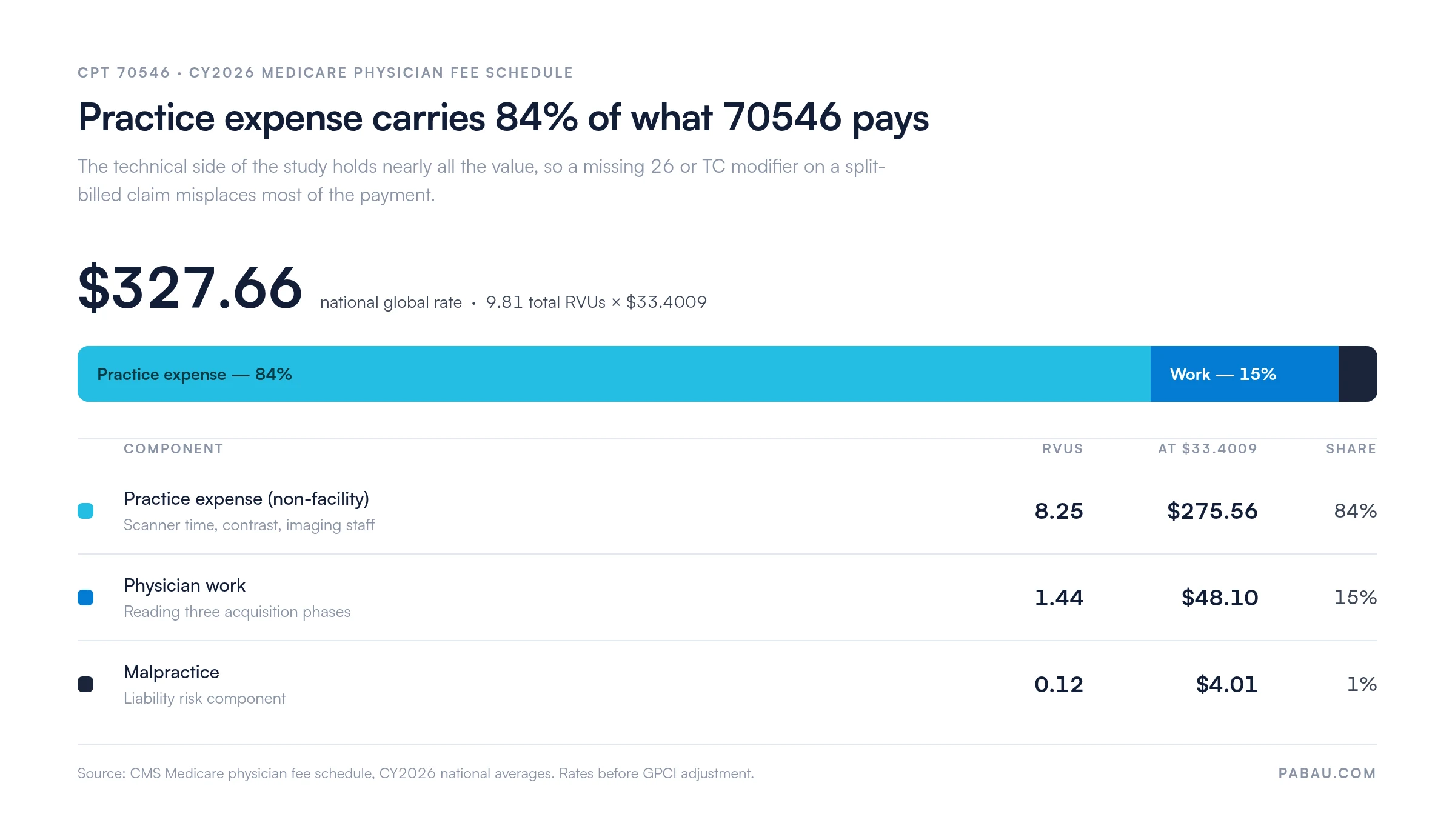
That weighting is what makes the component split the expensive decision on 70546. A group that bills the global code after the hospital has already billed TC is claiming the technical component twice. The correction then arrives as a recoupment rather than a denial, months after the money was posted.
On the hospital side, MR device costs follow OPPS rules instead of the fee schedule. An insertable coil reported as HCPCS C1770 is packaged into the APC payment, not paid as a separate line.
Every CPT 70546 claim requires a paired ICD-10-CM diagnosis code that establishes medical necessity. The diagnosis must match the documented clinical indication in the ordering physician’s notes and the radiology report. Payers cross-reference these codes against LCD-approved diagnosis lists, and a mismatch drives most medical-necessity denials. Full descriptors for each of the diagnoses below sit in our ICD-10-CM codes index.
Confirm the accepted diagnosis list against your MAC’s specific LCD for MRA of the head before billing. ICD-10 codes listed here are commonly accepted per published crosswalk data; individual MAC coverage policies may narrow or expand this list. Verify current codes using the CDC/NCHS ICD-10-CM web tool.
Clean CPT code 70546 claims rest on documentation that exists before the study is ordered, rather than assembled after a denial arrives. Compliance in diagnostic radiology requires that the ordering record and the radiology report each carry specific data elements. As a result, missing any one of them is enough to trigger a medical-necessity denial.
Required documentation elements for a defensible 70546 claim:
Run the eligibility and benefits check at scheduling, not at the front desk on the day of service. Confirm whether the plan requires prior authorization for CPT 70546, and capture the auth number in the scheduling record. Front-end capture is what keeps authorization denials off the back end.
Most CPT 70546 denials trace back to a handful of errors that repeat across billing cycles. Four of the five below are caught by a scrubber rule rather than by a coder remembering to check. The table names the rule worth building for each one.
Track denial reasons at the code level rather than across the claim file as a whole. That is what makes the pattern visible on a high-volume imaging code. A corrected claim then needs the updated documentation, the right code, and any applicable modifier before it goes back out. A practice seeing repeated downcoding here should review how it handles CPT 70544, since both codes are chosen from the same report.
Every error above is detectable before the claim leaves the practice. Billing software that validates the code, the modifier, and the paired diagnosis at charge entry catches them on the day of service. The alternative is finding out 30 days later. For a practice submitting 70546 and adjacent imaging codes in volume, first-submission accuracy compounds quickly.
Practice management software like Pabau keeps the coding decision and the claim on the same record. Pabau’s claims management software validates a claim before it is submitted, so a missing component modifier surfaces at charge entry.
Claims route electronically through Claim.MD, Pabau’s US clearinghouse partner, which reaches more than 4,000 US payers. Eligibility responses, remittance advice, and denial reason codes come back into the same record the claim went out from.

On combined head and neck MRA studies, the 837 claim file carries the modifier and diagnosis data that payers require for split-billed submissions. Once the payer adjudicates, remittance advice posts back against the expected rate. An underpayment on a 70546 line then surfaces without anyone reading the remittance by hand.
Centralizing imaging charge capture, modifier logic, and claim submission in one platform also removes the manual handoffs where coding errors start. The coder sees the confirmed CPT code, the diagnosis, the modifier, and the place of service in a single view before submitting.

Pabau validates claim data and submits electronically through Claim.MD, so a missing component modifier on a 70546 line is caught at charge entry. Eligibility responses and remittance advice post back to the same patient record.

One line in the radiology report decides whether 70546 survives an audit. If the technique section states that images were acquired without contrast, then with contrast, then in further sequences, the code holds. If it does not, no amount of appeal correspondence will supply that wording after the fact.
So the work worth doing sits upstream of billing. Standardize the technique sentence with your radiologists, put the covered-diagnosis list where schedulers can see it, and let the scrubber enforce the component modifier. Book a demo to see how Pabau validates and submits imaging claims like 70546 before a payer gets the chance to deny one.
CPT code 70546 describes magnetic resonance angiography (MRA) of the head performed without contrast materials, followed by contrast materials, and further sequences. It is the three-phase head MRA code in the AMA CPT code set and covers the complete with-and-without contrast imaging protocol.
Yes, Medicare covers CPT code 70546 when medical necessity is documented per the applicable MAC Local Coverage Determination (LCD). Coverage is not universal across all clinical scenarios. It depends on the patient’s documented diagnosis and the MAC jurisdiction. Common covered indications include intracranial aneurysm, TIA, AVM evaluation, and post-stroke cerebrovascular assessment.
Yes, CPT 70546 and CPT 70553 can be billed together when both studies are clinically indicated and separately documented. The first is MRA of the head, the second is MRI of the brain. The pairing draws payer scrutiny, so modifier 59 may be needed to show a distinct procedural service. Check the current NCCI edit status for the pair first. The radiology report must document separate acquisitions and separate clinical indications for each study.
The primary modifiers for CPT 70546 are 26 and TC. Modifier 26 covers the radiologist’s interpretation when it is billed separately from the technical component, while TC covers the facility’s equipment and staff costs. Add modifier 59 when 70546 is billed alongside another imaging code and NCCI edits are present, provided the studies are clinically distinct. Modifier 52 applies when the study was not completed as described.



