HCPCS Code L0472: Hyperextension TLSO billing guide
HCPCS code L0472: Official descriptor and device definition HCPCS code L0472 des...

Last Updated: Nov 5, 2026
65780 is the CPT code for ocular surface reconstruction; amniotic membrane transplantation. It covers placing an amniotic membrane graft on a damaged cornea or conjunctiva to calm inflammation and help the surface heal.
It sits in the Cornea range of the CPT Surgery section, beside 65781 and 65782, the two limbal graft codes. The operative note decides between the three, so it needs to record the graft material and where the tissue came from.
Let Pabau's smart automation suggest the right codes, reduce claim denials, and keep your practice compliant—effortlessly.
Automate repetitive tasks and focus on what matters most—your patients.
Reduce coding errors and ensure compliance with the latest regulations.
Clean claims, fewer denials, and faster reimbursements.
Powerful insights and reporting to help your practice thrive.
HIPAA compliant SOC 2 certified GDPR-compliant Trusted by 4,000+ clinics worldwide

CPT Code 65780 covers ocular surface reconstruction with an amniotic membrane graft. CPT 65781 covers a limbal stem cell allograft, and CPT 65782 a limbal conjunctival autograft.
Every 65780 claim needs -RT or -LT, and Medicare pays a same-session bilateral case at 150% on one line with modifier -50.
Most commercial payers and some Medicare Advantage plans require prior authorization, with an ICD-10-CM diagnosis from the H11.x, H16.x, or T26.x families.
Claims software such as Pabau checks modifiers and documentation before a 65780 claim leaves the practice.
CPT Code 65780 is the AMA’s code for ocular surface reconstruction; amniotic membrane transplantation. It sits in the Cornea subsection of the Surgery chapter, which runs from 65400 to 65785. Its neighbors include the pterygium excision and keratoplasty codes.
The procedure involves surgically placing a prepared amniotic membrane graft onto a diseased or damaged ocular surface. The membrane acts as a biological scaffold that suppresses inflammation, helps the epithelium regrow, and reduces scarring. It is used when the ocular surface cannot heal by conventional means.
According to the AMA’s CPT code set overview, codes in the corneal surgery range describe distinct surgical techniques. Selecting the correct code from the 65780-65782 family depends on graft source and cell type, not simply on whether a membrane was used.
The global surgical package for CPT 65780 bundles every step of placing and securing the amniotic membrane in one surgical session.
The global package also includes the standard 90-day postoperative period for Medicare and most commercial payers. Routine follow-up visits within that window are not separately billable unless a new and unrelated problem arises.
Several same-day services are separately billable with 65780. Each one needs the operative note to document it as a distinct procedure with its own clinical indication.
The membrane itself goes on a separate supply line. HCPCS V2790 describes amniotic membrane for surgical reconstruction, per procedure, so check the payer’s packaging rules before adding it.
Pterygium surgery needs the most care, because 65426 already includes a graft over the bare sclera. NCCI bundling edits also change quarterly. Verify current edits against the AAPC Codify CPT lookup or the CMS NCCI policy manual before filing concurrent claims.
All three codes describe ocular surface reconstruction, but each maps to a different graft material and source. Reporting the wrong one is an upcoding or downcoding error that exposes the practice to audit risk.
CPT 65780 uses an amniotic membrane, which gives the surface a temporary biological scaffold but does not restore limbal stem cells. Codes 65781 and 65782 transplant limbal tissue, and payers expect them only where the eye can no longer regenerate its own epithelium. A note describing a Prokera ring or sutured membrane, with no limbal tissue harvested, points to 65780.
Two details in the operative note settle the choice, and the chart below takes them in order.
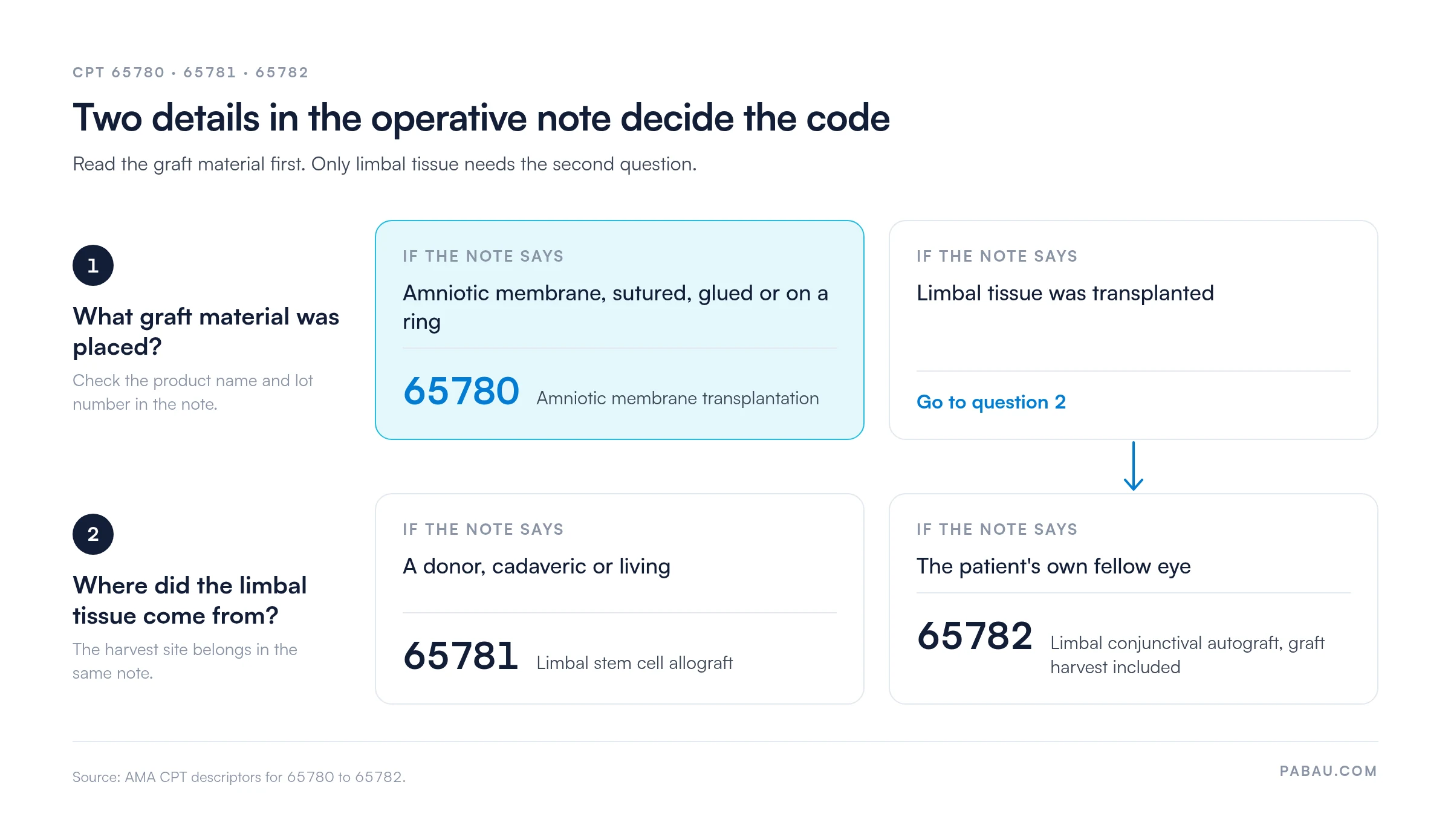
Check two things in the operative note before assigning a code from this family. First, the graft material, amniotic membrane or limbal tissue. Second, for limbal tissue, whether it came from the patient’s own eye or a donor.
Thin documentation sits behind a large share of 65780 denials. The operative note and medical record must establish medical necessity before the claim reaches the payer. A complete record on the first attempt starts with clean claim submission habits built into the billing workflow.
Every 65780 claim should be supported by the following documentation elements:
Ophthalmology surgical codes require laterality modifiers on nearly every claim. Missing a modifier on a 65780 claim is one of the fastest ways to trigger an automatic edit hold.
Prior authorization (PA) requirements for CPT 65780 vary by payer class, and individual plan policies govern. Some payers treat amniotic membrane reconstruction as investigational unless an approved PA is on file. Consistent medical billing compliance processes for PA tracking protect the practice from unexpected write-offs.
A PA request should carry the supporting ICD-10-CM diagnosis, the failed conservative treatment record, and the operative plan. Add the product details for the amniotic membrane too. An incomplete PA request can stop a 65780 case before the claim is even submitted.
Medicare reimbursement for CPT 65780 is calculated using the Medicare Physician Fee Schedule (MPFS) relative value unit (RVU) framework. The national average payment moves with each annual conversion factor update.
Check current rates in the CMS Physician Fee Schedule lookup tool before quoting expected reimbursement to surgeons.
Commercial payers negotiate rates independently of Medicare and may pay above or below the Medicare allowable. Posting each remittance against the expected allowable shows which payers underpay 65780.
The common denial triggers for 65780 are predictable, and each one has a fix that works before submission. Dedicated medical billing software can run these checks as pre-submission edits.
When a 65780 claim does come back, the claim adjustment reason code on the remittance names the cause. The common denial codes each map to one of the fixes above.
Tracking those reasons by code and payer through structured denial management workflows shows whether a pattern comes from the workflow or from one case’s documentation.
The ICD-10-CM diagnosis paired with 65780 must establish medical necessity for ocular surface reconstruction. Payers with LCD policies for this code typically publish a list of covered diagnoses. A diagnosis outside that list brings a medical necessity denial, even when the procedure was clearly appropriate.
Use the CrossCoder CPT-to-ICD-10 crosswalk to verify that the diagnosis code selected is included in the payer’s coverage policy for CPT 65780. Laterality must be specified in the ICD-10-CM code (e.g. H16.001 for right eye, H16.002 for left eye, H16.003 for bilateral). It must also match the laterality modifier on the CPT line.
Run a laterality check before submission. The ICD-10-CM eye qualifier (1 = right, 2 = left, 3 = bilateral) must match the modifier on the 65780 line. That means -RT, -LT, or -50 for a bilateral case. A mismatch fails the automatic edit at most clearinghouses.
In many ophthalmology practices, a 65780 case lives in three places. The operative note sits in the EHR, the authorization in an email thread, and the claim in a separate billing tool. Each hand-off is a chance to lose a modifier or a lot number.
Pabau, the practice management platform we build, keeps those steps on one patient record. Each prior authorization is stored as a case, so its code follows the appointment onto the claim. Claim validation then checks every claim for missing or invalid details before it leaves Pabau.
In the US, claims go out through the Claim.MD clearinghouse, which also runs eligibility checks before the visit. Payments are settled straight from electronic remittance advice files, so an underpaid 65780 line shows up as soon as the remittance arrives.

Pabau stores each prior authorization, scrubs claims for missing details, and routes them through Claim.MD, so your 65780 submissions go out clean the first time.

Coding 65780 well starts with the operative note, read before the claim is built. When the note names the graft material, its source and the eye, the code and modifier follow. The payer then has what it needs to confirm medical necessity.
The trade-off is a few minutes of review per case against a denial and appeal that can take months. For a high-value surgical code like 65780, that review earns its place in every case. Book a demo to see how Pabau keeps the operative note, the authorization and the claim in one workflow for your ophthalmology practice.

Need to understand how clearinghouse submission works for surgical codes? Pabau’s Claim.MD clearinghouse guide explains real-time eligibility and ERA remittance workflows for US practices.
Want to understand how the 837 electronic claim format works? 837 file format guide walks through the transaction structure that carries CPT claims to payers.
CPT Code 65780 covers ocular surface reconstruction using amniotic membrane transplantation. That includes host site debridement, membrane preparation and placement, and suture or glue fixation, plus the standard 90-day postoperative global period. The amniotic membrane product itself (e.g. Prokera, Ambio5) is billed separately using a product-specific HCPCS Level II supply code.
CPT 65780 uses an amniotic membrane graft, which is placental tissue. CPT 65781 uses a limbal stem cell allograft from a donor. CPT 65782 uses a limbal conjunctival autograft harvested from the patient’s own fellow eye. The operative note’s description of graft material and source drives code selection, not the diagnosis alone.
Laterality modifiers -RT (right eye) and -LT (left eye) are required by Medicare and most commercial payers. For a same-session bilateral case, Medicare takes one 65780-50 line with 1 unit and pays 150%. Some commercial payers want separate -RT and -LT lines instead. Modifier -79 applies when 65780 falls in the global period of an unrelated prior procedure. Modifier -58 applies when it is a planned, staged follow-on.
Prior authorization requirements vary by payer. Traditional Medicare does not require PA for 65780, though Local Coverage Determinations specify qualifying diagnoses. Most commercial plans require PA and apply a coverage policy (such as OC.UM.CP.0080) that mandates documented failure of conservative treatment. Medicare Advantage and Medicaid plans may impose their own PA rules independent of traditional Medicare.
The amniotic membrane product is billed separately from CPT 65780 using a product-specific HCPCS Level II supply code. The correct code depends on the product used, such as Prokera or Ambio5. Confirm the current code with the manufacturer or the current HCPCS Level II listing, since codes can change with annual CMS updates.
The most common triggers are thin medical necessity documentation, the wrong code from the 65780-65782 family, and a missing -RT or -LT modifier. Others are a bilateral case billed against the payer’s bilateral policy and no prior authorization on file for a commercial plan. The last is an NCCI conflict from pterygium excision billed without a separate-service modifier.