



CCSD code G5100: Bypass of duodenum billing guide
CCSD code G5100 bills a bypass that leaves the duodenum in place CCSD code G5100...

Last Updated: Oct 16, 2026

CPT code 64494 is the add-on code for a second lumbar or sacral paravertebral facet joint level, reported only with 64493.
Add-on status makes it exempt from modifier 51, and appending that modifier triggers an edit on the claim.
Image guidance is bundled into 64490-64495, so CPT 77003 and 77012 are never reported alongside 64494.
Medicare’s 2026 national average is about $44 in a facility and about $96 in the office, before geographic adjustment.
LCD L35936 allows no more than four therapeutic facet joint injection sessions per spinal region per rolling 12 months.
CPT code 64494 is an add-on code for the second lumbar or sacral paravertebral facet joint injection performed in one session. It covers the joint itself or the nerves innervating that joint, and its descriptor already includes fluoroscopic or CT guidance. It is reported only alongside primary code 64493.
This reference covers the official descriptor, the add-on pairing rules, and 2026 Medicare payment. It also covers LCD coverage criteria, documentation requirements, ICD-10 linkage, modifier usage, and the errors that deny these claims most often.
CPT code 64494 covers the second-level injection of a diagnostic or therapeutic agent into a lumbar or sacral paravertebral facet joint. The nerves innervating that joint are included in the same code. Its descriptor also includes image guidance by fluoroscopy or CT, so guidance is part of the procedure and not a separate service. The American Medical Association maintains this code within the CPT code set, and its add-on (+) designation is printed explicitly in the CPT manual.
CPT code 64494 carries a plus (+) designation in the CPT manual. That designation changes how the code is reported, priced, and edited, so the rules below differ from those for a standalone procedure code.
The claim line sequence matters for payer processing. Report 64493 first, then 64494 on the line below. Some practice management systems require the add-on code to be linked to the parent code line. Confirm that setup in your billing software to avoid sequencing errors.
Add 64495 when a third lumbar or sacral level is treated in the same session. It is an add-on code too, so modifier 51 stays off that line as well. The cervical and thoracic counterpart at that third level is 64492, reported alongside 64490 and 64491.
Paravertebral facet joint injection codes cover two spinal regions across three levels each. Selecting the wrong region (cervical/thoracic vs. lumbar/sacral) or using the wrong level code are the two most frequent coding errors in this family.
Image guidance is included in CPT code 64494 and must not be billed separately. The 64490-64495 descriptors cover injection with image guidance by fluoroscopy or CT, so the imaging work is already paid inside the injection code. Billing CPT 77003 or CPT 77012 on the same claim is an unbundling error rather than extra revenue.
Payment for CPT code 64494 varies by practice setting. Medicare pays a facility rate when the procedure happens in a hospital outpatient department or ambulatory surgery center. It pays a higher non-facility rate when the procedure happens in the office.
Both rates rest on the same 0.98 work RVU, so the whole difference sits on the practice-expense side. Use the CMS Physician Fee Schedule lookup tool to confirm current-year rates for your own geographic locality.
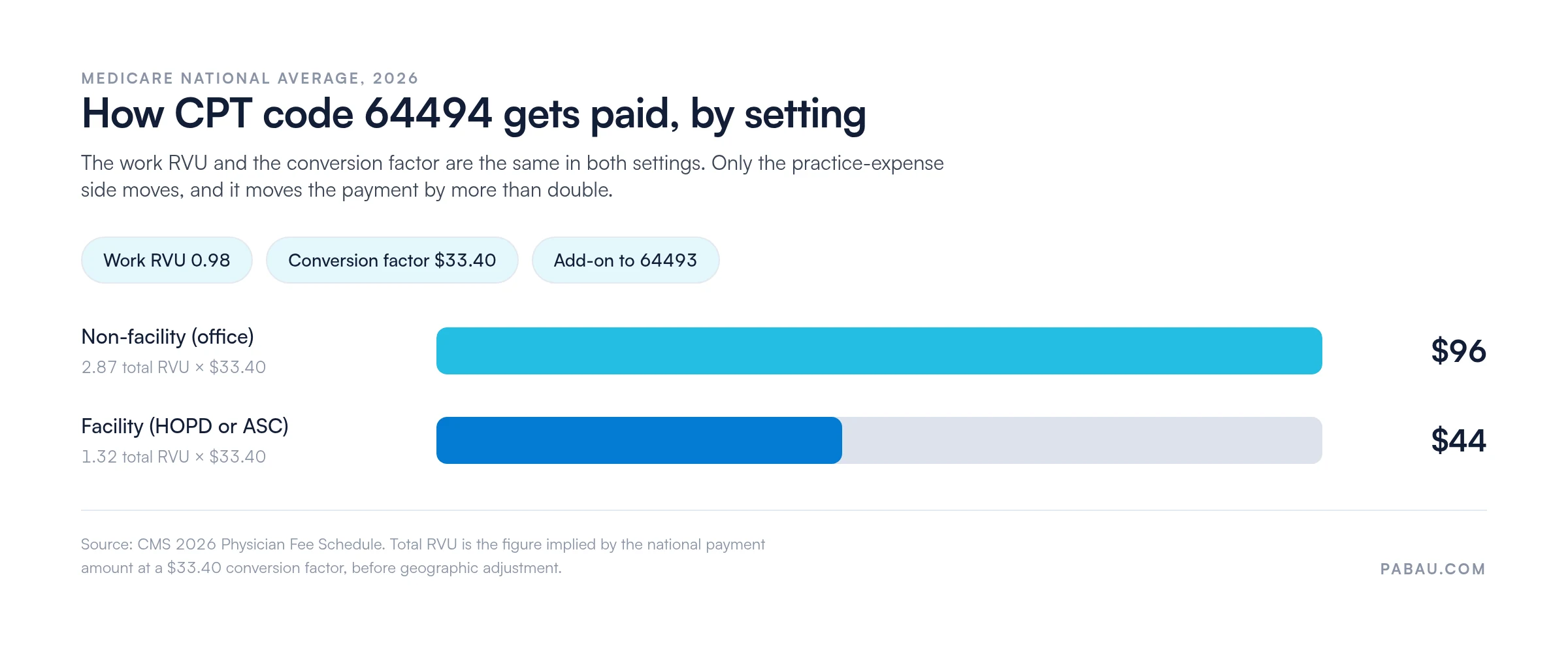
Geographic adjustment applies through the Geographic Practice Cost Index. Practices in high-cost markets such as metro California, New York, and Massachusetts typically receive more than the national average. The same CMS lookup returns the locality-adjusted amount for your MAC jurisdiction.
Check that your clearinghouse captures ERA 835 remittance data at the line-item level. Add-on payments then reconcile line by line, instead of disappearing into one visit total.
Facility vs. non-facility status is determined by where the physician performs the service, not where the practice is based. If your physician performs facet injections at a hospital outpatient department two days per week, those claims must use the facility rate. The status of your main office does not change that. Billing the non-facility rate for services performed in a facility setting is a common audit trigger.
Medicare coverage for CPT code 64494 is governed by Local Coverage Determinations issued by individual Medicare Administrative Contractors. LCD L35936 (Facet Joint Interventions for Pain Management) applies in many MAC jurisdictions and sets the coverage criteria, indications, and frequency limitations.
Read the current version of the LCD that applies in your jurisdiction before billing. Covered indications and session limits differ between contractors, so the figure below is a starting point rather than a rule.
Prior authorization requirements for the second-level add-on vary across MAC jurisdictions and commercial payers. Traditional Medicare fee-for-service does not universally require prior authorization for facet joint injections, but individual MACs and Medicare Advantage plans may. Verify the patient’s benefits before each session, and check how many sessions the plan has already covered.
Commercial payers have particularly variable requirements. Some require prior authorization for any spinal injection; others require only a referral or letter of medical necessity. Document the authorization number in the patient chart and on the claim when applicable.
Selecting the correct ICD-10-CM code is what establishes medical necessity on the claim. The diagnosis must align with the documented clinical findings and with the LCD’s covered indications. A non-specific pain code, where a facet joint pathology code fits better, invites a medical necessity review.
Two of the codes practices still reach for are no longer billable. Full descriptors and current child codes sit in our ICD-10-CM code library.
Specificity matters. M47.816 or M47.817 signals facet joint pathology, which aligns directly with the LCD’s covered indication for facet-mediated pain. A low back pain code such as M54.50 is billable but far less specific, so it raises audit risk. Always pick the code that matches the documented diagnosis.
Add-on code status governs which modifiers apply to CPT code 64494. The rules are more restrictive than for standalone procedure codes.
Bilateral facet joint injections are an area of genuine ambiguity. Some payers accept bilateral billing for add-on codes using modifier 50, RT, or LT; others do not. Confirm the payer’s specific policy before billing bilaterally to avoid systematic denials.
Modifier 59 and modifier XS also fail to separate a facet injection from a basivertebral nerve ablation. Noridian’s LCD L39642 excludes concomitant paravertebral injections at the same session and spinal region as CPT code 64628.
Incomplete documentation is the fastest path to a denied claim or a post-payment recoupment. Every CPT code 64494 claim needs a procedure note that supports both the service rendered and its medical necessity. The list below is what a reviewer looks for in that note.
Pain management practices lose reimbursement on facet joint injection claims because the same handful of errors repeats. Each one below is preventable at the point of coding, before the claim reaches a payer.
Pain management and physical therapy practices billing CPT code 64494 face three linked demands. Add-on codes need precise claim-line sequencing. Image guidance has to be documented even though it is not separately payable. Session counts need tracking across a rolling 12 months.
Practice management software like Pabau answers all three with claims management built in. The procedure note, the CPT and ICD-10 codes, and the claim sit on one patient timeline.
For US practices, electronic claims run through the Claim.MD clearinghouse, which connects to thousands of US payers. That covers CMS-1500 and 837P submission, real-time eligibility checks, and ERA 835 remittance processing. One system for documentation, coding, and submission removes the switching between a clinical record and a separate billing platform.
A built-in CPT and ICD-10 catalog also cuts manual entry errors on injection claims. The coding record stays aligned with the clinical note from the moment the physician documents the session.
Track facet injection sessions by spinal region on a rolling 12-month window inside each patient’s record. When a patient nears the four-session limit, document the rationale for continued treatment before the next procedure. A short addendum should note persistent pain, the response to prior injections, and the decision to continue. That addendum is the audit trail if a post-payment review lands.

Pabau helps pain management and injection practices document procedures accurately, submit claims electronically, and track reimbursement – all in one platform.

CPT code 64494 is straightforward once the add-on rules are clear. Pair it with 64493, leave modifier 51 off, and keep image guidance off its own claim line. Document the specific anatomical level, then match the diagnosis code to what the chart shows.
The payment per line is modest, near $44 in a facility and $96 in the office. A denied add-on line costs more than that, because it usually means reworking the whole session’s claim. Tracking the four-session limit per region is what keeps that rework rare.
Pabau keeps documentation and claim submission in step, so injection claims leave the practice with fewer manual corrections. See how it handles pain management billing by booking a demo.

Need a framework for clean claim submission? Clean claim requirements and common rejection causes covers the elements every claim must have before submission.
Dealing with denial patterns on injection codes? Denial management in healthcare outlines a structured approach to identifying, appealing, and preventing recurring claim denials.
Want to understand how remittance data flows after claim submission? Electronic remittance advice (ERA) explains how 835 files work and what to look for in payer payment responses.
CPT code 64494 bills the second lumbar or sacral paravertebral facet joint injection performed in a single session. It also covers the nerves innervating that joint. It is an add-on code that describes the second level of injection when the physician treats more than one spinal level at the same visit.
The primary code for CPT 64494 is CPT 64493, which covers the first lumbar or sacral paravertebral facet joint injection. CPT 64494 must always be reported with 64493 on the same service date and cannot be billed without it.
No. CPT 64494 is designated as an add-on code (+) and has no standalone billing status. Every claim for 64494 requires 64493 as the parent primary code. Claims submitted with 64494 alone will deny at the payer level.
None. Image guidance is built into CPT code 64494 itself, because the 64490-64495 descriptors include fluoroscopic or CT guidance. CPT 77003 and CPT 77012 must not be reported alongside 64494. CMS Local Coverage Articles for facet joint interventions state this directly. The procedure-to-procedure edit also carries modifier indicator 0, so no modifier can unbundle the pair. The guidance must still appear in the procedure note.
Prior authorization requirements vary by payer and MAC jurisdiction. Traditional Medicare fee-for-service does not universally require prior authorization for facet joint injections, but Medicare Advantage plans and many commercial payers do. Verify each patient’s specific plan requirements before scheduling the procedure.



