CCSD code G5100: Bypass of duodenum billing guide
CCSD code G5100 bills a bypass that leaves the duodenum in place CCSD code G5100...

Last Updated: Oct 16, 2026

CPT Code 64491 covers a paravertebral facet joint injection at the second cervical or thoracic level. It is an add-on code and cannot be billed on its own.
64491 must always appear alongside primary code 64490, and fluoroscopic or CT guidance is bundled into both codes.
Medicare’s Billing and Coding Article A56670 requires documented conservative treatment failure, and missing that documentation is the most common medical necessity denial.
The 2026 CMS work RVU for 64491 is 1.13, with a non-facility practice expense RVU of 1.81 and a malpractice RVU of 0.11.
Practice management software like Pabau auto-populates add-on codes, captures the documentation A56670 asks for, and reports denials by CPT code.
CPT Code 64491 is the add-on code for a paravertebral facet joint injection at the second cervical or thoracic level.
It is reported only alongside primary code 64490, and only once per session. Billed on its own, it is rejected before a human ever reads the claim.
This guide covers the AMA descriptor, the add-on rules that tie 64491 to 64490, and Medicare’s medical necessity criteria. It also sets out the 2026 fee schedule values, the documentation payers expect, and the errors that trigger denials.
CPT Code 64491 covers the injection of a diagnostic or therapeutic substance into a paravertebral facet joint. That joint is also called the zygapophyseal joint, and the code also covers the nerves that supply it. The region is cervical or thoracic, and 64491 marks the second level treated in a session.
The official descriptor comes from the AMA’s CPT code set. It names the agent and the target: “injection(s), diagnostic or therapeutic agent, paravertebral facet (zygapophyseal) joint (or nerves innervating that joint)”. It then requires “image guidance (fluoroscopy or CT)”. It closes with “cervical or thoracic; second level (List separately in addition to code for primary procedure)”. Two parts of that wording decide the billing. Image guidance is inside the descriptor, so it is not separately billable. The parenthetical makes 64491 an add-on, so it never carries a claim on its own.
The procedure targets the small synovial joints along the back of the cervical and thoracic spine. Those joints are frequent sources of axial neck pain, mid-back pain, and referred pain. The injection can be diagnostic or therapeutic, depending on the substance used and the clinical question.
64491 is a designated add-on code in the AAPC’s CPT code reference, so the AMA’s add-on rules apply rather than the rules for primary procedures. The whole cervical, thoracic, lumbar and sacral facet injection series follows one tiered structure.
Four rules govern how 64491 goes on a claim:
The codes that land on the claim depend only on how many levels were treated in that session. Past two levels, the claim picks up 64492, billed as one unit however many levels follow.
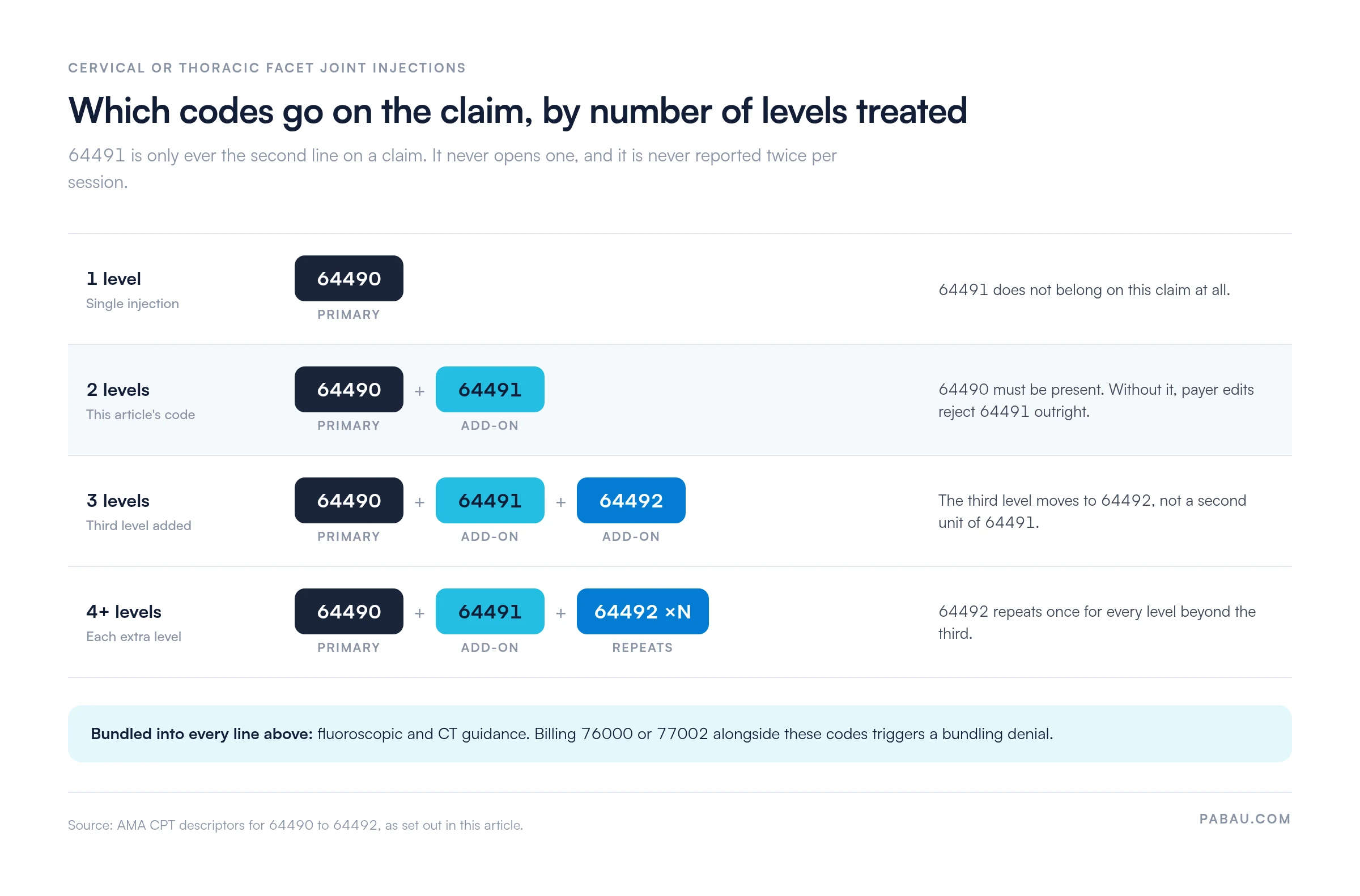
Fluoroscopic guidance and CT guidance are both bundled into CPT Code 64491, and neither can be billed on the same claim. Image guidance sits inside the code descriptor, so a separate charge duplicates work 64491 already pays for.
The American Society of Anesthesiologists has published coding guidance confirming the arrangement. Practices that bill imaging guidance separately from 64491 face repeat denials and audit exposure.
Medicare coverage for CPT Code 64491 runs through Billing and Coding Article A56670, the CMS article on facet joint interventions for pain management. A56670 is the billing article rather than the coverage determination itself, and the Local Coverage Determinations it supports carry L-numbers. Because Medicare Administrative Contractors (MACs) issue their own regional versions, the criteria vary by jurisdiction. Check your MAC’s active article and LCD before you submit.
The core medical necessity criteria in A56670 include:
Palmetto GBA, one MAC with detailed guidance on facet interventions, requires documentation showing the clinician assessed facet joint pain as a primary contributor. Templated notes that never connect the clinical picture to facet pathology are a common reason for post-payment recoupment.
Check your MAC’s active guidance before you submit 64491 claims. A56670 is the national billing and coding article, and regional MACs publish their own versions with added or modified criteria. Palmetto GBA, Novitas, and CGS each have jurisdiction-specific guidance on facet joint interventions that can differ from the baseline.
Incomplete documentation is the other common denial trigger for CPT Code 64491. The note and supporting records have to establish medical necessity at the time of service, not after a denial arrives. A clean claim for 64491 needs all of the following:
Prior authorization requirements for 64491 vary widely by payer. Some MACs require it for repeat injections beyond the first course, and commercial payers often require it for the initial series. Verify with the payer before you schedule.
Injectable drug codes are held to the same documentation standard. Gamma globulin billed under HCPCS code J1460 needs the exposure history or diagnosis recorded in the visit note before the claim goes out.
The 2026 Medicare physician fee schedule values for CPT Code 64491 come from the CMS Physician Fee Schedule lookup tool. Rates change with the setting and the geographic locality. The figures below are national and unadjusted, so apply your local Geographic Practice Cost Index (GPCI) for a usable estimate.
The facility practice expense RVU is lower than the non-facility figure, because the facility absorbs the overhead. Confirm the current facility value in the CMS lookup for your place of service before you model facility revenue.
Setting decides a large share of the payment on this code. In a hospital outpatient department or ambulatory surgery center, the practice expense RVU drops because the facility carries the overhead. In an office, the practice expense RVU is higher and total reimbursement to the billing provider is meaningfully larger.
Confirm that the place of service code on the claim matches where the injection was performed. A mismatch between the claim and the remittance is a common source of payment discrepancies and post-payment adjustments. Claims for CPT Code 64491 go out on the CMS-1500 form or in the 837P electronic format.
Medicare and most commercial payers cap how often facet joint injections can be billed in a 12-month period. The cap runs per spinal region, so cervical and lumbar are counted separately. Frequency limits on 64490 and 64491 do not touch the count for 64493 and 64494.
Under A56670, frequency criteria are tied to the medical necessity documentation. Medicare typically limits facet joint injections to three sessions per spinal region per year, and the active version should be confirmed with your MAC. Two cautions matter more than the number itself:
Denials on CPT Code 64491 cluster around a handful of repeatable errors. Each one has a specific fix at the coding or documentation stage. Flagging 64491 claims for pre-submission review catches most of them before they become appeals.
Reviewing denial codes for patterns specific to 64491 separates systemic problems from isolated ones. A systemic denial affects every 64491 claim and points to a process error at the coding or documentation stage.
Run a quarterly audit on every 64491 claim from the prior 90 days. Confirm that 64490 was present, that the place of service was correct, and that no imaging guidance codes slipped through. One review session usually surfaces two or three systematic errors before they compound.
Most revenue leakage on complex add-on codes happens between a correctly performed procedure and a correctly billed claim. Practice management software like Pabau narrows that distance by wiring the clinical note straight into the billing workflow. Integrated claims management software is what makes the connection hold.
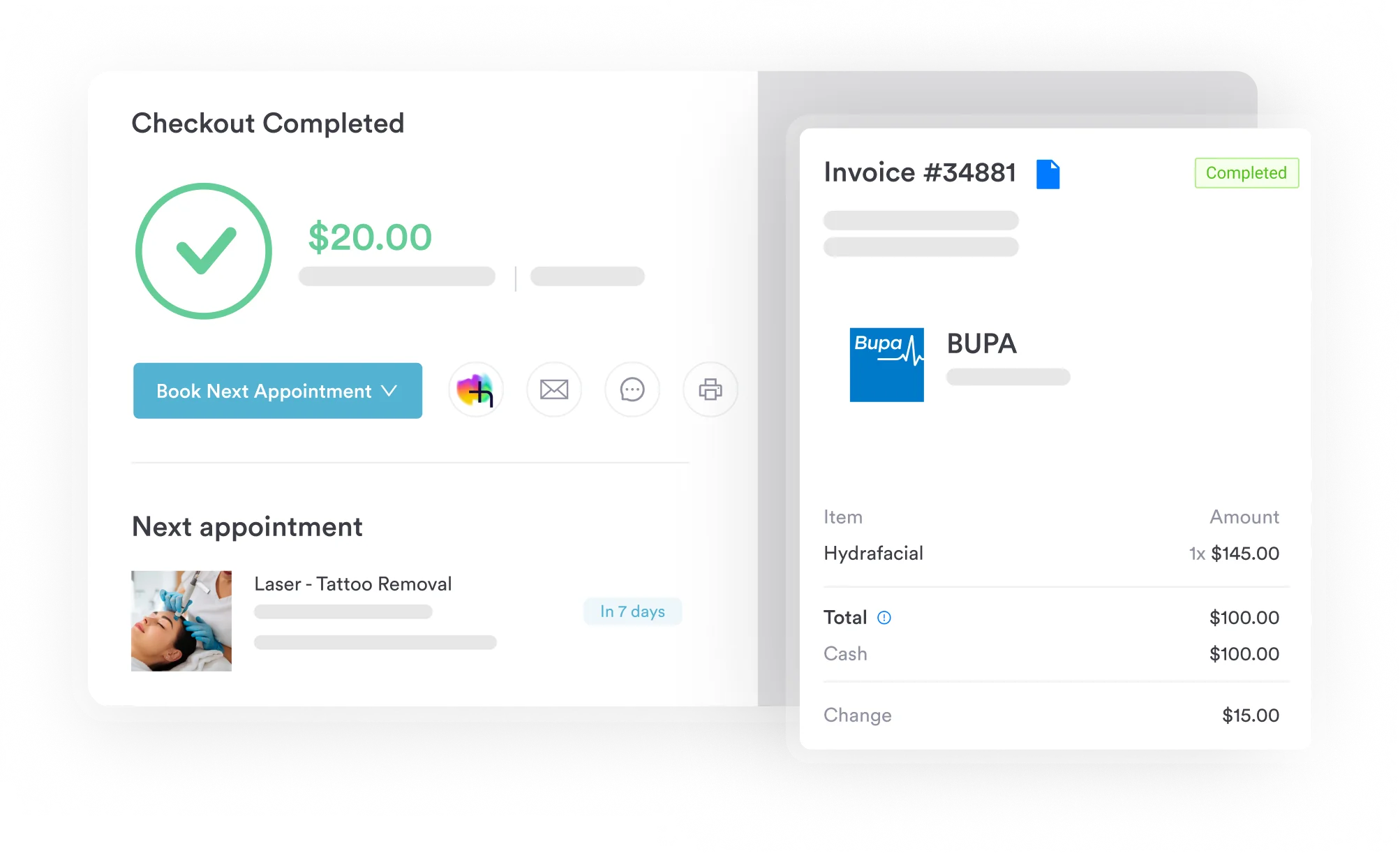
Pabau’s treatment note templates can be built to capture the A56670 fields at the point of care. When a clinician documents a cervical facet injection, the template prompts for spinal level, laterality, guidance type, conservative treatment history, and clinical findings. That structured data flows into the billing workflow, so nobody re-enters it and the coding errors that come with re-entry disappear.
Claims route through Claim.MD, our US clearinghouse partner, which validates the 837P file before it reaches the payer. A claim missing its primary code, carrying a bundled imaging charge, or showing the wrong place of service gets flagged there. That happens before submission, not after a denial. Pabau also processes the incoming 835 remittance files, so your team can read denial reasons by CPT code and fix the pattern once.

Pabau’s claims workflow helps pain management practices catch coding errors before submission. It also captures the A56670 documentation fields and processes remittances through our Claim.MD integration.

The rule that decides most 64491 claims is the simplest one in the article. The code is a second line, never a first, and the claim has to carry 64490 to exist at all.
The rest comes down to documentation written while the patient is still in the room. A note that names the level, the laterality, the guidance, and the conservative care that failed survives an audit two years later. A note written to satisfy a denial letter does not.
So the trade-off is a few structured fields at the point of care against appeal work months later. Book a demo to see how Pabau captures those fields and reports 64491 denials by code.

Want to understand how claims get processed end to end? Our medical claims clearinghouse guide explains how 837P files move from practice management system to payer and back.
Seeing high denial rates across your injection codes? The complete superbill guide covers how accurate charge capture at the superbill stage prevents downstream coding errors.
Need to verify payer-specific prior authorization requirements? Getting credentialed with insurance companies covers payer enrollment and the authorization requirements that follow.
CPT Code 64491 bills the injection of a diagnostic or therapeutic agent into a paravertebral facet joint at the second cervical or thoracic level. It is reported alongside primary code 64490, which covers the first level treated in the same session.
Yes. CPT 64491 is a designated add-on code and cannot be billed as a standalone procedure. It must always appear on the same claim as primary code 64490. Claims submitted with 64491 but without 64490 will be automatically denied by payer system edits.
Fluoroscopic and CT imaging guidance are bundled into CPT 64491 and cannot be billed separately on the same claim. Image guidance is written into the code descriptor itself. Billing fluoroscopy codes like 77002 alongside 64491 results in a bundling denial.
Per the 2026 CMS Physician Fee Schedule, CPT 64491 carries a work RVU of 1.13 and a malpractice RVU of 0.11. The non-facility practice expense RVU is 1.81, which gives a total non-facility RVU of 3.05. Confirm the facility practice expense RVU in the CMS lookup for your place of service.
CPT 64491 covers the second cervical or thoracic paravertebral facet joint level and is an add-on to primary code 64490. CPT 64493 is the primary code for the first lumbar or sacral facet joint level. They cover different spinal regions and are never billed as add-ons to each other.
Bilateral billing rules for CPT 64491 vary by payer. Some require modifier 50 on both 64490 and 64491. Others require separate line items. There is no universal rule, so verify each payer’s bilateral billing policy before submitting and document laterality explicitly in the procedure note.