



CCSD code G5100: Bypass of duodenum billing guide
CCSD code G5100 bills a bypass that leaves the duodenum in place CCSD code G5100...

Last Updated: Oct 16, 2026

CPT Code 64484 covers a transforaminal epidural injection of anesthetic or steroid at each additional lumbar or sacral level, rather than the first.
Because 64484 is an add-on code (+), it cannot be billed without the primary code CPT 64483 on the same claim.
Imaging guidance is built into the code descriptor, so 77003 and 77012 are never billed separately with 64484.
Medicare’s 2026 national average is about $118 in the office and about $44 in a facility, before geographic adjustment.
Practice management software like Pabau helps track the 64483/64484 pairing, and it also streamlines claim submission through the Claim.MD clearinghouse.
CPT Code 64484 is the add-on code for each additional lumbar or sacral level treated with a transforaminal epidural injection. So it is payable only when CPT 64483 also appears on the same claim for the first level. Two errors then drive most denials here. One is a missing primary code. The other is imaging guidance billed on its own line, even though the descriptor already includes it.
This reference covers the official descriptor, the 64483 pairing rule, and verified 2026 Medicare rates, including the two CY2026 conversion factors. In addition, it sets out RVU components, ICD-10 pairings, documentation requirements, and the errors that trigger denials.
CPT Code 64484 describes: Injection(s), anesthetic agent(s) and/or steroid, transforaminal epidural, with imaging guidance; lumbar or sacral, each additional level. During the procedure, a needle passes through the intervertebral foramen. It then deposits corticosteroid, local anesthetic, or a combination into the epidural space at the targeted nerve root.
The code carries a plus (+) symbol in the AMA CPT codebook, so its add-on status is explicit in the descriptor itself. It covers any additional lumbar or sacral level treated in the same operative session, once the first level has been reported with CPT 64483.
According to the American Medical Association’s CPT code set, add-on codes are never standalone billable services. CPT Code 64484 therefore exists to capture the incremental work of each extra spinal level treated in one session.
CPT 64483 is the primary code covering the first lumbar or sacral transforaminal epidural level. CPT Code 64484 then picks up every additional level treated in the same session. Because the two codes are structurally linked, 64484 has no billing meaning without 64483 anchoring it on the claim.
For example, a two-level lumbar TFESI is billed as 64483 for the first level plus 64484 for the second. A three-level session is likewise 64483 plus two units of 64484, since no separate code exists for a third level. Checking the payer’s level limit before the procedure prevents a partial denial on the extra units.
Several billing rules govern CPT Code 64484 specifically. If you violate any one of them, an automatic denial usually follows.
Neither fluoroscopic guidance (77003) nor CT guidance (77012) is separately reportable with 64483 or 64484. That is because the 2017 CPT revision folded imaging guidance into the descriptors for 64479 through 64484. Both the work and the expense are already paid inside the injection code.
The National Correct Coding Initiative enforces this with a hard edit. Appending a modifier does not unbundle it, and no payer policy restores separate payment. Reporting 77003 alongside 64484 therefore produces a denial on the imaging line every time.
Fluoroscopy still belongs in the procedure note. The image confirmation supports the level count and the medical necessity argument, even though it never becomes its own claim line here.
Medicare pays about $118 for CPT Code 64484 in a non-facility (office) setting, while a facility setting pays about $44 in 2026. Both are national averages before geographic adjustment. They come from the CMS physician fee schedule relative value files, specifically the July 2026 release. The chart below then sets those figures against the primary code and against bundled imaging.
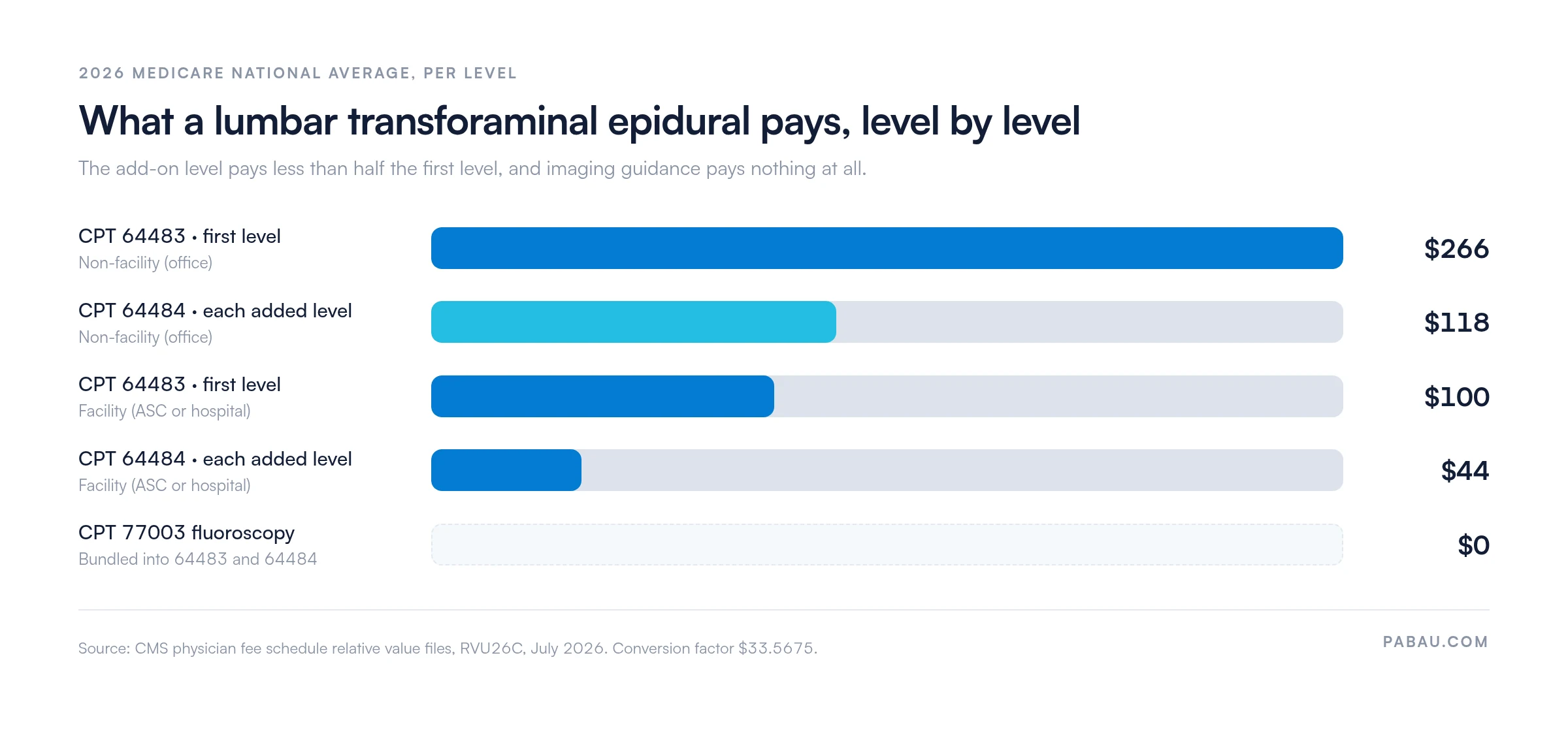
One detail changes the arithmetic, though most fee schedule summaries skip it. CY2026 carries two conversion factors rather than one. Qualifying alternative payment model participants are paid at $33.5675, while everyone else is paid at $33.4009. On 64484 the difference is only about 60 cents, so the figures here use the higher factor. Either way, verify your own locality in the CMS physician fee schedule lookup tool.
The differential between settings reflects who carries the overhead. In a hospital outpatient department or an ambulatory surgery center, for instance, the facility bills its own overhead through the OPPS or ASC payment system. The physician then receives only the lower professional rate. In an office-based procedure suite the physician absorbs the overhead, including the fluoroscopy, so the higher non-facility rate compensates for it.
That is why the office rate for 64484 is nearly triple the facility rate. Practice expense RVUs climb from 0.25 to 2.46 between the two settings, while the work RVU stays at 0.98.
Medicare’s payment formula is (work RVU + practice expense RVU + malpractice RVU) x conversion factor x GPCI. The components below are the CY2026 national values from the CMS relative value file, released June 30, 2026.
Note that the global period also differs behind those numbers. CPT 64483 carries a 000-day global period, while 64484 carries ZZZ because it is an add-on that inherits the primary code’s period.
Track the 64483/64484 pair by setting, rather than by code alone. A two-level lumbar TFESI in the office pays about $384 in 2026, while the same procedure in an ASC pays about $144 in professional fees. Imaging guidance is bundled into both codes, so the place of service is what moves the margin.
The diagnosis on the claim must reflect the documented condition justifying the injection. No ICD-10 code guarantees coverage, because the clinical record is what supports medical necessity. Certain diagnoses do appear consistently with CPT Code 64484, since they match the indications for lumbar and sacral TFESI.
Select the most specific code the documentation supports. Avoid defaulting to M54.50 when radiculopathy or a structural diagnosis is present in the record. Payers scrutinize non-specific low back pain particularly closely on multi-level injection claims. ICD-10-CM updates every October, so confirm code validity before the billing cycle turns over.
Thin documentation is the second most common denial trigger for CPT Code 64484, though the missing primary code still leads. Medicare also requires prior conservative treatment under its Local Coverage Determinations, and the specifics vary by MAC jurisdiction. Read your MAC’s active LCD for lumbar injections before the injection date, not after the denial.
Capture the level count and the place of service while the procedure note is being written. Retrofitting that detail once the claim has gone out is slow, and it creates a compliance risk.
Pain management billing teams generally meet a predictable set of denial patterns on this code. Recognizing them in advance is far cheaper than working the appeals.
To begin with, review the denial codes that show up on spinal injection remittances, then build a pre-submission checklist for the 64483/64484 pair. A structured review before claims leave the office catches unit-count and pairing errors while they are still free to fix.
Not every bad line reaches the denial queue. Clearinghouses screen against the active CMS code file, so a deleted code such as J1441 is rejected before adjudication and never shows on a remittance.
CPT Code 64484 belongs to a family organized by both approach and anatomic site. Transforaminal sits against interlaminar, while cervical or thoracic sits against lumbar or sacral. As a result, picking the wrong member of that family is a common source of denials and audits.
The transforaminal approach targets one nerve root through the foramen. By comparison, the interlaminar approach delivers medication through the posterior midline or paramedian space, across a broader epidural distribution. They are not interchangeable on the claim even at the same level, because they describe different procedures. For a single-level lumbar interlaminar injection, bill 62323 instead.
Add-on billing has one recurring failure point. The primary code has to travel with the add-on on the same claim, and the unit count has to match the operative note. When someone checks that by eye at the end of a busy day, it gets missed.
Pabau’s claims management software keeps both the procedure record and the outgoing claim in one system. Billing staff can then see the levels documented on the note next to the codes on the claim. That lets them check the 64483/64484 pairing against the record rather than from memory.
In addition, Pabau submits and tracks claims for US practices through the Claim.MD clearinghouse. That covers CMS-1500 and 837P formats, eligibility checks before the appointment, and electronic remittance advice coming back in. Remittance data is what tells you whether your 64484 denials are pairing errors or documentation errors.

Pabau keeps both the procedure note and the claim in one record, and submits through Claim.MD. Your billing team can check the 64483/64484 pairing before the claim goes out.

In short, 64484 denials trace back to a handful of causes. Either the primary code is missing, the unit count contradicts the note, the wrong anatomic family was used, or the necessity documentation is thin. Each one is cheaper to catch before submission than to appeal afterward.
Above all, the imaging correction is the one worth acting on this week. If your charge master still carries 77003 as a separate line against these injections, you are generating denials on purpose. Pull it out, then reset the revenue expectation for a two-level office session to roughly $384.
Book a demo to see how Pabau keeps the level count, the codes, and the claim in one record for pain management practices.

Need to understand how a clearinghouse scrubs a claim before submission? Medical claims clearinghouse overview explains the EDI submission pathway from practice to payer, including where scrubbing happens.
Dealing with repeated 64484 denials? Denial management in healthcare sets out how to work a denial queue by root cause rather than by age.
Want a clean claim checklist for spinal injection codes? Submitting a clean claim outlines the field-level requirements that reduce first-pass denials before they reach a payer.
Unsure where add-on errors enter the cycle? Revenue cycle management fundamentals covers the workflow stages where coding errors typically start.
Worried about LCD documentation on injection claims? Medical billing compliance covers the record-keeping that survives a payer audit, particularly on injection claims.
CPT Code 64484 bills each additional lumbar or sacral level of a transforaminal epidural injection. The first level is reported with CPT 64483 in the same session. 64484 then covers the second level, the third, and so on.
CPT 64483 is the primary code for the first lumbar or sacral transforaminal epidural level. CPT Code 64484 is the add-on code for each additional level treated in the same session. 64484 cannot be reported without 64483 on the same claim.
Medicare pays about $118 for 64484 in a non-facility setting and about $44 in a facility setting in 2026. Those figures use 3.52 and 1.31 total RVUs from the CMS relative value files, times the $33.5675 conversion factor. Locality adjustment then applies.
CPT Code 64484 is reported once per additional level treated beyond the first. A three-level transforaminal epidural session is billed as one unit of 64483 plus two units of 64484. The operative note must document each level to support the unit count.
Common pairings include M54.41 and M54.42 for lumbago with sciatica, and M54.31 and M54.32 for sciatica. Add M51.16 for lumbar disc disorder with radiculopathy, or M47.26 for lumbar spondylosis with radiculopathy. M54.3, M54.4 and M54.5 are not billable on their own.



