

CCSD code G5100: Bypass of duodenum billing guide
CCSD code G5100 bills a bypass that leaves the duodenum in place CCSD code G5100...

Last Updated: Oct 16, 2026
Billable Code
64480 is the CPT add-on code for each additional level of a cervical or thoracic transforaminal epidural injection with imaging guidance. It reads "Injection(s), anesthetic agent(s) and/or steroid; transforaminal epidural, with imaging guidance (fluoroscopy or CT), cervical or thoracic, each additional level (List separately in addition to code for primary procedure)."
Pairings with the wrong primary code, missing imaging documentation, and unmet Medicare LCD criteria are common causes of rejected 64480 claims. This guide covers the official descriptor, the pairing with CPT 64479, NCCI edits, reimbursement, documentation, and the costliest denial patterns.
Let Pabau's smart automation suggest the right codes, reduce claim denials, and keep your practice compliant—effortlessly.
Automate repetitive tasks and focus on what matters most—your patients.
Reduce coding errors and ensure compliance with the latest regulations.
Clean claims, fewer denials, and faster reimbursements.
Powerful insights and reporting to help your practice thrive.
HIPAA compliant SOC 2 certified GDPR-compliant Trusted by 4,000+ clinics worldwide

CPT code 64480 is an add-on code (+64480) and can never be billed without CPT 64479 on the same claim.
64480 covers cervical and thoracic levels only. Use CPT 64483 and 64484 for lumbar or sacral injections.
Imaging guidance (fluoroscopy or CT) is included in 64480, so do not bill 77003 or 77012 separately.
A bilateral injection is reported with modifier 50 (64479-50, plus 64480-50 for each additional level), never as an extra level.
Pabau’s claims management software streamlines 64480 claim submission, prior authorization tracking, and denial workflows for pain management practices.
CPT code 64480 describes a transforaminal epidural injection of anesthetic agent(s) and/or steroid, with imaging guidance, at the cervical or thoracic spine. It is reported for each additional level injected beyond the first. The AMA marks it with a plus symbol (+64480). That makes it an add-on code, which can only appear on a claim alongside its primary code.
The transforaminal approach places the needle through the neural foramen so the injectate bathes the nerve root directly as it exits the spinal canal. This differs from the interlaminar approach (codes 62321-62323), which targets the epidural space between the laminae. Getting the approach right in the operative note is the first documentation requirement payers audit.
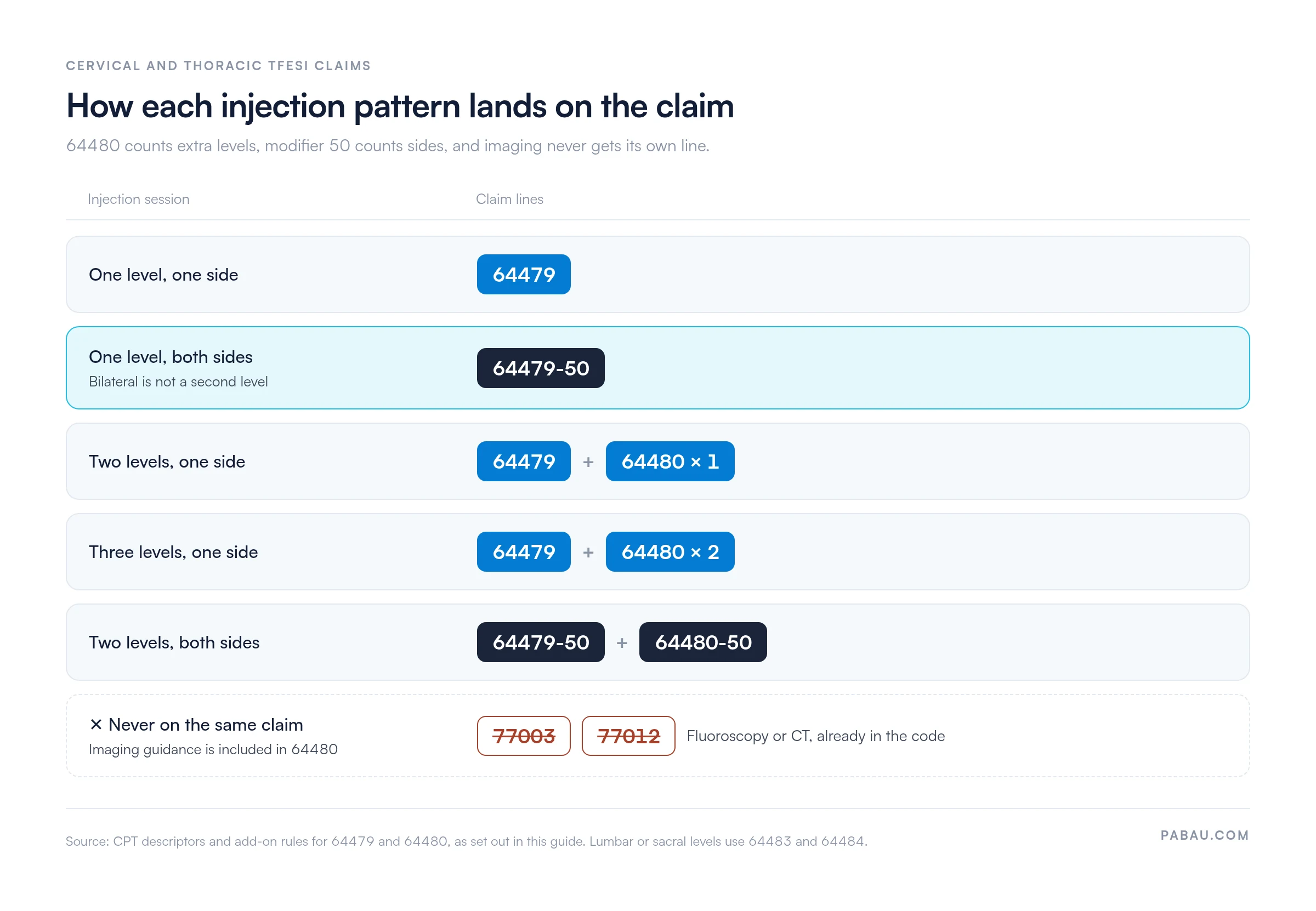
CPT 64479 is the primary code for the first cervical or thoracic transforaminal epidural injection level. CPT code 64480 is reported once for every additional level injected at the same session. A bilateral injection at one level is reported as 64479 with modifier 50 (64479-50), not as 64479 plus 64480. When additional levels are injected on both sides too, each one is reported as 64480-50.
Bilateral means both sides of the same level, so it never counts as a second level. Appending 64480 for the second side of a single level is a common and costly misread.
AMA add-on code rules prohibit billing 64480 without a matching 64479 on the same date of service. Payers process add-on codes only after the primary code clears editing. If 64479 is denied or missing, 64480 is denied automatically, regardless of medical necessity. This dependency makes correct claim construction essential before submission.
Put together, levels and sides produce a short list of claim patterns, shown below for the most common sessions.
The 64479/64480 code pair is anatomically restricted to the cervical and thoracic spine. The lumbar and sacral spine has its own pair. CPT 64483 reports the first level, and CPT 64484 reports each additional level. Reporting 64480 for a lumbar injection is an anatomical miscoding that triggers payer audits and recoupment requests.
When a patient receives cervical and lumbar injections in the same session, both pairs may be reported. That means 64479 + 64480 for the cervical levels and 64483 + 64484 for the lumbar levels, provided each is medically necessary and separately documented. According to the American Medical Association’s CPT code set guidelines, each code pair must correspond to the correct anatomical region confirmed in the operative note.
The National Correct Coding Initiative (NCCI) maintains column-one/column-two edit tables that govern what can be billed alongside CPT code 64480. Imaging guidance is the most commonly misunderstood bundling area for this code.
Fluoroscopy or CT guidance is included in 64480, because its descriptor reads “with imaging guidance (fluoroscopy or CT)”. The same is true of every code from 64479 to 64484. CPT 77003 (fluoroscopic guidance) and CPT 77012 (CT guidance) therefore cannot be billed with 64480. No modifier changes that.
Run your 64480 claims through the current NCCI edit table before submission every quarter. CMS updates these tables four times per year, and a modifier that was valid last quarter may no longer apply. Build a quarterly calendar reminder into your billing workflow to pull the updated tables from cms.gov.
Medicare coverage for CPT code 64480 is governed by Local Coverage Determinations (LCDs) issued by Medicare Administrative Contractors (MACs). Current epidural steroid injection LCDs include L39240 from Noridian, “Epidural Steroid Injections for Pain Management”. The specific active LCD varies by MAC jurisdiction. Coverage criteria are not uniform across the country, so a claim covered under one MAC may be denied under another.
Before billing 64480 under Medicare, document each of the following in the patient record.
Commercial payers follow similar criteria but often have their own clinical coverage policies that differ from Medicare LCDs. Always pull the specific payer’s coverage policy before assuming Medicare LCD criteria apply universally.
Medicare does not require prior authorization for CPT code 64480 in most MAC jurisdictions. Commercial payers are a different story. Most commercial health plans require prior authorization (PA) for transforaminal epidural steroid injections. The PA requirement applies to 64480 even when 64479 is already authorized.
Completing insurance eligibility verification before scheduling the procedure is the first workflow step. Authorization requirements can change between the time a patient’s benefits are verified and the date of service. For multi-level injections specifically, confirm whether the PA covers additional levels or only the first level, because some payers issue authorization for 64479 alone.
CPT code 64480 reimburses at different rates depending on the site of service where the injection is performed. CMS maintains a facility rate (applicable to hospital outpatient departments and ambulatory surgery centers) and a non-facility rate (applicable to office-based settings). The non-facility rate is typically higher because it includes the practice expense of running an equipped procedure room.
Verify current rates using the CMS Medicare Physician Fee Schedule lookup tool or the FastRVU 2026 RVU lookup for current RVU values. Both list the work, practice expense, and malpractice components. The rates below reflect approximate 2025 national amounts. What you are paid depends on the geographic adjustment factors (GPCI) applied to your practice location.
A clean claim submission for CPT code 64480 starts with a procedure note that auditors can read as a standalone document. The note must establish what was done, where, how, and why, without the reviewer pulling other records.
Use this list as a pre-billing documentation audit checklist. A superbill documentation workflow that captures all elements at time of service prevents the most common post-claim documentation deficiency denials.
Pairing CPT code 64480 with the correct ICD-10-CM diagnosis code is a prerequisite for medical necessity approval. The diagnosis must reflect the anatomical level injected and the clinical indication documented in the procedure note.
Avoid generic spinal pain codes (M54.2, cervicalgia) without a radiculopathy or structural diagnosis to support the transforaminal approach. Payers routinely reject 64480 when the only supporting diagnosis is non-specific neck pain. That diagnosis does not establish the need for a targeted nerve root injection.
Denials on CPT code 64480 cluster around six predictable failure points. Each maps to a specific workflow correction that practices can implement before the claim leaves the office. Tracking the medical billing denial codes payers return on these claims shows which failure point costs your practice most.
Build a six-point pre-submission checklist for every 64480 claim. Confirm 64479 is present for the correct region, the PA covers additional levels, and the ICD-10 code matches the injected level. Then confirm the procedure note documents imaging, no 77003, 77012 or other bundled service is billed separately, and the frequency count fits the payer LCD. Six checks before transmission cover the six most common denial categories.
Without software support, each of the six checks above is a manual step. A biller confirms 64479 sits on the claim, rereads the PA letter for every level, and counts past injections per region from old notes.
Pabau, the practice management platform we build, moves that work ahead of submission. It connects your practice to the Claim.MD clearinghouse for real-time eligibility checks and electronic claims. PA status is tracked against the booking, so a missing authorization shows up before the procedure date.
When a 64480 claim does come back denied, the Claim.MD clearinghouse integration surfaces the ERA denial codes (CARC codes) in your dashboard. Billing staff can correct and resubmit without cross-referencing remittance files by hand.

Pabau connects your practice to the Claim.MD clearinghouse for real-time eligibility verification, electronic claim submission, and ERA processing. Your team spends less time chasing denials and more time on patient care.

CPT code 64480 is simple to describe and easy to get wrong. It pays only when 64479 pays, it already includes the imaging, and it counts toward the patient’s LCD frequency limit.
The practical move is to check claim construction before submission instead of working denials afterward. Build the six checks into scheduling and charge entry, and the 64479/64480 pair stops coming back for rework. A few minutes of review per claim costs far less than an appeal.
Book a demo to see how Pabau tracks prior authorization and checks 64479/64480 claims before they leave your practice.

Choosing between the interlaminar and transforaminal approach? CPT code 62321 covers the cervical or thoracic interlaminar epidural injection with imaging guidance.
Billing additional lumbar or sacral levels? CPT code 64484 is the lumbar and sacral counterpart to 64480, reported for each additional transforaminal level.
Looking for the full RVU breakdown for this code? Medical billing workflows explained covers how RVUs translate into physician fee schedule payments and how practice settings affect reimbursement.
Managing denials across multiple CPT codes in your pain practice? Understanding electronic remittance advice explains how ERA files carry CARC denial codes that identify the specific reason each 64480 claim was rejected.
Want a repeatable process for working denied claims? Denial management in healthcare walks through tracking, appealing and preventing denials across your payer mix.
CPT code 64480 is the add-on code for a transforaminal epidural injection of anesthetic and/or steroid, with imaging guidance, at the cervical or thoracic spine. It is reported for each additional level injected beyond the first. It is designated +64480 and can only be billed when CPT 64479, the primary code for the first level, is also on the claim.
CPT 64480 is an add-on code, indicated by the plus symbol (+64480) in the AMA code set. It cannot be reported alone. CPT 64479 must be billed on the same claim as the primary code, or 64480 will be automatically denied regardless of medical necessity.
CPT 64480 is the add-on code for cervical or thoracic transforaminal epidural injections. CPT 64483 is the primary code for lumbar or sacral transforaminal epidural injections. The anatomical region is the distinguishing factor. Billing 64480 for a lumbar injection is a miscoding error that triggers payer audits.
CPT 64480 includes imaging guidance, either fluoroscopy or CT, as part of its descriptor. The guidance must be documented in the procedure note, including the modality used and the needle tip position. It is not billed separately, and a claim without that documentation is likely to be denied.
One unit of 64480 is billed per additional cervical or thoracic level injected beyond the first. If three levels are injected total (one primary + two additional), you report 64479 x1 and 64480 x2. Most payer LCDs cap the number of injection levels per session, so verify the applicable policy before assuming unlimited levels are covered.
Imaging guidance is included in CPT 64480 and is not separately billable, so 77003 and 77012 cannot be reported with it. Other NCCI edits bundle ancillary injection services into the code, so verify the current quarterly NCCI table from CMS before billing. Codes with a modifier indicator of “0” cannot be unbundled regardless of clinical circumstances.



