CCSD code H0410: Panproctocolectomy and ileostomy
CCSD code H0410: What it covers and when to use it CCSD code H0410 sits within t...

Last Updated: Nov 23, 2026
64620 is the CPT code for destruction by neurolytic agent, intercostal nerve. It covers a chemical or radiofrequency procedure that disables one intercostal nerve to give lasting relief from chest-wall pain, such as post-herpetic or post-thoracotomy neuralgia.
You report one unit per nerve treated, and imaging guidance is billed separately under its own code. A temporary anesthetic or steroid block of the same nerve is a different code, 64420.
Let Pabau's smart automation suggest the right codes, reduce claim denials, and keep your practice compliant—effortlessly.
Automate repetitive tasks and focus on what matters most—your patients.
Reduce coding errors and ensure compliance with the latest regulations.
Clean claims, fewer denials, and faster reimbursements.
Powerful insights and reporting to help your practice thrive.
HIPAA compliant SOC 2 certified GDPR-compliant Trusted by 4,000+ clinics worldwide

CPT code 64620 reports neurolytic destruction of an intercostal nerve, one unit per nerve, while a temporary intercostal block is 64420.
Imaging guidance is billed separately with 64620, as 77002 for fluoroscopy, 77012 for CT or 76942 for ultrasound.
Multiple intercostal levels are reported per payer policy and the MUE for 64620, using units or separate lines with 59/XS (or RT/LT) rather than 76.
Many commercial payers need prior authorization, and Cigna lists 64620 as not covered for intercostal neuralgia, so check the policy before booking.
Pabau tracks the prior authorization on the patient’s case, warns when it’s missing, and sends the claim through Claim.MD.
CPT code 64620 is the code for destruction by neurolytic agent, intercostal nerve, reported once for each nerve treated. Cigna’s nerve destruction coverage policy lists 64620 under that exact descriptor in its coding table.
The code sits in the Surgery section of the AMA CPT code set, under Nervous System, in the Destruction by Neurolytic Agent subsection (64600-64681). A pain physician uses it once a diagnostic block has confirmed the source of the pain.
Because the nerve is disabled for months, payers want the note to justify it. The usual drivers are thoracic post-herpetic neuralgia, post-thoracotomy pain, rib fracture pain and cancer pain in the chest wall.
The agent doesn’t change the code. Ethanol, phenol, glycerol and radiofrequency ablation all report as 64620 when the intercostal nerve is the target. Point the needle at the splanchnic nerves or the celiac plexus instead, and a different code applies.
Cryoablation is the case to watch. Cigna’s policy codes percutaneous cryoablation of a truncal nerve as Category III code 0442T, and it calls the method not medically necessary for pain. Check the payer’s policy before you report cryoneurolysis as 64620.
Reviewers hold the procedure note up against the descriptor before they pay. Match the scenario to the code with this table.
Here’s the path a clean 64620 claim follows in a pain practice. When one comes back denied, the cause usually sits in a step that got skipped.
Documentation is the part of a 64620 claim you control completely. If a reviewer can’t find any of these five items, they can deny the claim on medical necessity grounds.
Imaging guidance is separately billable with 64620 when it’s performed and documented. These are stand-alone imaging guidance codes rather than “+” add-on codes, and the right one depends on the modality.
Leave 77003 off these claims. It’s fluoroscopic guidance for spinal or paraspinal injections, so it doesn’t describe an intercostal procedure.
Verify the current NCCI edit pairs before billing, too. CMS updates the tables quarterly, and a pair that paid last quarter can bundle this one. Pull the current file before you submit 64620 with an imaging guidance code.
Run your NCCI check before the claim goes out, not after a denial arrives. Set a pre-submission scrubbing rule for 64620 paired with an imaging guidance code, and review it each quarter when CMS updates the edit tables.
The neurolytic destruction codes from 64600 through 64681 follow strict anatomic boundaries. Using 64620 for a celiac plexus or splanchnic procedure is miscoding, even when the clinical goal is similar. The most frequent mix-up is with 64640, the catch-all for other peripheral nerves.
The diagram below walks through the choice in three questions: what was done, which nerve, and which imaging.
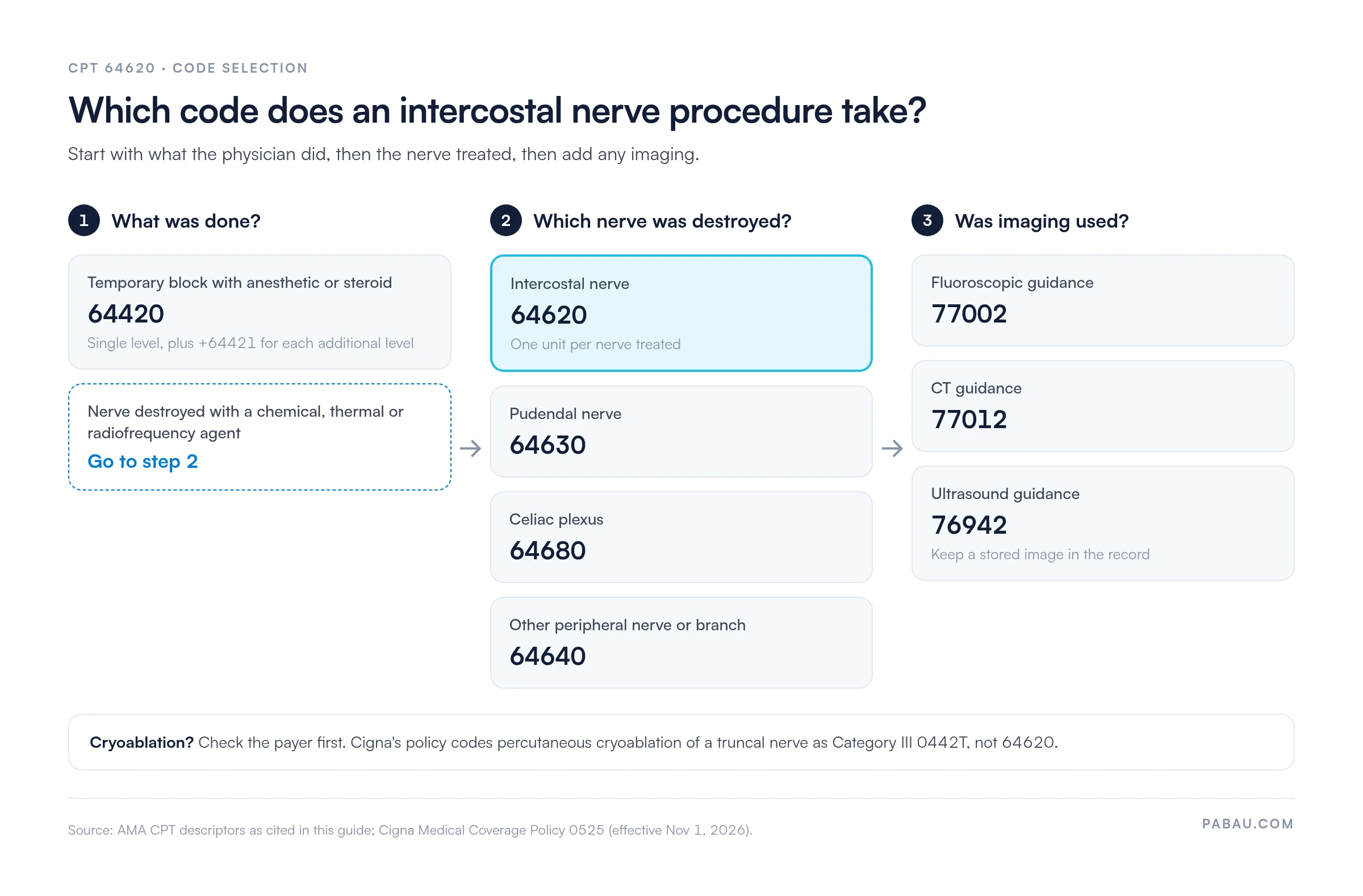
Every 64620 claim needs a diagnosis that explains why a nerve is being destroyed. When the encounter is for pain control, ICD-10-CM guidelines let a G89 pain code lead, with the underlying cause listed after it.
M79.2 shows up on many of these claims, but it’s unspecified. G58.0 names the intercostal nerve itself, so check whether your payer accepts it first.
Verify every ICD-10 code against the current fiscal year code set before billing. Codes change each October, and a retired code is an automatic denial.
Medicare covers 64620 when the record shows medical necessity and meets any local coverage determination (LCD) your MAC applies. Criteria can differ between MACs, say Noridian (JE/JF) and Palmetto GBA (JJ/JM). Check the policy for your jurisdiction before you treat a Medicare patient as covered.
Commercial plans can be stricter. Cigna’s policy 0525, effective November 1, 2026, lists 64620 as not covered or reimbursable for pain conditions, intercostal neuralgia included. Confirm each commercial plan’s position before the procedure goes on the schedule.
The CMS Medicare Physician Fee Schedule sets the RVUs for 64620 each year. The 2026 national figures below come from the CMS relative value file, as listed in the FastRVU 2026 lookup. Your MAC then applies a geographic adjustment (GPCI).
These figures are national and unadjusted. CMS publishes the final rule each November for the next calendar year, so re-check them every January.
The National Correct Coding Initiative (NCCI) governs how 64620 pairs with other codes on the same claim. CMS updates the edit tables quarterly, so verify against the current file before you submit.
Reviewing medical billing compliance for nerve procedures shows a steady pattern. Most 64620 bundling conflicts come from billing the intercostal diagnostic block, 64420 (+64421), on the same day as the neurolysis. The block may be a clinical prerequisite, but it can’t share that day’s claim unless a modifier breaks the bundle and the payer accepts it.
A solid denial management workflow starts before the claim is submitted. These five patterns come up again and again on 64620 claims.
When a 64620 claim comes back with medical billing denial codes like CO-50 (not medically necessary) or CO-197 (authorization absent), appeal inside the payer’s window. That’s often 60-180 days from the remittance date. Include the operative note, the diagnostic block record, the policy criteria met and a physician attestation letter.
Run through these eight checks and the claim has a far better chance of going out as a clean claim.
Each of these looks right at a glance, which is why it slips through.
A 64620 claim depends on details spread across the schedule, the procedure note and the payer portal. When the authorization lives in one place and the note in another, a missing auth number only shows up with the denial.
Pabau, the practice management platform we build, records the prior authorization on the patient’s case. The auth code, dates and sessions sit there, and Pabau warns your team when one is missing. The procedure note and imaging report stay in the patient record, ready for an appeal.
Its claims management software sends US claims as 837P files through Claim.MD, with eligibility checks before the visit. ERA remittances come back into Pabau from the payers supported through Claim.MD. Your billers see a CO-197 or CO-97 without logging into each payer portal.
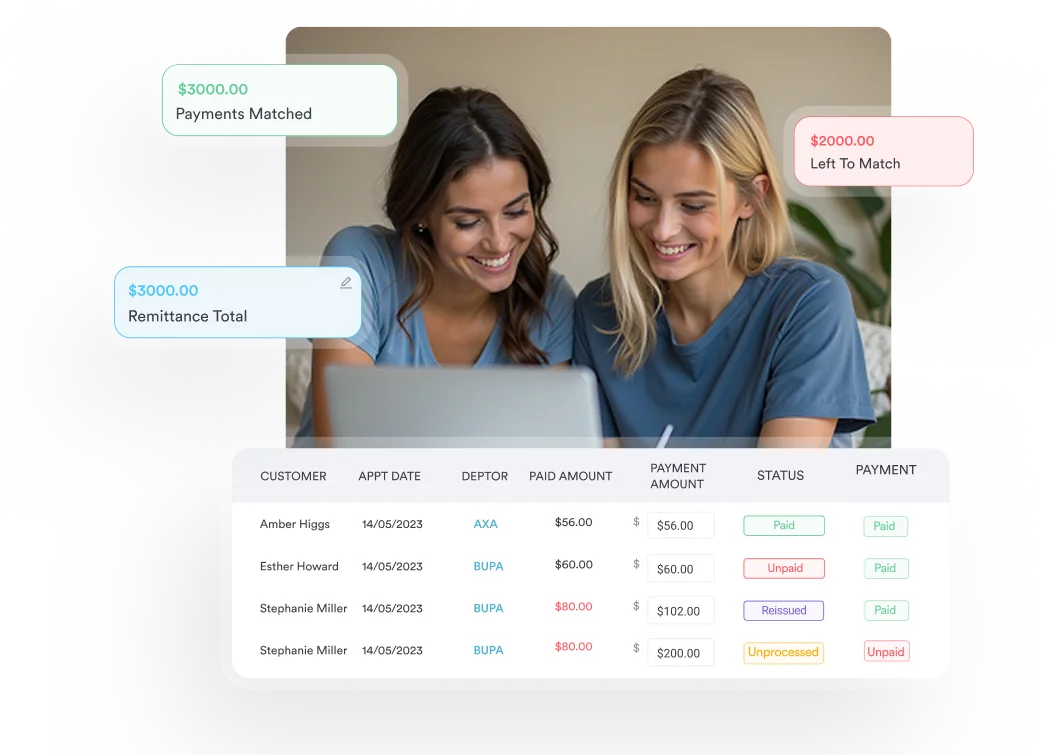

Pabau tracks prior authorizations on the patient’s case, warns when one is missing and sends claims through Claim.MD. Your team sees each ERA remittance without logging into payer portals.

64620 is a simple code to pick and an easy claim to lose. The payer decides it on paperwork: the authorization, the diagnostic block, a level-by-level note and the right imaging code.
If you change one habit, read the payer’s nerve destruction policy before the procedure is booked. With some commercial plans, that check tells you the claim won’t pay at all. Learning that up front costs far less than a CO-50 or CO-197 later.
Book a demo to see how Pabau tracks authorizations on each case and sends your 64620 claims through Claim.MD.

Coding a nerve other than the intercostal? CPT code 64640 covers neurolytic destruction of other peripheral nerves and branches.
Need a tighter authorization routine? Prior authorization process walks through each step from request to approval.
Want to understand the full claims submission workflow? 837 file submission guide explains the EDI transaction set that carries CPT claims to Medicare and commercial payers.
Building a denial recovery process for nerve procedure codes? Electronic remittance advice explained covers how 835 ERA files carry denial reason codes back from payers.
64420 is a temporary intercostal nerve block with anesthetic or steroid, single level, with +64421 for each extra level. 64620 destroys the nerve with a neurolytic agent for longer relief. The block often comes first, as the diagnostic test.
Report one unit per nerve treated. Multiple levels are reported per payer policy and the MUE for 64620, using units or separate lines with 59/XS (or RT/LT) rather than 76. Document each level separately.
Yes. Fluoroscopy (77002), CT guidance (77012) and ultrasound guidance (76942) are separately billable when performed and documented. Keep a stored image or report, and check the current NCCI edits each quarter.
It’s 10 days in the 2026 Medicare Physician Fee Schedule. Related follow-up visits in that window are included in the 64620 payment.
Not always. Cigna’s policy 0525 lists 64620 as not covered for pain conditions, including intercostal neuralgia. Other plans cover it with prior authorization, so check each plan’s policy before booking.