CCSD Code V1730: Extraoral fixation of mandible
What is CCSD code V1730? CCSD code V1730 is the UK private medical insurance cod...

Last Updated: Nov 24, 2026
64421 is the CPT code for injection(s), anesthetic agent(s) and/or steroid; intercostal nerves, each additional intercostal nerve. It is listed separately, in addition to the code for the primary procedure.
It is reported once for every intercostal nerve injected after the first in the same session, and never billed alone. CPT 64420 reports the first nerve, and each further nerve adds one unit of 64421.
Let Pabau's smart automation suggest the right codes, reduce claim denials, and keep your practice compliant—effortlessly.
Automate repetitive tasks and focus on what matters most—your patients.
Reduce coding errors and ensure compliance with the latest regulations.
Clean claims, fewer denials, and faster reimbursements.
Powerful insights and reporting to help your practice thrive.
HIPAA compliant SOC 2 certified GDPR-compliant Trusted by 4,000+ clinics worldwide

CPT code 64421 is an add-on code for each intercostal nerve injected after the first, and it is never billed without 64420.
Modifier 51 is never appended to 64421, because add-on codes are exempt from multiple-procedure reductions.
Each additional nerve treated is one unit of 64421 on the CMS-1500, and the procedure note must name every level by number.
64421 has no global period of its own (indicator ZZZ), so it follows the 0-day global period of 64420.
Pabau’s claims management software flags a 64421 line that has no 64420 primary before the claim is submitted.
CPT code 64421 is the add-on code for injecting an anesthetic or steroid at each intercostal nerve treated after the first in one session. The AMA’s CPT code set gives its official descriptor. Injection(s), anesthetic agent(s) and/or steroid; intercostal nerves, each additional intercostal nerve (List separately in addition to code for primary procedure).
The code covers needle placement, nerve localization, and drug delivery at each intercostal nerve level beyond the first. It never stands alone. The parenthetical note in the descriptor marks 64421 as an add-on code, and 64420 is its required primary procedure.
CPT 64420 is the primary code, covering the injection at the first intercostal nerve level. CPT 64421 covers every additional level treated in the same session. The two codes work as a pair and cannot be reversed or separated.
Take a session treating intercostal nerves at T5, T6, and T7. It is reported as 64420 for T5, the first level, plus two units of 64421 for T6 and T7. The 64421 units on the claim must match the additional levels documented in the procedure note, as the worked example below shows.
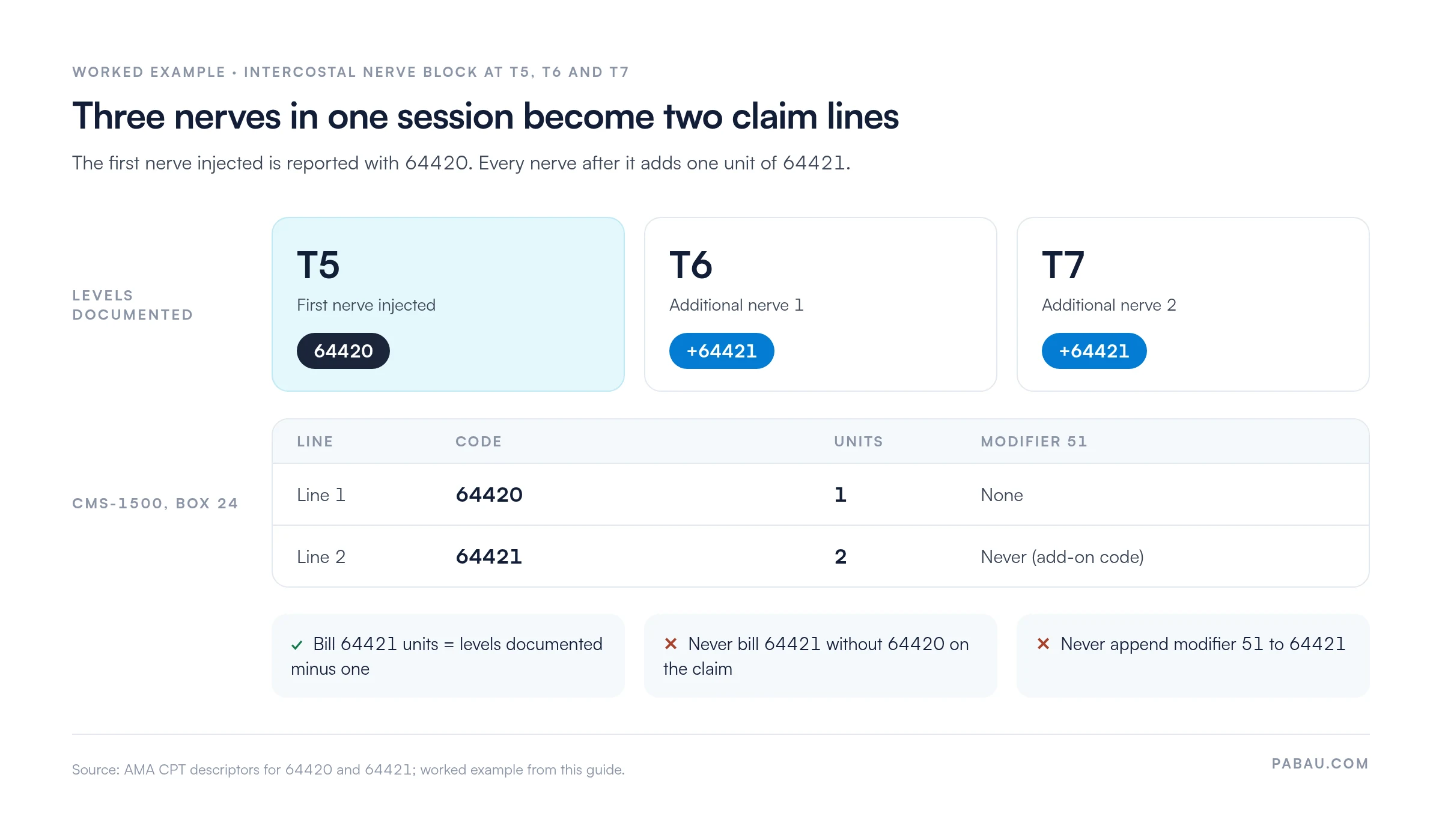
Read the rule the other way round when you audit a claim. Two 64421 units mean the note must name three intercostal levels, not two.
Knowing what 64421 bundles in, and what stays separately billable, prevents both underbilling and claim edits from NCCI bundling rules.
Imaging guidance is not bundled into CPT code 64421. When a physician uses ultrasound or fluoroscopy to guide needle placement, those services may be separately reportable. Payer policies on this vary widely.
Guidance can only be reported as a separate code when the record shows real-time image acquisition and permanent image storage. A note stating only that “ultrasound was used for guidance”, with no archived images, will not support a separate 76942 charge. Check current NCCI edits before billing guidance alongside 64421, because bundling policies are updated quarterly.
The diagnosis code must reflect the clinical reason for each additional intercostal level treated. A single ICD-10 code covering a broad pain condition is usually enough, but the procedure note must still justify why multiple levels were necessary. Use CrossCoder’s procedure-to-diagnosis crosswalk to verify LCD-compliant pairings for your MAC jurisdiction.
LCD coverage criteria differ by Medicare Administrative Contractor (MAC) jurisdiction. The ICD-10 codes above are common pairings, not a universal coverage guarantee. Confirm which codes your MAC’s Local Coverage Determination accepts before submitting, and look up any other documented condition in the ICD-10-CM code library.
Run a diagnosis-to-procedure crosswalk before submitting 64421 claims. Payers compare the reported ICD-10 code against their covered-diagnosis list for intercostal nerve blocks. A diagnosis like R07.9 (chest pain, unspecified) often triggers a medical necessity review. Document a more specific etiology whenever possible to avoid automatic denial.
Modifier selection for CPT code 64421 is a frequent source of claim errors. Because 64421 is an add-on code, modifier 51 never applies, but several other modifiers do in specific scenarios.
Vague procedure notes are a leading cause of 64421 denials. The operative or procedure note must do more than confirm that an intercostal nerve block was performed. It needs each of the elements below.
Payers may also request prior visit records showing that conservative treatment failed before authorizing the procedure. Summarizing that history in the procedure note, instead of relying on a separate chart pull, shortens the appeals cycle when a denial does happen.
Medicare pays CPT code 64421 under the Medicare Physician Fee Schedule (MPFS), which assigns work, practice expense, and malpractice RVUs to the code. Rates are updated annually and vary by geographic locality.
Use the CMS Physician Fee Schedule search tool to look up the current-year national payment amount and locality-adjusted rate for 64421.
For RVU-based financial planning, the FastRVU 2026 lookup tool lists current work, PE, and malpractice RVU values for 64421 alongside the Medicare conversion factor. As an add-on code, 64421 carries MPFS global period indicator ZZZ, so it has no global period of its own. It falls under the 0-day global period of its primary code, 64420.
Commercial payer rates for 64421 are negotiated separately and can sit well above or below Medicare allowables. Read each payer’s electronic remittance advice to see what it allowed per unit, because a payer that caps units will show it there first.
Traditional Medicare (Parts A and B) generally does not require prior authorization (PA) for CPT code 64421. Medicare Advantage plans, Medicaid managed care programs, and most commercial payers set their own PA policies, so verify with the specific plan before the procedure.
The payer’s current coverage policy is the authoritative source, and it sits alongside the wider medical billing compliance rules your practice follows.
When a PA request is required, include the following in the submission:
Most 64421 denials are preventable, and each pattern below has a fix you can apply before submission. Effective denial management starts with catching these patterns before the claim leaves the practice.
The CMS-1500 is the final step between a correctly performed procedure and a paid claim. A completed superbill pre-populates the service lines before you transfer them to the claim form. Here are the steps for a three-level session (T5, T6, T7).
Confirm that the units on Line 2 exactly match the additional levels documented in the procedure note. A mismatch between claim units and documented levels is a common trigger for post-payment audits.
For electronic claim submission, the AAPC Codify CPT lookup can confirm the current code descriptor before the 837P file is generated.
Audit your 64421 claims quarterly. Pull every claim where 64421 appears without 64420 on the same date of service, a count that should be zero. Also flag any claim where 64421 units exceed three. Sessions treating more than four intercostal levels are uncommon and may attract payer scrutiny without detailed documentation.
Most 64421 denials start in the hand-off between the procedure note and the claim. A biller re-keys the levels from the note, misses that 64420 belongs on the claim too, or carries a modifier 51 across from another line. The payer then rejects the add-on line, and the practice finds out weeks later.
Pabau, a practice management platform with built-in billing, keeps the procedure note and the claim in one record. Its claims software for practices checks eligibility, submits the claim electronically, and tracks its status through to the remittance. Because the note sits next to the claim, the biller can count the documented levels before setting the 64421 units.
The outcome is fewer add-on rejections to chase. Your team spends its time on the claims that need a coding decision, not on resubmitting a missing primary code.

Pabau’s claims management keeps the procedure note and the claim in one record, checks eligibility, and submits electronically. Your team can confirm 64420 and the 64421 units before the claim goes out.

Billing 64421 comes down to counting, and the procedure note holds the count. The claim follows it with one 64420, then one 64421 unit per additional nerve, and no modifier 51. When the units and the note disagree, correct the units to match the note before the claim goes out.
The trade-off is a few minutes of checking on every multi-level block, against weeks of appeals on the ones that slip through. A clean claim on the first pass costs far less than any appeal. Book a demo to see how Pabau puts the procedure note and the 64421 claim side by side for your billing team.

Billing a nerve block outside the intercostal nerves? CPT code 64450 covers injection of another peripheral nerve or branch, with its own unit and modifier rules.
Unfamiliar with common nerve block denial codes? Denial codes in medical billing explains the most frequent CARC codes and how to respond to each.
Want to understand the 837P claim file format? The 837 file explained breaks down the electronic claim transaction structure used for CPT code submissions.
CPT code 64421 is the add-on code covering injection of anesthetic agent(s) and/or steroid at each additional intercostal nerve level beyond the first. It includes needle placement, nerve localization, and drug delivery at that level. Imaging guidance is not included and is coded separately.
CPT 64420 is the primary code for the first intercostal nerve level injected. CPT 64421 is the add-on code reported for each additional level, and it must appear on the same claim as CPT 64420.
Yes. CPT 64421 is designated as a +add-on code in the AMA CPT codebook. It is exempt from modifier 51 and cannot be reported without its primary code, 64420. It may appear with several units on one claim, one per additional level.
Traditional Medicare Parts A and B typically do not require prior authorization for CPT 64421. Medicare Advantage, Medicaid managed care, and commercial plans often do. Always verify the specific plan’s PA requirements before performing the procedure, as policies differ by payer and region.
One unit of CPT 64421 is billed per additional intercostal nerve level treated. The unit count equals the total levels minus one, because 64420 covers the first level. Each unit must be supported by a documented level in the procedure note. Payers may also apply medically unlikely edit (MUE) limits per session, so check current CMS and commercial payer MUE tables.
CPT 64421 has no global period of its own. It carries the add-on indicator ZZZ in the Medicare Physician Fee Schedule, so it follows the 0-day global period of its primary code, 64420. Check the MPFS indicator each year, because designations can change with fee schedule updates.