



CCSD code G5100: Bypass of duodenum billing guide
CCSD code G5100 bills a bypass that leaves the duodenum in place CCSD code G5100...

Last Updated: Oct 16, 2026

CPT code 64405 covers an injection of anesthetic and/or steroid into the greater occipital nerve, on one side, at one session.
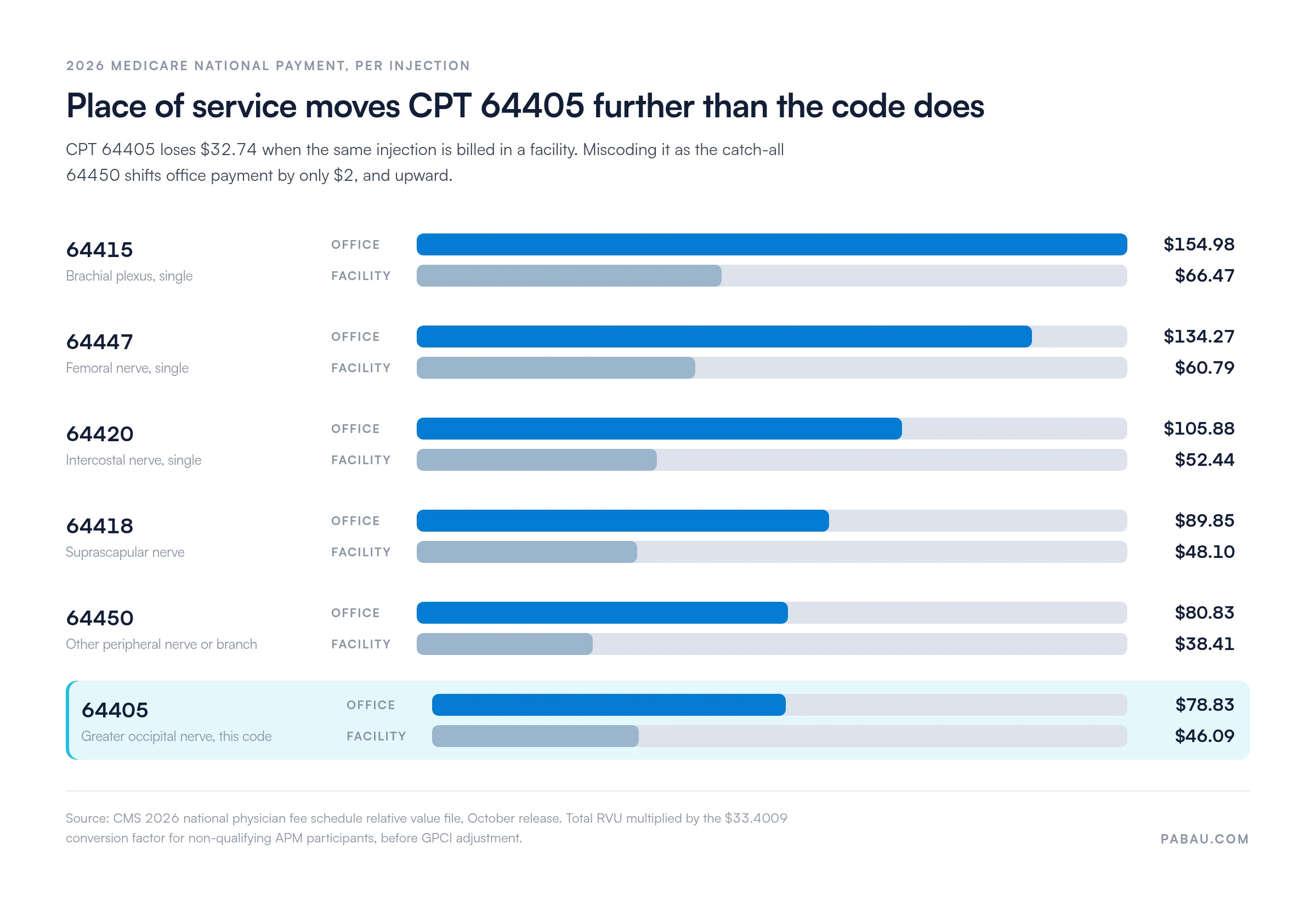
Medicare’s 2026 national payment is $78.83 in the office and $46.09 in a facility, before your locality adjustment.
Occipital neuralgia belongs to M54.81, not G54.2, and M54.81 has been valid since ICD-10-CM launched in 2015.
Modifier 50 makes a bilateral block pay 150%, but some commercial payers want LT and RT on separate lines instead.
Practice management software like Pabau pre-fills the CMS-1500 from the patient record, then routes it for eligibility checks and remittance posting.
CPT code 64405 bills a single injection of anesthetic, or anesthetic plus steroid, into the greater occipital nerve. It is one of the most common procedures in a headache practice, and one of the most reliably denied.
Three fields decide whether it pays. The diagnosis you attach, the modifier on a bilateral block, and the place-of-service code each carry their own denial.
Get all three right and the claim pays $78.83 in the office. Miss one and you are appealing a $78 line item. The 2026 rates, covered diagnoses, and modifier rules below come from the CMS fee schedule relative value file.
The American Medical Association’s CPT code set describes 64405 as: Injection(s), anesthetic agent(s) and/or steroid; greater occipital nerve.
That wording changed in 2020, and plenty of billing references still quote the retired version, “Injection, anesthetic agent; greater occipital nerve”. The difference is practical. Steroid now sits inside the code, so mixing a corticosteroid into the injectate does not earn a second line.
The target is a sensory branch of the C2 spinal nerve that supplies the back of the scalp. Most clinicians inject at the occipital protuberance, by landmark, without imaging.
One boundary is worth stating plainly. CPT 64405 and CPT 64450 are not interchangeable. The 64405 descriptor names the greater occipital nerve. CPT 64450 is the catch-all for peripheral nerves with no code of their own. Picking the right one still leaves the coverage question open.
Coverage turns on documented failure of conservative care, not on the diagnosis alone. Most local coverage determinations, including CMS LCD L33933 for peripheral nerve blocks, want medication trials and their outcome in the record first.
These are the indications payers accept most consistently:
Two requirements sit behind the diagnosis. Commercial payers often want prior authorization for this procedure. MAC policies also differ by jurisdiction, so read yours rather than assuming a neighboring state’s rule applies.
Verify your MAC’s LCD before billing CPT 64405 for migraine. Some MACs will not approve the block unless the note documents the migraine as refractory to two preventive medications. Missing that line is the fastest route to a medical necessity denial.
The 2026 national payment for CPT 64405 is $78.83 in a non-facility setting and $46.09 in a facility. Both figures use the $33.4009 conversion factor, which applies to practices outside a qualifying alternative payment model.
2026 is the first year with two conversion factors. Medicare pays qualifying APM participants on $33.5675, which lifts the same code to $79.22 in the office and $46.32 in a facility.
Both columns move again once your locality’s Geographic Practice Cost Index is applied. Run your own query in the CMS Physician Fee Schedule Look-Up Tool before quoting a figure to a patient or a payer.
The office rate is higher because practice expense RVUs cover the tray, the drug handling, and the staff time. In a facility, the ASC or hospital bills that overhead on its own claim. The physician line then drops to the professional work.
Medicare’s formula is total RVU multiplied by the conversion factor, then adjusted by your GPCI. For CPT 64405 the components look like this:
Work and malpractice hold steady across settings. Practice expense is the piece that moves, from 1.23 in the office down to 0.25 in a facility. CMS republishes these values quarterly on its relative value files page, so pull the current release before a contract renewal.
A place-of-service error on a 64405 claim costs roughly 16 times more than the 64405 versus 64450 mix-up. The RVUs above are only half the calculation, because the claim also has to say where the block happened.
Billing the office rate for a block performed in an ASC swings the line by $32.74. Coding 64450 instead of 64405 in the office swings it by $2.
And that $2 runs the other way. CPT 64450 carries a slightly higher non-facility total RVU, so the catch-all pays $80.83 rather than $78.83. A revenue review will not flag a $2 difference, which is how the substitution survives for years.
The place-of-service code on the claim decides which rate applies:
The audit exposure runs one way. A block performed in an ASC but submitted with POS 11 pays the office rate, and the overpayment comes back on review. Pull the site of service from the scheduling record, not from the provider’s usual location.
Occipital neuralgia is M54.81. That code has been valid since ICD-10-CM went live on October 1, 2015. Treat it as the first choice, not a fallback. G54.2 covers cervical root disorders and radiculopathy, and it carries no occipital neuralgia inclusion note.
Submitting without a covered diagnosis is the single most common cause of denial on this code. The pairings below are broadly accepted under LCD L33933, and commercial policies vary from them.
R51.9 deserves one extra warning. It passes the claim edit, so it looks harmless on the way out. An unspecified headache with an interventional procedure attached is exactly the pattern a medical review picks up.
CPT 64405 carries a bilateral surgery indicator of 1 in the Medicare fee schedule. That makes a bilateral block payable at 150% of the allowed amount. On the 2026 national office rate, that comes to $118.24 for one session.
Medicare wants that on a single line with modifier 50. Several commercial plans reject the single line and want two, one with LT and one with RT. Confirm the rule payer by payer, because the same claim fails both ways round.
Take a patient with occipital neuralgia who has both greater occipital nerves injected at one office visit.
For Medicare, that is one charge line. Enter 64405 with modifier 50, one unit, M54.81 in the diagnosis slot, and place of service 11. The allowed amount comes to $118.24.
For a plan that rejects modifier 50, split the same session across two lines. Line one is 64405 with LT, line two is 64405 with RT, one unit each. Check how that plan prices the second line, because its bilateral reduction still applies.
Ultrasound guidance goes on a line of its own as 76942. CPT 64405 does not include it.
A payable note proves three things. The block was indicated, it was performed as coded, and the patient was reassessed afterward.
Every modifier in the table above rests on it. Auditors at several MACs name insufficient documentation as the leading denial reason on this code.
One item catches people out. Several payers cap the number of blocks per year, commonly between three and six, so check your policy. A note that reads identically to the last four visits makes the case for the fifth harder to argue.
CPT 64405 sits in the 64400 to 64489 range. Each named nerve there gets its own code, and 64450 mops up the rest. That is why the note has to name the nerve. Reaching for a neighbor is an easy mistake, because the technique looks similar and the descriptors read alike.
Each of those codes carries its own RVUs and its own payer rules. The CPT code library works through them one at a time. Check the current descriptor in AAPC’s Codify CPT lookup before you substitute one for another.
Named nerves elsewhere in the 64400 to 64489 range follow the same pattern as the rows above. A single sciatic nerve injection carries its own code, 64445. A plantar common digital nerve injection for Morton’s neuroma bills under 64455.
CPT 64405 and CPT 64450 should never appear for the same nerve on the same date. NCCI edits bundle them, and modifier 59 clears the edit only when the note shows two distinct nerves were injected.
Imaging guidance follows a different rule further along the range. CPT 64454 for genicular nerve branches bundles guidance into the code, so 76942 does not go on a separate line.
A clean 64405 claim reaches payment in five steps. The code choice above is only the first of them. Each step has its own failure point, and each failure point produces a different denial.
The pattern is worth noticing. Four of those five failure points happen before the claim leaves the building, which is where they are cheapest to fix.
Five questions, asked in order, catch most of what comes back denied on this code:
That list does not call for new software. It calls for the answers to sit in the record before anyone builds the claim.
Run a quarterly audit of your CPT 64405 claims using clearinghouse remittance data. Filter for CO-50, not medically necessary, and CO-4, modifier missing or inconsistent. Those two codes account for most of the preventable denials on this code.
A pain practice running several nerve blocks a day rebuilds the same claim from scratch every time. The code is in the note, the diagnosis is in the problem list, the site of service is on the schedule. Someone still retypes all three into a claim form.
Practice management software like Pabau closes that loop. Its software for pain practices pre-fills the CMS-1500 straight from the patient record. The CPT code attached to the service lands on the charge line. Diagnosis codes come across from the recorded problem list.
Searchable ICD-10-CM and CPT libraries sit beside those fields, refreshed with each official release. Pabau also checks that the claim’s required fields are complete, including membership and authorization numbers, before the send button unlocks.
From there the claim routes through Claim.MD, our US clearinghouse partner. That covers real-time eligibility checks, CMS-1500 submission, claim-status tracking, and 835 remittance posting. Your team reconciles occipital nerve block payments in the same system that booked the appointment.

Pabau pre-fills the CMS-1500 from the patient record and checks the required fields are complete. The claim then routes through Claim.MD for eligibility checks and remittance posting.

CPT code 64405 is a small line item that behaves like a large one. At $78.83 an injection, a denial costs more in staff time than the claim is worth. So the fix belongs upstream of the claim, not in the appeal.
If you change one field after reading this, make it place of service. It moves the payment by $32.74, and it is the easiest of the three to get wrong. Worse, it surfaces on audit rather than on a remittance, which makes it expensive twice.
The rest is habit. Pull the diagnosis from the note instead of the shortlist. Record laterality while the patient is still in the chair, and read your 835s against the fee schedule. Book a demo to see how Pabau builds a 64405 claim from the record your team has already filled in.

Not sure whether the named nerve code applies? CPT code 64450 sets out when the catch-all peripheral nerve injection is the correct choice.
Need the diagnosis side of the claim? ICD-10 code M54.81 covers the documentation that supports an occipital neuralgia diagnosis.
Want to know how claim errors get resolved? Denial management in healthcare covers the workflows practices use to appeal, resubmit, and track payer decisions.
Checking coverage before the occipital block appointment? Insurance eligibility verification explains the pre-visit checks that catch a lapsed policy before the procedure.
Curious what the clearinghouse does with your claim? Medical claims clearinghouse overview explains how claims are validated and routed to payers.
Yes, where the state scope of practice allows the procedure. Billed under the nurse practitioner’s own NPI, Medicare pays 85% of the fee schedule amount. That makes the 2026 office rate about $67. Billed incident to a supervising physician, the claim pays the full amount, but you have to meet and document the supervision rules.
The code covers the injection, not the drug. In the office, the corticosteroid is reported on its own line with a HCPCS J code. J1030 covers 40 mg of methylprednisolone acetate. Most payers treat the local anesthetic as a bundled supply, so it gets no line of its own. In a facility, the site bills the drug on its own claim.
Yes. CPT 64405 carries a multiple procedure indicator of 2 in the Medicare fee schedule. When it is billed alongside another reduction-eligible procedure on the same day, the payer ranks the lines by allowed amount. The highest line pays in full and the rest drop to 50%.
The code is the same either way. What changes is the note. A diagnostic block tests whether the greater occipital nerve is the pain source. The record then needs pain scores before and after the injection. A therapeutic block treats a confirmed diagnosis, so it needs the treatment history instead.



