CCSD code G5100: Bypass of duodenum billing guide
CCSD code G5100 bills a bypass that leaves the duodenum in place CCSD code G5100...

Last Updated: Oct 16, 2026
CPT code 63045 is the billable procedure code for a laminectomy, facetectomy and foraminotomy at a single cervical vertebral segment. It covers decompression of the spinal cord, cauda equina and/or nerve root(s), most often for spinal or lateral recess stenosis. Excision of a herniated disc is not part of this code.
Spine surgery practices see this code denied when the operative note leaves the spinal level unclear. Denials also follow when 63045 is confused with the disc-excision codes 63020 and 63030. Two facts from the operative report settle the choice. Those are the primary surgical technique and the vertebral segment treated.

CPT code 63045 covers laminectomy, facetectomy and foraminotomy at a single cervical vertebral segment. It includes decompression of the spinal cord, cauda equina and/or nerve root(s).
Disc excision is not part of 63045. A cervical laminotomy performed to excise a herniated disc is reported with CPT 63020 instead.
The code applies to the cervical segment only. Thoracic decompression uses CPT 63046 and lumbar decompression uses CPT 63047.
Add-on code 63048 reports each additional vertebral segment decompressed. CPT 63052 and 63053 are separate add-ons for lumbar decompression during posterior interbody arthrodesis.
Pabau’s claims management software connects operative documentation directly to CPT code capture, reducing manual re-entry errors on spine procedure claims.
The American Medical Association (AMA) maintains the descriptor for CPT code 63045. It reads as follows.
Laminectomy, facetectomy and foraminotomy (unilateral or bilateral with decompression of spinal cord, cauda equina and/or nerve root[s], [eg, spinal or lateral recess stenosis]), single vertebral segment; cervical.
Reproduce that wording accurately in coding software. Any paraphrase can shift the billing meaning.
The procedure targets cervical spinal cord or nerve root compression, most often from spinal or lateral recess stenosis. The surgeon removes part of the lamina, resects part or all of the facet joint, and enlarges the neural foramen to relieve the compression. Those three techniques are reported together under one code for each vertebral segment treated.
Excision of a herniated intervertebral disc is not part of this descriptor. Where the surgeon performs a laminotomy to remove herniated disc material at a cervical interspace, the procedure is reported with CPT 63020, not 63045.
The surgical approach narrows the choice further. 63045 is the posterior route. An anterior procedure that resects the cervical vertebral body to decompress the cord is reported with 63081, not 63045.
The reason for the laminectomy also drives code selection. A laminectomy performed only to place an epidural plate or paddle neurostimulator electrode is reported with 63655.
Facetectomy and foraminotomy are inclusive components of 63045. Neither is billed separately when it is performed at the same vertebral segment.
The 63045-63048 laminectomy family uses the spinal level as the primary differentiator. CPT 63045 is the cervical code, CPT 63046 applies to the thoracic segment, and CPT 63047 covers the lumbar segment. Selecting the wrong level is the most common denial trigger for this code family.
Each code carries a distinct RVU weight and Medicare fee. A lumbar procedure billed as 63045 generates a claim denial and a potential compliance flag.
The operative report must state the spinal level explicitly. Coders cannot infer the level from a diagnosis code alone. An operative note documenting a C5 laminectomy with facetectomy and foraminotomy maps to 63045. The same procedure at L4 maps to 63047. Any ambiguity in the operative note should prompt a query to the surgeon before billing.
CPT 63020, 63030 and 63045 sit in two separate families that can address the same spinal level. Which one applies depends on the operative technique and the pathology it treats.
CPT 63020 reports a laminotomy, or hemilaminectomy, with decompression of nerve root(s) at one cervical interspace. Its descriptor includes partial facetectomy, foraminotomy and/or excision of a herniated intervertebral disc. CPT 63030 is the lumbar equivalent.
CPT 63045 carries no disc excision in its descriptor. It reports laminectomy, facetectomy and foraminotomy at a single cervical vertebral segment, and the usual indication is spinal or lateral recess stenosis.
The distinction matters because payers with local coverage determinations may audit for diagnosis-code alignment.
The practical test is the primary operative technique and the documented pathology. A laminotomy performed to remove herniated disc material at a cervical interspace is 63020. A laminectomy with facetectomy and foraminotomy performed to decompress a stenotic cervical segment is 63045.
Where a surgeon performs both a laminectomy for stenosis and a discectomy at the same cervical level, only one code is reported. NCCI edits bundle the decompression codes at the same spinal level, so billing 63020 and 63045 together for one level triggers a denial. Choose the code that matches the technique the operative report describes as primary.
Verify the primary operative technique and the documented pathology before selecting between these codes. A cervical stenosis case treated with laminectomy, facetectomy and foraminotomy bills 63045 alone. A cervical disc herniation treated by laminotomy and discectomy bills 63020 alone. The chart below runs both decisions in order, from the technique in the note to the code on the claim.
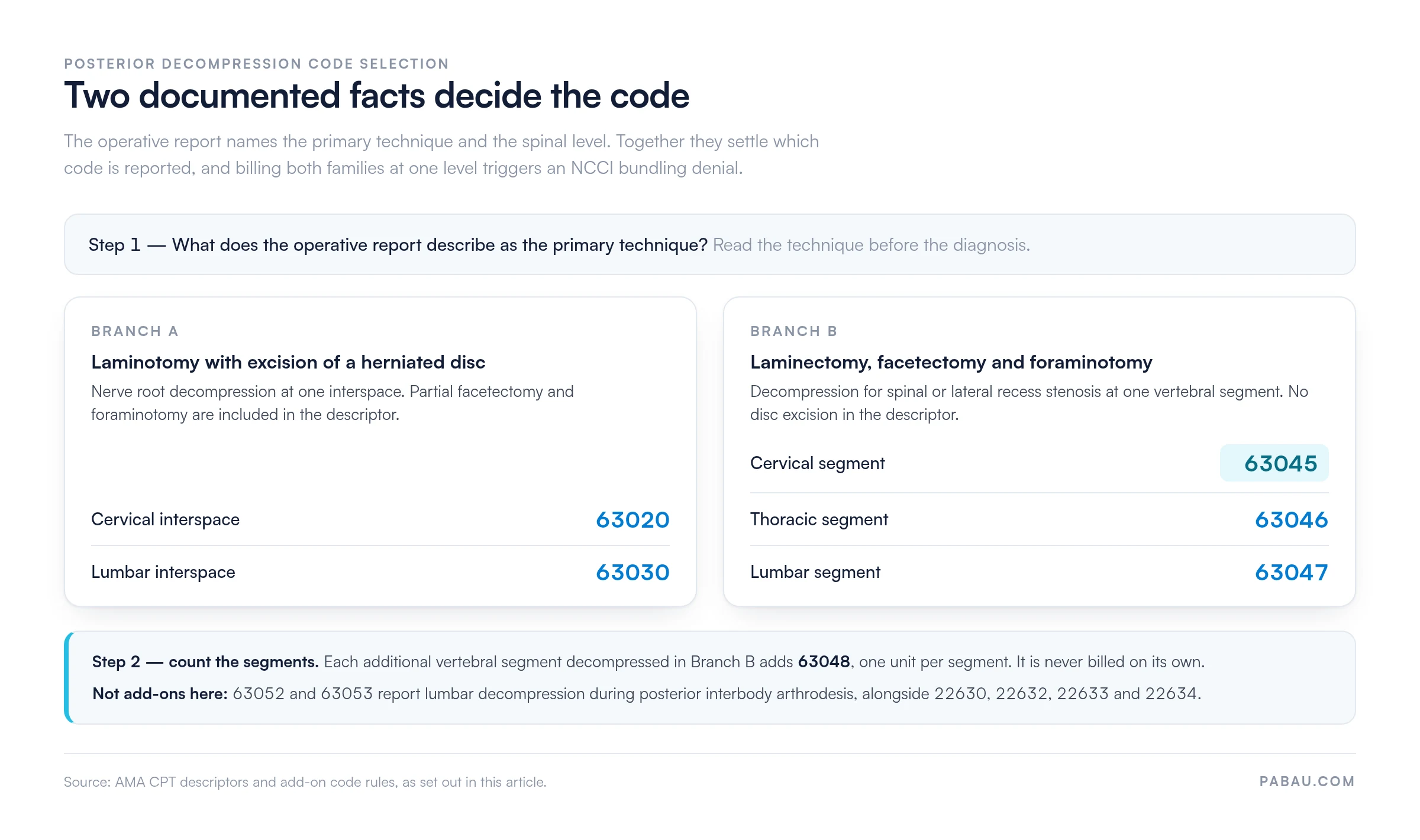
CPT 63048 is the add-on code for each additional vertebral segment decompressed. It is reported alongside 63045, 63046, or 63047 and cannot be billed as a standalone code. The sequence on the claim matters: The primary code goes first, then 63048 is listed once per additional segment.
CPT 63052 and 63053 are not add-on codes for 63045. They report laminectomy, facetectomy, or foraminotomy carried out during a posterior interbody arthrodesis of the lumbar spine. CPT 63052 covers a single vertebral segment and CPT 63053 covers each additional segment. Both are reported with the lumbar arthrodesis codes 22630, 22632, 22633 and 22634.
Document every vertebral segment by name in the operative report before billing add-on codes. If the surgeon decompresses C5 and C6 in the same session, the note must name both segments. Payers audit add-on code claims against the segment count in the operative report. A vague note such as ‘two levels decompressed’, with no named vertebral segments, is a reliable denial trigger.
Modifier selection for CPT code 63045 follows standard surgical modifier rules, with one exception. The descriptor already reads unilateral or bilateral, so modifier 50 does not apply to this code. Incorrect modifier usage, or omitting a required modifier, generates automatic payer-side edits. The table below covers the modifiers most commonly associated with this code.
Medicare reimbursement for CPT code 63045 is calculated using the Medicare Physician Fee Schedule (MPFS). Rates vary by geographic region through the Geographic Practice Cost Index (GPCI) adjustment. The CMS Physician Fee Schedule lookup tool provides current national and locality-specific rates. Practices submitting 63045 claims through practice management software like Pabau reach thousands of US payers via the Claim.MD clearinghouse. Eligibility verification and ERA receipt run in the same workflow.
National approximate RVU components for CPT 63045 (verify current figures via FastRVU 2026 RVU lookup before billing):
Spine surgery practices should pull locality-adjusted rates directly from the CMS MPFS Look-Up Tool. National estimates can differ from locality rates by hundreds of dollars per procedure.
CPT code 63045 must be paired with an ICD-10-CM diagnosis code that supports medical necessity for cervical posterior decompression. The diagnosis should reflect the specific pathology documented in the operative report, not just the anatomical level. Confirm the exact wording of a diagnosis in the ICD-10-CM code index before it reaches the claim.
Use the CrossCoder CPT-to-ICD-10 crosswalk to validate pairings against local coverage determinations.
Code to the highest specificity available. Use the M50.x subcategories to specify the cervical region (upper, mid, or lower) when the operative report names a specific vertebral level. Payers reviewing cervical spine claims match the ICD-10 specificity against the operative note. A vague diagnosis code on a detailed operative report increases audit risk.
The operative report is the primary documentation source for CPT code 63045. Each element below maps directly to a denial risk. Missing any one of them gives a claims reviewer grounds to reject the claim. Operative documentation should be finalized before claim submission, not amended after the fact.
Most denials on CPT code 63045 fall into six categories. Knowing which error type your practice generates most often is the fastest way to improve clean-claim rates. For strategies on denial management in healthcare, track denial reason codes at the CPT level rather than globally. That reveals whether the problem is coding selection, documentation, modifier usage, or eligibility.
Across all six, the pattern is consistent: The operative report is always the root cause. Coding accuracy cannot exceed documentation quality.
A coding reference gives you the descriptor and stops there. The operative note still has to reach the claim, and in most practices someone retypes it. Pabau’s claims management software links clinical documentation directly to CPT code capture, so the surgical team’s notes feed the billing workflow as written.
That removes one of the most common transcription error points on complex procedures like CPT code 63045. The coder needs the spinal level, the segment count, and the technique details confirmed before selecting the code.

Denial reporting adds a second layer. Practices using Pabau can surface denial trends by CPT code, rather than reviewing rejections one claim at a time. That shows how often 63045 denies, and for which reason codes.
That data goes back upstream to the documentation workflow, rather than sitting in the clearinghouse queue. Pabau routes claims through Claim.MD to thousands of US payers. Built-in CPT and ICD-10 catalogs validate code pairings before submission.
Spine surgery practices can also capture CPT codes at the point of service, in the treatment room where the coding really starts. Book a demo to see how Pabau handles the full billing cycle for surgical specialties.

Pabau’s claims management links the operative report to CPT code capture, so the spinal level and segment count reach the claim without re-entry. Denial trends are reported by code, so you can fix the documentation that causes them.

CPT code 63045 is a straightforward code to select, once two facts are confirmed. The operative report has to state the cervical level and the number of vertebral segments decompressed. Assume either one and the claim is exposed.
So the fix sits upstream of the coder. Query the surgeon on a vague operative note before the claim goes out, rather than appealing the denial six weeks later. That single habit removes most of the denial patterns in this guide.
Book a demo to see how Pabau carries the operative note through to a clean 63045 claim.

Need to understand what clean claims look like before submission? Clean claim requirements in medical billing covers the elements every claim needs to avoid automatic rejections.
Looking for guidance on CPT code crosswalks to ICD-10? 837 electronic claim file structure explains how CPT and ICD-10 codes travel together through the clearinghouse to the payer.
Want to verify payer credentialing before submitting spine claims? Getting credentialed with insurance companies outlines the steps to ensure your surgeons are enrolled with each payer before billing.
CPT code 63045 is the billing code for a laminectomy, facetectomy and foraminotomy performed at a single cervical vertebral segment. It covers decompression of the spinal cord, cauda equina and/or nerve root(s), typically for spinal or lateral recess stenosis. Excision of a herniated disc is not part of the descriptor.
CPT 63020 is a cervical laminotomy code used when the surgeon decompresses a nerve root and excises a herniated intervertebral disc at one interspace. CPT 63045 is a cervical laminectomy, facetectomy and foraminotomy code used for stenosis decompression at a single vertebral segment. They are alternative codes for the same level, so billing both for one level triggers a bundling edit.
Use CPT 63045 for a laminectomy, facetectomy and foraminotomy at a cervical vertebral segment. Use CPT 63047 for the same procedure at a lumbar segment, and CPT 63046 for a thoracic segment. The operative report must name the vertebral segment treated. Never select between these codes on the diagnosis code alone.
CPT 63048 is the add-on code for each additional vertebral segment decompressed with CPT 63045, and it cannot be billed on its own. CPT 63052 and 63053 are not add-ons for 63045. They report lumbar decompression performed during a posterior interbody arthrodesis, alongside 22630, 22632, 22633 or 22634.
Yes. When the surgeon decompresses a cervical segment (63045) and a lumbar segment (63047) in the same operative session, both may be billed. Modifier 51 typically applies to the lower-valued procedure. The operative report must document each level separately, with distinct clinical justification.
Commonly paired ICD-10-CM codes include M50.12 (cervical disc displacement with radiculopathy, mid-cervical region) and M47.22 (other spondylosis with radiculopathy, cervical region). M48.02 (spinal stenosis, cervical region) and M50.02 (cervical disc disorder with myelopathy) are also common. Always code to the highest specificity the documentation supports.