CPT Code 25210: Excision of a single carpal bone
CPT Code 25210: Official descriptor and quick-reference data CPT Code 25210 is a...

Last Updated: Nov 26, 2026
61796 is the CPT code for stereotactic radiosurgery (particle beam, gamma ray, or linear accelerator); 1 simple cranial lesion. It covers the first lesion in a course of treatment that CPT classes as simple rather than complex.
Choosing between 61796 and 61798, and between 61797 and 61799 for additional lesions, depends on the lesion's size, type and distance from critical structures. Getting that choice right before the claim is submitted avoids denials and rework.
Let Pabau's smart automation suggest the right codes, reduce claim denials, and keep your practice compliant—effortlessly.
Automate repetitive tasks and focus on what matters most—your patients.
Reduce coding errors and ensure compliance with the latest regulations.
Clean claims, fewer denials, and faster reimbursements.
Powerful insights and reporting to help your practice thrive.
HIPAA compliant SOC 2 certified GDPR-compliant Trusted by 4,000+ clinics worldwide

CPT code 61796 reports stereotactic radiosurgery of one simple cranial lesion, and add-on 61797 covers each additional simple lesion in the same course.
A lesion of 3.5 cm or more is complex and takes 61798. So is a lesion inside the brainstem or within 5 mm of the optic pathway, and every schwannoma, AVM and pituitary tumor.
Medicare pays 61796 as a global surgical service with a 90-day global period. The physician bills it without modifier 26, and the facility bills delivery on its own claim.
HCPCS codes G0173 and G0251 were deleted in 2015, so a charge master that still lists them needs updating to 77372 or 77373.
In Pabau’s practice management software, the auth code, dates and sessions sit on each SRS case, with a warning when an authorization is missing.
CPT code 61796 reports stereotactic radiosurgery (SRS) of one simple cranial lesion, delivered by particle beam, gamma ray or linear accelerator. The official descriptor in the AMA’s CPT code set reads: “Stereotactic radiosurgery (particle beam, gamma ray, or linear accelerator); 1 simple cranial lesion.” The code sits in the 61796-61800 stereotactic radiosurgery range of the nervous system surgery section.
Three elements define what the code covers. The treatment must be SRS, a high-dose technique that uses three-dimensional stereotactic targeting. Any listed platform qualifies, so Gamma Knife and linear accelerator systems both use the same code. The lesion must also meet CPT’s definition of simple, which the 61796 vs 61798 section below sets out.
CPT code 61796 is used when a physician treats one intracranial target with SRS and that target meets CPT’s definition of a simple lesion. The diagnosis alone doesn’t settle the code, because the same tumor can be simple or complex depending on its size and location. The common indications are:
Some common SRS diagnoses never qualify for 61796. CPT classes schwannomas (including acoustic neuroma), arteriovenous malformations (AVMs), pituitary tumors, glomus tumors and pineal region tumors as complex, so they take 61798. The record must also explain why radiosurgery was chosen over conventional radiation.
Local coverage determinations (LCDs) from Medicare Administrative Contractors (MACs) such as Noridian, CGS, Palmetto GBA and NGS set the medical necessity criteria in each jurisdiction. Those criteria decide which diagnoses support 61796 reimbursement there.
The ICD-10-CM diagnosis on the claim is how payers judge medical necessity for CPT code 61796. A diagnosis outside the payer’s covered list for SRS leads straight to a medical necessity denial.
Always check the accepted ICD-10 list against your MAC’s LCD, because covered diagnoses vary by jurisdiction. Reporting C79.31 when imaging shows meningeal rather than parenchymal disease is a specificity error that payers flag on audit. C79.32 fits that case.
Diagnoses such as D33.3 (acoustic neuroma or vestibular schwannoma), D35.2 (pituitary adenoma) and Q28.2 (cerebral AVM) point to 61798 instead. CPT classes those lesions as complex whatever their size.
CPT 61796 is the primary code for the first simple cranial lesion in a course of SRS. CPT 61797 is the add-on for each additional simple lesion in that course. The add-on can’t be reported without a primary SRS code. CPT also caps 61797 at four units for the entire course of treatment, whatever the number of lesions.
A patient treated for three simple brain metastases in one course generates one unit of 61796 plus two units of 61797. Each lesion needs its own documentation showing that it meets the simple criteria.
The most consequential coding decision on an SRS claim is whether the lesion is simple (61796) or complex (61798). CPT defines a complex lesion by three tests, and a lesion that meets none of them is simple. The chart below runs a lesion through those tests in order.
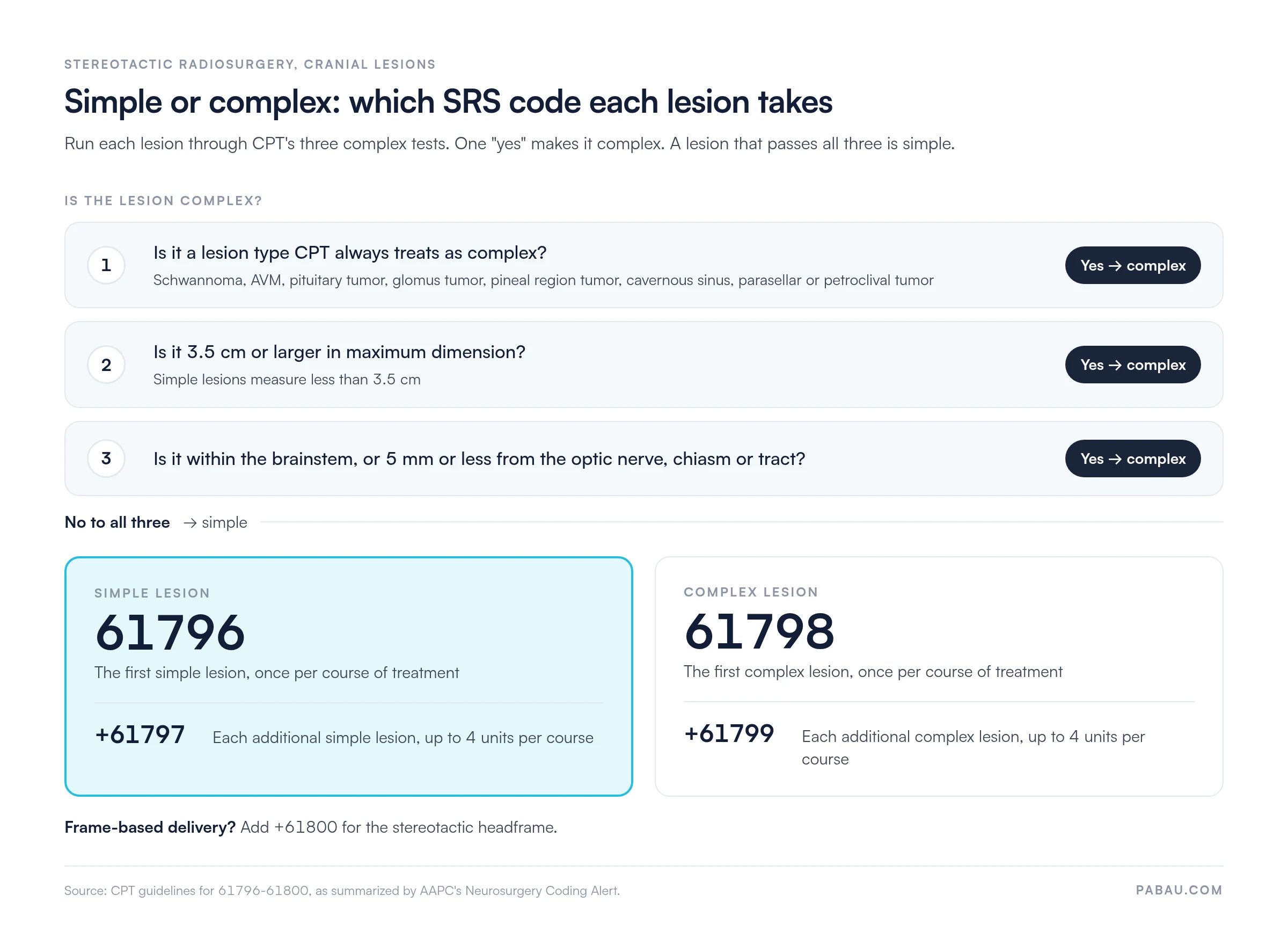
These thresholds come from CPT itself, so they hold across payers. The treatment-planning report should state the lesion’s maximum dimension and its distance from the optic apparatus and brainstem. That attestation is a documentation requirement, and coders shouldn’t infer simplicity from the imaging alone.
CPT code 61796 is one of five codes in the cranial SRS family. Knowing how they fit together prevents both underbilling and unbundling errors. Each neighbor has its own page in Pabau’s CPT code reference library, with the descriptor and billing rules side by side.
CPT 61800 covers application of a stereotactic headframe when a frame-based technique is used. It is an add-on, so it is reported with 61796 or 61798 rather than on its own. Linear accelerator treatment is usually frameless, so 61800 mostly appears on Gamma Knife cases.
Check whether your MAC LCD specifies separate coverage criteria for Gamma Knife vs LINAC-based SRS claims. A handful of local determinations apply different documentation requirements depending on the delivery platform used, even when the CPT code is identical.
HCPCS codes G0173 and G0251 described linear accelerator SRS delivery, and both were deleted effective January 1, 2015, according to AAPC’s deleted-code record. They covered the delivery of treatment, never the physician’s radiosurgery service that 61796 reports.
Medicare does not require G0173 or G0251, and a claim carrying either one rejects as an invalid code. Facilities now report single-session LINAC delivery with 77372 and fractionated delivery with 77373. If an older charge master or payer grid still lists the G-codes, update it before the next SRS claim goes out.
Several billing rules govern how CPT code 61796 is submitted. A mistake on any one of them turns a clean claim into a denial or an overpayment recovery.
SRS is almost always performed in a hospital outpatient or other facility setting, and POS 22 (on-campus outpatient hospital) is the most common designation. The physician bills 61796 as a global professional service on their own claim. The facility bills its equipment, staff and treatment delivery separately, on its own claim.
CPT 61796 may not be reported with the radiation treatment delivery codes 77371-77373 on the same date of service, because NCCI bundling edits apply. NCCI edits update quarterly, so confirm the current version before assuming a code pair is allowed. Delivery belongs on the facility’s claim.
US practices using Pabau send claims to payers through the Claim.MD clearinghouse and run eligibility checks before the visit. Checking each code pair against the current NCCI edit file remains part of the coder’s review.

SRS audits test whether the medical record supports every element of the code descriptor. For 61796, that means the record has to prove the lesion is simple, as well as treated.
Coders reviewing records for a clean claim should confirm that the planning report addresses lesion simplicity in its own words. A report that places a lesion 4 mm from the optic chiasm contradicts a 61796 claim, and that conflict will surface on audit.
Prior authorization for CPT code 61796 is required by most commercial insurers and Medicare Advantage plans, but not by traditional Medicare fee-for-service (FFS). Practices that apply FFS workflows to Medicare Advantage patients skip the authorization step and generate avoidable denials.
A typical SRS prior authorization package includes:
Submit the request as soon as the treatment decision is made, since payer review for SRS commonly takes 5-10 business days. Treating without an approved authorization is a denial reason on its own, whatever the clinical merits. Running insurance eligibility verification at scheduling shows whether the plan requires authorization before the patient arrives.
Medicare reimbursement for CPT code 61796 is set annually by the Medicare Physician Fee Schedule (MPFS). CMS publishes updated RVU values each November for the following calendar year. The figures below reflect the structure rather than a specific dollar amount, which you should verify against the current year’s MPFS.
Use the CMS Physician Fee Schedule lookup tool to retrieve the current-year facility and non-facility RVU values and national allowed amounts for 61796. Geographic practice cost indices (GPCIs) adjust these figures by locality, so the allowed amount in a high-cost metro area differs from a rural one.
For component values, the FastRVU lookup shows current work, practice expense and malpractice RVUs for 61796 alongside the MPFS conversion factor. Good revenue cycle management captures these geographic adjustments at charge entry rather than during accounts-receivable review.
Seven denial patterns come up repeatedly on 61796 claims. Front-end controls prevent each one.
A denial management workflow that tracks 61796 denials by reason code shows billing managers which of these patterns costs their practice the most.
In many neurosurgery and radiation oncology practices, an SRS case lives in several places. The authorization sits in a payer portal, the planning report in the treatment system, and the claim in a separate billing tool. Each handoff is a chance for a missing auth number or a retired code to reach the payer.
Pabau keeps the case in one record. The auth code, approved dates and sessions are tracked on the case, and staff see a warning when an authorization is missing. Claims go out through Claim.MD, eligibility checks run before the visit, and ERA remittances post back against each claim, all within Pabau’s end-to-end claims management.
The result is fewer SRS claims held up by a missing authorization, and less time chasing remittances. The imaging report, planning report and physician attestation stay on the patient record, ready for medical billing compliance reviews.

Pabau tracks authorization codes, dates and sessions on each SRS case and sends US claims through Claim.MD. Your billing team sees a missing authorization before the claim goes out.

Code 61796 only after the lesion has passed CPT’s three complex tests, and record each test in the planning report. That habit protects the claim at its weakest point, the simple-versus-complex call.
Then fix the billing setup around the code. Bill 61796 as a global service without modifier 26, TC or 62, and retire G0173 and G0251 from the charge master.
The trade-off is a few extra minutes of documentation per lesion, against a corrected claim and a delayed payment later.
Book a demo to see how Pabau tracks SRS authorizations and claims for neurosurgery and radiation oncology practices.

Coding image-guided cranial surgery too? CPT code 61781 covers stereotactic computer-assisted navigation for cranial intradural procedures.
Treating a meningioma surgically instead? CPT code 61512 covers craniotomy for excision of a supratentorial meningioma.
Seeing repeat denials you cannot categorize? Denial codes in medical billing explains how to read CARC and RARC codes on remittance advice so you can target the right fix.
Want a faster ERA workflow? Electronic remittance advice covers how 835 ERA files map payer adjudication results back to individual 61796 claims and speed up posting.
CPT code 61796 reports stereotactic radiosurgery of one simple cranial lesion, delivered by particle beam, gamma ray or linear accelerator. It is the primary code for simple lesions in the 61796-61800 SRS family. The physician bills it as a global professional service without modifier 26, and the facility bills its delivery separately.
Use CPT 61796 when the lesion is simple. That means under 3.5 cm in maximum dimension, outside the brainstem, and more than 5 mm from the optic pathway. Use CPT 61798 when the lesion fails any of those tests. Schwannomas, AVMs, pituitary tumors, glomus tumors, pineal region tumors and cavernous sinus, parasellar or petroclival tumors are always complex.
Prior authorization for CPT 61796 is required by most commercial insurers and Medicare Advantage plans, but not by traditional Medicare FFS. Treating without authorization from a plan that requires it is a denial reason on its own, whatever the clinical merits of the procedure.
Yes. CPT 61796 covers the first simple lesion in a course of SRS, and 61797 is added for each additional simple lesion. CPT caps 61797 at four units for the entire course of treatment, whatever the number of lesions. Each lesion needs documentation supporting its simple classification.
Common pairings for CPT 61796 are C79.31 (brain metastasis) and C79.32 (meningeal metastasis). Benign tumors pair as D33.0 or D33.1 (benign brain neoplasm) and D32.0 (meningioma), and trigeminal neuralgia as G50.0. Schwannoma, pituitary and AVM diagnoses usually point to 61798, because CPT classes those lesions as complex. Always verify the accepted list against your MAC’s current LCD.
Medicare reimbursement for CPT 61796 is calculated each year from the RVU values in the Medicare Physician Fee Schedule. Dollar amounts change every calendar year and vary by locality through GPCI adjustments. Use the CMS Physician Fee Schedule lookup tool or FastRVU to find the current facility and non-facility amounts for your area.
CPT 61796 carries a 090 global period on the MPFS, so related care in the 90 days after treatment is included in the payment. Bill an unrelated E/M visit in that window with modifier 24, or an unrelated procedure with modifier 79.