HCPCS Code Q4185: Cellesta flowable amnion billing guide
HCPCS Code Q4185: definition and official descriptor HCPCS Code Q4185 is the Lev...

Last Updated: Nov 20, 2026
61512 is the CPT code for craniectomy, trephination, bone flap craniotomy; for excision of meningioma, supratentorial. It applies only when the meningioma sits above the tentorium cerebelli, in the cerebral hemispheres.
Coders who confuse it with CPT 61519, the posterior fossa equivalent, bill the wrong anatomical site. Payers commonly deny on that basis. Claims for 61512 turn on three things: the supratentorial qualifier, the correct ICD-10 pairing, and an operative report that documents both.
Let Pabau's smart automation suggest the right codes, reduce claim denials, and keep your practice compliant—effortlessly.
Automate repetitive tasks and focus on what matters most—your patients.
Reduce coding errors and ensure compliance with the latest regulations.
Clean claims, fewer denials, and faster reimbursements.
Powerful insights and reporting to help your practice thrive.
HIPAA compliant SOC 2 certified GDPR-compliant Trusted by 4,000+ clinics worldwide

CPT Code 61512 covers craniectomy or craniotomy to excise a meningioma located above the tentorium cerebelli, in the supratentorial compartment.
A meningioma in the posterior fossa is reported with CPT 61519, so billing 61512 for an infratentorial tumor is a wrong-site coding error.
D32.0 is the primary diagnosis pairing for a benign cerebral meningioma, and the operative report must confirm supratentorial location and extent of resection.
CMS lists 36.21 work RVUs and 73.76 total facility RVUs for 61512 in 2026, with a 90-day global period.
Pabau, the practice management platform we build, submits 61512 claims through the Claim.MD clearinghouse, runs eligibility checks and returns ERAs.
CPT Code 61512 reports a craniectomy, trephination, or bone flap craniotomy to excise a meningioma located above the tentorium cerebelli. The code sits under the Craniectomy or Craniotomy heading (61304-61576) of the CPT code set, which the AMA’s CPT Editorial Panel maintains and updates. The official descriptor reads: Craniectomy, trephination, bone flap craniotomy; for excision of meningioma, supratentorial.
Three elements in that descriptor control code selection.
A supratentorial craniotomy for meningioma excision follows a defined surgical sequence that coders must understand to validate operative report completeness. The surgeon positions the patient, then marks and incises the scalp. Depending on tumor size and location, the surgeon creates either a burr hole (trephination) or a full bone flap craniotomy.
Once the bone is reflected, the dura is opened and the meningioma is resected. Extent of resection is graded on the Simpson scale (Grade I through V). Payers and auditors may look for that grade in the operative report. After tumor removal, the dura is closed, the bone flap is replaced and secured, and the scalp is closed in layers.
The operative report should reflect each of these steps. A report that names the approach but not the tumor’s location gives payers grounds to query or deny the claim. Leaving out the Simpson grade weakens the claim too.
CPT Code 61512 carries a 90-day global surgical package. Pre-operative visits on the day of surgery and post-operative care within that window are bundled into the single code. Billing separately for routine follow-up during the global period triggers National Correct Coding Initiative (NCCI) edit denials.
Record the global period end date for every CPT 61512 case at scheduling. Billing staff then know which post-operative visits fall inside the 90 days, and which unrelated visits need modifier 24 or 79.
The error to guard against most closely in this range is billing CPT Code 61512 for a meningioma in the posterior fossa. That case maps to CPT 61519. The two codes share a similar operative approach, so the mistake is easy to make and hard to catch without reading the report’s anatomical description.
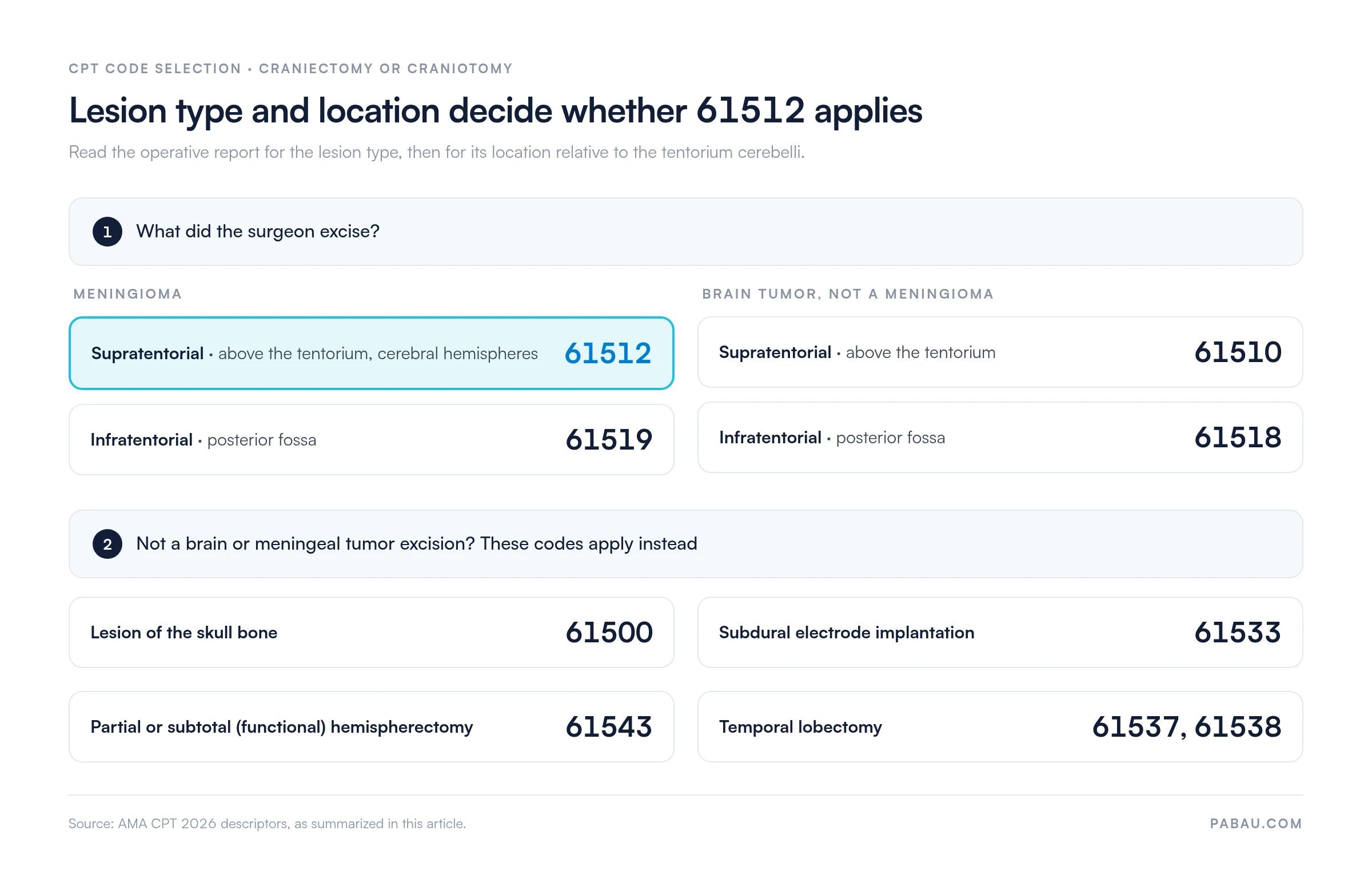
Tumor type matters as much as location. A supratentorial brain tumor that is not a meningioma takes a different code, 61510. A bone flap opened to evacuate a supratentorial epidural or subdural hematoma is a different service again, reported with 61312. Use the AAPC’s CPT code lookup to verify descriptors before submitting.
Read the lesion type first and its location second. Temporal lobectomy is reported with 61537 or 61538, not 61543. The chart below sorts each code by those two questions.
Medical necessity for CPT Code 61512 rests on a correct ICD-10 diagnosis code that maps to a meningioma requiring surgical excision. The ICD-10 code must reflect the specific pathology confirmed by pre-operative imaging and, where available, intraoperative or post-operative pathology.
D32.1 is an easy mismatch to make. A coder selects it when the report says “meningioma” without reading the anatomical qualifier, yet spinal meningiomas require different CPT codes entirely.
When the report names a cerebral site, D32.0 is more specific than the unspecified D32.9. Verify the site with the operative report and imaging before assigning any code from the D32 range.
Medicare reimbursement for CPT Code 61512 is set by the Medicare Physician Fee Schedule (MPFS), which CMS updates annually. Payment varies by geographic locality through the Geographic Practice Cost Index (GPCI).
The table below shows national unadjusted figures from the CMS 2026 relative value files (October 2026 update). CMS prices 61512 only in the facility setting, so no non-facility rate applies.
With 73.76 total RVUs behind it, 61512 moves by a noticeable dollar amount even when a locality’s GPCI shifts slightly. Use the CMS Physician Fee Schedule lookup tool or the FastRVU 2026 lookup to pull locality-specific figures before contract negotiations or reimbursement benchmarking. Pabau’s US clearinghouse integration then submits the claim to payers on the Claim.MD clearinghouse network.
Run a FastRVU lookup for CPT 61512 using your practice’s specific Medicare locality before quoting reimbursement figures to administrators. National unadjusted rates can sit well above or below your locality’s payment once GPCI adjustments apply.
An incomplete operative report is a common path to a CPT Code 61512 denial. Medicare and commercial payers expect the report to match the code billed and to confirm the anatomical site explicitly. It should also show a clinical indication that supports surgery.
Complete clean claim submission for 61512 depends on the operative note addressing each of these elements before the claim is filed.
Traditional Medicare fee-for-service (Part B) generally does not require prior authorization for CPT Code 61512. It does expect medical necessity documentation that holds up in a post-payment audit. Meeting billing compliance requirements from the outset reduces that audit exposure.
Commercial payers and Medicare Advantage plans commonly require prior authorization. Requirements vary by plan, and most ask for the following documentation with the request.
Never assume a blanket authorization rule applies across payers. Verify pre-authorization requirements for each individual plan before scheduling elective meningioma surgery. A denial for missing required authorization can be difficult to overturn on appeal.
Modifier selection for CPT Code 61512 affects reimbursement amount, claim routing, and audit risk. Apply a modifier only when the operative record supports it, because payers review modifier use closely on high-RVU surgical codes.
CPT Code 61512 denials concentrate around three failure points. The first is wrong code selection, usually 61512 billed when 61519 was correct. The other two are incomplete operative documentation and missed authorizations.
The table below maps each denial to its root cause and prevention action. To decode the CARC and RARC codes on a remittance, use the medical billing denial codes guide.
A neurosurgery practice sees few 61512 cases, but each one carries a prior authorization trail, a 90-day global period and a high-value claim. Spread across spreadsheets, inboxes and payer portals, that work makes each claim slower to follow.
Pabau’s claims management software submits CMS-1500/837P claims to payers on the Claim.MD clearinghouse network. It runs eligibility checks before the surgery date and returns Electronic Remittance Advice (ERA) once the payer processes the claim.
Your coders still choose the code and confirm the operative report before submission, the first step in revenue cycle management for surgical specialties. Pabau then keeps the submission, the eligibility result and the remittance on one patient record.

Pabau’s claims management submits 61512 claims through Claim.MD, runs eligibility checks and returns ERAs. Your team can follow each neurosurgery claim from submission to payment.

CPT Code 61512 is a low-volume, high-stakes code, and one word in the operative report often decides the claim: supratentorial. Getting the anatomical qualifier, ICD-10 pairing and prior authorization right before submission separates clean claims from weeks spent chasing denials.
Build the location check into coding before the claim leaves the practice. Read the report for an explicit supratentorial statement, pair the diagnosis the pathology confirms, and confirm authorization for commercial and Medicare Advantage plans.
Pabau’s clearinghouse integration submits claims, runs eligibility checks and returns ERAs on the Claim.MD network. Book a demo to see how Pabau keeps each 61512 claim on one record, from authorization to remittance.

Need to understand how clearinghouse claim routing works? Claim.MD clearinghouse explained covers how EDI 837P transmission, payer enrollment, and ERA processing reduce surgical claim denials.
Looking for a structured approach to claim error analysis? 837 file format and submission guide breaks down the electronic claim file structure that governs every 61512 submission.
Want to benchmark your neurosurgery billing denial rate? Electronic remittance advice (ERA) explained explains how to read ERA 835 files to identify denial patterns across CPT code families.
CPT Code 61512 is a surgical procedure code for craniectomy, trephination, or bone flap craniotomy to excise a supratentorial meningioma. It belongs to the AMA’s Craniectomy or Craniotomy heading (61304-61576). It applies only when the meningioma sits above the tentorium cerebelli in the cerebral hemispheres.
CPT 61512 covers excision of a supratentorial meningioma, above the tentorium cerebelli. CPT 61519 covers excision of an infratentorial meningioma in the posterior fossa. Tumor location is the sole differentiator, so read the operative report before choosing between them.
The primary pairing is D32.0 (benign meningioma of cerebral meninges). D42.0 (neoplasm of uncertain behavior, cerebral meninges) applies when pathology is indeterminate, and C70.0 (malignant meningioma, cerebral meninges) covers WHO grade 2-3 tumors. Never use D32.1 (spinal meninges) with 61512.
CMS assigns 61512 73.76 total facility RVUs for 2026, which works out to $2,463.65 nationally at the $33.4009 conversion factor. Payment varies by locality through GPCI adjustments, so check the CMS Physician Fee Schedule Lookup Tool for your MAC jurisdiction.
CPT Code 61512 is active for 2026 with its descriptor intact. AMA descriptors can change annually, so check the current descriptor against the AMA CPT 2026 codebook before filing claims for a new code year.