CCSD code J1900: Gallbladder anastomosis billing guide
CCSD code J1900 joins the gallbladder to another organ CCSD code J1900 is the UK...

Last Updated: Oct 22, 2026
60252 is the CPT code for a total or subtotal thyroidectomy performed for malignancy, with a limited neck dissection in the same session. The surgeon removes all or most of a cancerous thyroid and clears selected lymph node levels, not the whole side of the neck.
The extent of that dissection decides the code. With no dissection, the case points to 60240, and a radical one points to 60254. Choose the wrong code and the claim is underpaid or denied. Below, you'll find the documentation, diagnosis pairings and claim checks that get 60252 paid on the first submission.
Let Pabau's smart automation suggest the right codes, reduce claim denials, and keep your practice compliant—effortlessly.
Automate repetitive tasks and focus on what matters most—your patients.
Reduce coding errors and ensure compliance with the latest regulations.
Clean claims, fewer denials, and faster reimbursements.
Powerful insights and reporting to help your practice thrive.
HIPAA compliant SOC 2 certified GDPR-compliant Trusted by 4,000+ clinics worldwide

CPT code 60252 covers a total or subtotal thyroidectomy for malignancy with a limited neck dissection in the same session.
The claim needs a cancer diagnosis, most often C73, because 60252 can’t be billed for benign thyroid disease.
No neck dissection points to 60240, a radical one to 60254, and completion surgery after a prior partial removal to 60260.
Claims software with CPT and ICD-10 lookups, record-based pre-fill and required-field checks cuts rework on 60252 claims.
Eligibility checks before surgery and ERA posting after it keep the claim moving through the clearinghouse.
CPT code 60252 is defined in the American Medical Association’s CPT code set as Thyroidectomy, total or subtotal for malignancy; with limited neck dissection. It sits in the Surgery section, Endocrine system subsection, under Excision procedures on the thyroid gland (code range 60200-60300).
Three facts have to line up for the code to stick. First, the patient has a thyroid cancer diagnosis. Second, the surgeon removed all or most of the gland. Third, the operative report names the lymph node levels cleared in a limited dissection.
The thyroidectomy family is small, but each code turns on one detail. Picking the wrong one is a common denial trigger for ENT and head and neck surgery practices.
The line between 60252 and 60254 is the extent of the lymph node dissection. A limited or selective dissection removes specific node levels and leaves other structures intact. A radical neck dissection clears all five cervical levels and can take the sternocleidomastoid muscle or internal jugular vein.
So if the operative report names selected levels only, 60252 applies. When it describes a radical dissection, look at 60254 instead.
The most common misassignment is coding 60240 when a limited neck dissection was performed. CPT 60240 is a total or complete thyroidectomy without neck dissection, and it doesn’t require malignancy.
The error usually starts with vague wording, such as “lymph node sampling” or “sentinel node biopsy.” A formal selective dissection with named levels is what 60252 needs. Getting it wrong costs money, because 60252 carries more RVUs for the added dissection work.
The flow below puts the four thyroidectomy codes side by side, so you can test an operative report against them in two questions.
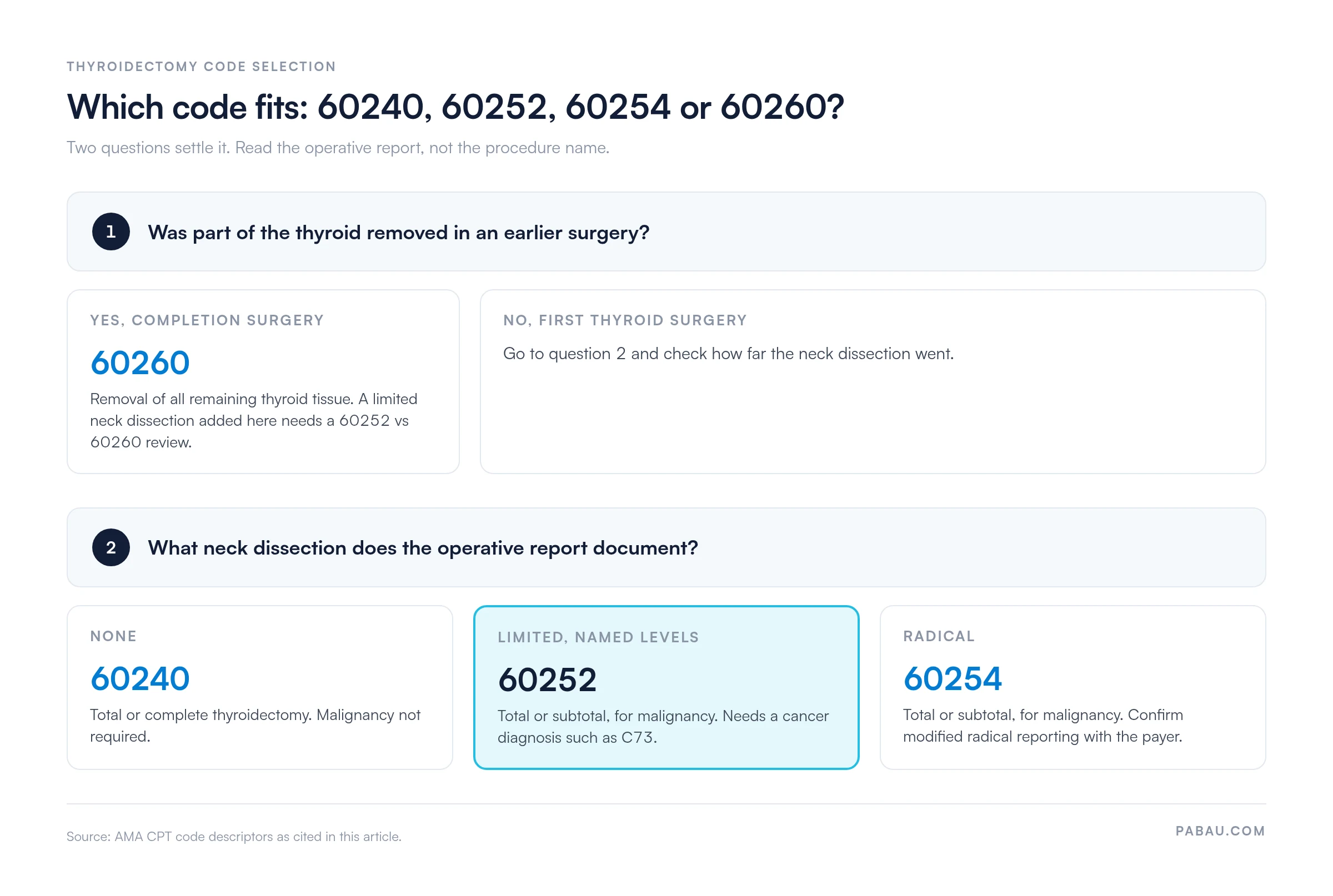
Thyroid cancer surgery sometimes involves a limited dissection on one side and a more extensive one on the other. In that case, the code pair is often 60252 plus 38724.
CPT 38724 describes cervical lymphadenectomy with modified radical neck dissection. Here, 60252 captures the thyroidectomy and the limited dissection. The modified radical work on the other side is then reported separately with 38724.
For bilateral limited dissections, National Correct Coding Initiative (NCCI) edits govern bundling. Check the current CMS NCCI edits before adding neck dissection codes to 60252, because the edit pairs are updated every quarter.
Completion thyroidectomy removes the thyroid tissue left after an earlier partial removal or hemithyroidectomy. CPT gives it a dedicated code. 60260 describes removal of all remaining thyroid tissue following previous removal of a portion of thyroid.
Read the operative report language before trusting the procedure name. The word “completion” tells you about the earlier surgery. It says nothing about how far the neck dissection went.
CPT code 60252 needs a malignancy diagnosis to show medical necessity. These ICD-10-CM codes are the main supporting diagnoses.
ICD-10 code C73 sits on nearly every 60252 claim. Without a malignancy diagnosis, expect a medical necessity denial. Benign diagnoses, such as E04.x nodular goiter or E05.x thyrotoxicosis, don’t support this code.
Modifiers on CPT code 60252 change both payment and approval. These four come up most often on thyroidectomy-for-malignancy claims.
Modifier -22 draws close payer scrutiny on 60252 claims. Payers want a specific narrative from the operating surgeon on why this case was harder than the descriptor. A generic note like ‘patient was complex’ is routinely denied. Document operative time against typical, the specific problem you hit (for example, extensive paratracheal fibrosis or a redo field), and the extra steps it took.
Medicare pays CPT code 60252 under the Medicare Physician Fee Schedule (MPFS). Rates are adjusted by locality through the Geographic Practice Cost Index (GPCI). The CMS Physician Fee Schedule lookup tool shows current facility and non-facility rates.
Private payer rates vary by contract and aren’t published in a standard fee schedule. Check your payer contract or a fee schedule benchmarking service. Never quote a private payer rate as a fixed figure.
The 90-day global period bundles routine post-operative care into the surgical payment. Visits for normal recovery aren’t separately billable during this window.
Many commercial payers want prior authorization for CPT code 60252 before surgery. A malignancy diagnosis alone won’t carry the request, so build the package early.
Assemble these items with medical billing workflows that capture documentation before the case is scheduled:
Medicare doesn’t require prior authorization for most surgical procedures, including 60252. Medicare Advantage plans often do, so verify requirements by plan, not just by payer name.
For emergency or urgent thyroidectomies, start a retrospective authorization right after the procedure. Document the clinical urgency in the medical record to support the request.
Denials on CPT code 60252 follow a familiar pattern. Each one has a clear fix.
Tracking denials by procedure code finds root causes faster than working claim by claim. Electronic remittance advice (ERA) files carry the CARC reason codes, so your team can act without waiting for paper explanations of benefits. That habit is the base of good denial management workflows.
Run a monthly denial review filtered to CPT code 60252. If CARC 16 or CARC 50 keeps appearing on dissection disputes, the problem sits upstream. Your operative report template isn’t capturing node level detail. Work with the surgeon to add a structured neck dissection section that names the levels removed.
The operative report for CPT code 60252 needs all of these elements to survive a payer audit. Missing any one can lead to a denial or a post-payment recovery audit.
Build these elements into operative note templates before cases are scheduled. Late addendums are allowed if clearly dated and signed, but they draw more audit scrutiny. Under medical billing compliance standards, contemporaneous notes carry the lowest risk.
On the claim side, claims management software with claim-field validation catches missing authorization or membership details before submission.
Electronic submission for 60252 needs accurate CPT-to-ICD-10 pairing, correct modifiers and NCCI compliance before the claim reaches the payer.
Here’s the usual path:
Submitting clean claims on the first attempt saves surgical billing teams hours of rework. The common denial codes reference explains the CARC and RARC structure on your 60252 ERAs.
For descriptor text and crosswalks, the AAPC’s CPT code lookup tool covers 60252 and the rest of the thyroidectomy family.
Many surgical practices still rebuild each 60252 claim by hand. Someone copies codes from the operative report, retypes insurer details and checks remittances in a separate portal.
Pabau, the practice management platform we build, pre-fills the claim from the patient record and invoice. Its CPT and ICD-10 lookup libraries help coders find 60252 and C73 quickly. Claim validation then checks required fields, such as authorization and membership details, before the claim leaves.
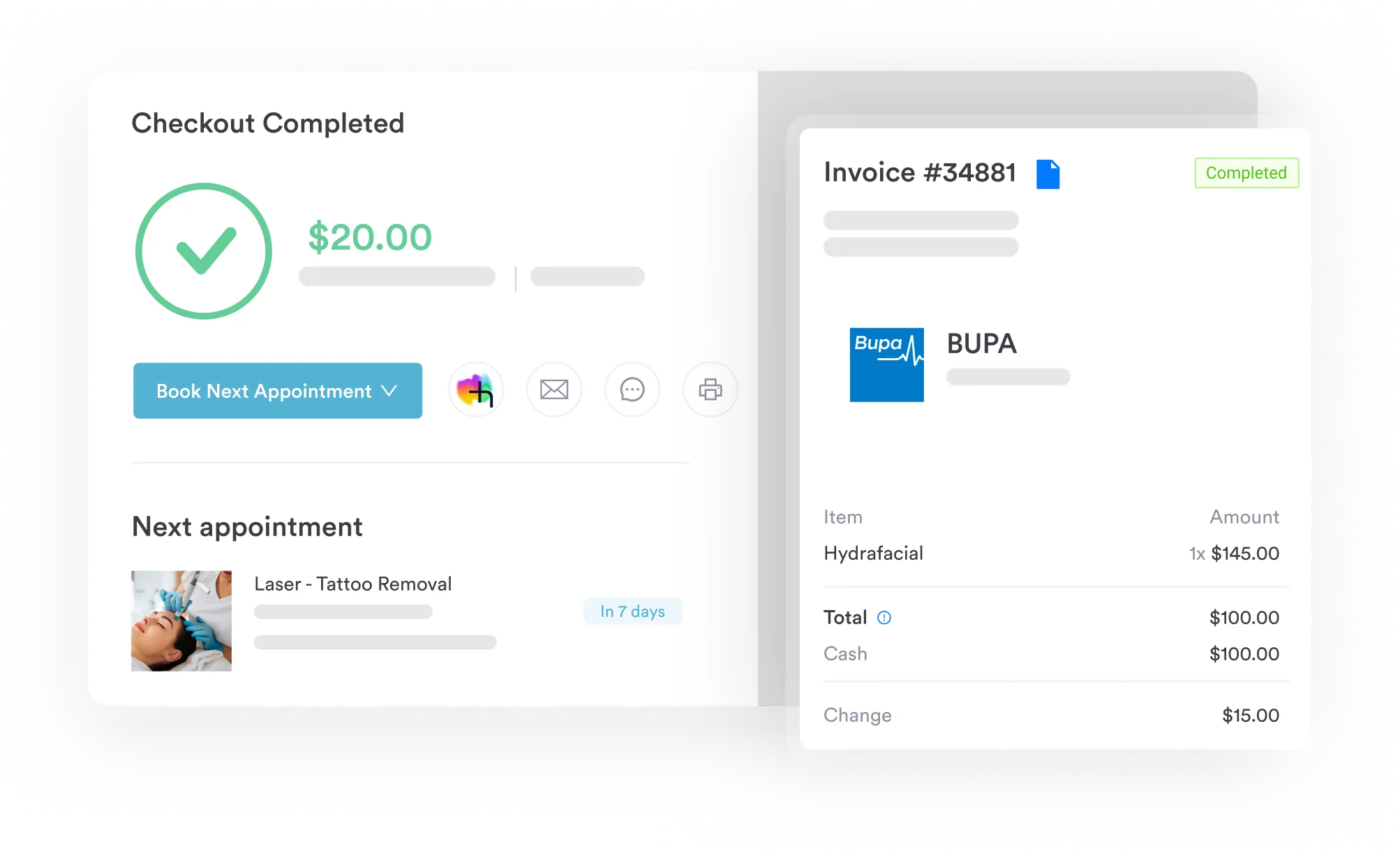
Claims then go through Claim.MD, a US-based clearinghouse that processes CMS-1500 and 837P claims. Your team can check eligibility before the surgery date and post ERAs back into billing. The result is fewer resubmissions and denials you can read in one place.

Pabau pre-fills claims from the patient record, validates required claim fields, submits through Claim.MD and posts ERAs back into billing. Book a demo to see it on a surgical claim.

Treat the operative report as the claim. If it names the node levels, states total or subtotal removal and sits beside a cancer diagnosis, 60252 holds up. If any of those is vague, the payer may push the code down to 60240 or deny it outright.
The trade-off is a little surgeon time on templates now, in exchange for far less rework later. Fix the template once, and every future 60252 claim starts on firmer ground.
Book a demo to see how Pabau pre-fills and validates surgical claims like 60252 before they reach the payer.

Need to read the denial codes on your 60252 ERAs? Common denial codes in medical billing explains the CARC and RARC structure that appears on your electronic remittance advice.
Coding a single-lobe thyroid surgery instead? CPT code 60220 covers thyroid lobectomy billing and the modifiers that go with it.
Billing the biopsy that confirmed the cancer? CPT code 60100 walks through percutaneous core needle biopsy of the thyroid.
Submitting claims electronically for the first time? 837 file format guide walks through how 837P claims are structured for physician procedures like thyroidectomy.
Want to verify eligibility before the day of surgery? Insurance eligibility verification covers the checks that catch authorization problems before they become post-service denials.
Yes, when it’s documented. Add-on code 60512 covers parathyroid autotransplantation and is reported in addition to the thyroidectomy. The operative report should say which gland was reimplanted and where.
No. CPT 60252 requires a total or subtotal thyroidectomy, so a single-lobe removal doesn’t qualify. A lobectomy codes to 60220. Check how to report the dissection in CPT Assistant or with the payer.
Yes, when the surgeon performs a limited dissection on one side and a modified radical dissection on the other. 60252 covers the thyroidectomy and limited side, and 38724 covers the modified radical side. Never add 38724 for a one-sided limited dissection.
It’s 90 days. Routine post-op visits are bundled into the surgical payment. Unrelated E/M visits need modifier -24, and a return to the OR for a complication needs -78.
Use the CMS Physician Fee Schedule lookup tool. Pick the current year and your MAC locality, because GPCI adjustments change the rate by region. Private payer rates come from your contract.