CPT code 21011: Excision of soft tissue tumor of the face
CPT code 21011: Official descriptor and procedure overview CPT code 21011, as pu...

Last Updated: Oct 8, 2026

CPT code 59410 covers vaginal delivery with postpartum care, but it does not include antepartum care.
The AMA has deleted 59410 effective January 1, 2027. It stays valid and billable through December 31, 2026.
From January 1, 2027, vaginal delivery is reported with 59431 or 59432, and antepartum and postpartum care move to per-encounter E/M billing.
Labor management becomes separately billable in 2027 under new codes 59080 to 59083, priced by day and complexity.
Use 59410 rather than 59409 while it lasts, when the same provider delivers and manages the 6-week postpartum period.
Unbundling postpartum care (CPT 59430) alongside 59410 is a common NCCI edit violation unless a distinct condition applies.
Practice management software like Pabau supports accurate OB claim submission with coding validation and Claim.MD clearinghouse integration.
CPT code 59410 covers vaginal delivery with postpartum care, billed by the provider who handles both. Antepartum care is not included, which is why coders confuse it with 59400 and 59409.
There is a deadline attached to it. The AMA has deleted 59410 effective January 1, 2027, so the code is billable only for dates of service through December 31, 2026. After that, vaginal delivery is reported with 59431 or 59432, and postpartum care is billed per encounter with an E/M code.
This guide covers what 59410 includes today and how it differs from 59409. It also covers the ICD-10 crosswalk, the modifiers payers expect, and the replacement framework you need before January.
Delivery codes differ by which phases of maternity care the same provider handled. That one question decides whether 59400, 59409, or CPT code 59410 is correct.
CPT code 59410 describes vaginal delivery with postpartum care. The American Medical Association’s (AMA) official descriptor reads: “Vaginal delivery only, including postpartum care.” The code covers:
Antepartum (prenatal) care is not included. When a single physician provides all three components (antepartum care, delivery, and postpartum care), the appropriate code is CPT 59400, not 59410.
The textbook 59410 case is a patient who transfers into the practice late in pregnancy. Another practice handled the prenatal visits, and your provider handles the delivery and the 6-week check.
Status update: The AMA’s CPT Editorial Panel approved the deletion of CPT code 59410 in September 2025, effective January 1, 2027. The code remains valid and billable for dates of service through December 31, 2026. This section describes how it works inside that window.
From January 1, 2027, one 59410 claim becomes three separate claim lines. The delivery is reported with 59431, or with 59432 after a previous cesarean. Labor management is billed on its own, and postpartum visits are reported per encounter with the appropriate E/M code.
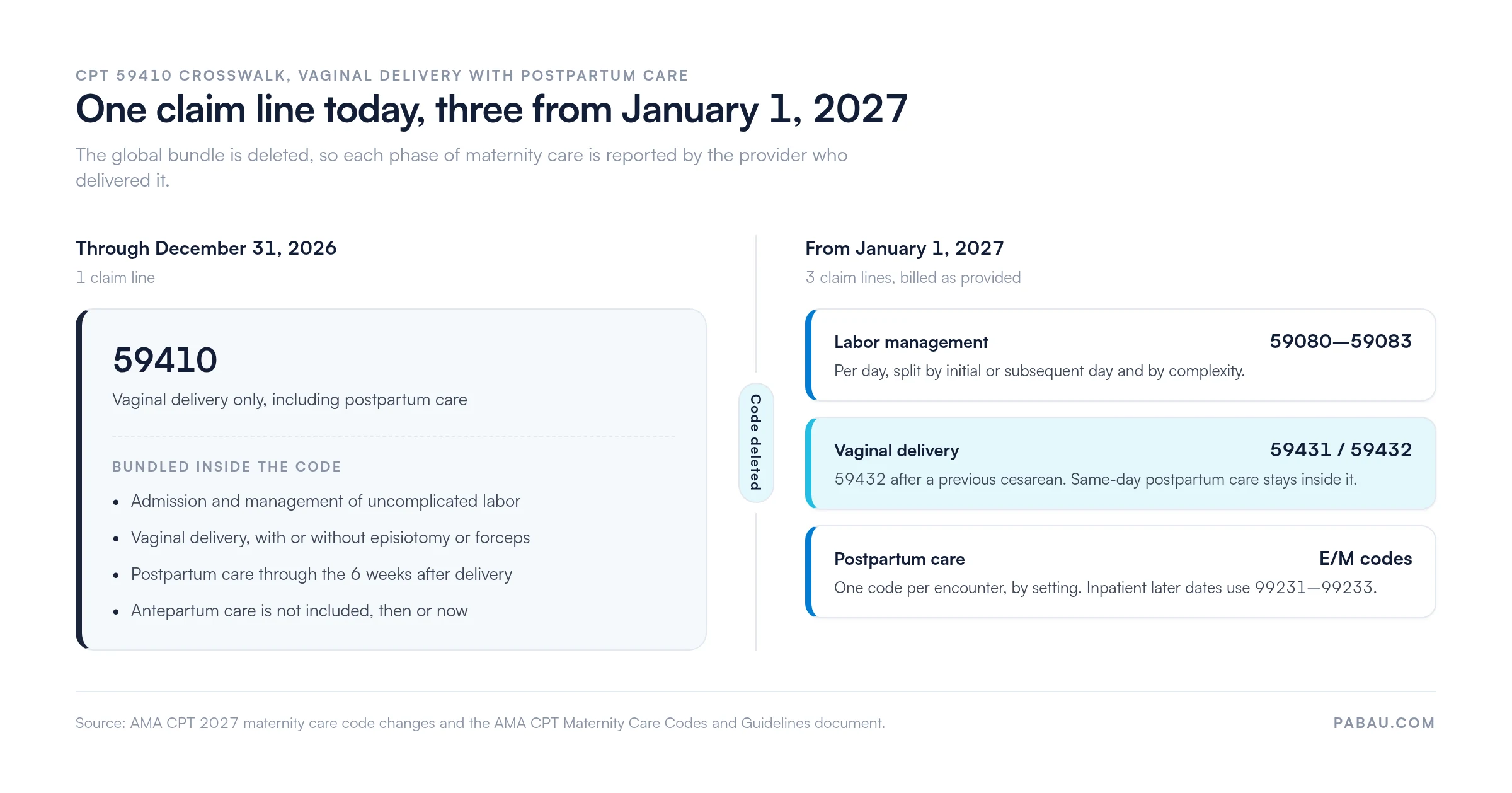
The AMA has restructured maternity care into four phases that are reported separately: antepartum care, labor management, delivery care, and postpartum care. The global bundle disappears. Each phase is billed as it is provided, by the provider who provided it.
Seventeen maternity codes go on the same date. Alongside 59410, the AMA deletes 59050, 59400, 59409, 59425, 59426, 59430, 59510, 59514, 59515, 59525, 59610, 59612, 59614, 59618, 59620, and 59622.
The cutoff itself is not negotiable. Per the AMA’s CPT 2027 maternity FAQ, deleted codes are invalid for dates of service on or after January 1, 2027. Claims systems and clearinghouses should reject them.
Two details in the new structure trip practices up. Same-day postpartum care stays inside the delivery code, so it is not billed again. Inpatient postpartum care on any later date is reported with a subsequent hospital care code such as 99231, 99232, or 99233.
Descriptors above come from the AMA’s CPT Maternity Care Codes and Guidelines document, published early so practices can prepare. Confirm final language against the CPT 2027 Professional Edition when it is available.
Payers are already moving ahead of the deadline. ACOG’s payment guidance for obstetric services asks health plans to pay antepartum visits with E/M codes from September 1, 2026. ACOG wants that shift made without preauthorization limits, because it becomes the standard in 2027.
Adoption will not be uniform. Some commercial and Medicaid plans will map to the new codes on day one, and others will keep processing legacy codes for a while. Confirm each payer’s cutover date rather than assuming a single national switch.
Load the 2027 codes into your charge master before December, and keep both code sets live through the changeover. Deliveries that begin in late December and finish in January straddle the cutover, so agree in advance which date of service governs each claim.
The global obstetric package bundles antepartum care, delivery, and postpartum care into a single CPT code, and that structure applies through December 31, 2026. Which code you pick depends on how many of those three phases your practice actually handled.
Every code in this table is deleted on January 1, 2027, and the bundled global package goes with them. The columns describe how the codes behave for dates of service up to December 31, 2026.
According to ACOG’s coding guidance, the postpartum period is defined as the 6-week period following delivery. Services within this window are generally bundled unless a separate, distinct condition requires additional care beyond routine postpartum management.
The most frequent point of confusion in OB billing is choosing between 59410 and 59409. The difference is straightforward. 59409 covers the delivery alone, and CPT code 59410 adds the postpartum care period on top of it.
When the delivering provider will not manage postpartum care, bill CPT 59409 with modifier 54 (surgical care only).
The provider who takes over postpartum management bills 59409 with modifier 55 (postoperative management only). Never bill CPT code 59410 in this split-care scenario, as postpartum care would be double-counted.
When a provider delivers antepartum care but does not perform the delivery, antepartum-only codes apply. These interact directly with CPT code 59410 in split-care billing scenarios.
If fewer than 4 antepartum visits were provided, bill each encounter using the appropriate E/M code (99202-99215) rather than a global antepartum code. Always verify current National Correct Coding Initiative (NCCI) edits before billing components separately.
Both antepartum codes are deleted on January 1, 2027. From that date the visit count stops mattering, because every antepartum encounter is reported with the E/M code that matches the service provided.
CPT 59430 describes postpartum care only. According to ACOG’s 4th trimester coding guidance, it is separately billable in three specific circumstances.
Do not bill CPT 59430 alongside CPT code 59410 for the same patient encounter. Because 59410 already includes postpartum care, adding 59430 constitutes an unbundling violation under NCCI edits. The record must clearly identify which provider is responsible for which care component.
CPT 59430 is deleted on January 1, 2027 as well. Postpartum care is then reported per encounter with the appropriate E/M code, by whichever provider delivered that care, which removes the unbundling conflict entirely.
Every code in the current maternity family shares one expiry date. All of them are billable through December 31, 2026 and deleted the next day. Use this table to pick a code today and to see what it maps to in 2027.
Only the maternity family changes on that date. Codes for other specialties keep working as they do now, and the CPT code library covers each of those separately.
Labor management has no equivalent in the left-hand column, because the current codes bundle it into the delivery. From 2027 it is billed on its own with 59080 to 59083, priced by day and by complexity.
Every claim for CPT code 59410 requires a supporting ICD-10-CM diagnosis code. The primary code for an uncomplicated vaginal delivery is O80. Verify the full crosswalk against current payer guidelines before you submit.
When coding for a complicated vaginal delivery, O80 is excluded. Assign the specific complication code as the principal diagnosis. Add the outcome of delivery (Z37.x) and weeks of gestation (Z3A.xx) codes as required secondary codes.
This table survives the 2027 change. The restructuring touches procedure codes only, so the same ICD-10-CM diagnoses pair with 59431 and 59432 exactly as they pair with 59410 today.
Split-care scenarios are where modifier errors most commonly occur on CPT code 59410 claims. Confirm modifier requirements with each payer before submission. The guidance here is general, and it does not replace payer-specific policy.
In a split-care scenario with modifiers 54 and 55, the two claims together should not exceed the allowed amount for the complete code. Payers apply a percentage split, typically 70% to the delivering physician and 30% to the postpartum provider, though this varies by contract.
The split-care construct itself ends with the code family. From January 1, 2027, postpartum visits are billed per encounter by whoever provides them. A transferred postpartum period becomes a set of E/M claims rather than a modifier 55 claim.
Reimbursement for CPT code 59410 is based on the Medicare Physician Fee Schedule (MPFS) set annually by the Centers for Medicare and Medicaid Services (CMS). Private payer rates vary by contract. To look up verified figures, use the CMS Physician Fee Schedule lookup tool.
The RVU breakdown for CPT 59410 includes work RVUs (wRVU), practice expense RVUs (PE RVU), and malpractice RVUs (MP RVU). The total RVU is multiplied by the annual CMS conversion factor. That produces the Medicare payment rate for a given geographic area.
2026 is the last fee schedule year that carries 59410. Values for the replacement codes are still settling, because the AMA/Specialty Society RVS Update Committee only sent its maternity recommendations to CMS in February 2026. Build your 2027 budget from the final rule, not from today’s 59410 rate.
Run an eligibility check before every OB delivery admission. Verifying coverage and benefit limits for maternity services catches payer-specific bundling restrictions before submission. That cuts postpartum-care denials on CPT code 59410 claims.
Accurate documentation is the foundation of every defensible CPT code 59410 claim. The medical record must support all services bundled within the code.
HIPAA mandates the use of standardized code sets, including CPT and ICD-10-CM, for all electronic claim submissions. Missing or incomplete documentation is the leading cause of CPT code 59410 claim denials. Capture every element above at the point of care, rather than reconstructing the chart at billing.
The 2027 structure raises the bar on two of these records. Labor management is billed per calendar date and by complexity, so the chart has to show what was managed on each day. Antepartum and postpartum notes have to support an E/M level, not just a completed visit count.
OB billing errors on CPT code 59410 fall into five predictable patterns. Each one is cheaper to prevent at the point of coding than to chase through an appeal.
A clean claim for CPT code 59410 requires that the code, modifier, and ICD-10 combination all be validated before transmission. Practices with high OB claim volumes benefit from automated pre-submission scrubbing to catch these patterns at scale. Review NCCI edit updates quarterly so the scrubbing rules stay current.
The largest operational lever for cutting CPT code 59410 errors is the platform your OB team codes in. Practice management software like Pabau ties the code that leaves the building to the care the chart documents.
Pabau’s OB claims management connects practices to thousands of US payers through the Claim.MD clearinghouse. Real-time eligibility verification before each delivery admission catches coverage problems before the claim is submitted.
Built-in CPT and ICD-10-CM catalogues support code validation at claim level, flagging combinations that would trigger NCCI edit rejections.
For practices managing split-care billing, Pabau tracks which provider owns the delivery and which owns postpartum care. It then applies the correct modifier, 54 or 55, based on that assignment.
After submission, electronic remittance advice comes back through the clearinghouse. Pabau posts it straight to the patient account, so nobody reconciles ERAs by hand.
The same catalogue handles the 2027 cutover. Code lists in Pabau can be updated ahead of January. Billers then pick from the codes each payer accepts, and deleted codes stop appearing as options.
Audit your CPT 59410 denial rate by reason code monthly. Claims denied for ‘unbundling’ (reason code 97) signal that 59430 or antepartum codes are being added incorrectly. Claims denied for ‘missing modifier’ indicate split-care scenarios aren’t being flagged at scheduling.

Pabau’s built-in claims management connects directly to Claim.MD. It helps OB practices submit accurate CPT code 59410 claims, catch unbundling errors early, and move cleanly onto the 2027 replacement codes.

CPT code 59410 is straightforward in concept and generates disproportionate claim errors in practice. Unbundling postpartum care, misapplying split-care modifiers, and omitting required ICD-10 secondary codes share one root cause. They all come out of manual coding workflows with no automated validation.
The deadline changes what those errors cost. You can bill 59410 for dates of service through December 31, 2026, and after that the claim gets rejected rather than corrected.
Map delivery to 59431 and 59432, and cesarean delivery to 59502 and 59503. Move antepartum and postpartum care onto E/M codes, and cash keeps flowing through the cutover.
Pabau gives OB practices a structured workflow for both code sets, with claims management and Claim.MD submission built in. Book a demo to see how it handles OB claims before and after the 2027 change.

Want to understand how OB claims move through the payer system? Medical claims clearinghouse guide explains how electronic claims are validated, scrubbed, and transmitted to payers.
Need to understand denial reason codes on OB claims? Denial codes in medical billing covers the most common CARC codes that affect obstetric claim reimbursement.
Building the charge document behind the claim? Superbill documentation shows which fields a payer expects, so split-care ownership is recorded at the point of care.
CPT code 59410 is vaginal delivery with postpartum care. It covers hospital admission and management of uncomplicated labor. It also covers vaginal delivery, with or without episiotomy or forceps, plus postpartum care through the 6 weeks after delivery. Antepartum care is not included. The AMA has deleted the code effective January 1, 2027.
CPT 59409 covers vaginal delivery only, with no postpartum care included. CPT code 59410 adds the 6-week postpartum care period to the delivery. Use 59410 when the delivering physician also manages postpartum care. Use 59409 with modifiers 54 and 55 when a different provider handles the postpartum period. Both codes are deleted on January 1, 2027 and replaced by 59431 and 59432.
No. CPT code 59410 does not include antepartum care. When a provider delivers all three components (antepartum, delivery, and postpartum), use CPT 59400 (routine obstetric care, vaginal delivery) instead of 59410. From January 1, 2027, antepartum care is billed per encounter with the appropriate E/M code.
No. Billing CPT 59430 alongside CPT code 59410 for the same postpartum period is an unbundling violation under NCCI edits. The payer will deny it. Use 59430 only when a different provider than the one who billed 59410 manages the postpartum period. Both codes are deleted on January 1, 2027.
In split-care scenarios, modifier 54 (surgical care only) is appended to 59409 for the delivering provider. The provider who assumes postpartum care appends modifier 55 (postoperative management only) to 59409. CPT code 59410 itself is not used in a split-care scenario because it already bundles both services.
Yes, but only through the end of the year. CPT code 59410 is valid and billable for dates of service through December 31, 2026. The AMA has deleted the code effective January 1, 2027, and deleted codes are invalid for dates of service from that date onward. Clearinghouses and claims systems are expected to reject them.
Three claim lines replace the one. Labor management is billed with 59080 to 59083, by day and complexity. The delivery is reported with 59431, or 59432 after a previous cesarean. Each postpartum visit is then reported with the appropriate E/M code. Same-day postpartum care stays inside the delivery code.
No. The restructuring changes procedure codes only, so O80, the weeks-of-gestation codes (Z3A.xx), and the outcome-of-delivery codes (Z37.x) work the same way. Pair them with 59431 or 59432 from January 1, 2027 in the same combinations payers expect with 59410 today.