HCPCS code V5259: Digital binaural ITC hearing aid billing
HCPCS code V5259 reports a digital ITC hearing aid pair HCPCS code V5259 reports...

Last Updated: Oct 22, 2026
59160 is the CPT code for curettage, postpartum. It reports scraping or suctioning the uterus after a completed delivery, usually to remove retained placental tissue or control bleeding. It carries a 10-day global period.
Coders often mix it up with 58120 (nonobstetric D&C) and 59812 (incomplete abortion treatment). That confusion is a common source of claim denials for this code. The delivery date, the diagnosis and the global-period modifier decide whether the claim gets paid.
Let Pabau's smart automation suggest the right codes, reduce claim denials, and keep your practice compliant—effortlessly.
Automate repetitive tasks and focus on what matters most—your patients.
Reduce coding errors and ensure compliance with the latest regulations.
Clean claims, fewer denials, and faster reimbursements.
Powerful insights and reporting to help your practice thrive.
HIPAA compliant SOC 2 certified GDPR-compliant Trusted by 4,000+ clinics worldwide

CPT code 59160 reports postpartum curettage after a completed delivery, and it sits in the Excision subsection (59100-59160) of Maternity Care and Delivery.
Sharp and suction curettage both report as 59160, while hysteroscopic sampling goes to 58558 and nonobstetric D&C goes to 58120.
Pregnancy-related curettage before a delivery is never 59160, so report 59812 for an incomplete abortion and 59820 or 59821 for a missed abortion.
Inside the delivery’s global package, add modifier -78 or -79 according to the payer’s policy, or expect a bundling denial.
The 2026 Medicare national rate is about $263.53 in the office and $167.67 in a facility, with a 10-day global period.
CPT code 59160 reports postpartum curettage, the scraping or suctioning of the uterus after a completed delivery. It sits in the Excision subsection (59100-59160) of Maternity Care and Delivery, in the Surgery section of the AMA CPT codebook. The official descriptor reads: Curettage, postpartum.
Those two words cover a lot of ground. In practice, 59160 is reported when retained placental tissue or postpartum bleeding sends the patient back for a curettage. The approach doesn’t change the code.
The scope of 59160 starts once a delivery is complete. Use the table below to check whether a scenario belongs to it or to a neighboring code.
The deciding fact is a completed delivery. If the pregnancy ended in an incomplete abortion, report 59812. A missed abortion goes to 59820 or 59821. If the patient isn’t pregnant and hasn’t recently delivered, the D&C is nonobstetric and 58120 applies.
Payer auditors look for five elements in the operative note before they pay a 59160 claim. If one is missing, expect a records request or a medical necessity denial.
Good medical billing compliance means these elements live in a structured operative note template. They get captured before the case closes, not rebuilt from memory after a denial.
The primary diagnosis is another frequent denial trigger for 59160. The ICD-10-CM code has to match the indication in the operative note, so check it against the CDC ICD-10-CM tool.
Always assign the most specific code available. O72.2 is the correct primary when retained products cause bleeding after 24 hours, a common outpatient 59160 scenario. Some payers also limit which diagnoses support the procedure, so check your MAC’s LCD database before billing.
Run a two-step check before submitting. First, confirm the diagnosis falls in a postpartum complication category (O70-O75 or O85-O92). Second, confirm your payer accepts it as a primary diagnosis for 59160. Diagnoses from neighboring O-chapter categories are a fast route to a denial.
Four neighboring codes are the usual mix-ups with CPT code 59160. They differ on obstetric context, surgical approach and global period, as the AAPC CPT code reference and AMA descriptors show.
The chart below puts the choice in the order a coder should ask the questions.
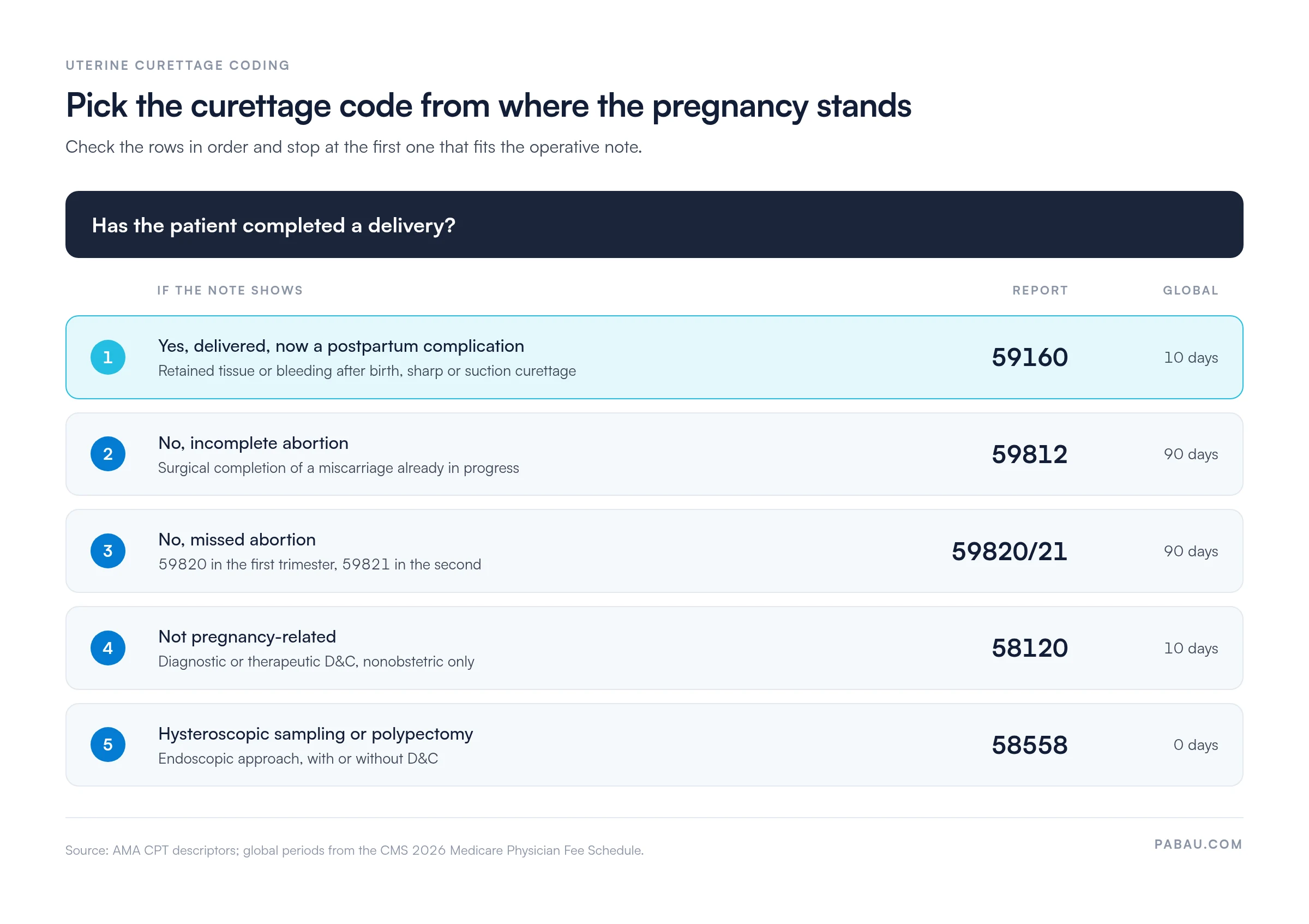
59160 vs 58120: 58120 is strictly nonobstetric, so pregnancy-related curettage never belongs there. Curettage for retained products after a miscarriage goes to 59812, or to 59820 or 59821 for a missed abortion. A curettage on day 5 after a term vaginal delivery is 59160.
59160 vs 59812: Both codes sit in Maternity Care and Delivery, but they cover different events. 59812 completes an incomplete abortion. 59160 treats a new complication after a delivery is complete.
CPT code 59160 carries its own 10-day global period. The harder question is whether it pays while the patient is still inside the global package of her delivery code.
The global obstetric package covers antepartum care, the delivery and routine postpartum care. It applies to delivery codes such as 59400 and 59510. A curettage for a distinct postpartum complication is generally reported on top of that package, and payers expect a modifier to show why.
A missing global-period modifier is one of the most common reasons 59160 denies. The payer sees the delivery global still open, bundles the curettage into it and denies the line.
The 2026 Medicare Physician Fee Schedule (MPFS) sets national rates for 59160, adjusted locally by Geographic Practice Cost Indices (GPCI).
The table shows national unadjusted figures at the 2026 conversion factor of $33.4009. Use the CMS MPFS look-up tool to pull your locality rate.
Check current figures with the FastRVU RVU look-up tool, which mirrors the CMS 2026 file. Rates change every January 1 and vary by locality. Medicaid rates are set by each state, and many commercial payers pay a percentage of Medicare.
Anesthesia for 59160 is billed separately by the anesthesiologist under the appropriate anesthesia codes. The surgeon doesn’t bill it. Record the anesthesia type in the operative note, but submit only 59160 under the surgeon’s NPI.
Here’s the path a postpartum curettage claim takes, with the step where each problem usually shows up.
Example: A patient returns on day 9 after a vaginal delivery with heavy bleeding. Ultrasound shows retained tissue, and the obstetrician performs a suction curettage in the OR. Report 59160 with O72.2 as the primary diagnosis. Because the delivery global is still open, add -78 or -79 according to the payer’s policy.
Five denial patterns come up again and again on 59160 claims. Each has a clear fix, and these denial management steps apply to Medicare and commercial payers alike. For what each code means, keep a billers’ CARC reference open.
It’s cheaper to send a clean claim than to win an appeal. Same-day charge capture and a second look at the modifier and diagnosis cut first-pass denials on postpartum curettage.
Review your 59160 EOBs for CARC 97. A cluster of those denials usually means the global-period modifier is being missed at charge entry. Add a billing rule that flags any 59160 billed by the same provider during the delivery’s postpartum care period.
Most 59160 rework starts at charge entry, when someone retypes dates and codes from the chart. Pabau, the practice management platform we build, pre-fills each claim from the patient record instead. Its claims software for practices also checks that required claim fields are filled in before submission.
ICD-10 and CPT lookup libraries help coders confirm 59160 and the right O-chapter code without leaving the record. For US practices, the Claim.MD integration adds eligibility checks, claim tracking, ERA posting and CMS-1500 export. Billing staff can see where each claim stands and post the payment when it lands.

Pabau pre-fills each claim from the patient record and checks required fields before submission. See how it handles 59160 claims in a live demo.

Treat the delivery date as the first field you check on any postpartum curettage claim. If the patient delivered, 59160 is the code. The remaining work is proving the complication and choosing the modifier your payer expects.
If she didn’t deliver, you’re looking at 59812, 59820, 59821 or 58120, and no modifier will rescue the wrong code. A couple of extra minutes at charge entry cost far less than an appeal on a claim worth about $264.
Book a demo to see how Pabau pre-fills postpartum curettage claims from the chart and checks them before they reach the payer.

Billing the delivery itself? CPT code 59400 explains the global obstetric package that a 59160 claim often sits inside.
Was the procedure done through a hysteroscope? CPT code 58558 covers hysteroscopic sampling and polypectomy, with its own 0-day global period.
Seeing persistent CARC 97 denials across maternity codes? Denial codes in medical billing covers the most common CARC and RARC combinations and their correction paths.
Need to understand how your clearinghouse processes these claims? Our Claim.MD clearinghouse guide explains how electronic claims are scrubbed, submitted, and tracked.
Want to verify eligibility before the procedure date? Insurance eligibility verification walks through eligibility checks and how they reduce claim rejections.
It depends on whether the pregnancy ended in a delivery. Retained products after a completed delivery are coded 59160. After an incomplete miscarriage, report 59812. For a missed abortion, report 59820 in the first trimester or 59821 in the second. 58120 never applies, because it covers nonobstetric dilation and curettage only.
Sometimes, but expect scrutiny. Delivery of the placenta, including manual removal, is part of every delivery code. A curettage to remove retained tissue is a separate procedure, so the operative note must show it clearly. Many payers still bundle a same-day 59160, so check their modifier policy and bill the date it was performed.
ICD-10-CM guidelines define the postpartum period as starting right after delivery and lasting six weeks. Inside that window, the O-chapter postpartum codes apply to complications such as retained tissue or delayed bleeding. Payers may define postpartum care differently in the delivery package, so check the delivery code’s global terms too.
Yes. Medicare publishes a non-facility rate for 59160, about $263.53 nationally in 2026, so office-based curettage is payable. The facility rate is lower, about $167.67, because the hospital bills its own costs separately. Commercial payer rules vary, so confirm coverage before scheduling.
Yes. 59160 is approach-neutral, so sharp and suction (vacuum) curettage after a delivery both report as 59160. A hysteroscopic procedure falls under a different code family, which is why the approach still belongs in the operative note.