CPT code 59618: Cesarean after attempted VBAC billing guide
CPT code 59618 bills a cesarean after a VBAC attempt CPT code 59618 is the globa...

Last Updated: Nov 4, 2026
59151 is the CPT code for laparoscopic treatment of ectopic pregnancy; with salpingectomy and/or oophorectomy.
It applies when the surgeon removes the affected fallopian tube, the ovary, or both through a laparoscope. When the tube is spared, as in a salpingostomy, the correct code is 59150. The operative report has to state the tube removal to support 59151.
Let Pabau's smart automation suggest the right codes, reduce claim denials, and keep your practice compliant—effortlessly.
Automate repetitive tasks and focus on what matters most—your patients.
Reduce coding errors and ensure compliance with the latest regulations.
Clean claims, fewer denials, and faster reimbursements.
Powerful insights and reporting to help your practice thrive.
HIPAA compliant SOC 2 certified GDPR-compliant Trusted by 4,000+ clinics worldwide

CPT code 59151 covers laparoscopic treatment of an ectopic pregnancy when the surgeon removes the fallopian tube, the ovary, or both.
Tube removal is the only difference from CPT 59150. Without a documented salpingectomy or oophorectomy, the claim is downcoded to 59150.
A 90-day global surgical period applies, and NCCI bundles 58661 into 59151 when ectopic pregnancy is the indication.
Tubal and ovarian ectopic diagnoses are billable only with the sixth-character laterality digit, such as O00.102 for a left tubal pregnancy.
Pabau’s claims management software scrubs each 59151 claim for missing or invalid details before it reaches the payer.
CPT code 59151 is the code for laparoscopic treatment of an ectopic pregnancy with salpingectomy and/or oophorectomy.
Report it when the surgeon removes the affected fallopian tube, the ovary, or both through a laparoscope. It sits in the Maternity Care and Delivery range (59000-59899) of the Surgery chapter, maintained by the AMA CPT Editorial Panel.
In the procedure, the surgeon establishes laparoscopic access and finds the implantation site, most often the fallopian tube. The affected tube is then excised. When the ovary on the same side is also involved or at risk, the oophorectomy happens in the same session under the same code. Neither component is billed separately.
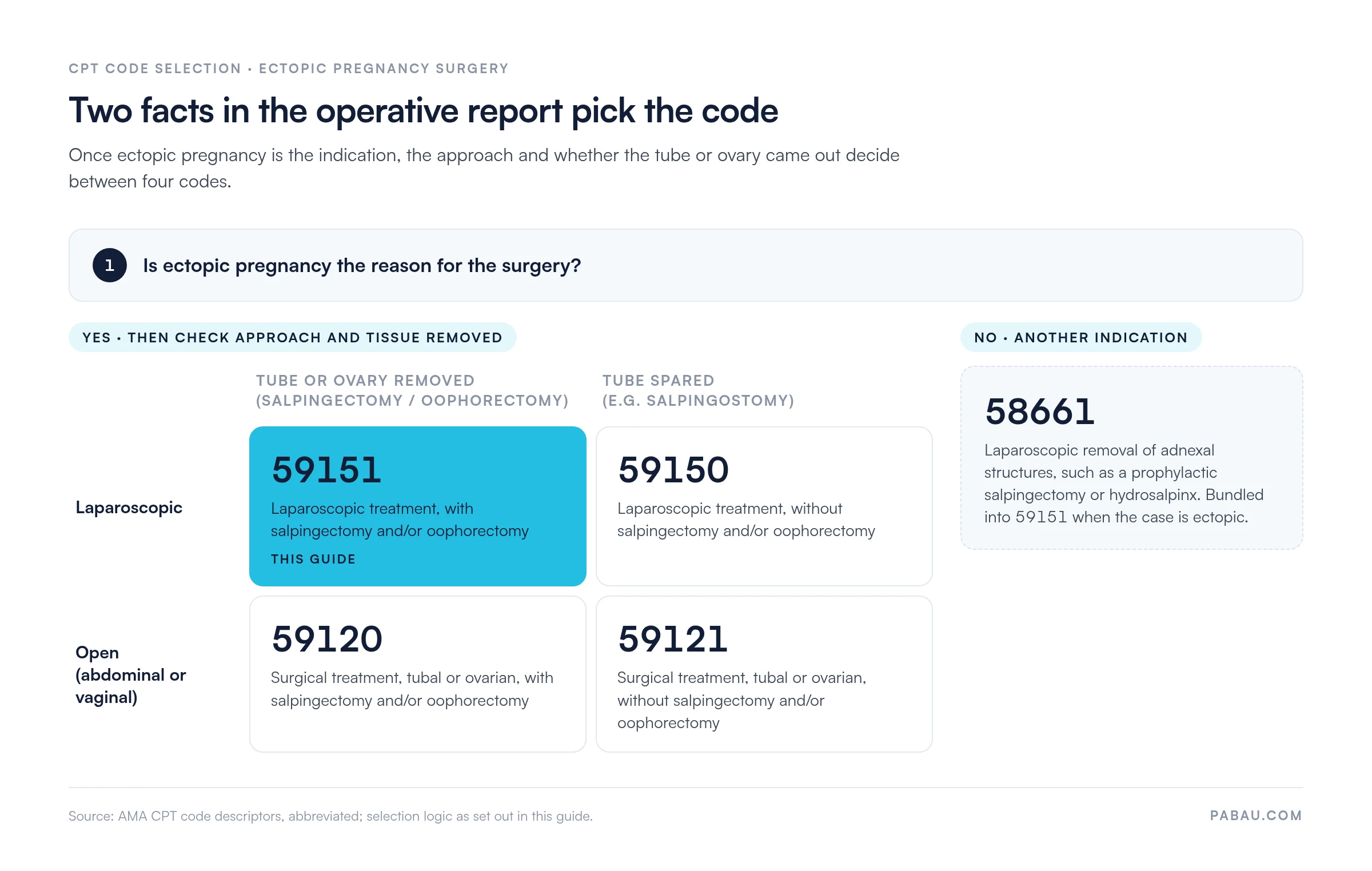
CPT 59150 applies when the fallopian tube is preserved, and CPT code 59151 applies when it is removed. Tube-sparing approaches include salpingostomy and fimbrial expression. A salpingectomy, with or without oophorectomy, always routes to 59151.
Intraoperative conversion: A surgeon may start a salpingostomy and convert to a salpingectomy during the case. The final operative report then has to describe the salpingectomy. Coders who work from pre-op documentation often submit 59150 in these cases, when 59151 is correct.
Several codes border CPT code 59151 and are often confused with it on claims. The table below sets out the ectopic pregnancy codes alongside 58661, the general laparoscopic salpingectomy code.
Key rule: When ectopic pregnancy is the operative indication, report 59150 or 59151 and leave 58661 off the claim. Billing 58661 alongside 59151 triggers an NCCI bundling edit. Even billed alone for an ectopic case, it can draw a denial or an audit flag.
Put together, the choice turns on three facts: the indication, the approach, and whether tissue came out. The chart below sets those decisions out in order.
Every CPT code 59151 claim needs an ectopic pregnancy diagnosis from ICD-10-CM category O00 as the primary diagnosis. Tubal pregnancy, subcategory O00.1, is the most common site. Tubal and ovarian codes are billable only at the sixth character, which records the side.
Laterality: O00.10, O00.11, O00.20 and O00.21 are non-billable parent codes. A tubal or ovarian claim needs the sixth character, which is 1 for right, 2 for left and 9 for unspecified. A claim that stops at the parent code is denied, so take the side from the operative note before you code.
Abdominal (O00.0x) and other-site (O00.8x) codes carry no laterality digit. Check the current CDC/NCHS ICD-10-CM tabular each October, when the annual update takes effect.
CPT code 59151 reimbursement rates are set annually through the CMS Medicare Physician Fee Schedule. The procedure carries a 90-day global period (indicator 090), which affects how pre-operative and post-operative services are billed.
Ectopic pregnancy surgery almost always happens in a hospital or ASC, so the physician is paid at the facility rate. The hospital or ASC bills its own facility fee separately.
Work RVU values and national payment amounts change with each calendar year’s MPFS final rule. The FastRVU lookup tool returns the current-year work, practice expense and malpractice RVUs for CPT 59151. It also applies the geographic adjustment (GPCI) for your locality.
Run a fee schedule check at the start of each calendar year. Medicare updates MPFS rates for CPT 59151 every January 1. Prior-year RVU figures on current claims throw off expected payment across your whole OB-GYN surgery mix.
The operative report is the billing anchor for CPT code 59151. One missing element can force a downcode to 59150 or a denial outright. The report and its supporting records should cover each of the following.
Downcode trigger: A salpingostomy opens the tube, removes the pregnancy tissue, and leaves the tube in place. If that is what the operative note describes, the correct code is 59150, whatever was submitted. Coders need to read the full operative note as well as the procedure heading.
Most payers don’t require prior authorization for CPT code 59151 when the surgery is an emergency, such as a ruptured ectopic pregnancy. Payers widely treat ectopic pregnancy as an obstetric emergency, and their emergency exceptions usually waive the requirement.
Some commercial plans still require authorization for elective laparoscopic surgery, even in obstetric cases. These situations may call for authorization or a retroactive review:
Payer policies vary and change often. Treat the emergency waiver as a common pattern and check the specific plan’s policy for 59151 whenever timing allows.
Modifier selection for CPT code 59151 affects payment and audit risk. The table below covers the modifiers coders encounter most often on ectopic pregnancy surgery claims. Consult the AAPC CPT modifier guide for the full modifier set.
Modifier -LT/-RT: Some payers request laterality modifiers to identify which tube was involved. These are not universally required for 59151 but should be applied when payer-specific instructions indicate them. The operative report’s laterality documentation must match.
CPT code 59151 denials cluster around a small set of repeating errors. A denial management workflow that catches them before submission costs far less time than an appeal. When a claim does come back, decoding denial codes on the remittance tells you which error the payer found.
NCCI (National Correct Coding Initiative) edits define what is included in CPT code 59151 and cannot be billed alongside it. CMS maintains these edits and updates them quarterly, so work from the current edit table each time.
For detailed guidance on medical billing compliance around NCCI edits, review the CMS NCCI Policy Manual for Medicare Services.
Bundled into 59151 (do not bill separately):
May be billed separately (with correct documentation and modifiers):
CPT code 59151 carries a 90-day global surgical period under CMS policy. The global period begins the day before surgery and runs for 90 days post-operatively. Related evaluation and management services, routine wound checks, and follow-up visits in this window are part of the global payment. They can’t be billed separately.
Knowing what falls inside and outside the global period prevents both underbilling and denial exposure. A superbill for surgical procedures can flag the global window’s end date when the claim goes out. Billing staff can then see which post-op visits are included and which are separately payable.
A 59151 denial usually starts with something the operative note or the claim left out. It then surfaces weeks later on the remittance, after the coder has moved on to other cases.
Pabau, the practice management platform we build, raises the claim from the invoice your team already creates. Its claims management tools scrub each claim for missing or invalid details before it leaves the system. A claim with a missing or invalid detail is marked as needing action, with guidance on the fix.
US claims go out through the Claim.MD clearinghouse, which reaches thousands of US payers. Eligibility checks run before the visit, and claim status and electronic remittance advice come back to the same record. A rejected claim shows as needing action on the day it bounces.
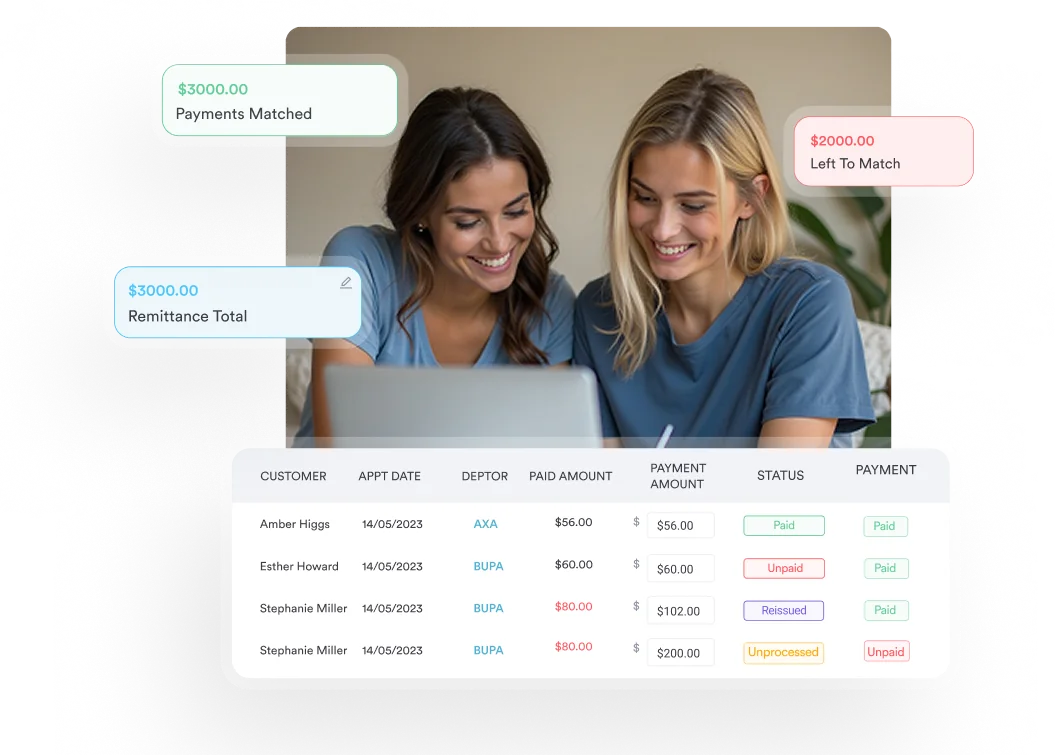

Pabau scrubs each claim for missing or invalid details before it leaves the system, then tracks it through to remittance. Your team fixes coding errors while they are still cheap to fix.

A 59151 claim is paid or denied on the strength of two lines in the operative report. One says the tube came out. The other names the implantation site and side, which sets the O00 code. Get both written on the day of surgery and the coding decisions that follow are straightforward.
The trade-off is coder time. Reading the full operative note on every ectopic case takes minutes, while recovering a denied surgical claim can take weeks. Book a demo to see how Pabau checks each OB-GYN claim before it reaches the payer.

Removing a tube through an open incision? CPT code 58700 explains how to bill an open salpingectomy outside the ectopic code family.
Coding a postpartum curettage from the same code group? CPT code 59160 sets out how to bill uterine curettage after delivery.
CPT code 59151 covers laparoscopic treatment of an ectopic pregnancy with salpingectomy and/or oophorectomy. It includes removal of the affected fallopian tube and, where performed, the ovary on the same side. Diagnostic laparoscopy in the same session is bundled in, and so is 58661, so neither is billed separately.
Tube removal is the only difference. CPT 59150 covers laparoscopic ectopic treatment that spares the tube, such as a salpingostomy. CPT 59151 applies when a salpingectomy was performed, and the operative report must document the tube removal to support it.
CPT code 59151 carries a 90-day global surgical period under the CMS Medicare Physician Fee Schedule. The window starts the day before surgery and runs for 90 days afterward. Related post-op E/M visits in that window are part of the global payment and aren’t billed separately.
Usually not, when 59151 is performed as an emergency for a ruptured or high-risk ectopic pregnancy. Some commercial plans still require authorization for non-emergent or elective laparoscopic surgery. Check the specific plan’s policy before the procedure whenever the clinical timeline allows.
Modifier -22 applies when documented complexity adds significant work, such as dense adhesions or hemoperitoneum. Modifiers -54, -55 and -56 split global surgical care between providers. Modifier -78 covers an unplanned return to the OR for a related complication. Modifier -51 goes on a second distinct procedure in the same session.
Most denials trace back to a handful of errors. The coder picks 59150 when a salpingectomy was performed, or the O00 diagnosis is missing, mismatched, or missing its laterality digit. The operative report may not state the salpingectomy. Other claims unbundle 58661 or carry an office place-of-service code.
The primary diagnosis comes from ICD-10-CM category O00. Tubal pregnancy codes are the most common, and they need a sixth-character laterality digit. Use O00.101, O00.102 or O00.109 without an intrauterine pregnancy, and O00.111, O00.112 or O00.119 with one. Ovarian codes follow the same pattern, from O00.201 to O00.219.