

HCPCS Code L0472: Hyperextension TLSO billing guide
HCPCS code L0472: Official descriptor and device definition HCPCS code L0472 des...

Last Updated: Nov 5, 2026
59000 is the CPT code for amniocentesis; diagnostic. It covers transabdominal needle aspiration of amniotic fluid for laboratory testing, such as genetic analysis or fetal lung maturity, and carries a 0-day global period.
Common denial causes include pairing the code with the wrong ICD-10-CM diagnosis. Another is billing 59000 when the note describes a therapeutic procedure, which belongs under CPT 59001. Documentation and prior authorization requirements vary by payer.
Let Pabau's smart automation suggest the right codes, reduce claim denials, and keep your practice compliant—effortlessly.
Automate repetitive tasks and focus on what matters most—your patients.
Reduce coding errors and ensure compliance with the latest regulations.
Clean claims, fewer denials, and faster reimbursements.
Powerful insights and reporting to help your practice thrive.
HIPAA compliant SOC 2 certified GDPR-compliant Trusted by 4,000+ clinics worldwide

CPT code 59000 covers diagnostic amniocentesis only: transabdominal needle aspiration of amniotic fluid for laboratory analysis, not fluid reduction.
Therapeutic amniocentesis (amnioreduction) is coded separately with CPT 59001. Billing 59000 for a volume-reduction procedure misreports the service and invites an audit.
CPT 59000 carries a 0-day global period and is not bundled into the global obstetric package (59400, 59510, 59610, 59618), so it is billed separately.
Ultrasound guidance (CPT 76946) is separately reportable when performed and documented with its own report. Some payers bundle it, so verify before billing.
Pabau’s practice management software submits claims electronically through Claim.MD and tracks their status, so billing teams can see where each CPT 59000 claim stands.
The American Medical Association (AMA) defines CPT code 59000 as Amniocentesis; diagnostic. Within the CPT book, it sits in the Antepartum and Fetal Invasive Services subsection (59000-59076) of the Maternity Care and Delivery range.
The code applies when a clinician inserts a needle through the abdomen into the amniotic cavity to draw fluid for laboratory testing. The most common tests include genetic analysis, chromosomal screening and fetal lung maturity.
The word “diagnostic” in the descriptor is the critical qualifier, because CPT code 59000 does not cover procedures intended to reduce amniotic fluid volume. Instead, report that purpose with CPT 59001.
Coders reviewing an amniocentesis note need to confirm that it documents a diagnostic aspiration rather than a therapeutic one. The procedure usually runs in four stages, so each should appear in the procedure note.
CPT 59000 covers the aspiration procedure only, so it does not include imaging supervision or interpretation. If the physician performs and separately documents real-time ultrasound guidance, bill that component under CPT 76946. Keep the guidance report with the procedure note, so an auditor can see both services in the record.
A common coding error on amniocentesis claims is using CPT 59000 when the clinical purpose was therapeutic, or the reverse. The note settles it once you know where to look.
If the procedure note documents large-volume removal and no specimen goes to a laboratory, CPT 59001 is the correct code. Billing CPT code 59000 in that scenario misrepresents the service and is a common audit trigger. The guide below runs the same check and adds the ultrasound guidance question.
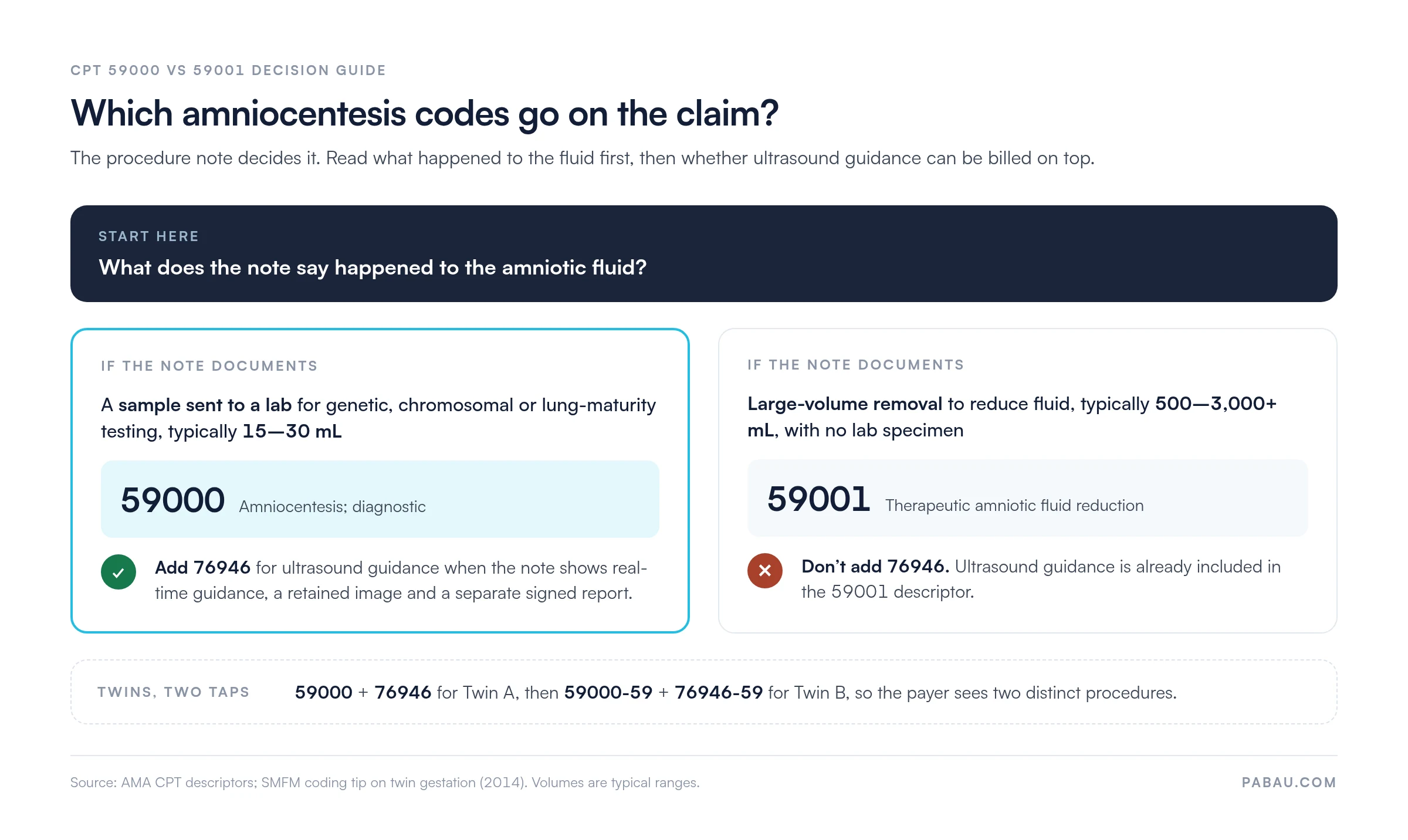
CPT 76946 covers ultrasonic guidance for amniocentesis, including imaging supervision and interpretation. It is not bundled into CPT code 59000 by default under the AMA codebook or standard CMS National Correct Coding Initiative (NCCI) edits.
To bill 76946 separately, the documentation must satisfy three conditions:
When those elements are present, 76946 is reportable in addition to 59000. If any are missing, the 76946 line lacks support and will not survive a documentation review. Some Medicare Advantage and commercial plans also apply local edits that bundle 76946 into 59000 regardless of documentation. Check the specific payer’s policy before billing the two codes together.
No. CPT code 59000 is not bundled into any of the global obstetric packages: 59400, 59510, 59610 or 59618. These packages carry an MMM (maternity) global period in the MPFS, covering antepartum, delivery and postpartum care. CPT 59000, by contrast, carries a 0-day global period.
A practice billing the global OB package can still bill 59000 separately when it performs a diagnostic amniocentesis. That holds even when the same provider is managing the antepartum care.
Some payers still bundle 59000 into the global package payment by mistake and deny it. In that case, the appeal should cite the 0-day global period in the CMS fee schedule. It should also note that no NCCI edit bundles 59000 with the global OB codes.
The ICD-10-CM diagnosis code you submit alongside CPT code 59000 establishes medical necessity. So a mismatch between the procedure and the diagnosis is a common denial trigger. The codes below are commonly accepted pairings, but each payer and local coverage determination (LCD) sets its own list, so check the payer’s policy before you submit.
Most of these O-codes need a seventh character that identifies the fetus. Use 0 for a single gestation or an unspecified fetus. Otherwise, use 1 to 5 for fetus 1 to 5, and 9 for any other fetus. Because ICD-10-CM codes change every October and CMS publishes each year’s files, confirm the effective date of any code you submit.
Always list the most specific ICD-10-CM code available. A nonspecific code, such as a Z36 screening code, often triggers a medical necessity review when the note documents a known chromosomal abnormality. That happens even when the code is technically valid.
The procedure note supporting CPT code 59000 must contain six elements to withstand a payer audit. If any one is missing, a documentation-based denial can follow, or, in a post-payment audit, a demand to repay the claim.
When you build these elements into a structured procedure note template, no element depends on memory. Submitting a clean claim for CPT 59000 starts with the note, well before the clearinghouse sees it.
Prior authorization requirements for diagnostic amniocentesis vary by payer type, so no single rule covers them all. Assuming coverage without checking often causes CPT 59000 denials. Build the prior authorization process into scheduling, so the request goes out before the procedure date.
A prior authorization request for CPT 59000 should include:
The CMS Physician Fee Schedule (PFS) look-up tool publishes Medicare payment rates for CPT code 59000 each year. Rates change every calendar year and vary by locality, so use the current year’s fee schedule for billing and contract decisions, not figures cited in secondary sources.
In the October release of the 2026 CMS relative value file, CPT 59000 carries a work RVU of 1.27, while total RVUs are 3.58 in a non-facility setting and 2.18 in a facility setting.
At the 2026 non-QP conversion factor of $33.4009, that gives national unadjusted rates of about $119.58 non-facility and $72.81 facility. Qualifying APM participants receive $33.5675, which gives about $120.17 and $73.18. However, your locality’s geographic adjustment changes the final amount.
The same file sets these payment indicators for CPT 59000:
The table lists six common denial reasons for CPT code 59000, the claim adjustment reason code (CARC) a payer typically returns, and the fix. Our breakdown of the top 20 CARC codes explains each code in more depth.
Structured denial management workflows that log CARC codes against each CPT code help OB-GYN billing teams spot repeat patterns. A one-off fix on each denial, by contrast, leaves the cause in place.
Modifier selection for CPT code 59000 is an area where incorrect usage creates audit exposure on both sides. Attaching the wrong modifier can trigger fraud flags, while leaving off a required one causes repeat denials or underpayment.
Always verify modifier use against the specific payer’s policy as well as AMA and CMS guidance. Commercial payer policies often depart from standard NCCI rules on modifier acceptance, so check each one.
Modifier 59 also covers twin gestations with two separate taps. The SMFM coding tip on twin amniocentesis reports 59000 and 76946 for the first twin. The second tap goes on as 59000-59 and 76946-59, with the multiple-gestation diagnosis sequenced first. Ask the payer how it bills multiples and whether it reduces payment on the second tap.
Run a quarterly audit of CPT 59000 claims by modifier. Are claims with modifier -59 denied more often than unmodified 59000 claims? Then the documentation behind the distinct-service rationale may be too thin. Pull a sample of five denied -59 claims and compare the procedure notes against the criteria above.
Without a connected system, an amniocentesis claim often travels by hand. Someone re-keys the 59000 and 76946 lines into a clearinghouse portal, then logs back in days later to see whether the payer accepted them.
Pabau, the practice management platform we build, keeps the procedure note, the patient record and the claim in one system. Its claims management software also submits claims electronically through Claim.MD and tracks their status.
Each claim then shows as pending, submitted, processing, paid or in error. A rejected guidance line surfaces while there is still time to correct and resubmit it. Our Claim.MD clearinghouse review explains how electronic routing and payer enrollment work for US practices.
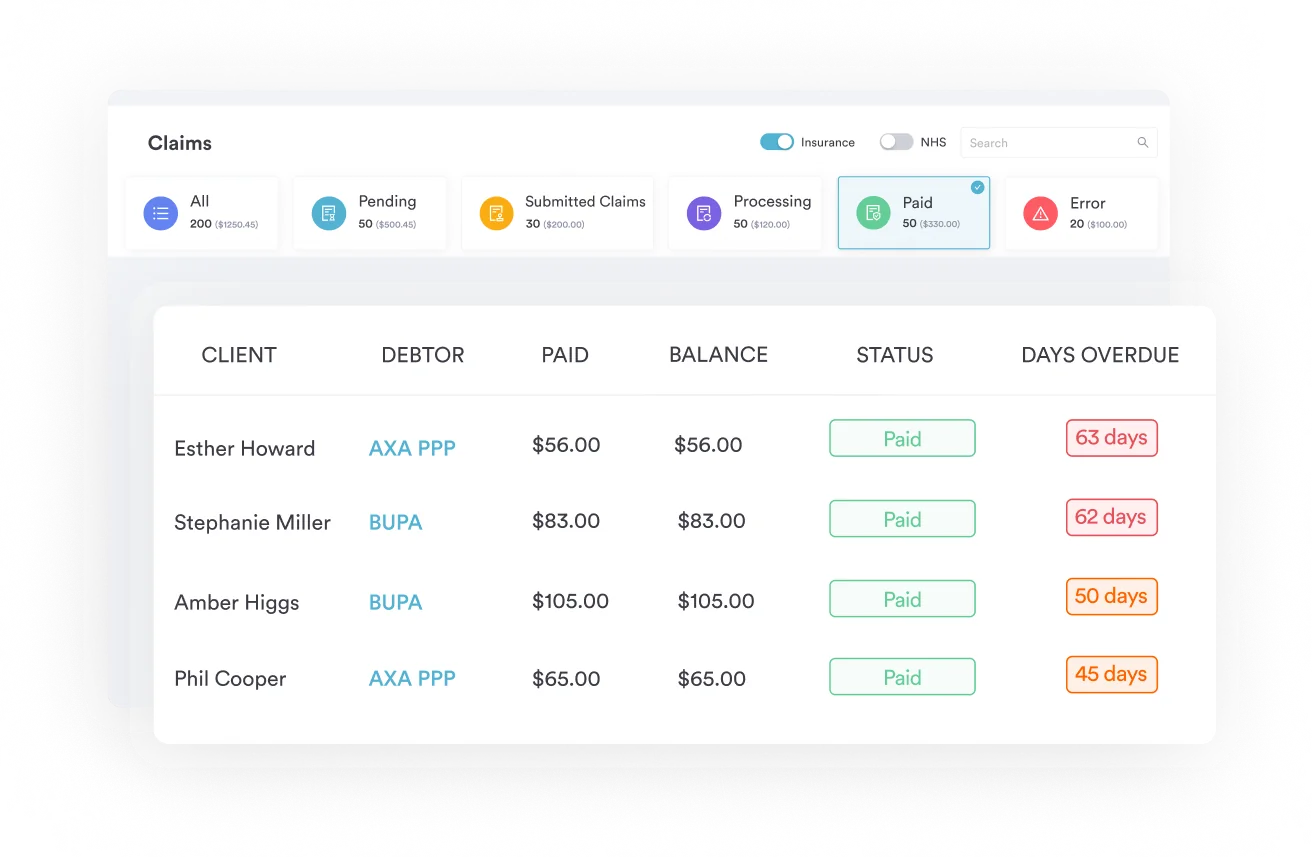

Pabau submits claims electronically through Claim.MD and tracks their status, so your team sees where every CPT 59000 claim stands. See how OB-GYN practices keep procedure notes and claims in one system.

CPT 59000 is won or lost in the procedure note. A note that records the specimen, the volume withdrawn and a signed guidance report supports 59000 and 76946 on first submission and on appeal.
The trade-off is a few minutes at scheduling. However, checking prior authorization and the payer’s 76946 policy before the procedure costs far less than reworking a denied claim afterward.
Pabau keeps those notes and claims in one place and tracks each claim’s status through Claim.MD. If you want to see how it fits your OB-GYN billing workflow, book a demo.

Need to understand how clearinghouse submission works for obstetric claims? Pabau’s Claim.MD clearinghouse guide explains how electronic claim routing and payer enrollment work for US practices.
Want to reduce CPT 59000 denials at the source? Denial codes in medical billing explains how to read CARC and RARC codes and build an appeal response for each category.
Sending a prior authorization request for amniocentesis? Medical prior authorization form gives you a structured request to send to the payer before the procedure date.
Appealing a bundling or medical necessity denial? Medical appeal form template gives you a ready structure for the appeal and its supporting documentation.
CPT code 59000 covers diagnostic amniocentesis, the transabdominal insertion of a needle into the amniotic cavity to withdraw fluid for laboratory analysis. However, it does not cover therapeutic amniocentesis (amnioreduction), which you report with CPT 59001. You report ultrasound guidance separately with CPT 76946 when you document it.
CPT 59000 is diagnostic amniocentesis: the physician withdraws fluid and sends it to a laboratory for analysis. CPT 59001 is therapeutic amniocentesis: the physician removes large volumes of fluid to reduce amniotic pressure, and no specimen goes for testing. So the clinical purpose and the volume withdrawn separate the two in the procedure note.
No. Standard AMA and CMS NCCI rules do not bundle ultrasound guidance into CPT 59000. CPT 76946 is separately reportable when the physician performs real-time guidance, retains a permanent image, and completes a separate written interpretation report. Some Medicare Advantage and commercial payers apply local edits that bundle 76946, so verify before billing both codes together.
The most common are missing prior authorization (CARC 197) and an ICD-10-CM code that does not support medical necessity (CARC 50). Also, a payer edit that bundles 76946 into 59000 returns CARC 97. Billing 59000 alongside 59001 for the same session and incorrect global package bundling also cause denials. The denial table in this article lists the corrective action for each.



