

HCPCS Code Q4185: Cellesta flowable amnion billing guide
HCPCS Code Q4185: definition and official descriptor HCPCS Code Q4185 is the Lev...

Last Updated: Nov 20, 2026
81265 is the CPT code for a comparative analysis using short tandem repeat (STR) markers on a patient specimen and a comparative specimen. Labs use it to build a baseline genetic profile, most often pre-transplant recipient and donor germline testing, so later chimerism results can be read.
The descriptor also covers post-transplant recipient germline testing on a buccal swab, twin zygosity testing and maternal cell contamination of fetal cells. It is usually billed once per lifetime as one unit. Post-transplant engraftment monitoring is a different service, reported with 81267 or 81268.
Let Pabau's smart automation suggest the right codes, reduce claim denials, and keep your practice compliant—effortlessly.
Automate repetitive tasks and focus on what matters most—your patients.
Reduce coding errors and ensure compliance with the latest regulations.
Clean claims, fewer denials, and faster reimbursements.
Powerful insights and reporting to help your practice thrive.
HIPAA compliant SOC 2 certified GDPR-compliant Trusted by 4,000+ clinics worldwide

CPT 81265 is a comparative STR analysis of a patient specimen and a comparative specimen, used to build a baseline genetic profile.
Its descriptor covers pre-transplant recipient and donor testing, post-transplant recipient germline testing, twin zygosity, and maternal cell contamination of fetal cells.
Post-transplant engraftment monitoring is not 81265. Report it with 81267, or with 81268 when specific cell types are selected.
MolDX guidance treats 81265 as a test usually performed once per lifetime, billed as one unit and not alongside 81267.
Report add-on 81266 for each additional specimen, and look up Medicare payment on the Clinical Laboratory Fee Schedule (CLFS).
CPT code 81265 reports a comparative analysis using short tandem repeat (STR) markers on a patient specimen and a comparative specimen. In transplant medicine, it is the baseline test that profiles the recipient and the donor before chimerism monitoring starts. Donor matching relies on a separate test, HLA typing. Each HLA Class II locus typed at high resolution is billed as CPT code 81382. Columbia University’s transplant immunogenetics lab lists 81265 and 81266 for the first, pre-transplant chimerism test and 81267 for post-transplant chimerism.
The result is a map of informative markers, meaning the STR alleles that tell the two genomes apart. Later engraftment tests read against that map, but those later tests carry their own codes. The full AMA descriptor reads:
Comparative analysis using Short Tandem Repeat (STR) markers; patient and comparative specimen (eg, pre-transplant recipient and donor germline testing, post-transplant non-hematopoietic recipient germline [eg, buccal swab or other germline tissue sample] and donor testing, twin zygosity testing, or maternal cell contamination of fetal cells)
CPT 81265 describes a side-by-side genotype comparison of two people, or of two cell sources that should belong to different people. The lab genotypes the same panel of STR loci in both specimens and records where the allele patterns differ.
The procedure has four steps that the lab report should reflect:
The output is a list of informative loci. A percentage of donor versus recipient cells comes from a post-transplant specimen, which is 81267 or 81268 territory. If the report gives a chimerism percentage, the service billed is probably 81267 or 81268.
The AMA descriptor names four comparisons as examples. Each one pairs a patient specimen with a comparative specimen, and each one is a single baseline study rather than a series.
A buccal swab matters in the second scenario because blood is no longer a clean recipient source after transplant. Donor cells now make up some or most of the recipient’s blood.
81265 sets the baseline once. 81267 and 81268 measure engraftment after the transplant, and they can repeat as the transplant team monitors the graft. The timeline below places each code against the transplant date.
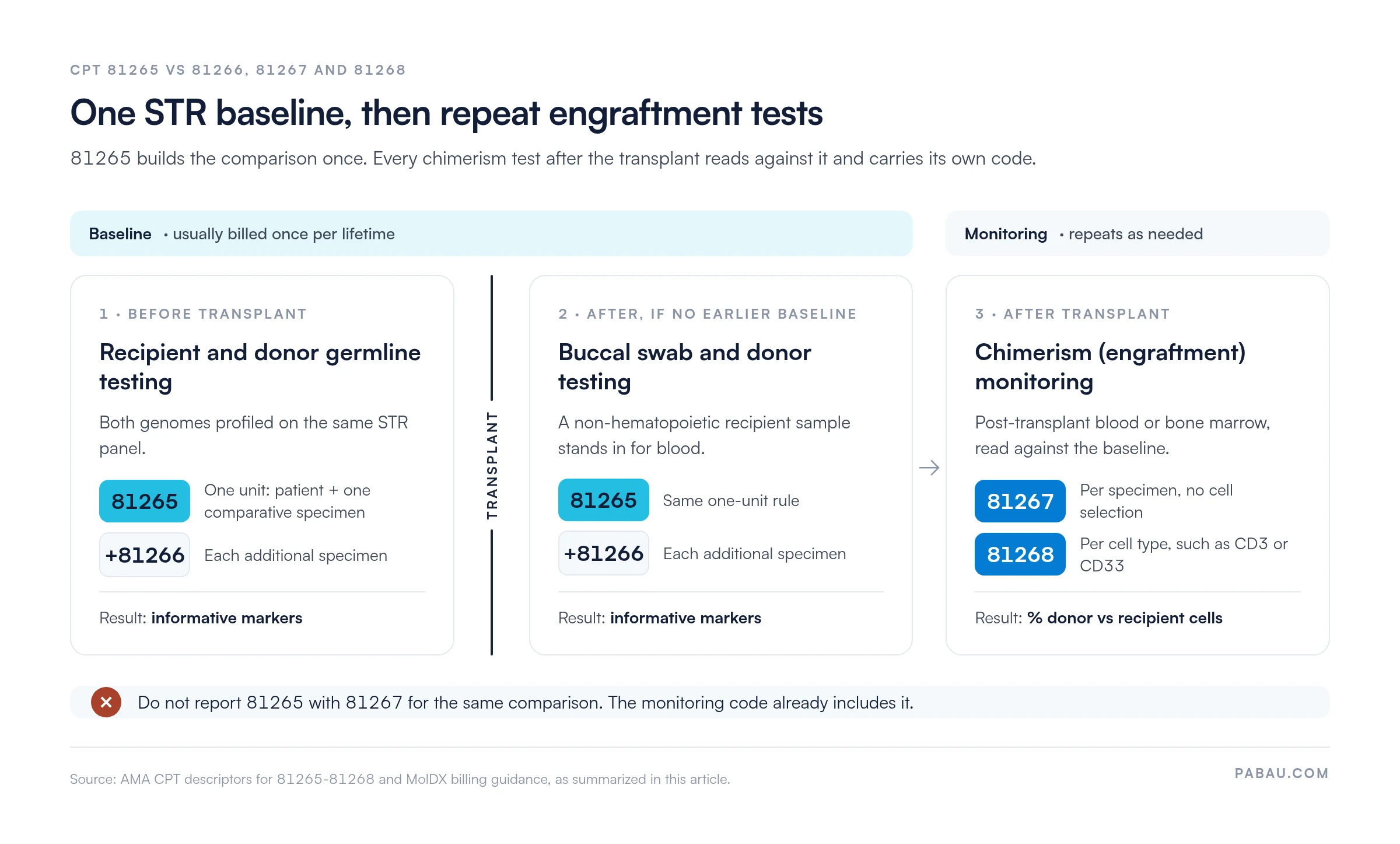
Engraftment schedules, mixed chimerism, relapse surveillance and graft-versus-host disease workups all belong to 81267 and 81268. The baseline is referenced in each of those reports, but it is not billed again.
MolDX guidance says not to report 81265 with 81267, because the post-transplant code already includes the comparison to the baseline. A claim that bills both for the same monitoring study is a common audit target.
CPT 81266 is the add-on for each additional specimen in a comparative STR study. It is reported on the same claim as 81265 and never on its own.
If a study compares more than two specimens, bill 81265 once and 81266 for each specimen beyond the first pair. Check the payer’s own policy before you add 81266 for a specific scenario, because guidance on its examples varies between sources.
The diagnosis on an 81265 claim should explain why a baseline comparison was needed. For transplant baselines, that means the planned transplant and the condition behind it. The codes below are illustrative examples, not a covered-diagnosis list.
For maternal cell contamination studies, the diagnosis follows the indication for the prenatal genetic test itself. Confirm each code against the applicable MolDX billing article or commercial policy before submission.
Medicare pays for 81265 under the Clinical Laboratory Fee Schedule when medical necessity is documented. In MolDX jurisdictions, a billing and coding article on STR markers and chimerism sets the rules for codes 81265 through 81268.
That guidance shapes three things on the claim:
Commercial plans set their own rules. Some require prior authorization for molecular pathology tests, and some limit payment to in-network specialty labs. Check the plan’s lab policy and network status before the specimen is sent.
CPT code 81265 is paid under the CMS Clinical Laboratory Fee Schedule, not the Physician Fee Schedule. It is a laboratory-only code, so it carries no physician work or malpractice RVU. CMS publishes the CLFS files each year and updates them quarterly.
Key payment facts for lab billing teams:
Because 81265 is a once-per-lifetime baseline, few modifiers apply. The table covers the ones billers ask about most.
Before you bill 81265, search the patient’s claim history for an earlier 81265. A prior baseline usually means today’s test is 81267 or 81268, or a second baseline that needs an ABN and a documented reason.
STR markers are microsatellites, so the same lab instrument can run comparison studies and microsatellite instability (MSI) testing. The two answer different questions and carry different codes.
CPT 81265 asks how two genomes differ, such as a recipient and a donor. MSI testing asks whether a tumor shows mismatch repair deficiency. It compares tumor and normal tissue from the same patient, not two people.
The correct code for MSI analysis is CPT 81301. CPT 81300 is not an MSI code; it describes MSH6 gene analysis. Both are defined in the AMA CPT code set with their own descriptors.
When an order comes in, ask one question. Is there a second person’s specimen, or a fetal sample checked against the mother? If not, 81265 is the wrong code, even if the lab report uses STR language.
CPT 81265 denials cluster around six coding errors, and each one can be caught before submission. Each denial comes back as a CARC and RARC pair, which the guide to denial codes in billing decodes. Effective denial management workflows start with these root causes.
A complete documentation package is the strongest defense against both denials and audits. Each element below is part of submitting a clean claim for this code.
Transplant programs bill an 81265 baseline once, then a run of 81267 or 81268 tests for months after. Pabau, the practice management platform we build, keeps those billed tests and their claims on one patient record. Your team can see which tests have already been billed before the next claim goes out.
Pabau’s claims management software submits claims electronically through Claim.MD. Your team can check eligibility first and see the remittance details when a claim comes back.
That shortens the loop when a frequency edit or a code pairing denial lands. The biller sees the denial reason next to the patient’s earlier claims, and can tell whether a baseline was billed twice.
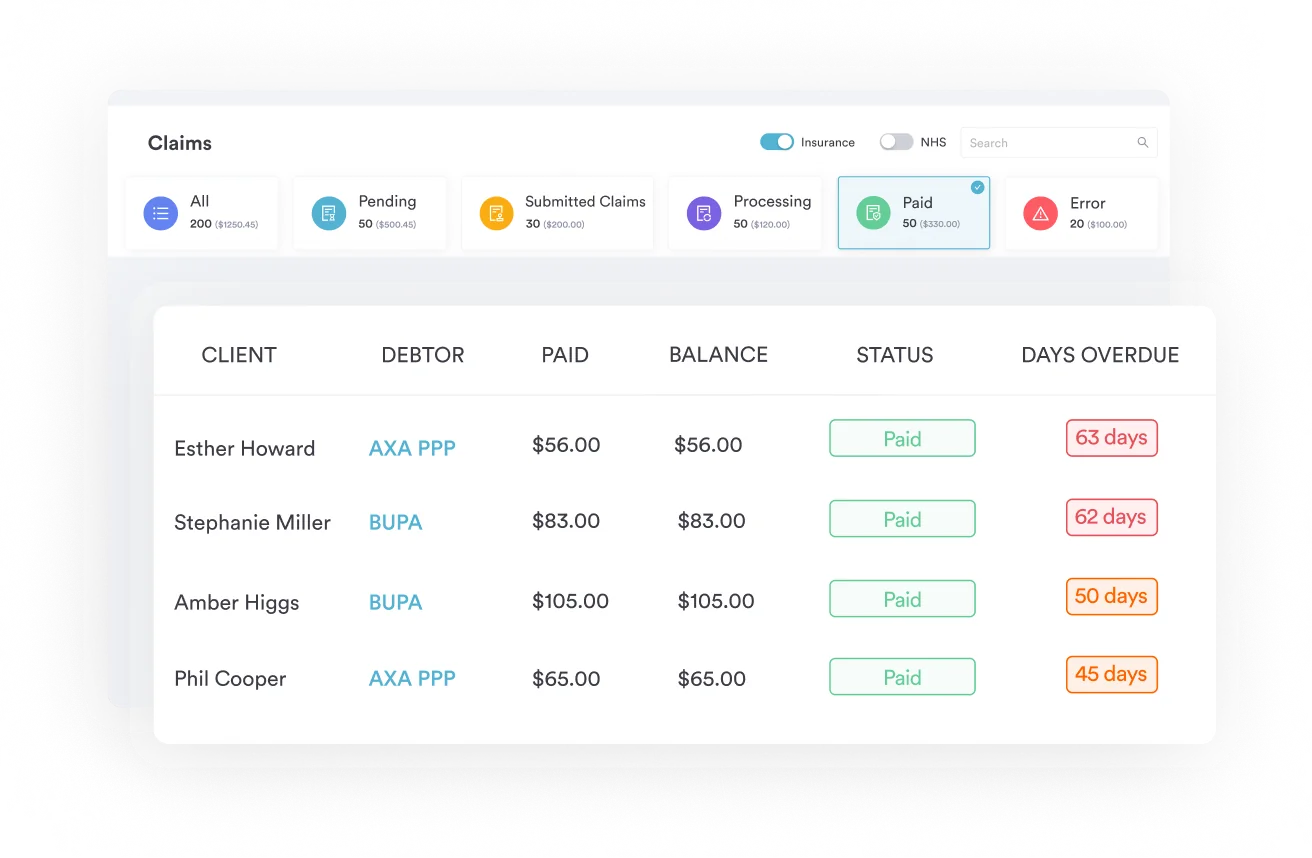

Pabau keeps billed tests, claims and remittance data on one patient record. Your team submits claims through Claim.MD, checks eligibility first and sees why a claim came back.

Read the specimen before you pick the code. A first comparison of two genomes is 81265, billed once, with 81266 for each extra specimen. A post-transplant blood or marrow sample measured against that baseline belongs to 81267 or 81268.
A claim-history check is the habit that pays off most. An earlier 81265 on file usually means today’s test is monitoring, or a second baseline that needs an ABN and a documented reason.
Book a demo to see how Pabau keeps transplant claims and billing history on one patient record.

Need a framework for handling claim rejections systematically? Denial codes in medical billing explains CARC and RARC code categories and how to build a resolution workflow around them.
Want to understand what a clearinghouse actually does with your 81265 claim? Medical claims clearinghouse guide covers the 837P validation, payer routing, and ERA return process step by step.
Looking for guidance on electronic remittance and payment posting? Electronic remittance advice (ERA) explains how 835 files map denial reasons back to individual claim lines for molecular pathology codes.
CPT code 81265 covers a comparative analysis using short tandem repeat (STR) markers on a patient specimen and a comparative specimen. Examples are pre-transplant recipient and donor testing, post-transplant recipient germline testing on a buccal swab, twin zygosity, and maternal cell contamination of fetal cells.
CPT 81265 is the primary code for a comparative STR study of a patient specimen and a comparative specimen. CPT 81266 is the add-on for each additional specimen in that study. Bill one unit of 81265 and add 81266 for extra specimens, rather than billing 81265 twice.
Yes, when medical necessity is documented. Medicare pays 81265 under the Clinical Laboratory Fee Schedule. MolDX guidance treats it as a test usually performed once per lifetime, billed as one unit, and not reported with 81267. Twin zygosity testing is treated as excluded from Medicare payment.
No. Engraftment or chimerism monitoring after a transplant is reported with 81267, or with 81268 when specific cell types are selected. Those codes include the comparison to the earlier baseline. CPT 81265 is the baseline comparison itself, usually done once.
No. CPT 81265 compares the genomes of two specimens, such as a recipient and a donor. Microsatellite instability testing of a tumor is reported with CPT 81301. CPT 81300 is not an MSI code; it describes MSH6 gene analysis.





