CPT Code 50432: Nephrostomy tube placement billing guide
CPT Code 50432: Official description and procedure overview CPT Code 50432 is th...

Last Updated: Nov 13, 2026
58572 is the CPT code for laparoscopy, surgical, with total hysterectomy, for uterus greater than 250 g. The surgeon removes the uterus and cervix entirely through laparoscopic ports and leaves the tubes and ovaries in place.
Two facts decide the code. The pathology report must record a uterus heavier than 250 g, or the claim belongs on 58570. If any tube or ovary comes out in the same session, the correct code is 58573.
Let Pabau's smart automation suggest the right codes, reduce claim denials, and keep your practice compliant—effortlessly.
Automate repetitive tasks and focus on what matters most—your patients.
Reduce coding errors and ensure compliance with the latest regulations.
Clean claims, fewer denials, and faster reimbursements.
Powerful insights and reporting to help your practice thrive.
HIPAA compliant SOC 2 certified GDPR-compliant Trusted by 4,000+ clinics worldwide

CPT 58572 reports a total laparoscopic hysterectomy for a uterus greater than 250 g, with no removal of tubes or ovaries
Uterine weight separates 58572 from 58570, and the signed pathology report is the only source for that weight
Adnexal removal separates 58572 from 58573, so any tube or ovary removed in the same session moves the claim to 58573
Never add 58661 or 58700 to 58572 for tube or ovary removal, because 58573 already describes that combination
Pabau, the practice management platform we build, keeps the operative note and pathology report on one patient file and submits claims electronically through Claim.MD
The American Medical Association defines CPT Code 58572 as Laparoscopy, surgical, with total hysterectomy, for uterus greater than 250 g. It belongs to the 58570-58573 family of total laparoscopic hysterectomy (TLH) codes in the AMA CPT code set.
Two variables split that family: the weight of the uterus and whether any tube or ovary comes out. 58572 is the large-uterus code with the tubes and ovaries left in place.
The approach must be fully laparoscopic, including detachment of the cervix. A laparoscopically assisted vaginal hysterectomy uses 58550-58554, and a laparoscopic supracervical hysterectomy uses 58541-58544. A case that converts to an open incision is reported with an open hysterectomy code such as 58150 instead.
Bundling rules matter on this code. The costliest error is adding a second code for work that another member of the TLH family already describes.
Included in 58572:
Not included, or a sign that a different code applies:
Check the current quarterly NCCI procedure-to-procedure edits before you report any second code alongside 58572. The edits update every quarter.
58570 and 58572 describe the same procedure, a TLH with the tubes and ovaries left in place. The only difference is weight: 250 g or less for 58570, greater than 250 g for 58572.
The pathology report is the authoritative source for that weight. An intraoperative estimate or an ultrasound measurement does not support the code. If pathology records 250 g or less, the claim belongs on 58570, even when the uterus looked large on imaging.
Hold the claim until the final pathology report is signed. Coding from the estimate in the operative note invites a recoupment when pathology comes back lighter.
58572 and 58573 share the same weight band, greater than 250 g. 58573 adds removal of one or more fallopian tubes and/or ovaries in the same session.
That includes an opportunistic salpingectomy performed to lower ovarian cancer risk. If the surgeon removed even a single tube with a uterus over 250 g, the code is 58573, not 58572.
Reporting 58572 plus 58661 for that case is unbundling, and NCCI edits deny it. The single code 58573 already captures both components.
Put the two questions side by side and the four TLH codes read as one decision.
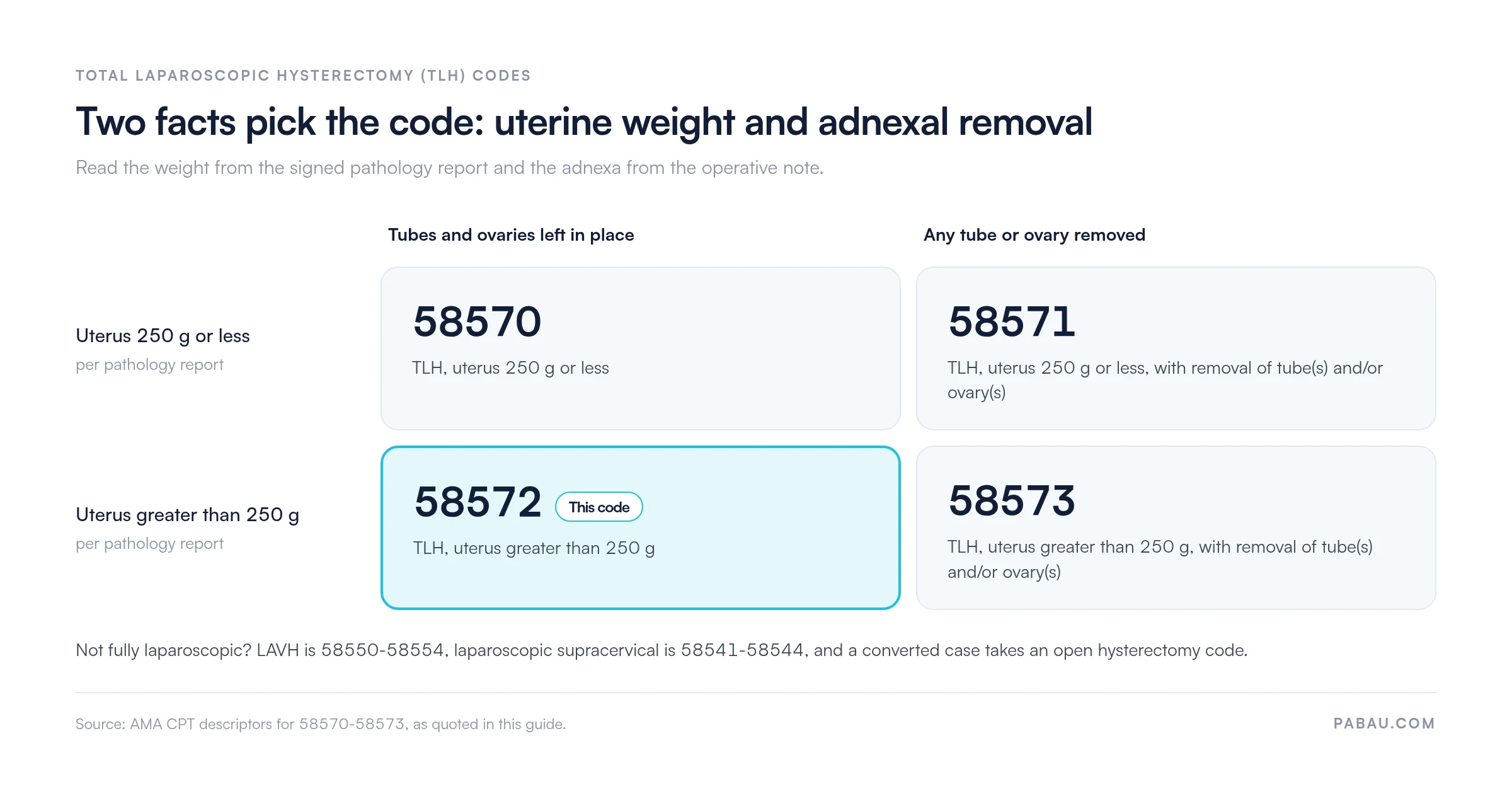
Run a two-question check on every 58572 claim. Does the signed pathology report show a uterus over 250 g? Does the operative note confirm that no tube or ovary was removed? Two yes answers mean 58572. A no on weight points to 58570, a no on adnexa points to 58573, and two no answers point to 58571.
Payer review of 58572 claims focuses on three facts: a fully laparoscopic approach, a uterus over 250 g, and no adnexal removal. Your workflow should capture all three before the claim leaves the practice.
The following elements must appear in the clinical record to support a 58572 claim:
A structured operative note template records these facts while the surgeon is still writing. A required field asking whether the adnexa were preserved stops the 58572-versus-58573 error before coding starts.
Modifiers explain circumstances that the code alone cannot convey. The wrong modifier, or a missing one, changes payment and can trigger a payer audit.
Modifier 22 carries a documentation burden. The operative note should name the cause and quantify the extra work. Record, for example, the added time spent on dense adhesions from a prior cesarean section.
Prior authorization rules for 58572 vary by payer and change often. Authorization is one of the front-end steps in medical billing, and a missing one denies an otherwise correct claim.
Key considerations by payer type:
Treat each payer policy as its own rule set. Check the current authorization grid or coverage policy for every case rather than relying on last year’s answer.
CPT Code 58572 carries a 90-day global surgical period under the Medicare Physician Fee Schedule (MPFS). Related services by the same surgeon during that window are not billed separately.
Use the CMS Physician Fee Schedule Look-Up Tool to retrieve the current national payment for 58572. Payment is adjusted by the Geographic Practice Cost Index (GPCI) for each locality.
For 2026, CMS publishes two conversion factors: $33.5675 for qualifying APM participants and $33.4009 for everyone else. Confirm which one applies to the billing clinician before you project revenue.
Hysterectomy is performed in a hospital or ambulatory surgery center, so the surgeon is paid the facility rate. The facility bills its own fee separately for the overhead.
Every CPT 58572 claim needs at least one ICD-10-CM code that establishes medical necessity. Payers check the diagnosis against their accepted indications, and an unsupported code denies automatically.
Payer coverage lists may exclude some subcodes or require more specificity than the category level. Review the payer policy before you finalize the diagnosis link, and code the condition at the highest specificity the record supports.
Bleeding codes show why. An unspecified code such as N93.9 rarely carries a hysterectomy on its own. Pair it with the fibroid or adenomyosis code that the pathology report supports.
Most 58572 denials trace to one of six root causes. Each one has a fix you can build into the pre-submission workflow.
A pre-submission check of these six points catches most avoidable 58572 denials. Make it a required step in the claim workflow so no coder can skip it under deadline pressure.
Check NCCI edits every quarter, not once a year. Bundling relationships between 58572 and codes such as 58661 or 49320 come from the quarterly CMS release. Set a reminder for each release date and review the edits for the codes your practice bills most often.
These codes sit next to 58572 in the AMA Laparoscopy/Hysteroscopy subsection or come up in the same claims. Match the code to the approach, the uterine weight, and what was removed.
Most 58572 errors start before a claim exists. The weight sits in a pathology report, the adnexal detail sits in an operative note, and the coder works from a third screen. Pabau keeps those records on one patient file.
Pabau’s electronic claims management submits the claim through Claim.MD, our US clearinghouse integration. Claim.MD returns Electronic Remittance Advice (ERA) data, so payer responses and denial reason codes appear in Pabau.
Your coders still make the code call. Pabau puts the operative note, the pathology report, and the signed consent form in front of them when they do.

Pabau keeps operative notes, pathology reports, and consent forms on the patient record. Claims go out electronically through Claim.MD, and ERA data comes back into the same system.

CPT Code 58572 turns on two facts: a uterus heavier than 250 g on the pathology report, and tubes and ovaries left in place. Get the weight wrong and the claim belongs on 58570. Miss a removed tube and it belongs on 58573.
Code from the signed pathology report and the operative note, never from an estimate. That one habit prevents most recoupments across the TLH family. Book a demo to see how Pabau keeps the records behind each TLH claim in one place.

Billing a smaller uterus with tube or ovary removal? CPT code 58571 covers the 250 g or less TLH code with adnexal removal.
Did the case convert to an open incision? CPT code 58150 covers total abdominal hysterectomy and the documentation it needs.
Want to reduce denials across your surgical code set? Denial management in healthcare covers the core workflows for preventing and working denials.
Leaving the cervix in place? CPT code 58542 covers laparoscopic supracervical hysterectomy for a uterus of 250 g or less with tube or ovary removal.
CPT Code 58572 reports a total laparoscopic hysterectomy for a uterus weighing more than 250 g, with no removal of tubes or ovaries. It sits in the 58570-58573 TLH family. 58570 covers the same procedure for a uterus of 250 g or less, and 58573 adds tube or ovary removal.
The difference is adnexal removal. Both codes cover a total laparoscopic hysterectomy for a uterus over 250 g. 58573 adds removal of one or more fallopian tubes or ovaries, including an opportunistic salpingectomy. 58572 applies only when the tubes and ovaries are left in place.
Medicare payment for CPT 58572 varies by locality through the Geographic Practice Cost Index (GPCI). Retrieve the current national facility and non-facility amounts from the CMS Physician Fee Schedule Look-Up Tool. For 2026, CMS uses two conversion factors, so confirm which one applies to the billing clinician.
The most common are 22 for substantially increased work, 62 for two surgeons, and 80 or AS for an assistant at surgery. Use 59 or XS only for a distinct, separately reportable service. Modifier 51 goes on secondary procedures, not on 58572 as the primary code.
No. If a tube or ovary is removed with a uterus over 250 g, report 58573 alone. Adding 58661 or 58700 to 58572 unbundles a combination that 58573 already describes, and NCCI edits deny it. Check the current quarterly NCCI edits for any other code you pair with 58572.
CPT Code 58572 carries a 90-day global surgical period under the Medicare Physician Fee Schedule. It covers preoperative visits the day before and the day of surgery, plus related postoperative care through day 90. Most commercial payers follow the same period.