CPT code 52648: Laser ablation of the prostate billing guide
What CPT code 52648 covers, and what it bundles in CPT code 52648 is the code fo...

Last Updated: Oct 21, 2026
57520 is the CPT code for conization of the cervix by cold knife or laser. The surgeon removes a cone of cervical tissue for pathology review. Fulguration, dilation and curettage, or repair at the same session are included, and the code carries a 90-day global period.
Cold knife or laser conization bills under 57520 and loop electrode conization under 57522. A technique mismatch triggers claim rejections and may require a corrected claim. So read the technique off the signed operative note before you code, then pair it with the diagnosis the pathology confirms.
Let Pabau's smart automation suggest the right codes, reduce claim denials, and keep your practice compliant—effortlessly.
Automate repetitive tasks and focus on what matters most—your patients.
Reduce coding errors and ensure compliance with the latest regulations.
Clean claims, fewer denials, and faster reimbursements.
Powerful insights and reporting to help your practice thrive.
HIPAA compliant SOC 2 certified GDPR-compliant Trusted by 4,000+ clinics worldwide

CPT code 57520 covers cervical conization by cold knife or laser, while loop electrode conization bills under 57522.
Fulguration, dilation and curettage, and repair at the same session are part of 57520, so none of them bills separately.
The code carries a 90-day global period, so related post-op visits are included in the surgical payment.
Pair it with N87.1 for CIN II, a D06.- code for CIN III or carcinoma in situ, or R87.613 when only cytology shows HSIL.
The most avoidable denial is a technique mismatch between the operative note and the code on the claim.
CPT code 57520 is the code for conization of the cervix done with a cold knife or a laser. Here is the full American Medical Association descriptor.
Conization of cervix, with or without fulguration, with or without dilation and curettage, with or without repair; cold knife or laser.
The instrument is what sets this code apart. A scalpel or a laser means 57520. A loop electrode moves the claim to a different code entirely.
Most cold knife cones happen in a hospital operating room (OR) or an ambulatory surgical center (ASC) under general or regional anesthesia. The surgeon removes a cone of tissue that takes in the transformation zone and part of the endocervical canal. The specimen then goes to pathology for margin review.
Three extras are already built into the code when they happen at the same session. The table shows what’s included and what bills on its own.
Surgeons reach for a cold knife cone when colposcopy can’t show the whole lesion, or when pathology needs clean, readable margins. A loop leaves some thermal artifact at the edges. That matters most when microinvasive cancer is suspected.
Typical indications include:
Record why you chose a cold knife over a loop in the operative note. Without that rationale, some payers send a 57520 claim to medical necessity review.
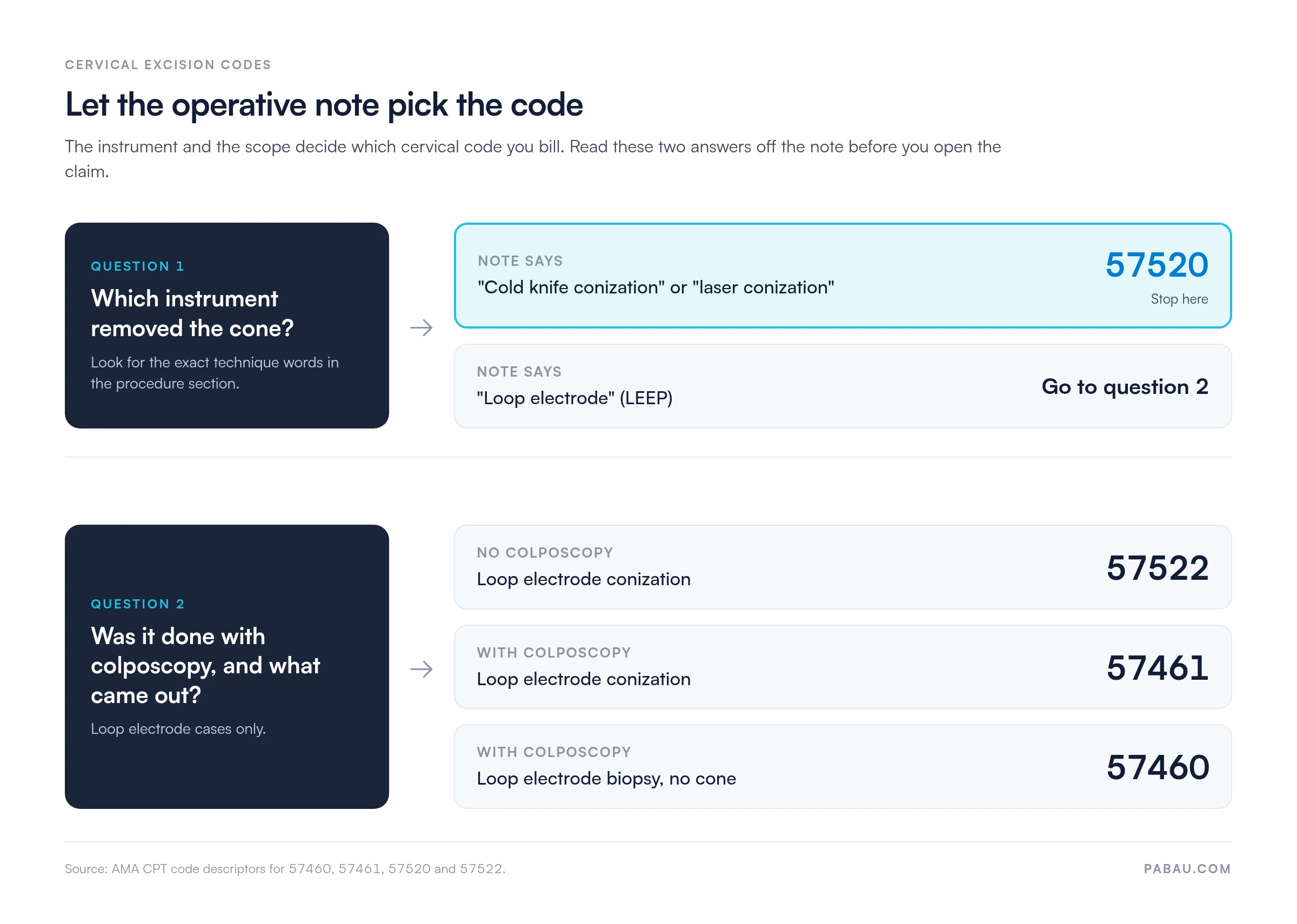
Swapping these two codes is the most common billing error on cervical cones. Both describe a cone-shaped excision, but the technique sets the code. 57522 covers conization by loop electrode, often called LEEP conization.
A LEEP done under colposcopy is a different code again. Colposcopy with loop electrode biopsy bills under 57460, and 57461 is colposcopy with loop electrode conization.
The decision path below gets you from the operative note to the right code in two questions.
CPT code 57520 sits in a family of cervical procedures that seldom pay together on one date. National Correct Coding Initiative (NCCI) edits decide which pairs bundle. Check the current column 1/column 2 status before you bill any two of these on the same day.
For descriptors outside this family, our CPT code library covers the rest of the female genital system codes.
Every 57520 claim needs an ICD-10-CM diagnosis that shows medical necessity. Payers expect the most specific code the pathology supports. An unspecified dysplasia code against a surgical procedure invites a denial.
Watch the CIN III row closely. ICD-10-CM has no N87.2 code, so CIN III and severe dysplasia both go to the D06 category for carcinoma in situ of the cervix.
Code to the grade the pathology confirms. CIN II takes N87.1, while CIN III moves to a D06.- code. Keep N87.9 for the rare note that gives no grade at all, and expect closer review when you use it.
Solid documentation is what separates a paid cone claim from a denial or an audit finding. The operative note and the pathology report form the core of the record. Good medical billing compliance means the note is signed before the claim goes out, not dug up when an audit letter arrives.
The operative note for CPT 57520 should show:
A clean claim for 57520 has three documents behind it: the operative report, the pre-op colposcopy note and the pathology report. When one of them is missing, a documentation denial usually follows.
Here’s the usual path for a cold knife cone claim, and the point where each step tends to stall.
Pathology often reports after the claim is otherwise ready. If the final report changes the grade, update the ICD-10 code before you submit. Correcting it afterwards costs you a resubmission.
CPT code 57520 carries a 90-day global surgical period under the CMS Physician Fee Schedule. Related post-op visits in those 90 days are part of the surgical payment. An unrelated visit or procedure inside the window needs modifier 24 or 79.
Payment also varies by Medicare Administrative Contractor (MAC) locality. Check this year’s figures for your area in the FastRVU 2026 RVU lookup.
Track the global period start date in your billing workflow for every surgical code like 57520. That date is what stops a bundled post-op visit from going out as a separate charge.
Traditional Medicare (Parts A and B) generally doesn’t require prior authorization for CPT 57520, though it’s worth confirming with your MAC. Medicare Advantage plans and commercial insurers are a different story. Many set their own rules for surgical gynecologic procedures, and those vary by plan and state.
So build a prior auth check into your insurance eligibility verification before the surgery date goes on the calendar. When a commercial payer wants authorization, the package typically includes:
Medicaid rules for 57520 vary a lot by state. Some programs pre-certify every ASC or hospital OR gynecologic procedure. Never assume that Medicare’s lack of a prior auth rule carries over to a Medicare Advantage or Medicaid managed care plan.
A good denial management workflow for 57520 starts with the errors that hit this code most often. Same-day bundling comes first.
NCCI edits bundle several 57500-family codes with 57520 on the same date. ECC (CPT 57505) is the usual problem. When the ECC is a distinct, separately documented procedure, modifier 59 or XU may apply. When it’s part of the conization itself, don’t bill it.
Check the NCCI modifier indicator for 57505 with 57520 before you add a modifier. That indicator decides whether a modifier is allowed at all.
Same-day colposcopy is the other frequent trigger. Colposcopy done only to guide the cone is part of the surgical service. If a separate evaluation came first and led to the decision to operate, modifier 59 may be warranted with documentation of that encounter.
In many OB/GYN practices, the operative note lives in one system and the claim gets built in another. Someone retypes the codes, and that’s where a 57522 slips in for a cold knife cone.
Pabau, the practice management platform we build, keeps the note and the claim in the same patient record. With claims management built in, the CPT code attached to the procedure lands on the charge line. Diagnoses come from the patient’s recorded problem list.
Pabau connects that documentation to claim submission through Claim.MD in the US and Healthcode in the UK. CPT and ICD-10 lookup libraries sit inside the claim form. Required fields, such as authorization numbers, get checked before the claim can be sent.
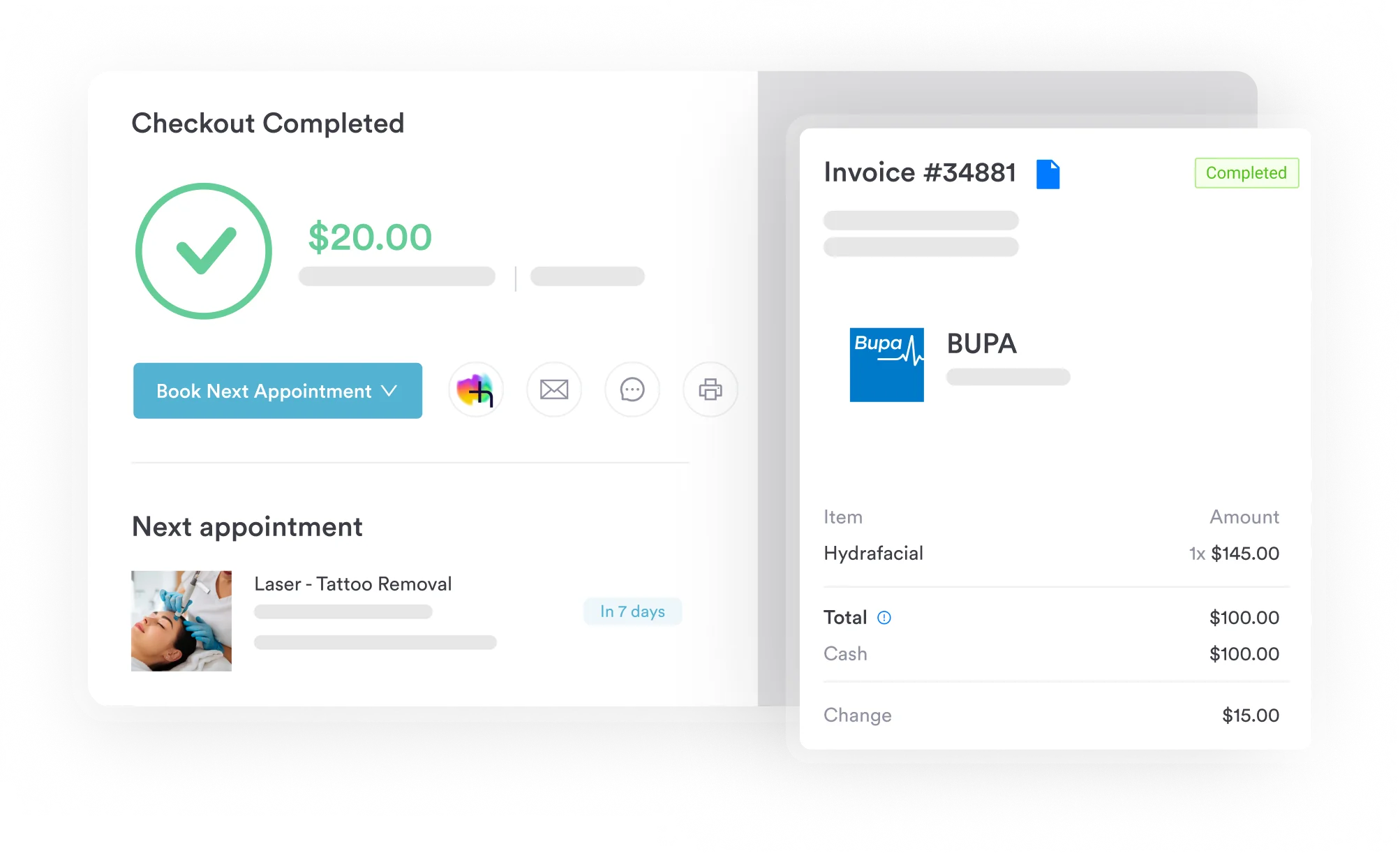

Pabau pre-fills claims from the patient record and sends them through Claim.MD, so your 57520 claims match the procedure your surgeon documented.

Treat the operative note as the source of the code, not the surgery schedule. If the note says cold knife or laser, bill 57520. If it says loop electrode, the claim belongs to another code, whatever the booking said.
Give the diagnosis the same discipline. Wait for the pathology grade, code CIN III to D06.-, and keep post-op visits off the claim for 90 days. Those three habits remove the most avoidable denials on cervical cones.
If retyping codes between systems is where your errors start, book a demo to see Pabau build the claim straight from the operative record.

Need to understand how clearinghouse claim submission works? Medical claims clearinghouse guide explains how electronic claim routing and payer edits work before a claim reaches the payer.
Want to reduce claim rejections before they happen? Denial codes in medical billing covers the CARC codes that explain why CPT claims are rejected and how to respond.
Looking to verify 837P submission requirements? 837 file guide covers the electronic claim format used for CPT procedure codes, including surgical gynecologic claims.
Coding the colposcopy that came before the cone? CPT code 57452 covers diagnostic colposcopy of the cervix without biopsy.
Was it a loop biopsy rather than a cone? CPT code 57460 explains colposcopy with loop electrode biopsy and how it differs from conization.
No. CPT 57520 covers cold knife or laser conization. A LEEP cone bills under 57522, or under 57461 when it’s done with colposcopy. A loop biopsy under colposcopy is 57460.
Bill one unit per session. The code already describes the whole cone procedure, including any fulguration, D&C or repair, so those steps never add units.
It depends on whether the return was planned. Use modifier 58 when a re-excision was planned at the first surgery. Use modifier 78 for an unplanned return to the OR for a related problem.
No. The anesthesia provider bills their own anesthesia code, and the pathologist bills the specimen exam separately. CPT 57520 pays only for the surgeon’s work and the steps in its descriptor.
Yes, when the record supports medical necessity, typically CIN II, CIN III or adenocarcinoma in situ. Traditional Medicare generally needs no prior authorization, but Medicare Advantage plans often set their own rules.
Rarely. Cold knife cones usually happen under general or regional anesthesia in a hospital or ASC. Bill the place of service where the surgery took place, because Medicare pays a different rate by setting.