HCPCS Code Q4185: Cellesta flowable amnion billing guide
HCPCS Code Q4185: definition and official descriptor HCPCS Code Q4185 is the Lev...

Last Updated: Nov 20, 2026
57511 is the CPT code for cautery of the cervix by cryocautery, initial or repeat. It reports destroying abnormal cervical tissue by freezing it, usually to treat biopsy-confirmed dysplasia, once per treatment session.
The code belongs to the cautery of cervix family. 57510 reports electro or thermal cautery and 57513 reports laser ablation, so the energy source decides the code. The number of freeze cycles never changes it.
Let Pabau's smart automation suggest the right codes, reduce claim denials, and keep your practice compliant—effortlessly.
Automate repetitive tasks and focus on what matters most—your patients.
Reduce coding errors and ensure compliance with the latest regulations.
Clean claims, fewer denials, and faster reimbursements.
Powerful insights and reporting to help your practice thrive.
HIPAA compliant SOC 2 certified GDPR-compliant Trusted by 4,000+ clinics worldwide

CPT Code 57511 reports cautery of the cervix by cryocautery, initial or repeat, which destroys abnormal cervical tissue by freezing it.
The cautery of cervix family splits by energy source. 57510 is electro or thermal cautery, 57511 is cryocautery, and 57513 is laser ablation.
In the CY2026 Medicare fee schedule, 57511 carries 1.90 work RVUs, 5.69 total non-facility RVUs and a 10-day global period.
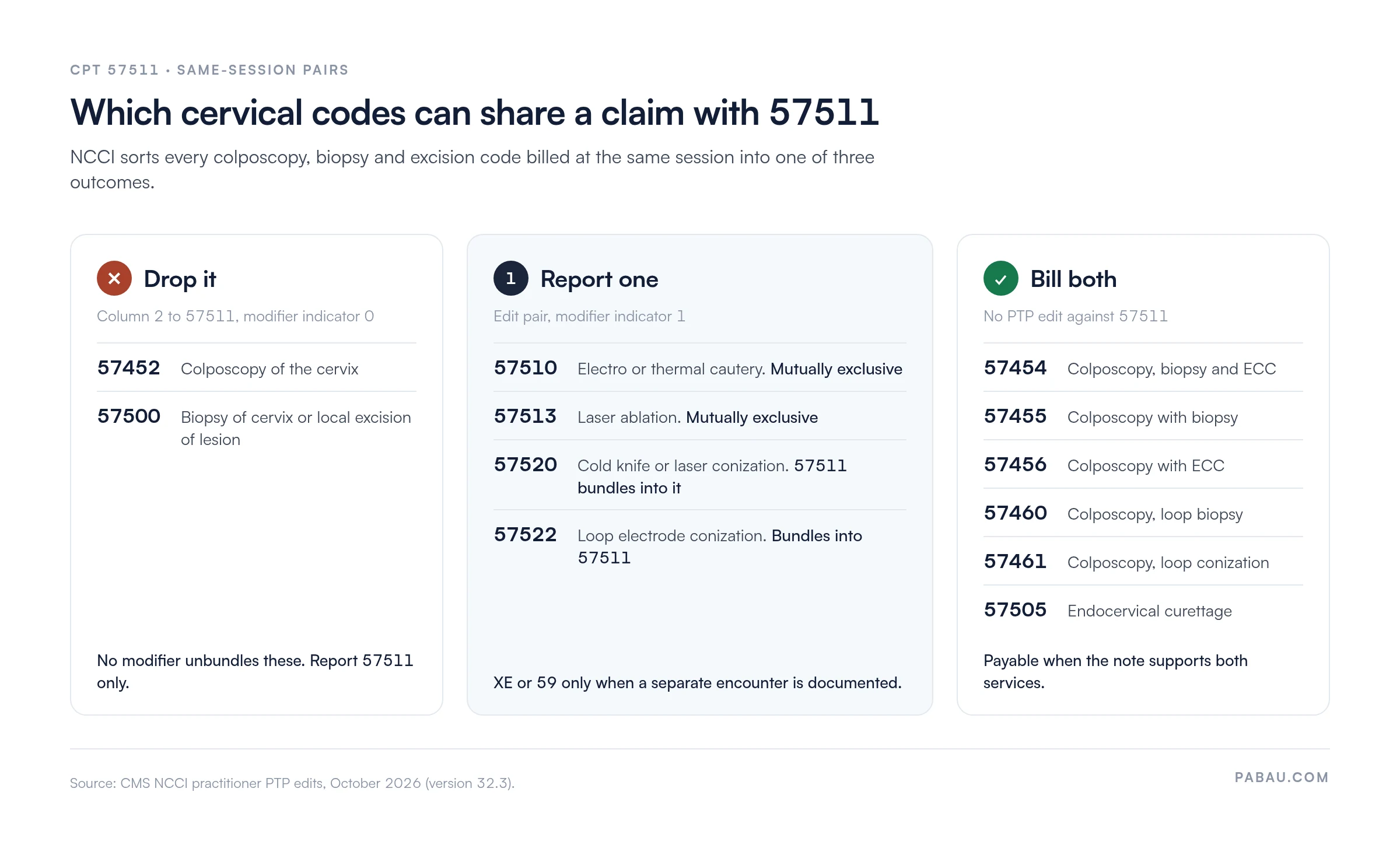
NCCI bundles colposcopy 57452 and cervical biopsy 57500 into 57511 with no modifier bypass, while 57454 through 57461 carry no edit against it.
Pabau, the practice management and billing platform we build, submits 57511 claims through Claim.MD and posts the remittance back to the patient record.
CPT Code 57511 is the code for cautery of the cervix by cryocautery, initial or repeat. A cryoprobe freezes abnormal tissue on the cervix, which then dies and sloughs off. The AAPC code listing for 57511 describes it as using cryocautery one or more times to destroy cervical tissue.
Initial or repeat means the code describes each treatment session. The descriptor does not count the freeze cycles the provider applies within that session. A double-freeze technique is common in practice, but the descriptor does not mention it and it does not change the code.
Clinically, 57511 treats cervical lesions where ablation suits the case, most often biopsy-confirmed cervical dysplasia. The diagnosis and the colposcopy findings decide whether ablation is appropriate. The code only records which ablation method was used.
The three cautery of cervix codes share one structure. Each reports destruction of cervical tissue in a session, and each is defined by the energy the provider uses.
Pick the code from the device named in the procedure note. A note that records cryotherapy or cryocautery supports 57511, and a laser note supports 57513. NCCI treats 57510, 57511 and 57513 as mutually exclusive, so one cautery method is reported per encounter.
Colposcopy, biopsy and excision codes often land on the same date as 57511. Codes outside this cervical family are in our CPT library for coders. The table shows how Medicare NCCI practitioner edits treat each pair (October 2026 file, version 32.3).
No PTP edit means NCCI does not bundle the pair. The payer can still review medical necessity, so the note must support both. The table lists CPT 57505 as one such pair, so a same-day endocervical curettage needs its own documented reason. For the colposcopy side, see the guides to CPT 57452 and CPT 57460.
Together, the edits sort every same-session cervical code into three outcomes: drop it, report one, or bill both.
Every 57511 claim needs a diagnosis that supports destroying cervical tissue. Coverage rests on medical necessity and on payer policy, so treat the codes below as common indications rather than a covered list. Confirm them against your MAC and commercial policies.
Lead with the confirmed diagnosis from colposcopy-directed biopsy. Claims that carry only a screening code or a cytology finding are the ones payers most often question. Verify current code status in the CMS ICD-10 resources before you submit.
CMS prices 57511 under the Medicare Physician Fee Schedule. The figures below come from the CY2026 PFS relative value file, October release (RVU26D).
CY2026 uses two conversion factors. Qualifying APM participants are paid at $33.5675 per RVU, and other clinicians at $33.4009. Each payment row is the total RVU multiplied by that factor.
These are national amounts before geographic adjustment. Your MAC applies locality GPCIs, so look up your own rate in the CMS Physician Fee Schedule look-up tool.
Two more indicators in the file matter on busy claims. Multiple procedure indicator 2 applies the standard reduction when 57511 is not the highest-valued procedure. Assistant at surgery indicator 1 means Medicare does not pay an assistant.
The procedure note has to name the energy source, because that is what separates 57511 from 57510 and 57513. It also has to justify treating the cervix in the first place.
A repeat treatment is still 57511, because the descriptor covers initial or repeat sessions. Inside the 10-day global period of an earlier procedure, it needs a modifier that explains it, such as 58 for a planned staged procedure.
Prior authorization for 57511 depends on the payer and the place of service. Medicare Advantage and commercial plans set their own rules, and an office procedure can need approval when it moves to an ASC. Check the plan through its provider portal before you schedule. The medical billing fundamentals guide covers the wider authorization workflow.
The National Correct Coding Initiative decides which codes can be paid alongside 57511. The rows below come from the Medicare practitioner PTP file for October 2026. Read them against the billing compliance requirements your practice already follows.
NCCI tables change every quarter. Check the current CMS NCCI PTP edit files before you build a claim template around these pairs.
Most 57511 denials trace back to how the claim was built. Tracking denial management workflows at the code level shows which of these patterns your practice repeats.
The place of service code decides which fee schedule rate applies. 57511 is usually done in the office, where the physician is paid the non-facility rate. In a hospital outpatient department or an ASC, the physician is paid the facility rate and the facility bills separately.
A billing system that defaults to POS 11 for a facility case overpays the physician. That claim is exposed on audit, so confirm the POS on every 57511 claim.
Run a quarterly report of 57511 claims by place of service. If a provider moved cryocautery into an ASC, the billing default may still say POS 11. Fixing the default once stops the overpayment on every later claim.
Many 57511 denials start before the claim leaves the building. A bundled colposcopy line, a screening-only diagnosis, or a note that never names the method each sends the claim back.
Pabau keeps the procedure note, the diagnosis and the claim on one patient record. Your team can build a cryocautery note template that asks for the method, the area treated and the indication. That note then sits in the patient’s chart, ready to support the code if a payer asks.
In the US, Pabau’s claims management software submits CMS-1500 claims through Claim.MD, checks eligibility and posts ERA remittances. Your coder still chooses the codes and modifiers, and Pabau sends and tracks what the coder entered.
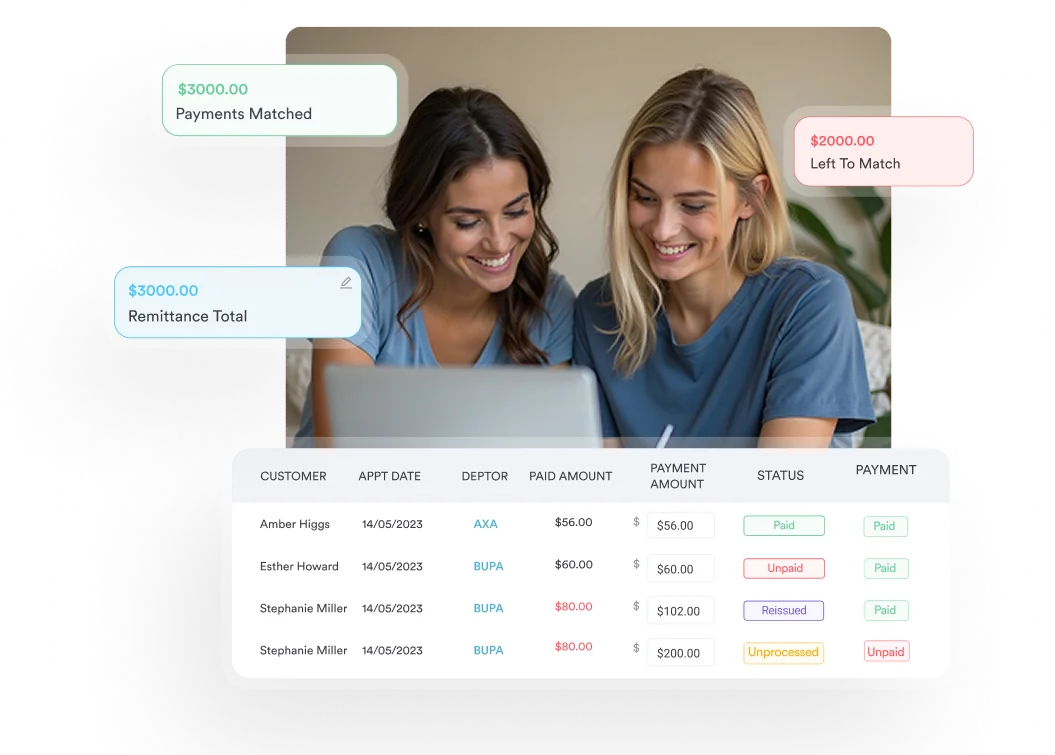

Pabau keeps the cryocautery note, the diagnosis and the claim on one record, then submits through Claim.MD and tracks the remittance. Your team spends less time reworking bundled lines.

Choose the cautery code from the energy source named in the note. If the provider froze the tissue, the claim is 57511, however many freeze cycles were used.
The rest of the claim depends on the session. Drop 57452 and 57500 when they ride along, add 25 only for a separate E/M, and lead with the biopsy-confirmed diagnosis.
Book a demo to see how Pabau keeps cervical procedure notes and claims on one record for gynecology practices.

Treating with a loop excision instead? CPT 57522 covers loop electrode conization of the cervix, which removes tissue rather than freezing it.
Billing colposcopy without treatment? CPT 57452 covers the diagnostic colposcopy that 57511 bundles when both happen at one session.
Looking for denial prevention strategies beyond 57511? Denial management in healthcare covers how billing teams track, categorize and reduce denials.
Want to understand what makes a claim pay first time? Submitting a clean claim breaks down the field-level requirements that separate paid claims from rejected ones.
CPT Code 57511 reports cautery of the cervix by cryocautery, initial or repeat. Providers use it when they destroy abnormal cervical tissue, such as biopsy-confirmed dysplasia, by freezing it with a cryoprobe.
The energy source. 57510 reports electro or thermal cautery of the cervix, and 57511 reports cryocautery. A third code, 57513, reports laser ablation. The number of freeze cycles does not change the code.
Common indications include N87.0 for mild and N87.1 for moderate cervical dysplasia, N87.9 for unspecified dysplasia, and N86 for erosion or ectropion. A screening code such as Z12.4 does not support treatment on its own. Check covered codes against your payer policy.
It depends on the plan. Medicare Advantage and commercial plans set their own rules, often by place of service. Check the plan before you schedule, because some payers refuse retroactive requests.
The CY2026 national non-facility amount is $190.05, from 5.69 total RVUs at the $33.4009 conversion factor. The facility amount is $131.60. Qualifying APM participants get $191.00 and $132.26, and locality adjustments change the final figure.