

CCSD code G5100: Bypass of duodenum billing guide
CCSD code G5100 bills a bypass that leaves the duodenum in place CCSD code G5100...

Last Updated: Oct 16, 2026
54056 is the CPT code for destruction of lesion(s), penis (eg, condyloma, papilloma, molluscum contagiosum, herpetic vesicle), simple; cryosurgery. It covers simple cryosurgical destruction of benign penile lesions, while extensive destruction by any method is reported with 54065.
The code sits in the male genital system section of CPT surgery. A penile wart destroyed by simple cryosurgery is reported with 54056, not with the 17000-series codes used at other body sites.
Let Pabau's smart automation suggest the right codes, reduce claim denials, and keep your practice compliant—effortlessly.
Automate repetitive tasks and focus on what matters most—your patients.
Reduce coding errors and ensure compliance with the latest regulations.
Clean claims, fewer denials, and faster reimbursements.
Powerful insights and reporting to help your practice thrive.
HIPAA compliant SOC 2 certified GDPR-compliant Trusted by 4,000+ clinics worldwide

CPT code 54056 covers simple cryosurgical destruction of penile lesions only, and extensive destruction is reported with CPT 54065.
The anatomical site documented in the procedure note decides whether 54056 or a 17000-series code applies.
Supported ICD-10-CM codes include A63.0 (anogenital warts), B08.1 (molluscum contagiosum), A60.01 (herpesviral infection of penis), and D29.0 (benign neoplasm of penis).
A procedure note that states site, method, lesion count, lesion size, and “simple” prevents most avoidable 54056 denials.
Pabau’s claims management software links CPT code selection to the procedure note, so codes aren’t retyped between systems.
CPT code 54056 is a surgical procedure code in the male genital system chapter of the AMA CPT code set. Its official descriptor reads: Destruction of lesion(s), penis (e.g., condyloma, papilloma, molluscum contagiosum, herpetic vesicle), simple; cryosurgery.
The parenthetical examples in the descriptor are illustrative, not exhaustive. Any benign penile lesion destroyed by simple cryosurgery can be reported under this code, provided the documentation supports it.
“Simple” distinguishes this code from CPT 54065, which covers extensive destruction. The method must be cryosurgery. Laser, electrosurgery, chemosurgery, and surgical excision are reported with other codes in the same range.
The simple/extensive distinction is where coders working with penile lesion destruction most often go wrong. CPT 54056 reports simple cryosurgical destruction. CPT 54065 reports extensive destruction of penile lesions by any method (cryosurgery, laser, electrosurgery, or chemosurgery), with a greater scope of tissue involvement.
The AMA CPT manual does not publish a lesion count that separates simple from extensive. Without one, a payer reviewing the operative note may decide that a case billed as 54056 was extensive. The safest approach is to document the number of lesions, their size, and the clinical reason for classifying the procedure as simple.
Coders frequently reach for CPT 17000 or 17110 when a patient presents with penile warts. That is the wrong code family. Anatomical site drives selection, not lesion type, and the decision path below asks the three questions in that order.
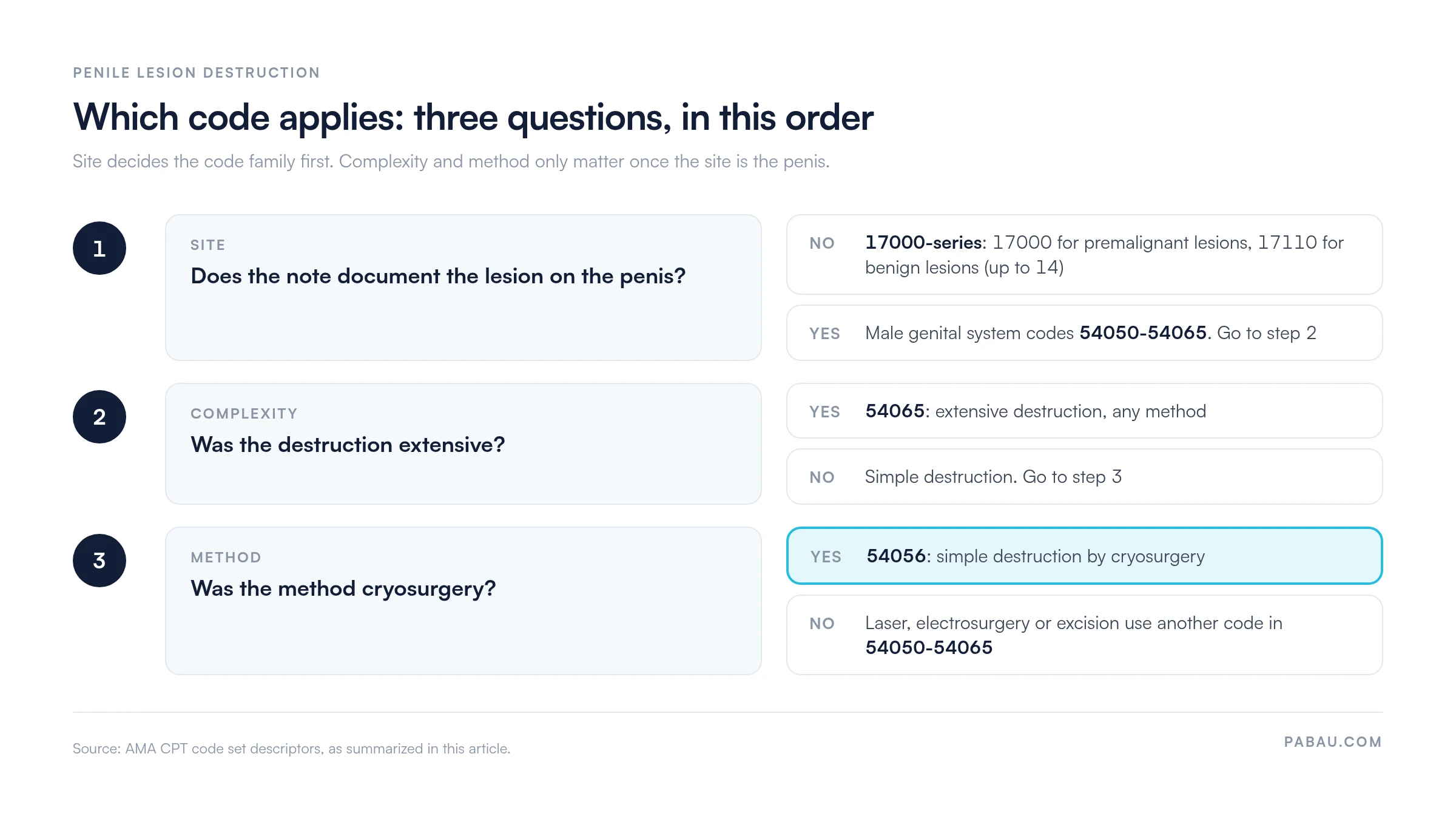
When the documentation specifies that the lesion is on the penis, codes from the male genital system chapter (54050-54065) apply. The 17000-series covers destruction at other body sites and does not include the penis.
Billing 17000 or 17110 for a penile lesion will likely draw a medical necessity denial. Payer claim edits expect those codes at non-genital body sites.
Every CPT 54056 claim requires a supported ICD-10-CM diagnosis code. Use the CPT-to-ICD-10 crosswalk to verify current payer-accepted pairings, and select the most specific code available.
Payers increasingly reject claims where the ICD-10 code is not specific enough to establish medical necessity for a penile-site destruction procedure.
The procedure note must address six elements to support a clean 54056 claim. Missing any one of them gives the payer grounds for a medical necessity denial or a request for records.
Take a note that reads “destroyed wart on penis with liquid nitrogen, 3 lesions, each approximately 3 mm, simple cryosurgery.” That one line covers five of the six elements, and consent is recorded separately. Vague notes such as “treated penile lesion” cover almost none of them.
Build a procedure note template for penile lesion destruction. Make site, method, lesion count, lesion size, and the simple/extensive designation required fields before the note can be finalized. The clinician then can’t sign a note that is missing the details a payer checks first.
Three modifiers come up regularly on CPT 54056 claims. Applying them incorrectly is one of the fastest routes to a bundling denial.
Per CMS National Correct Coding Initiative (NCCI) policy, modifier 25 belongs on the E/M code, not on the procedure. The E/M service must be documented as medically necessary and beyond the pre/post-operative care included in the procedure’s global period.
A note that says only “examined the patient prior to destruction” is not sufficient to support a separately identifiable E/M.
Medicare reimbursement for CPT code 54056 is determined by the CMS Physician Fee Schedule, which publishes facility and non-facility rates annually.
Rates change each January and vary by geographic location via the Geographic Practice Cost Index (GPCI). Always verify current rates directly through the CMS MPFS lookup tool before quoting a patient or preparing a financial forecast.
For reference, CPT 54056 carries a work RVU in the range of approximately 1.0-1.5. The total RVU (work + practice expense + malpractice) will be higher in the non-facility setting. Use the FastRVU lookup tool to retrieve current RVU values and convert them to a payment estimate for your Medicare contractor’s locality.
Private payer contracts may reimburse above or below the Medicare fee schedule. Verify your contracted rate for 54056 in your individual payer agreements. Rates sourced from third-party aggregators should always be cross-checked against the official CMS tool before use in financial planning.
Yes, CPT 54056 can be billed on the same day as an evaluation and management (E/M) service. The E/M must be a significant, separately identifiable service beyond the care built into the destruction procedure. It also needs its own documentation in the medical record.
Modifier 25 goes on the E/M code. The procedure note for 54056 and the E/M note must be distinct. A common audit trigger is an E/M note that only describes the lesion and the plan to destroy it. That documentation supports the procedure, not a separate E/M visit.
Here is an E/M that is separately billable. The patient presents with a newly noticed penile lesion, and the provider takes a sexual history, orders STI screening, and counsels on transmission risk.
That evaluation is substantively beyond preparing to perform cryosurgery and warrants a separate E/M with modifier 25. Before submitting, check both notes against what a clean claim needs.
Prior authorization (PA) requirements for CPT code 54056 vary significantly by payer and plan. Medicare traditionally does not require PA for this procedure, but Medicare Advantage plans may. Commercial insurers increasingly require PA for dermatological and urological destruction procedures, including penile lesion cryosurgery.
Before scheduling a 54056 procedure, verify authorization requirements directly with the patient’s payer. Ask three questions:
Some payers apply clinical criteria that mirror published guidelines from the American Urological Association (AUA) or the American Academy of Dermatology. Documenting that the lesion is symptomatic, confirmed by clinical examination, and appropriate for cryosurgical management strengthens the authorization request.
PA requirements shift frequently, so verify them at scheduling rather than at billing. Insurance eligibility verification before each visit catches plan changes that would affect authorization requirements.
Most 54056 denials fall into five categories. Understanding the root cause of each lets billing staff resolve them faster and prevent them on future claims.
For claims already denied, denial management workflows give billing teams a fixed sequence. They track the claim adjustment reason code (CARC), find the missing documentation, correct it, and resubmit within the payer’s timely filing window. Appeals without the corrected documentation rarely succeed.
The denial code reference explains the CARC codes that appear most often on dermatology and urology procedure denials.
In most sexual health and urology practices, the clinician writes the procedure note. A biller later reads it to pick the CPT and ICD-10 codes. Each handoff is a chance for “penis” to become “genital area” or for “simple” to drop out of the record.
Pabau, the practice management and billing platform we build, keeps the note and the claim in one record. With Pabau’s claims management software, the codes documented at the point of care carry through to the claim without manual re-entry. Claims go out electronically through the Claim.MD clearinghouse integration, with eligibility checked before the visit.
When a denial does come back, the ERA attaches the CARC code to the claim itself. Your team can flag it, correct the note, and resubmit without leaving the billing module. Fewer 54056 claims then age out of the timely filing window.

Pabau connects the procedure note to claim submission, so CPT and ICD-10 codes travel together. See how it handles 54056 and its paired codes.

Treat 54056 as a site code first and a method code second. If the note says penis, cryosurgery, and simple, the claim has what it needs. If any of those words is missing, fix the note before the claim goes out, because a correction is faster than an appeal.
The trade-off is a little more structure in every procedure note. Once that structure lives in a template, coders stop reconstructing what the clinician did. Medical billing then gets faster for every lesion destruction code, not only this one.
Book a demo to see how Pabau keeps the procedure note, the ICD-10 pairing, and the claim in one workflow for your practice.

Choosing how to submit 54056 claims electronically? Claim.MD clearinghouse guide explains how real-time eligibility checks reduce payer rejections.
Facing repeated E/M bundling denials? Medical billing compliance guidance covers NCCI bundling rules, modifier application, and documentation standards for same-day procedure and E/M billing.
Does the payer require prior authorization for 54056? The prior authorization process walks through each step, from checking requirements to submitting the request.
Billing another male genital system procedure? CPT code 55250 covers vasectomy billing, modifiers, and reimbursement.
CPT code 54056 is the procedure code for simple cryosurgical destruction of lesion(s) of the penis. It covers benign lesions such as condyloma acuminata, molluscum contagiosum, herpetic vesicles, and papillomas. It applies only when the method is cryosurgery, the site is the penis, and the destruction is simple rather than extensive (CPT 54065).
CPT 54056 covers simple cryosurgical destruction, while CPT 54065 covers extensive destruction by any method. Extensive cases involve more tissue or more complex lesion patterns. The AMA does not publish a lesion count that sets the threshold. The note must therefore explain why the procedure was classified as simple or extensive. When in doubt, document lesion count, size, and the clinical reasoning.
The primary supported ICD-10-CM codes are A63.0 (anogenital warts/condyloma acuminata), B08.1 (molluscum contagiosum), and A60.01 (herpesviral infection of penis). A60.09 (herpesviral infection of other male genital organs) and D29.0 (benign neoplasm of penis) are also supported. Using an unspecified or non-penile-site code is a common medical necessity denial trigger.
CPT 17000 covers destruction of premalignant lesions at non-penile body sites, while CPT 54056 covers benign penile lesion destruction by cryosurgery. When the documented site is the penis, the male genital system codes (54050-54065) apply. Billing 17000 or 17110 for a penile lesion typically draws a medical necessity denial, because payer edits expect those codes at non-genital sites.
Modifier 25 is used on a same-day E/M code when a significant, separately identifiable evaluation and management service is documented. Modifier 51 applies when 54056 is a secondary procedure in a multi-procedure session. Modifier 59 is used when 54056 is a distinct procedural service that would otherwise bundle with another code under NCCI edits. Modifier 25 goes on the E/M, not on the 54056 line item.
Four reasons account for most 54056 denials. The ICD-10 code may not support medical necessity for a penile-site procedure, or 17000 or 17110 was billed instead of 54056. A same-day E/M may lack modifier 25 on the E/M code. The procedure note may not state “simple” or name the penis as the site. Check the denial’s CARC code to find the specific reason before resubmitting.



