

HCPCS code E0198: Water pressure pad billing guide
HCPCS code E0198 is a water pad for a standard mattress HCPCS code E0198 is the ...

Last Updated: Oct 13, 2026
53899 is the CPT code for an unlisted procedure on the urinary system. It's used when no other code in the 50010-53899 range describes the work on the kidneys, ureters, bladder or urethra. Medicare has no set fee for it, so the MAC prices each claim by report.
That's why getting it right matters. The claim pays on the strength of the operative note, a special report and one analogous listed code. Below, you'll find when 53899 applies, how the claim moves through Medicare, and a checklist to run before you submit.
Let Pabau's smart automation suggest the right codes, reduce claim denials, and keep your practice compliant—effortlessly.
Automate repetitive tasks and focus on what matters most—your patients.
Reduce coding errors and ensure compliance with the latest regulations.
Clean claims, fewer denials, and faster reimbursements.
Powerful insights and reporting to help your practice thrive.
HIPAA compliant SOC 2 certified GDPR-compliant Trusted by 4,000+ clinics worldwide

CPT 53899 is for urinary system procedures that no Category I, Category III or laparoscopy code describes.
Every claim needs the operative note plus a special report that names one analogous listed code.
Medicare gives 53899 status C in the fee schedule, so the MAC prices each claim by report.
Electronic claims work when the 837P carries a narrative and the report follows through the MAC’s attachment process.
Most denials trace back to a missing special report or a listed code that would have fit.
CPT code 53899 reports a urinary system procedure that no other code describes. The AMA’s CPT code set gives it a short descriptor: Unlisted procedure, urinary system.
The urinary system section runs from 50010 to 53899. It covers the kidneys, ureters, bladder and urethra, and 53899 is its last code. Every code before it names a specific service, from cystoscopy and ureteroscopy to catheter insertion and prostate thermotherapy.
So 53899 is a last resort. You reach for it after you’ve ruled out every listed code, and the claim then pays on documentation rather than a published fee.
In day-to-day urology billing, 53899 tends to show up in four situations. Each one needs a clear justification in the operative note.
Typical examples include new bladder neck reconstruction techniques and ureteral reimplantation variants that 50780-50785 don’t capture. Urethral procedures using equipment introduced after the latest CPT cycle also land here.
Before any of those count, run three checks in order. A yes at any step means 53899 is the wrong code.
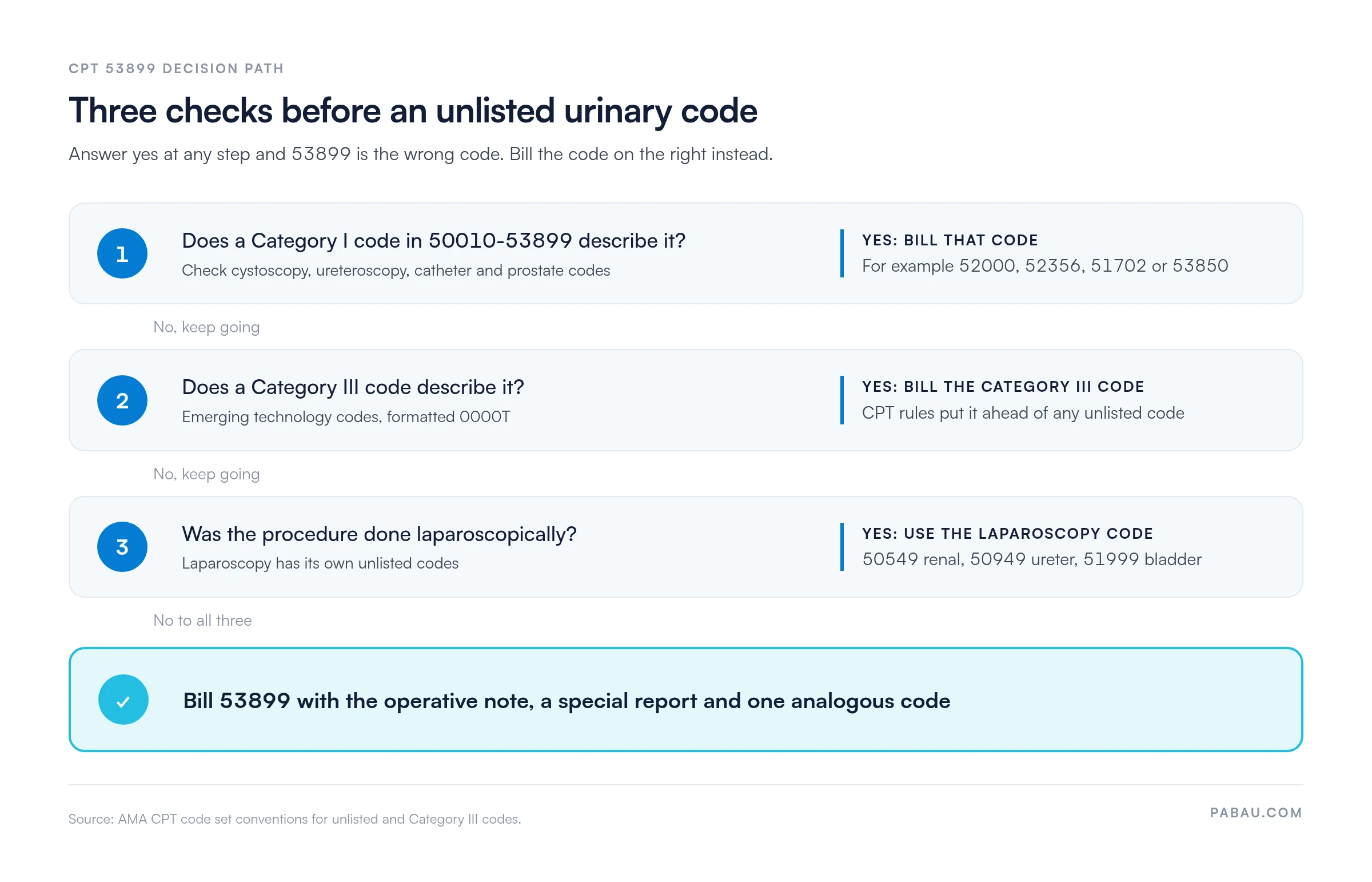
The second check catches more claims than people expect. CPT guidelines say a Category III code must be reported instead of an unlisted Category I code whenever one exists. The third matters too, because laparoscopic work has its own unlisted codes: 50549 for the kidney, 50949 for the ureter and 51999 for the bladder.
Picking 53899 when a specific code exists is one of the most common compliance errors in urology billing. Before you submit, rule out the codes below.
If any of these describes the procedure, bill it. Using 53899 when a listed code exists is a compliance risk and a common audit trigger. The AAPC Codify CPT lookup is a quick way to confirm that no specific code exists.
Our guides to CPT 52000 and CPT 52356 cover the two codes most often confused with 53899 in endoscopic work.
Payers expect two documents with every unlisted code claim: the operative report and a special report. Neither works alone. Good medical billing compliance means both are complete before the claim goes out.
The special report is a cover letter that travels with the operative note. It tells the payer why no existing code captures the procedure, and it needs five elements to survive MAC medical review.
Reports usually fail at point four. They name the analogous code but never explain the clinical difference. A line like “this procedure is similar to CPT 52356 but differs because…” gives the reviewer what a description alone can’t.
Draft the special report while the operative note is still open. Written from memory a week later, reports tend to skip the analogous-code comparison that reviewers look for first. Build the five points into your post-procedure documentation routine.
Medicare has no set fee for 53899. The CMS Physician Fee Schedule gives unlisted codes status C, meaning carrier-priced, or priced by report. Your Medicare Administrative Contractor (MAC) prices each claim individually.
Here’s the path a clean claim takes from the procedure room to payment.
Electronic submission is fine, but each MAC handles attachments its own way. Check your MAC’s instructions before the first claim goes out.
No Local Coverage Determination (LCD) or National Coverage Determination (NCD) covers unlisted urological procedures automatically. Coverage is decided case by case.
There’s no universal prior authorization (PA) rule for 53899. It varies by payer and by the procedure billed under it.
An approved PA doesn’t guarantee payment. It confirms the payer accepts the service, not that your documentation will pass review. Treat the two as parallel jobs.
CPT code 53899 has no relative value units (RVUs) in the Medicare fee schedule. Instead, the MAC prices it by report from the documentation. The FastRVU 2026 RVU lookup is a handy way to compare values for analogous listed codes.
In practice, the analogous code is your benchmark. Pick the listed code closest to the procedure, look up its current Medicare rate, and cite it in the special report. Most MACs start from that figure and adjust for documented differences in complexity or time.
Work RVUs come from the CMS 2026 relative value file. They change every year, so confirm current values in the CMS lookup before citing one in a report.
Modifiers on an unlisted code work a little differently. With no fixed descriptor or value, some common ones have little to adjust.
Talk to your billing team before adding -22. Because 53899 has no published rate, -22 would only raise a negotiated figure. Payers usually want unusual complexity explained in the special report, not signaled by a modifier. If modifier logic is new to your team, our guide to medical billing basics is a good starting point.
The ICD-10-CM code on the claim must support both the procedure and the medical necessity statement. A diagnosis that doesn’t match the operative narrative is a direct path to denial. Your superbill should carry both codes so they travel together.
Always use the most specific code the record supports. If imaging places the stone in the ureter, bill N20.1 rather than N20.9, urinary calculus, unspecified. Payers read unspecified codes as a sign of thin documentation.
When you bill 53899 with a revision diagnosis like N99.89, include the original procedure in the special report. MAC reviewers often request the index operative report to confirm the revision was medically necessary.
Run this list on every 53899 claim before it leaves the practice. It takes a few minutes and catches the problems reviewers flag most.
Knowing why 53899 claims get denied is the fastest way to stop it happening. Good denial management starts with these five triggers.
When a denial does come back, the remark code tells you which of these went wrong. Our list of claim denial codes helps you match it fast.
In many urology practices, unlisted claims are still tracked by hand. The 837P goes out from one system, while the special report sits in another and claim status lives in a spreadsheet.
Pabau, the practice management platform we build, keeps those steps in one place. Its claims management software pre-fills the claim from the patient record and checks required fields before sending. It then submits electronic 837P claims through Claim.MD and tracks each claim’s status.
The result is fewer claims bounced back for missing fields, and a clear view of which 53899 claims are still waiting on the MAC.

Pabau pre-fills claims from the patient record and sends them electronically through Claim.MD. It tracks each claim’s status, so your team knows where every 53899 claim stands.

CPT 53899 rewards discipline more than speed. Clear the three checks first, and write the special report while the case is fresh. When you do, the MAC has what it needs to price the claim on the first pass.
The trade-off is time spent up front. A good report takes longer than a coded line, but it costs less than an appeal. Book a demo to see how Pabau tracks your unlisted code claims from submission to payment.

Need to understand claim submission workflows for complex codes? Claim.MD clearinghouse overview explains how electronic claims flow from practice management systems to MAC review.
Looking for guidance on clean claim standards? Clean claim submission covers the data elements payers require before accepting a claim for adjudication.
Want to understand the broader revenue cycle context? Electronic remittance advice explains how to read the ERA responses that follow 53899 by-report adjudications.
Was it only a catheter insertion? CPT 51702 covers simple temporary bladder catheter insertion and how to bill it.
CPT code 53899 reports an unlisted procedure on the urinary system. Use it only when no Category I, Category III or laparoscopy code describes the work, and send a special report with the claim.
Not a fixed one. Medicare lists unlisted codes with global indicator YYY, so the MAC sets the postoperative period when it prices the claim. Ask your MAC before billing follow-up visits separately.
Choose by organ system. Procedures on the kidney, ureter, bladder or urethra go to 53899. Procedures on the penis, testis or scrotum, or an open prostate procedure, go to 55899, the unlisted male genital code.
Medicare wants trial claims flagged. Add ICD-10-CM code Z00.6 as a secondary diagnosis and report the trial’s NCT number. Append modifier Q0 to investigational services or Q1 to routine trial care.
Yes, when two distinct unlisted procedures are performed. Put each on its own line with its own description and a distinct-service modifier such as -59 or XS. Cover both in the special report.



