HCPCS Code A4627: Spacer and valved holding chamber
HCPCS Code A4627: official descriptor and code definition HCPCS Code A4627 is th...

Last Updated: Oct 21, 2026
52500 is the CPT code for "Transurethral resection of bladder neck (separate procedure)." It describes the general resection of an obstructing bladder neck, typically for primary bladder neck obstruction or fibrosis not documented as a postoperative contracture.
The code sits within the CPT 52000-52700 Endoscopy-Cystoscopy, Urethroscopy, Cystourethroscopy subsection, maintained by the American Medical Association (AMA). When the note documents a contracture after earlier surgery or radiation, the correct code is CPT 52640 instead. Coders also confuse 52500 with CPT 52601, which covers resection of the prostate, not the bladder neck.
Let Pabau's smart automation suggest the right codes, reduce claim denials, and keep your practice compliant—effortlessly.
Automate repetitive tasks and focus on what matters most—your patients.
Reduce coding errors and ensure compliance with the latest regulations.
Clean claims, fewer denials, and faster reimbursements.
Powerful insights and reporting to help your practice thrive.
HIPAA compliant SOC 2 certified GDPR-compliant Trusted by 4,000+ clinics worldwide

CPT Code 52500 covers transurethral resection of the bladder neck itself, not the prostate.
Choose CPT 52640 instead when the note documents a postoperative bladder neck contracture, whatever surgery or treatment came before it.
CPT 52601 (TURP) is the other common mix-up, because it targets prostatic tissue rather than the bladder neck.
ICD-10-CM N32.0 (bladder-neck obstruction) is the primary paired diagnosis for 52500.
Claims fail most often from wrong code selection (52601 or 52640 vs 52500) and missing medical necessity documentation.
CPT Code 52500 is officially described as “Transurethral resection of bladder neck (separate procedure)” in the AMA CPT code book. Under the “(separate procedure)” designation, 52500 is not reported when the bladder neck work is integral to a larger procedure in the same session.
The code applies when the surgeon performs electrosurgical or sharp resection at the bladder neck itself. If the operative report describes work at the prostate, or a combination of prostatic and bladder neck tissue, a different code applies.
Transurethral resection of the bladder neck addresses obstructing tissue or fibrosis at the vesicourethral junction. The surgeon passes a resectoscope transurethrally and resects the narrowed tissue under direct visualization, restoring adequate outflow.
CPT 52500 is the general bladder neck resection code. Typical indications are primary bladder neck obstruction, where the bladder neck fails to open during voiding, and fibrosis not documented as a postoperative contracture.
A contracture that forms after earlier treatment is coded differently. If the note documents a postoperative bladder neck contracture, report CPT 52640 rather than 52500. That holds whether the contracture followed TURP, radical prostatectomy, radiation or other bladder neck surgery.
What to look for in the operative report to support CPT 52500:
If the operative report uses language like “prostatic obstruction,” “enlarged prostate,” or “median lobe,” the procedure may be a TURP coded under 52601, not 52500. If it describes a contracture after earlier surgery or radiation, the procedure belongs under 52640.
CPT Code 52500 is a global procedure code. The single code captures the entire surgical encounter, so these components should not be billed separately on the same date of service.
Billing 52000 separately for a cystoscopy performed only to access and assess the bladder neck is a bundling error. NCCI edits treat diagnostic cystoscopy that is integral to the surgical approach as not separately reimbursable.
Several urology procedures can occur during the same cystoscopic session and may be separately billable. That applies only when they are distinct from the bladder neck resection and supported by separate documentation.
Check the CMS NCCI edits before billing any secondary code alongside CPT 52500. CMS updates the bundling edits quarterly, so a pairing that cleared last year may be restricted now.
The decision that matters most for CPT 52500 is telling bladder neck resection apart from prostatic resection. Payers flag this routinely because both procedures use a resectoscope, both are transurethral, and both can appear in patients with a history of prostate surgery.
The 52500 vs 52640 distinction turns on how the note describes the narrowing. CPT 52640 is transurethral resection of a postoperative bladder neck contracture, and it sets no limit on which earlier procedure caused it. That covers contracture after TURP, radical prostatectomy, radiation or other bladder neck surgery.
CPT 52500 is the general bladder neck resection, used when the note does not document a postoperative contracture. Read the surgical history in the medical record as well as the current operative note.
Bladder neck resection coding requires working through the operative note methodically. A four-step review catches the most common misassignments before a claim goes out.
The decision path below condenses those checks into the three outcomes a coder reaches most often.
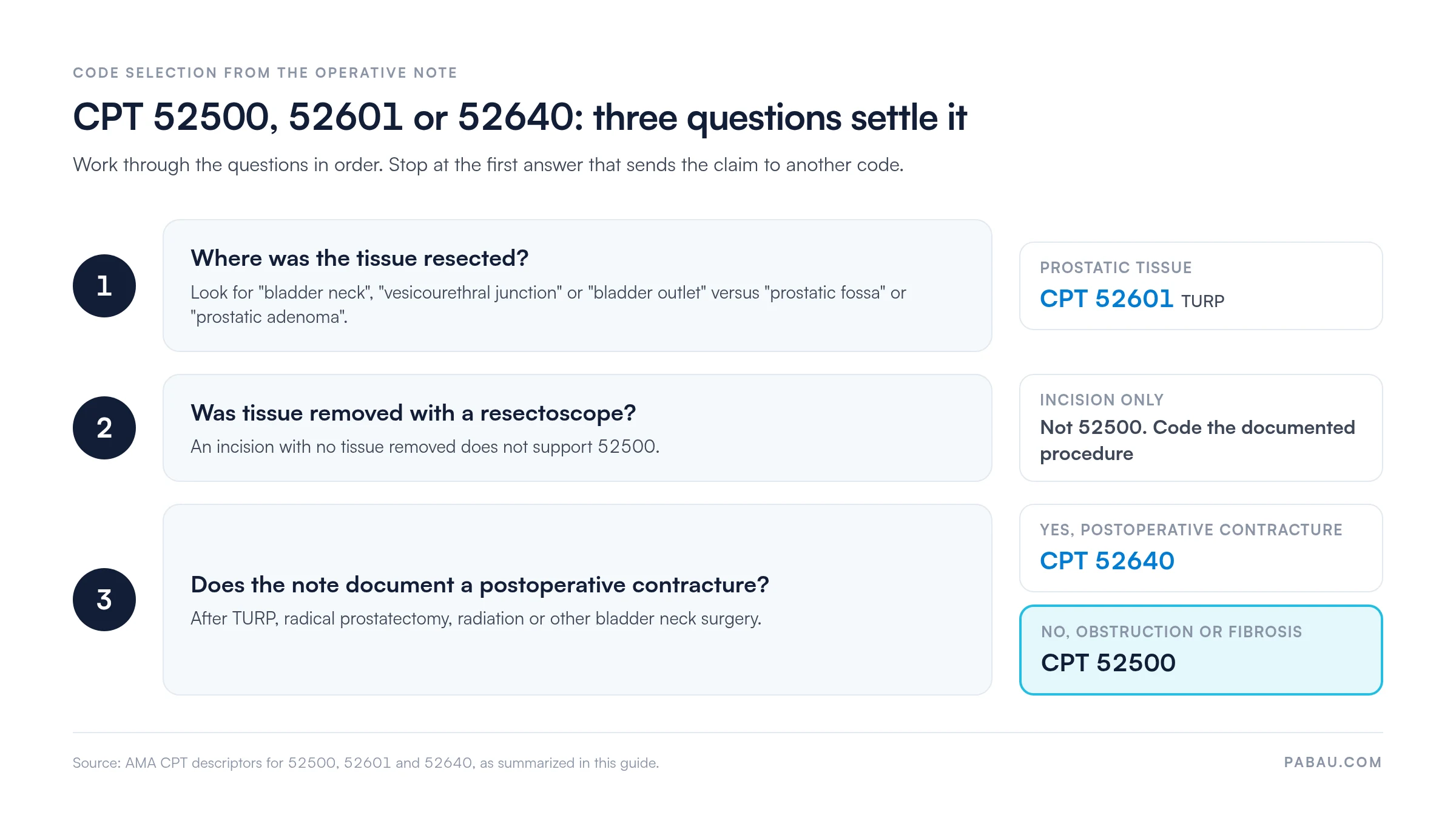
Flag operative reports that describe a contracture after radical prostatectomy carefully. The prostate has been removed, so 52601 is never correct for this intervention. Because the note documents a postoperative bladder neck contracture, the resection is reported with 52640, not 52500.
The ICD-10-CM codes paired with CPT 52500 must reflect the documented clinical condition precisely. Using a non-specific code when a more specific one exists can trigger a medical necessity denial.
Verify all ICD-10-CM codes against the CDC/NCHS ICD-10-CM tool for the current fiscal year. Codes are updated annually and a retired code on a claim generates an automatic rejection.
Medicare reimbursement for CPT 52500 is calculated from the CMS Physician Fee Schedule using Relative Value Units (RVUs). The payment formula is Total RVU x Geographic Practice Cost Index (GPCI) x Conversion Factor. Rates vary by MAC region and change annually.
The figures below are the 2026 national values before geographic adjustment, and CMS sets the same totals for both settings. Confirm current-year amounts in the CMS Physician Fee Schedule lookup tool, or cross-check them in FastRVU’s 2026 RVU lookup.
The 90-day global period means post-operative visits within 90 days of the procedure are included in the surgical payment. Routine follow-up cystoscopy within this window cannot be billed separately unless a new, distinct problem arises. Urology practices using revenue cycle management workflows should flag the global period end date at scheduling to avoid inadvertent bundling.
The anesthesia code for CPT 52500 is 00910 (Anesthesia for transurethral procedures, not otherwise specified), which carries 3 base units. Total billable units also include the time units the anesthesia provider reports. The neighboring codes describe other procedures: 00912 is for resection of bladder tumors, and 00914 is for TURP.
General anesthesia or monitored anesthesia care (MAC) may be used, depending on the patient’s comorbidities. The anesthesia provider, not the surgeon, reports 00910, so confirm the pairing against the current ASA Crosswalk before billing.
Medicare covers CPT 52500 when the claim is supported by documented medical necessity. The operative report, urodynamic study results (where applicable), and a clear diagnosis of bladder neck obstruction are the minimum required.
Medicaid programs follow CMS CPT coding rules but set their own reimbursement rates. State Medicaid programs also vary in prior authorization requirements for endoscopic urology procedures.
Prior authorization: what payers typically require. Commercial payers vary widely. The common criteria for PA approval include:
Never state that a specific payer does not require prior authorization without verifying their current policy. Authorization requirements change with plan year cycles, and billing on an assumption of non-requirement is a common source of after-service denials.
Most CPT 52500 denials trace to a small number of repeatable errors. Effective denial management workflows for urology practices should include a pre-submission audit against this list.
Practices can cut submission errors by routing claims through urology claims management software that keeps the operative note, diagnosis and claim on one patient record.
Use this checklist before submitting any CPT 52500 claim. Every item should be verifiable in the chart before the claim is transmitted. For superbill documentation, ensure each field maps directly to the operative record.
Most 52500 coding errors start before billing, when the operative note, the surgical history and the diagnosis sit in different systems. The coder then chooses between 52500, 52640 and 52601 without the full picture.
Pabau, the practice management platform we build for specialist practices, keeps the patient’s history, clinical notes and invoices on one record. Claims go out electronically through our Claim.MD integration, with eligibility checks before the procedure and status tracking after submission.
Your billing team sees the prior surgery and the operative wording in the same place as the claim. That means fewer claims sent back for the wrong code and less time spent reworking denials.

Pabau keeps notes, surgical history and claims on one patient record, then submits claims electronically through Claim.MD with real-time eligibility checks. Catch coding errors before the claim goes out.

CPT Code 52500 fits one scenario: a resection at the bladder neck where the note does not document a postoperative contracture. Once the record shows a contracture after earlier surgery or radiation, the claim belongs under 52640. Prostate tissue work belongs under 52601.
Coders who read the surgical history alongside the operative note will get most of these claims paid on the first submission.
Pabau keeps the operative note, the diagnosis and the claim on one record, then submits the claim electronically through Claim.MD. If preventable 52500 denials are costing your urology practice revenue, book a demo to see the workflow end to end.

Need to understand the claims lifecycle before a 52500 denial lands? What is medical billing covers the full end-to-end claims workflow from charge capture to payment posting.
Dealing with repeated urology claim rejections? Denial codes in medical billing explains the most common CARC and RARC codes and how to action each one.
Want to understand how CMS sets RVU-based payment? Revenue cycle management explains how fee schedule amounts flow from RVU assignment to collected payment.
CPT Code 52500 covers transurethral resection of the bladder neck. The surgeon uses a resectoscope to remove obstructing tissue or fibrosis at the bladder outlet. It is the general bladder neck resection code. A documented postoperative bladder neck contracture is reported with CPT 52640 instead. The code includes the endoscopic approach, resection, hemostasis, and catheter placement as a single global service.
CPT 52500 targets the bladder neck (vesicourethral junction), while CPT 52601 covers transurethral electrosurgical resection of the prostate (TURP). The anatomical site is the key distinction. If the operative report names prostatic tissue, prostatic chips, or the prostatic fossa as the resection target, 52601 applies. If it names the bladder neck or vesicourethral junction, 52500 applies.
The leading denial reason is wrong code selection, either 52601 or 52640 submitted instead of 52500 or the reverse. Others are missing medical necessity documentation, NCCI bundling errors from billing integral cystoscopy, absent prior authorization, and ICD-10 code mismatch. A pre-submission checklist against each of these catches most denials before the claim goes out.
Yes, CPT 52500 can be billed with distinct, separately performed services on the same date. Examples are a concurrent bladder biopsy (52204) or ureteral stent placement (52332). Each service must be documented on its own, with modifier 59 applied where required. Integral parts of the resection are not separately reportable and will be denied under NCCI edits. That includes diagnostic cystoscopy used only to access the surgical site.