

CCSD code G5100: Bypass of duodenum billing guide
CCSD code G5100 bills a bypass that leaves the duodenum in place CCSD code G5100...

Last Updated: Oct 16, 2026
52281 is the CPT code for cystourethroscopy with calibration and/or dilation of a urethral stricture or stenosis. The descriptor also covers meatotomy and injection for cystography when the urologist performs them, in male or female patients. Medicare pays roughly $310 for it in the office and $137 in a facility in 2026.
Getting the code right the first time means knowing when 52281 applies rather than CPT 53600 or CPT 52284. It also means knowing which ICD-10 codes satisfy payer medical necessity criteria. Modifier rules, bundling edits, and the documentation on file decide whether the claim pays.
Let Pabau's smart automation suggest the right codes, reduce claim denials, and keep your practice compliant—effortlessly.
Automate repetitive tasks and focus on what matters most—your patients.
Reduce coding errors and ensure compliance with the latest regulations.
Clean claims, fewer denials, and faster reimbursements.
Powerful insights and reporting to help your practice thrive.
HIPAA compliant SOC 2 certified GDPR-compliant Trusted by 4,000+ clinics worldwide

CPT Code 52281 covers cystourethroscopy with calibration and/or dilation of urethral stricture or stenosis, including optional meatotomy and cystography injection, for male or female patients.
When cystoscopy and urethral dilation happen in the same session, report CPT 52281 rather than CPT 53600. The instrument used does not matter.
CPT 52284 is a male-only code for drug-coated balloon dilation, not the female counterpart to CPT 52281.
ICD-10 codes in the N35.x series (urethral stricture) are the primary medical necessity anchors; payers require the most specific available sub-code.
Pabau’s claims management software routes urology claims through Claim.MD, supporting electronic submission, real-time eligibility checks, and ERA posting for codes including 52281.
CPT Code 52281 sits in the urethra and bladder transurethral section of the code set. The American Medical Association (AMA) maintains it and updates it annually through the CPT Editorial Panel. The official long descriptor reads as follows.
Cystourethroscopy, with calibration and/or dilation of urethral stricture or stenosis, with or without meatotomy, with or without injection procedure for cystography, male or female.
The short descriptor used on claims is: Cystoscopy, dilate urethra stricture. Medicare and commercial payers accept both forms; the long descriptor governs the scope of what the code covers when auditors review claims.
Four procedure components fall under this single code. Each is optional except for the cystourethroscopy itself and the dilation or calibration:
The phrase “male or female” in the descriptor is clinically significant. Some payers apply sex edits to urology codes, so documentation confirming the patient’s biological sex helps bypass automated claim filters. Female urethral stricture coding carries additional nuances covered in a dedicated section below.
Medicare reimbursement for CPT Code 52281 varies by place of service and by geographic locality. The CMS Physician Fee Schedule lookup tool gives the authoritative rate for any locality and year. The figures below are the 2026 national averages, calculated at the non-qualifying conversion factor of $33.4009. Confirm your MAC-specific rate before quoting patients or setting collection targets.
Geographic payment modifiers (GPCIs) move the total in either direction. Medicare pays practices in high-cost localities such as Manhattan and San Francisco more than it pays rural ones. Run your own Medicare Administrative Contractor (MAC) locality through the CMS tool above rather than working from the national figure.
Whatever the locality rate, the patient’s share of a 52281 claim still runs through the Part B deductible and coinsurance. Medicare waives both for preventive administration codes such as HCPCS code G0010, but only when the beneficiary’s high or intermediate risk category is documented.
The ICD-10-CM diagnosis codes submitted on the claim establish medical necessity for CPT Code 52281. Payers require the most specific code available. Submitting a parent code when a sub-code exists is a common cause of denials. Our ICD-10-CM code library carries the full tabular entry for each code below.
Payers increasingly require laterality and etiology specificity. Some carriers accept “urethral stricture, unspecified” (N35.9), but the code often triggers requests for additional documentation. Code to the highest specificity the clinical record supports.
Accurate billing for a cystoscopy with urethral dilation begins before the urologist performs the procedure. Checking the patient’s urology benefit and any prior authorization rule reduces post-service surprises. The tips below cover the coding decisions billers face most often with this code.
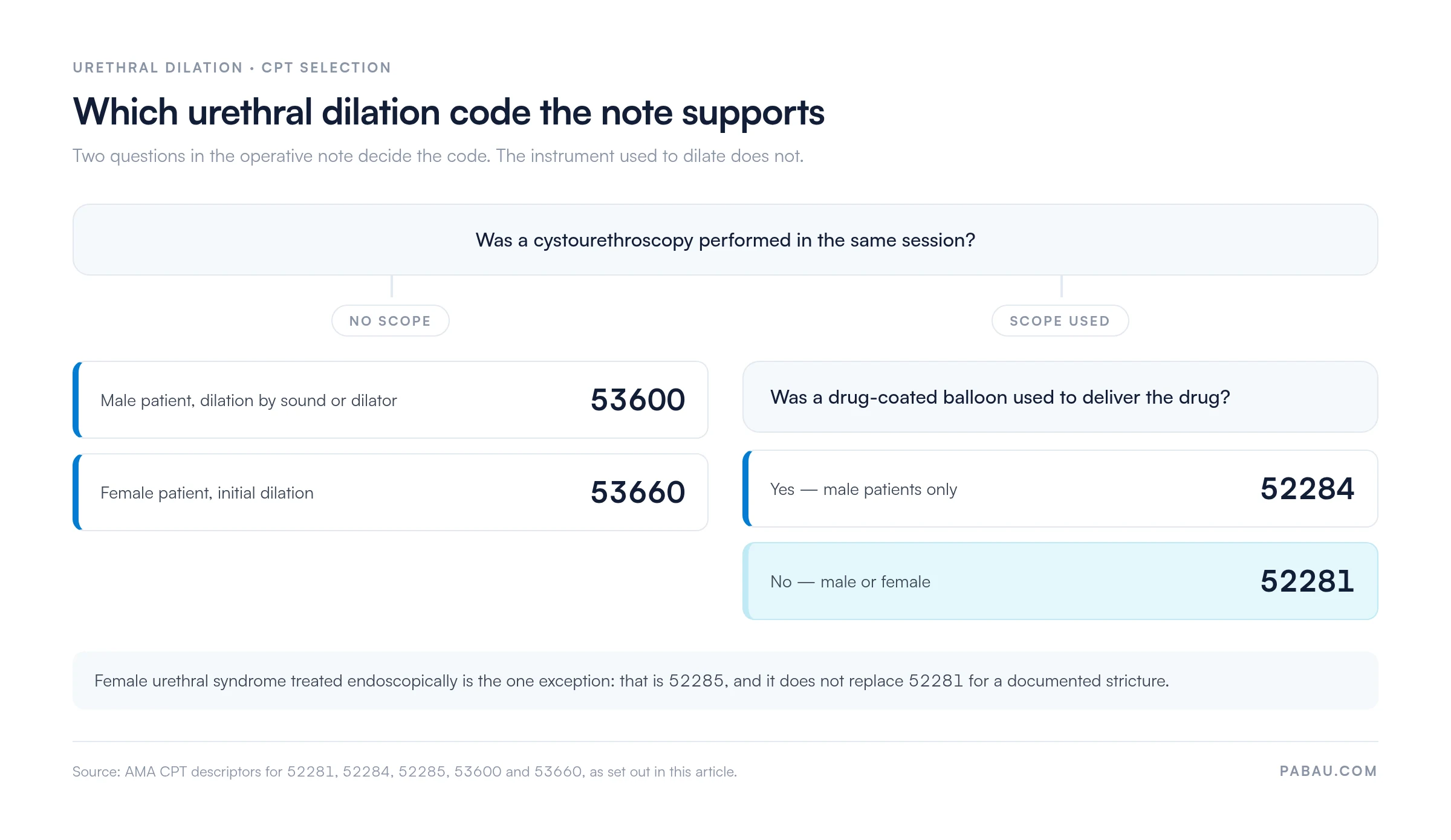
Choosing between CPT 52281 and CPT 53600 is one of the most common coding questions in urology billing. CPT 53600 covers dilation of a urethral stricture by passage of a sound or urethral dilator, male. The rule is straightforward. Bill CPT 52281 whenever the urologist performs cystoscopy in the same operative session as the dilation. The instrument used to dilate does not change the code.
Billing CPT 53600 when the urologist also performed cystoscopy constitutes under-coding and may trigger an audit when the operative note describes endoscopic visualization. Always let the documented procedure drive the code, not the instrument used. The same two questions settle every code in this family, including the ones covered further down.
Correct modifier selection prevents incorrect bundling and supports medical necessity when coders bill CPT Code 52281 alongside other procedures. The modifiers below are those most frequently applied in urology billing scenarios involving this code.
Modifier -59 requires that the operative note explicitly document why the second service is distinct. Attaching it without supporting documentation is one of the top audit triggers in urology billing. Review your compliance protocols before applying -59 on a routine basis.
National Correct Coding Initiative (NCCI) edits govern which codes may be billed together with CPT Code 52281. Submitting paired codes without checking these edits is a leading cause of denials in urology practices. Three pairings come up repeatedly in urology operative sessions.
The same distinct-service test applies to 52353, which covers ureteroscopy with lithotripsy where no indwelling stent is placed. A stent placed on the same ureter in that session moves the case to 52356 instead.
Check the current NCCI edit table for CPT 52281 before billing any paired codes. The CMS NCCI policy manual updates quarterly. A code pair that coders could report separately last year may now require a modifier, or NCCI may bundle it fully. Build a quarterly edit-check into your urology coding workflow.
Every CPT Code 52281 claim needs an operative note that documents each element of the procedure. Missing or vague operative documentation is the primary reason claims fail on post-payment audit. A clean claim starts with a complete note, written before the charge ever reaches the biller.
Denial management for CPT Code 52281 claims follows predictable patterns. Identifying the root cause early and applying the correct resolution prevents write-offs and reduces the cost of rework. Match the remark code on the remittance to a cause in the table below before you rework anything.
Female urethral stricture is less common than the male form, but it is a recognized clinical entity. CPT Code 52281 applies to both sexes, and its descriptor ends in the words “male or female”. Coding references illustrate the code mainly with male-patient examples, so the female pathway is worth spelling out.
When the urologist performs cystourethroscopy with dilation on a female patient for a documented urethral stricture or stenosis, CPT 52281 is the code to report. There is no sex-specific alternative to reach for, because the descriptor already covers her.
Some coding summaries describe CPT 52284 as a female bladder neck code. That is incorrect, and billing on that understanding produces a sex-edit rejection. The official descriptor reads as follows.
Cystourethroscopy, with mechanical urethral dilation and urethral therapeutic drug delivery by drug-coated balloon catheter for urethral stricture or stenosis, male, including fluoroscopy, when performed.
The AMA created 52284 as a Category I code effective January 1, 2024, replacing Category III code 0499T. It describes drug-coated balloon treatment with the Optilume device, which carries an FDA indication for men only. Carrier valuation sets the work RVU at 3.10 with a 0-day global period.
Because 52284 includes the cystoscopy, the mechanical dilation, and the imaging, coders do not report CPT 52000, 52281, 52283, 74450, and 76000 separately with it. Report 52284 only for a male patient treated with a drug-coated balloon, never as a substitute for 52281.
No CPT code describes dilation of a female bladder neck contracture as a service separate from urethral dilation. If the note documents dilation of a stricture or stenosis anywhere along the female urethra, 52281 fits. That holds when the narrowing sits at the bladder neck.
The female-specific code in this family is CPT 52285, and it answers a different clinical question. It covers cystourethroscopy performed to treat female urethral syndrome, allowing any or all of the following in one session:
Female urethral syndrome is a symptom complex rather than a documented stricture. Reporting 52285 for a straightforward stricture dilation overstates the service, so match the code to the diagnosis the urologist recorded.
CPT Code 52281 sits within the Urethra and Bladder Transurethral Surgery section of the AMA CPT code set. Knowing the adjacent codes helps coders select the right code for each clinical scenario and understand bundling relationships. The AAPC Codify CPT lookup provides crosswalk and bundling information for each of these codes. Practices can also reference the CMS list of CPT/HCPCS codes for coverage and policy context.
In most urology practices, staff handle the same claim details twice. The operative note sits in the chart, the charge sheet sits in a spreadsheet, and a biller keys both into a clearinghouse portal. Each retype is another chance for a wrong place of service or a missing modifier on a 52281 claim.
Practice management software like Pabau keeps the patient record and the claim in one system. Pabau’s claims management software connects to the Claim.MD clearinghouse. Coded charges leave the record as an electronic 837P, with no second round of data entry. Eligibility responses and ERAs post back against the same record.
Your coders still decide which code the documentation supports. What changes is the distance between the operative note and the remittance, so follow-up time goes to the claims that came back denied.

Pabau integrates with Claim.MD to automate claim submission, eligibility checks, and ERA posting for urology practices billing CPT 52281 and related codes. Reduce manual work and cut denial follow-up time.

CPT Code 52281 covers a clinically common urology procedure, and most denials on it are avoidable. Two habits close out the bulk of them. Code to the highest ICD-10 specificity the record supports, and confirm the operative note documents both the cystoscopy and the dilation or calibration.
The 52284 correction matters just as much. It is a male-only drug-coated balloon code, so a female urethral dilation performed with a scope stays on 52281. To see how the submission workflow fits your practice, book a demo with the team.

Need to understand the claims submission process end to end? Medical claims clearinghouse guide explains how electronic claims move from practice to payer and where errors occur.
Want to track down the specific denial code on your remittance? Electronic remittance advice (ERA) explained breaks down how to read ERA files and match denial codes to the right appeal action.
Working through a backlog of denied urology claims? Denial management in healthcare sets out how to triage denials by root cause and rework them in priority order.
CPT Code 52281 is the procedure code for cystourethroscopy with calibration and/or dilation of a urethral stricture or stenosis. The descriptor also covers meatotomy and injection for cystography when the urologist performs them, in male or female patients. It covers the entire endoscopic assessment and dilation encounter under a single billable code.
Bill CPT 52281 whenever the urologist performs cystoscopy in the same operative session as urethral dilation, regardless of the instrument used for dilation. Bill CPT 53600 only when the urologist performs urethral dilation in a male patient without any cystoscopy during that encounter. Using 53600 when the urologist also performed a cystoscopy is under-coding and an audit risk.
Yes, coders can bill CPT 52281 and CPT 52332 together when the urologist performs both procedures as clinically distinct services in the same operative session. Append modifier -51 to the lower-valued code and document each procedure separately in the operative note. Verify current NCCI edits before submitting, as bundling rules update quarterly.
No. CPT 52284 is a male-only code. It covers cystourethroscopy with mechanical dilation and drug delivery by a drug-coated balloon catheter. The AMA created it as a Category I code in 2024 to replace Category III code 0499T. CPT 52281 applies to male or female patients, so coders still report a female urethral dilation performed with a scope with 52281.



