CPT code 63081: Vertebral corpectomy, cervical spine
CPT code 63081: official descriptor and procedure overview CPT code 63081 descri...

Last Updated: Oct 6, 2026
51102 is the CPT code for aspiration of bladder; with insertion of suprapubic catheter. The physician reaches the bladder percutaneously above the pubic symphysis, drains urine, and leaves an indwelling suprapubic catheter in place.
It sits in the Surgery/Urinary System section of the AMA's CPT code set. It is the only one of the three bladder aspiration codes (51100, 51101, 51102) that leaves an indwelling catheter. It is often confused with CPT 51702, a transurethral catheter insertion code.
Let Pabau's smart automation suggest the right codes, reduce claim denials, and keep your practice compliant—effortlessly.
Automate repetitive tasks and focus on what matters most—your patients.
Reduce coding errors and ensure compliance with the latest regulations.
Clean claims, fewer denials, and faster reimbursements.
Powerful insights and reporting to help your practice thrive.
HIPAA compliant SOC 2 certified GDPR-compliant Trusted by 4,000+ clinics worldwide

CPT Code 51102 covers bladder aspiration with suprapubic catheter insertion, not urethral catheterization.
Modifier 50 (bilateral) does not apply because the bladder is a single, unpaired organ.
Documentation must confirm both bladder aspiration and suprapubic catheter placement, or payers downcode to 51100 or 51101.
Under the CY2026 Medicare fee schedule, 51102 carries 2.63 work RVUs and pays about $241 nationally in the office setting.
Pabau’s claims management software submits urology claims, tracks claim status and flags denied claims for rework through Claim.MD.
CPT Code 51102 is defined by the American Medical Association as Aspiration of bladder; with insertion of suprapubic catheter. The physician reaches the bladder percutaneously above the pubic symphysis and aspirates urine to decompress it. An indwelling suprapubic catheter is then placed through that same access point.
Common clinical indications include acute or chronic urinary retention, urethral obstruction or trauma preventing transurethral access, and neurogenic bladder requiring long-term drainage. The code applies in office, outpatient hospital, and inpatient settings.
Three codes cover bladder aspiration, and what is left in place after the aspiration decides which one applies. Picking the wrong one is a frequent denial trigger for this family. The decision guide below the table adds the two urethral catheter codes that get confused with them.
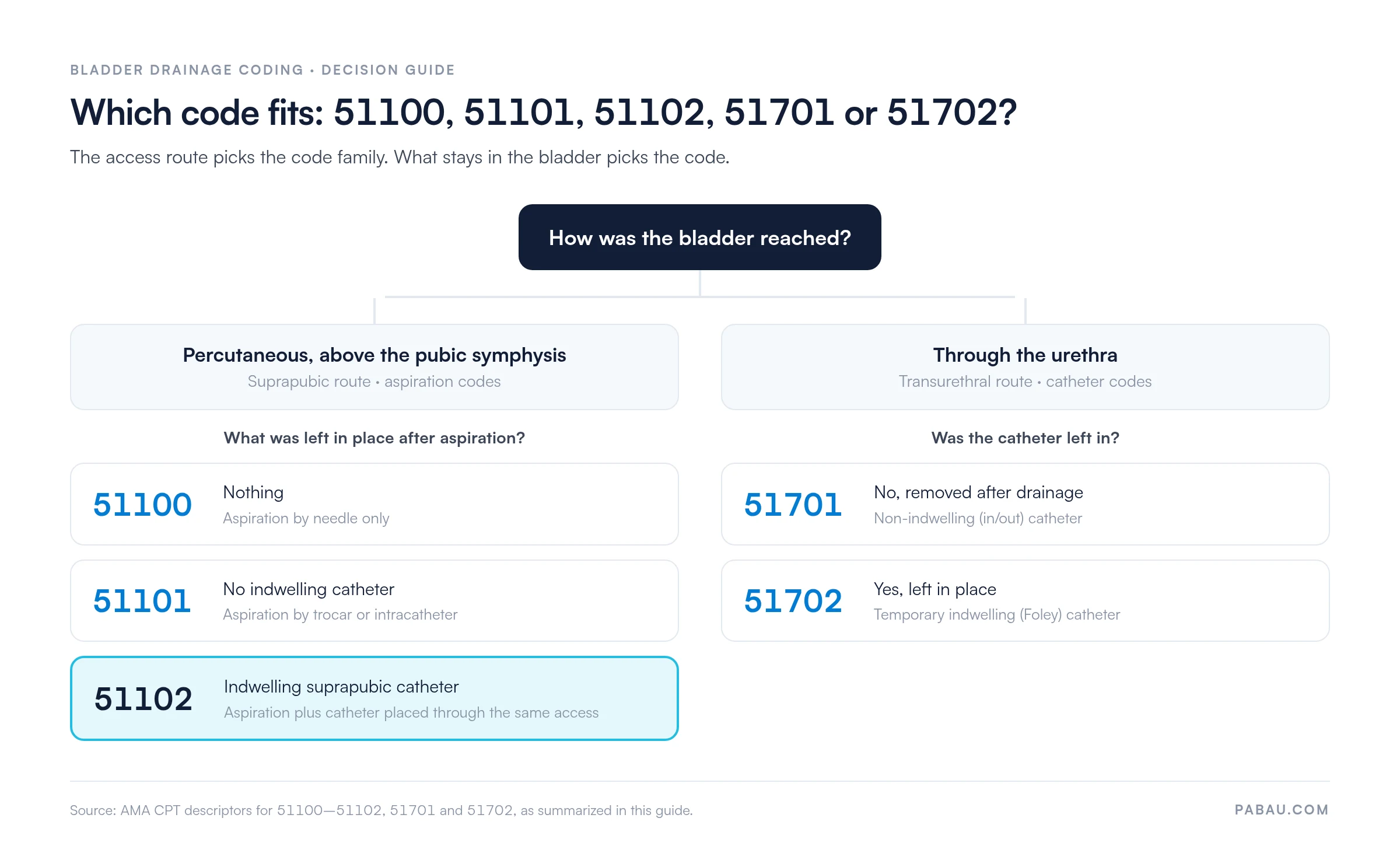
Coders mix up these two codes more often than any other pair in the 511xx/517xx range. Bill CPT Code 51102 when the physician accesses the bladder percutaneously above the pubic symphysis and places a suprapubic catheter through that entry point. Bill 51702 when the physician inserts a Foley catheter transurethrally.
The anatomical route decides the code. Both codes leave an indwelling catheter in place, but the access route and the procedural complexity differ significantly.
Scenario A: A patient with prostate cancer and complete urethral obstruction requires bladder decompression. The physician makes a percutaneous suprapubic puncture, aspirates urine, and places an indwelling suprapubic tube. Report CPT Code 51102.
Scenario B: A patient presents with urinary retention after hip replacement surgery. A nurse inserts a transurethral Foley catheter. Report 51702, not 51102.
Understanding the bundling rules prevents both undercoding and NCCI conflicts.
CPT Code 51102 carries 000 global days per the CMS Medicare Physician Fee Schedule. No pre- or post-operative services are bundled beyond the day of surgery. Follow-up care is billed separately.
After wrong code selection, incomplete documentation is the next frequent denial trigger. Reviewing medical billing compliance expectations early in the documentation workflow prevents downcoding before a claim ever reaches the payer.
The procedure note must contain all of the following to support a CPT Code 51102 claim:
When payers downcode 51102 to 51100 or 51101, the note usually falls short in one of two ways. Either aspiration is confirmed but catheter insertion is not documented, or the suprapubic approach is stated without a catheter type or size.
Pairing CPT Code 51102 with the correct ICD-10-CM diagnosis code is a medical necessity requirement. The diagnosis must justify why the suprapubic approach was clinically necessary, not just that urinary drainage was needed.
Always select the most specific code available. R33.9 is acceptable when the etiology is unknown at the time of service. Payers increasingly flag it for additional documentation requests when it is paired with a suprapubic procedure, so code the underlying cause when documented.
Medicare reimburses CPT Code 51102 under the Medicare Physician Fee Schedule (MPFS), with separate rates for facility and non-facility settings. Non-facility rates are higher because the physician bears the overhead cost of the procedure rather than the hospital or ASC. Use the CMS Physician Fee Schedule lookup tool to retrieve the current year’s payment rates, as the conversion factor updates annually.
The table below shows CY2026 RVU values from the CMS MPFS relative value file. Values update each January with the annual final rule, so check the current file before relying on them.
*Approximate national figures based on the CY2026 conversion factor of $33.4009 for clinicians who are not qualifying APM participants. A separate conversion factor of $33.5675 applies to qualifying APM participants (QPs). Geographic practice cost indices (GPCIs) adjust the payment by location, so verify exact amounts in the CMS MPFS lookup.
Place of service (POS) affects the physician payment rate. POS 11 (office) yields the non-facility rate. POS 22 (outpatient hospital), POS 21 (inpatient hospital) and POS 24 (ambulatory surgical center) yield the lower facility rate. A urology group performing 51102 in its own office suite bills POS 11. The same procedure in an ASC is billed under POS 24 at the physician facility rate, even when the group owns the ASC.
Applying the right modifier prevents claim rejection without undermining the code’s integrity. The most common modifier question concerns laterality.
Modifier 50 does not apply to CPT Code 51102. The bladder is a single, unpaired organ. Applying a bilateral modifier triggers an automatic denial and may flag the claim for audit. Remove Modifier 50 before submission if it appears on a 51102 line.
Denials on 51102 claims follow the seven patterns below, and each is cheaper to fix in the documentation workflow than on appeal. Tracking which pattern your practice hits most often is the first step in denial management in healthcare.
Tracking denials by CARC (Claim Adjustment Reason Code) shows which pattern costs the most in write-offs. A denial codes reference maps each CARC to its fix.
Clearinghouse edit checks can catch bundling conflicts before the payer sees the claim. That is one of several clean claim habits worth building into charge entry.
Many urology billing teams key 51102 claims by hand from the procedure note, then chase each rejection through a payer portal. That manual handoff is where a missing catheter size or a stray Modifier 50 slips through.
Pabau, the practice management platform we build, pulls record data into a pre-filled claim and submits it through Claim.MD to thousands of US payers. Its claims software for practices tracks each claim’s status and flags denied claims for rework, so your team fixes them in one place.
Real-time eligibility checks (270/271) run before the visit, and ERA (835) remittances post back against the claim. That cuts manual reconciliation on high-volume urology schedules.
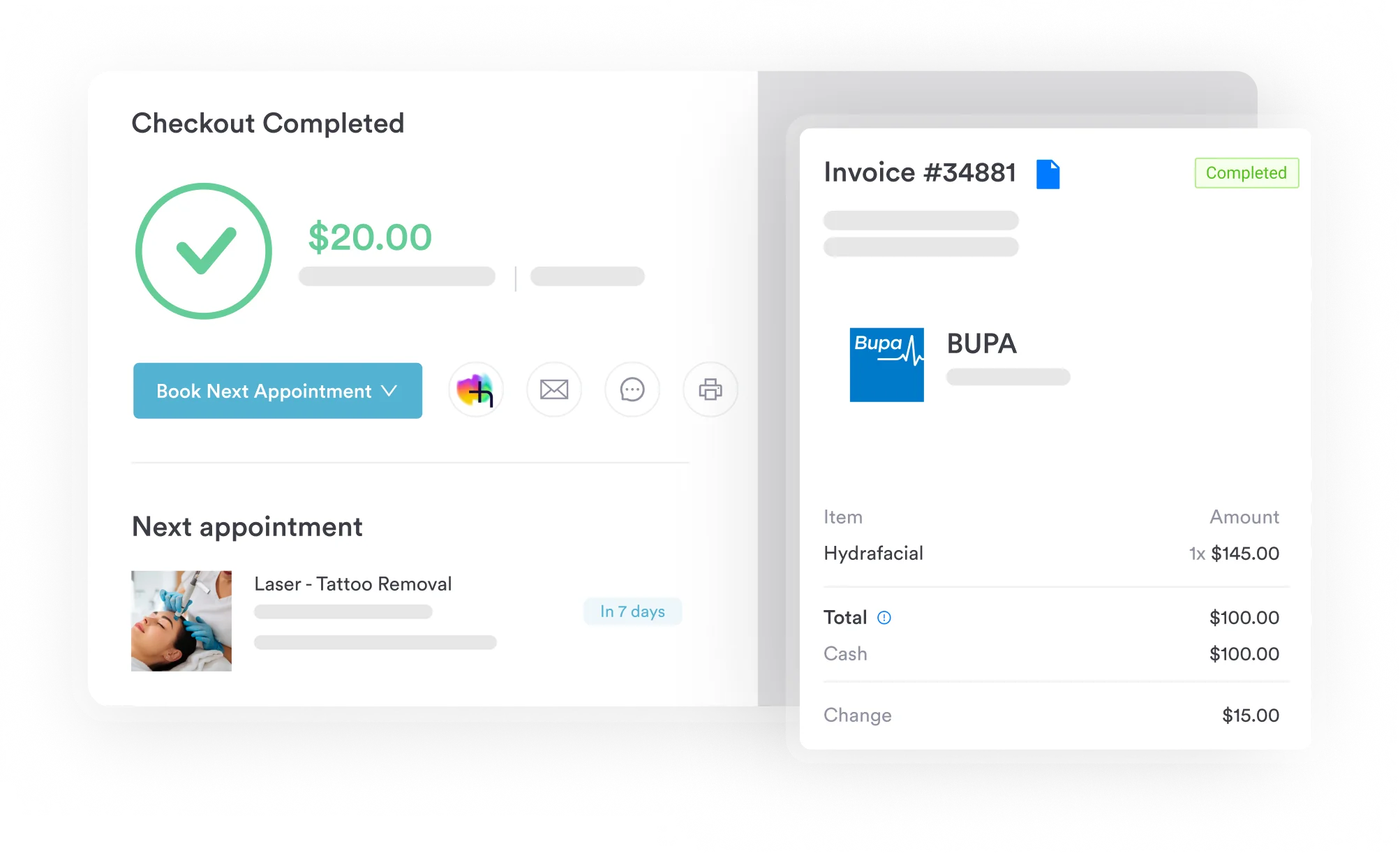

Pabau pulls record data into a pre-filled claim, submits it through Claim.MD, tracks status and flags denied claims for rework. Your team sees each 51102 claim’s progress in one place.

Code 51102 only when the note shows a percutaneous suprapubic puncture, aspiration, and an indwelling catheter left in place. If the record is missing any of the three, the claim will not hold up on review.
The cheapest fix is a procedure note template that asks for the route, the aspirated volume, and the catheter type and French size before sign-off. Coders then choose between 51102 and 51702 from the note rather than from memory, and fewer claims get downcoded to 51100 or 51101.
Pabau keeps the note, the pre-filled claim and its Claim.MD status together, so your team can see which 51102 claims were denied and need rework. Book a demo to see how it handles urology claims from procedure note to payment.

Need to understand how clearinghouse submissions work? Medical claims clearinghouse overview explains how claims move from provider to payer and where errors are caught.
Tracking denied claims across your urology schedule? Revenue cycle management fundamentals covers the end-to-end workflow from charge capture through payment posting.
Want a reference for denial reason codes on 51102 claims? Denial codes in medical billing maps CARC codes to actionable correction steps.
Billing bladder irrigation for the same patient? CPT code 51700 covers simple bladder irrigation, lavage and instillation.
Posting Medicare remittances on urology claims? Electronic remittance advice explains how 835 files reconcile payments against submitted claims.
CPT Code 51102 is the procedure code for aspiration of the bladder with insertion of a suprapubic catheter. The physician reaches the bladder percutaneously through the abdominal wall above the pubic symphysis, drains urine, and places an indwelling catheter. The code covers aspiration and catheter placement as a single service. The approach separates it from the simple aspiration codes (51100, 51101) and from transurethral catheterization (51702).
No. Modifier 50 (bilateral) does not apply to CPT Code 51102 because the bladder is a single, unpaired organ. Appending Modifier 50 will trigger an automatic denial and may flag the claim for review. Remove Modifier 50 from any 51102 line before submission.
Yes, Medicare covers CPT Code 51102 when medical necessity is documented. Coverage is subject to the Medicare Physician Fee Schedule payment rates and local coverage determinations issued by the patient’s Medicare Administrative Contractor (MAC). Prior authorization is not routinely required by Medicare for this code, but commercial payers vary, so verify authorization requirements per plan before scheduling.
CPT Code 51102 carries 000 global days under the CMS Medicare Physician Fee Schedule. Only the day of the procedure falls in the global package. Post-operative follow-up visits are billed separately under the appropriate evaluation and management code. They need no modifier to show they fall outside the global period.