CPT code 65205: Conjunctival foreign body removal
CPT code 65205 covers superficial conjunctival foreign bodies only CPT code 6520...

Last Updated: Oct 22, 2026
50545 is the CPT code for laparoscopic radical nephrectomy. The code includes removal of Gerota's fascia, the surrounding fatty tissue, regional lymph nodes, and the adrenal gland.
Because those steps are part of the code by definition, none of them is billed separately. Billers most often confuse 50545 with CPT 50546 (nephrectomy with partial ureterectomy), 50548 (with total ureterectomy), and 50543 (partial nephrectomy). Confirm in the operative report that the approach stayed laparoscopic and the whole kidney was removed within Gerota's fascia.
Let Pabau's smart automation suggest the right codes, reduce claim denials, and keep your practice compliant—effortlessly.
Automate repetitive tasks and focus on what matters most—your patients.
Reduce coding errors and ensure compliance with the latest regulations.
Clean claims, fewer denials, and faster reimbursements.
Powerful insights and reporting to help your practice thrive.
HIPAA compliant SOC 2 certified GDPR-compliant Trusted by 4,000+ clinics worldwide

CPT code 50545 reports laparoscopic radical nephrectomy, and its descriptor already includes removal of regional lymph nodes and adrenalectomy.
No laparoscopic code adds a lymphadenectomy to 50545, and CPT 50546 covers nephrectomy with partial ureterectomy rather than a lymph node dissection.
Same-side adrenalectomy is written into the 50545 descriptor, so it is never billed as a separate code at the same session.
Medicare pays bilateral cases at 150% with modifier 50 on one line, and co-surgery with modifier 62 needs documented medical necessity.
Pabau’s claims management software supports modifier entry, ICD-10 pairing, and electronic submission for urology billing teams.
The American Medical Association sets the official descriptor for CPT code 50545. It reads: “Laparoscopy, surgical; radical nephrectomy (includes removal of Gerota’s fascia and surrounding fatty tissue, removal of regional lymph nodes, and adrenalectomy).” The parenthetical lists what the code includes by definition. Removal of regional lymph nodes and adrenalectomy are part of 50545, so neither one is reported with a second code.
The code sits in the laparoscopy range for the kidney (50541-50549), within the Urinary system section (50010-53899) of the AMA CPT code set. It is a major surgical procedure with a 90-day global period under Medicare. Pre-operative visits from the day before surgery and most post-operative services through day 90 are bundled into the payment. Verify the global period in the CMS Physician Fee Schedule lookup for the current calendar year before billing.
Coders don’t need surgical training, but they do need enough procedural literacy to confirm the operative note supports the code billed. Laparoscopic radical nephrectomy follows a recognizable sequence, and each step should appear in the documentation.
If any of the above steps are absent from the operative report, the claim is vulnerable on audit. The documentation must confirm a laparoscopic approach throughout and removal of the whole kidney with Gerota’s fascia. It should also state whether the adrenal gland and regional lymph nodes were removed or spared.
The most common coder error on kidney surgery claims is selecting the wrong code from the laparoscopic kidney range. The table below covers the codes that come up most often next to 50545 in urology billing.
The 50545 vs 50546 decision turns on the extent of the operation, not on lymph node wording. A radical nephrectomy removes the kidney inside Gerota’s fascia with the surrounding fat, and the 50545 descriptor includes regional nodes and the adrenal gland. A simple nephrectomy (50546) removes the kidney and part of the ureter without that radical scope. Four questions about the operative report settle the code, in the order below.
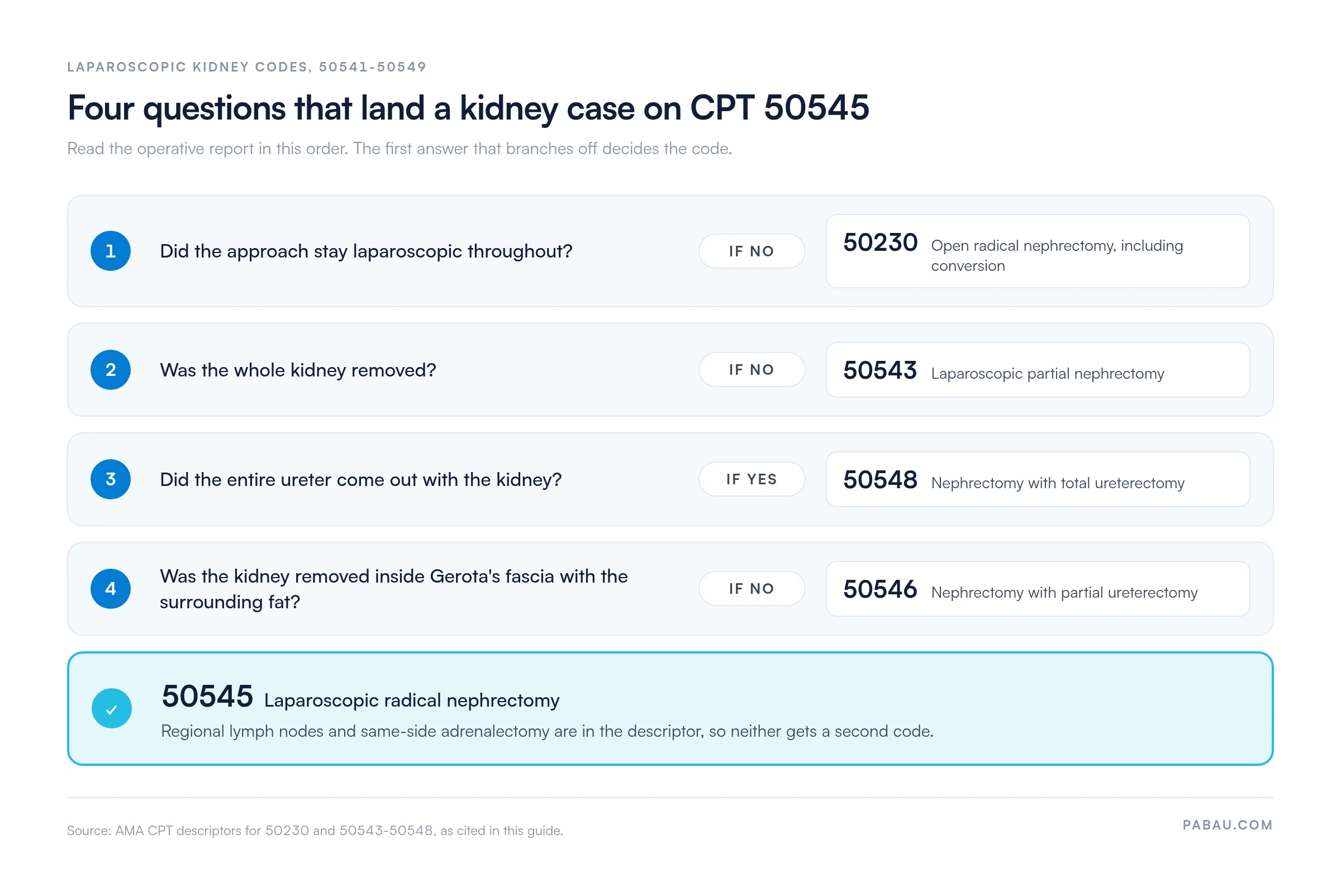
If the whole ureter comes out with the kidney, the code is 50548. No laparoscopic code adds a formal lymphadenectomy to 50545. Open code 50230 names regional lymphadenectomy, but it has no laparoscopic counterpart in 50541-50549.
Run a quick pre-bill check on the operative report. Look for the words radical, Gerota’s fascia, partial, and ureterectomy, and confirm whether the adrenal and regional nodes were removed or spared. Those details separate 50545 from 50543, 50546, and 50548.
Understanding the global surgical package for CPT code 50545 prevents both underbilling and unbundling errors that trigger NCCI edit rejections.
Adrenalectomy is where most of the confusion sits. The bundling comes from the CPT descriptor itself, which names adrenalectomy as part of 50545. Billing a separate adrenalectomy code, such as laparoscopic adrenalectomy 60650, for the same side and session double-counts the work. Check other code pairs against the current NCCI edit tables in the AAPC Codify CPT lookup before submitting.
Payers require a supporting ICD-10-CM diagnosis code that establishes medical necessity for radical nephrectomy. The table below lists the codes most commonly paired with CPT code 50545.
Use the most specific laterality code available, such as C64.1 or C64.2 rather than C64.9. Submitting C64.9 (unspecified side) when the surgical report documents right or left kidney draws payer scrutiny. It may also trigger a request for additional documentation. Benign diagnoses paired with radical nephrectomy almost always trigger medical necessity review.
Three modifier scenarios come up when billing CPT code 50545: bilateral procedures, co-surgery, and both together. The 2026 Medicare Physician Fee Schedule lists 50545 with bilateral indicator 1 and co-surgeon indicator 1.
Modifier 62 applies only when the procedure needs two surgeons, each performing a distinct part of it. A surgeon who assists but does not perform a distinct step uses modifier 80 (assistant surgeon). Medicare’s assistant-at-surgery indicator for 50545 is 2, so an assistant can be paid. Confirm all three indicators in the CMS Physician Fee Schedule lookup for your date of service, and check commercial payer co-surgery policies.
Prior authorization rules vary by payer and plan. Maintaining medical billing compliance starts with knowing each payer’s requirements before scheduling the case.
No universal rule covers every payer. Do not assume a procedure is pre-authorized without written confirmation. An authorization number must appear on the claim for payers that require it.
Medicare pays for CPT code 50545 under the Medicare Physician Fee Schedule (MPFS), based on relative value units (RVUs). Rates are updated each January 1. The figures below are 2026 national values, as listed on FastRVU’s CPT 50545 page. Verify the current amounts in the CMS MPFS search before billing.
Geographic Practice Cost Indices (GPCI) adjust the base payment up or down depending on practice location. A urology practice in Manhattan will receive a different payment than one in rural Mississippi for the same code. For accurate revenue projections, use the locality-adjusted figure from the MPFS lookup rather than the national average.
Practices that submit claims electronically can compare ERA data with expected rates after each remittance, building a locality baseline over time. Tracking remittances this way also supports revenue cycle management benchmarking for the practice.
A claim for CPT code 50545 is only as strong as the operative report that supports it. The following elements must be present to pass a payer audit and support clean claim submission.
Effective denial management in healthcare for urology practices starts by knowing which errors generate the most CPT code 50545 rejections.
Build a one-page CPT 50545 billing checklist for your urology billing team. Confirm the approach and the extent of the operation (50543, 50545, 50546, or 50548), and verify prior auth status. Report bilateral Medicare cases with modifier 50 on one line, and attach pathology where required.
Yes, CPT code 50545 covers robotic-assisted laparoscopic radical nephrectomy when the da Vinci or a comparable robotic system is used within the laparoscopic approach. The AMA CPT code set classifies procedures by surgical approach and extent, not by the instrument used. A robotic arm driving the camera and instruments through laparoscopic ports is still a laparoscopic procedure for coding purposes.
There is no separate AMA CPT code for robotic radical nephrectomy in the current code set. Some payers track robotic cases with HCPCS S-codes, but these are not universally adopted. Ask each commercial payer whether it wants a supplemental HCPCS code alongside CPT 50545 for robotic cases. When in doubt, call the payer’s provider relations line before submitting.
A 50545 claim often passes from the operative note to a separate clearinghouse portal, then to a spreadsheet of open denials. Each handoff is another chance for a modifier or a laterality-specific diagnosis to drop off the claim.
Pabau’s billing tools connect to the Claim.MD clearinghouse for US practices. Your billing team checks eligibility before the surgery date, attaches the ICD-10-CM code and modifiers, and submits the claim electronically.
After submission, status tracking shows where each claim sits, and ERA posting matches each remittance back to it. A denied or underpaid 50545 claim surfaces while there is still time to appeal with the operative note.

Pabau helps urology billing teams attach the right ICD-10 codes, apply modifiers correctly, and submit clean claims through an integrated clearinghouse workflow. See how it works for your practice.

CPT code 50545 pays for a laparoscopic radical nephrectomy, and its descriptor already covers regional lymph nodes and the adrenal gland. The coding risk sits with the extent of surgery, where 50543, 50546, and 50548 describe different operations.
Billing teams that match the code to the operation, report bilateral Medicare cases with modifier 50, and document co-surgery roles avoid the costliest denials. Book a demo to see how Pabau tracks those claims from submission to payment.

Coding the diagnosis for a right-kidney tumor? ICD-10 code C64.1 covers malignant neoplasm of the right kidney, the diagnosis most often paired with 50545.
Want to understand how clearinghouse claim routing works? How a medical claims clearinghouse works covers the end-to-end claim path from submission to payment posting.
Looking for guidance on managing claim denials systematically? Denial management in healthcare outlines the workflows and tracking tools that reduce write-offs.
CPT code 50545 covers laparoscopic radical nephrectomy. Its descriptor includes removal of Gerota’s fascia and surrounding fatty tissue, removal of regional lymph nodes, and adrenalectomy. Robotic-assisted cases are reported with the same code.
CPT 50545 is a laparoscopic radical nephrectomy, including Gerota’s fascia, regional lymph nodes, and the adrenal gland. CPT 50546 is a laparoscopic nephrectomy including partial ureterectomy, without that radical scope. The extent of the operation decides between them, since 50545 already includes regional nodes.
Modifier 50 reports a bilateral procedure on one line, and Medicare pays it at 150% because 50545 carries bilateral indicator 1. Modifier 62 applies when two surgeons each perform a distinct part, with documented medical necessity. Two-surgeon bilateral cases combine modifiers 50 and 62.
Yes. CPT 50545 covers robotic-assisted cases because the AMA defines the code by surgical approach (laparoscopic) and extent, not by the tool used. There is no separate AMA CPT code for robotic radical nephrectomy. Verify with individual payers whether any supplemental HCPCS code is required.
Each surgeon bills CPT code 50545 with modifiers 62 and 50 on a single line, under their own NPI. Medicare’s co-surgeon indicator for 50545 is 1, so the operative notes must show why two surgeons were needed. Pre-authorization is strongly recommended for bilateral co-surgery cases.
The most frequent denials come from four errors. The first is a code that doesn’t match the extent of surgery, such as 50545 billed for a 50543, 50546, or 50548 case. The others are missing prior authorization, bilateral modifiers formatted wrongly for the payer, and a separately billed same-side adrenalectomy.