

CCSD code G5100: Bypass of duodenum billing guide
CCSD code G5100 bills a bypass that leaves the duodenum in place CCSD code G5100...

Last Updated: Oct 16, 2026
45390 is the CPT code for colonoscopy, flexible, proximal to splenic flexure; with endoscopic mucosal resection. It applies when the endoscopist lifts a flat or sessile lesion with a submucosal injection, then removes it with a snare in the same session.
The code sits in the colonoscopy family that runs from 45378 to 45398. Choosing it over 45385 turns on the documented submucosal lift. When the procedure started as a screening, add modifier -PT for Medicare or -33 for commercial payers.
Let Pabau's smart automation suggest the right codes, reduce claim denials, and keep your practice compliant—effortlessly.
Automate repetitive tasks and focus on what matters most—your patients.
Reduce coding errors and ensure compliance with the latest regulations.
Clean claims, fewer denials, and faster reimbursements.
Powerful insights and reporting to help your practice thrive.
HIPAA compliant SOC 2 certified GDPR-compliant Trusted by 4,000+ clinics worldwide

CPT Code 45390 requires a completed EMR, meaning a submucosal lift followed by snare removal. An EMR that is attempted but not completed is reported as 45390 with modifier -52 and a documented reason.
When a screening colonoscopy turns therapeutic because of EMR, append modifier -PT for Medicare or modifier -33 for commercial and ACA plans. The wrong modifier, or none, causes patient cost-sharing errors.
Of 45378, 45380 and 45381, only 45380 can be unbundled from 45390, with modifier -59 for a biopsy at a different site. 45378 and 45381 carry NCCI modifier indicator 0 and never can.
Anesthesia for 45390 is billed separately by the anesthesia provider, normally under code 00811.
Practice management software like Pabau checks each claim for required details, such as authorization numbers, before submission. That cuts front-end rejections on 45390 claims.
CPT Code 45390 describes a colonoscopy, flexible, proximal to splenic flexure, with endoscopic mucosal resection (EMR). Under the American Medical Association’s CPT code set, it covers the full lower GI endoscopy from the anus to beyond the splenic flexure. During that exam, EMR removes a sessile or flat lesion that is too large, or the wrong shape, for standard snare polypectomy.
EMR starts with a fluid injection into the submucosal layer, which lifts the lesion away from the muscularis propria. The lesion is then captured and removed with a snare. So this lift-and-cut technique sets 45390 apart from simple polypectomy codes. Three clinical conditions must all be met for 45390 to apply:
If the endoscope does not pass the splenic flexure, report a code from the flexible sigmoidoscopy series (45330 and up) instead. Within that series, a biopsy taken at one or more sites is reported as 45331. If EMR is attempted but cannot be completed, report 45390 with modifier -52 and document the clinical reason in the procedure note.
If bleeding at a separate, distinct site is controlled during the same colonoscopy, CPT Code 45382 covers hemostasis by any method. Bleeding controlled at the resection site itself is normally bundled into the therapeutic code. NCCI edits shift each quarter, so check the current pair before reporting both.
Payers auditing 45390 claims look for five documentation items that confirm EMR was performed rather than a standard polypectomy. So missing any one of them gives reviewers grounds for downcoding to 45378 or 45385.
The claim file for 45390 should also hold the procedure report, the pathology order, and the pre-procedure assessment. So that assessment establishes medical necessity under the CMS LCD A58428 criteria.
The colonoscopy code family (45378 through 45398) follows an upgrade logic, where each code adds a service to the diagnostic baseline. So selecting 45390 over a neighboring code requires that the key service (EMR) was both indicated and completed.
The most costly miscoding is billing 45385 when EMR was performed. In fact, snare polypectomy (45385) does not include a submucosal injection step. If the operative note documents a submucosal lift followed by snare capture, that is EMR, and 45390 is the correct code no matter the lesion size. The chart below pairs each documented technique with its code, then adds the modifier the payer expects.
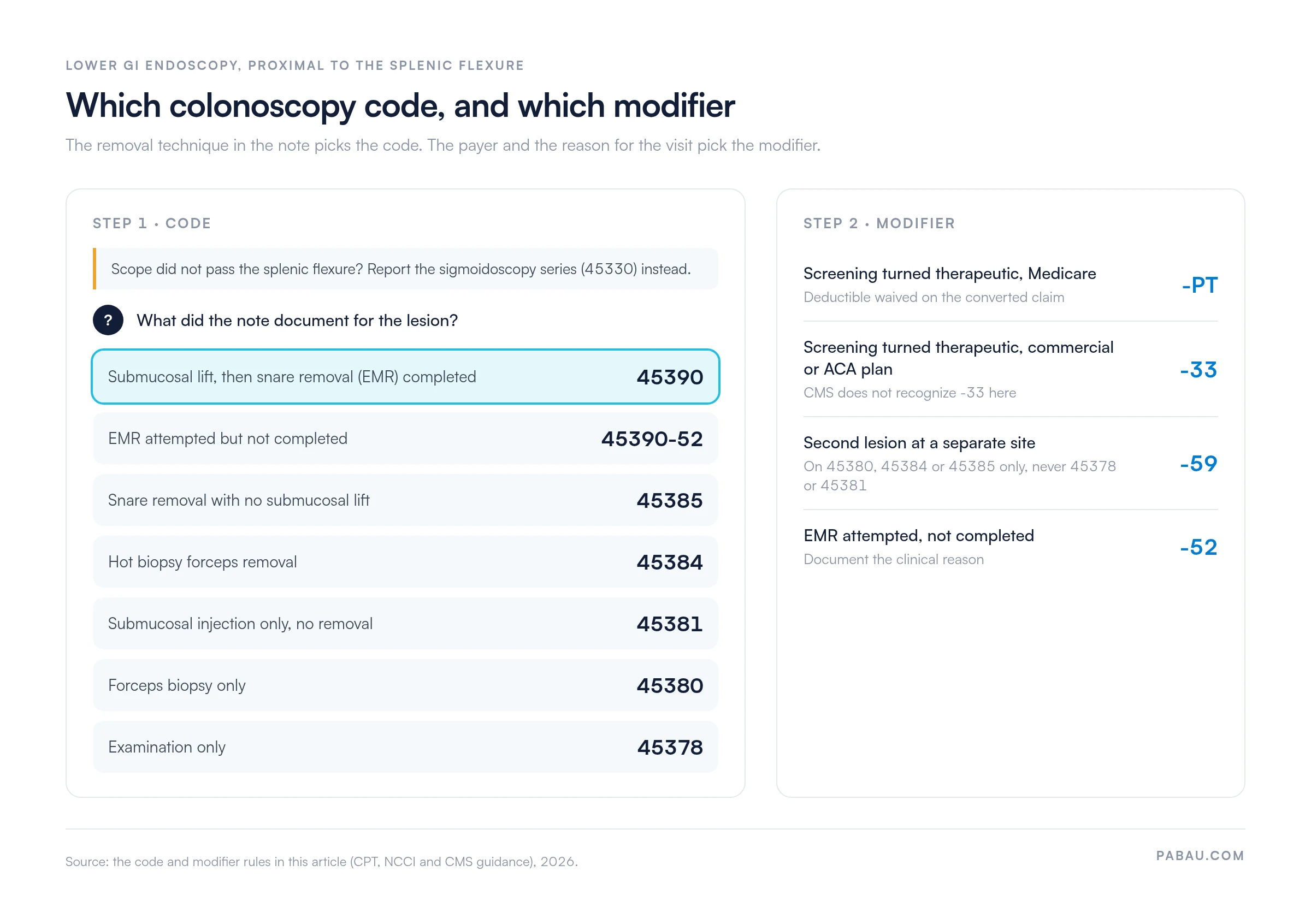
Modifier choice for CPT Code 45390 is one of the most denial-prone steps in GI billing. Four modifiers apply across distinct billing scenarios. So the wrong choice creates patient cost-sharing errors, claim rejections, or NCCI edit conflicts.
Sometimes a Medicare beneficiary comes in for a routine colorectal cancer screening, and the endoscopist finds a lesion and removes it using EMR. The claim then converts from the screening HCPCS code to CPT Code 45390, following the Medicare Claims Processing Manual:
Skipping step 3 lands on the patient. Without -PT, Medicare processes the claim as a standard therapeutic procedure and applies a deductible the patient should not owe. That counts as improper billing under CMS rules and often ends in a refund. Commercial plans expect modifier -33 instead, and their policies vary, so check each payer’s rules before submission.
Run a monthly audit of 45390 claims that started as G0105 or G0121 screening encounters. Filter for claims missing modifier -PT (Medicare) or -33 (commercial), then cross-check EOBs for patient cost-sharing charges. Catching these systematically prevents both compliance exposure and patient complaints.
Medical necessity for CPT Code 45390 requires an ICD-10-CM diagnosis code that supports EMR rather than a simpler removal technique. CMS LCD A58428 governs diagnostic colonoscopy coverage criteria. Also, use the CrossCoder crosswalk tool to check procedure-to-diagnosis pairings against current LCD policies.
Code Z12.11 is the primary diagnosis when the encounter started as a colorectal cancer screening. The finding (K63.5 or D12.x) is listed as an extra diagnosis. So this pairing supports the modifier logic in the screening conversion section above.
The 2026 Medicare Physician Fee Schedule assigns 45390 three sets of relative value units (RVUs). Work RVUs reflect the physician’s time and skill, practice expense RVUs cover overhead, and malpractice RVUs cover professional liability. Use the CMS Physician Fee Schedule lookup tool to pull the locality-adjusted rate for your Medicare Administrative Contractor (MAC) jurisdiction. But national averages differ from what an individual practice receives.
Facility and non-facility payment rates differ a lot for 45390. A hospital outpatient department or ambulatory surgical center bills at the facility rate. An office-based endoscopy suite bills at the non-facility rate, which is often higher. So confirm your setting before you use a rate for financial planning.
Commercial payers often pay a negotiated multiple of the Medicare rate, and the multiplier varies by contract. Check each payer’s electronic remittance advice (ERA) for underpayments on 45390. They are common when the payer applies the diagnostic colonoscopy rate instead of the EMR rate.
Electronic claims to Medicare and most commercial payers use the 837P format. Confirm yours pairs the procedure and diagnosis codes correctly before it goes out.
Medicare does not always require prior authorization for 45390 as a standard therapeutic colonoscopy. CMS has expanded prior authorization for some outpatient procedures, so check the current CMS list and your MAC’s rules for 2026. Checking coverage and benefits before the procedure date surfaces most prior auth rules before they turn into a denial.
Many commercial payers do require prior authorization for 45390. A commercial request often includes:
Performing 45390 without an approved prior auth on a payer that requires one results in a full claim denial. A missing-auth denial can’t be appealed on medical necessity grounds. So the only fix is a corrected claim with the auth number attached, and only if the payer allows a backdated authorization.
The National Correct Coding Initiative (NCCI) bundles several colonoscopy codes with 45390 when they are performed in the same session. After a wrong code choice, billing a bundled code without meeting the unbundling conditions is the second most common denial trigger for 45390. NCCI edits change quarterly, so check the current edit pairs before you bill.
The unbundling rule for -59 is strict. The operative note must place the second lesion at an anatomic site distinct from the EMR site. So a note reading “two polyps, one removed by EMR and one by snare” with no segment-level location will not survive an audit.
The six denial patterns below recur on 45390 claims. A clean claim avoids a 30- to 45-day rework cycle that ties up biller time and delays cash flow. Practices that validate claims before submission catch missing-field rejections, such as an absent authorization number, before the claim leaves the practice.
Run each claim through your clearinghouse’s validation layer before submission. Clearinghouses catch format errors and payer-specific edits a practice management system may miss, cutting front-end rejections apart from any medical necessity review.
When EMR is performed at two or more different sites in one colonoscopy, the question is whether 45390 can be reported more than once. NCCI policy and payer guidance often treat 45390 as a per-session code rather than a per-lesion code. Reporting multiple units on the same claim will often trigger a medically unlikely edit (MUE) denial.
The supported billing approach for multi-site EMR in the same session:
Payer-specific rules on multiple EMR units vary. So check MAC policy before submitting multiple units of 45390 on a single claim date of service.
Anesthesia for colonoscopy with EMR is billed on its own by the anesthesiologist or CRNA and does not appear on the gastroenterologist’s claim. The standard crosswalk for 45390 is anesthesia code 00811. It covers lower intestinal endoscopic procedures with the endoscope introduced distal to the duodenum, not otherwise specified.
Code 00812 applies only to a screening colonoscopy that stays a screening. Code 00813 covers combined upper and lower GI endoscopy in one session. Check the assignment against the current American Society of Anesthesiologists relative value guide, because base unit values change often.
Monitored anesthesia care is the most common modality for outpatient colonoscopy. General anesthesia is less common but may suit pediatric patients, patients with serious health conditions, or complex EMR cases expected to run long. The billing entity (anesthesiology group, CRNA, or facility) determines which provider number appears on the anesthesia claim. Gastroenterology practices never bill 00811 themselves.
Audit 45390 claims quarterly using the AAPC CPT code lookup to confirm the procedure note language matches code descriptor rules. Cross-reference against your MAC’s LCD for any policy updates affecting EMR coverage criteria, mainly for piecemeal resection of large sessile lesions.
Many GI billing teams build each 45390 claim by hand from the procedure note. A missing authorization number or membership number then surfaces only when the payer rejects the claim.
Practice management software like Pabau links the patient’s insurer and policy to their record, so each invoice routes to the right payer. Every time you send a claim, Pabau checks that the details insurers need, such as membership numbers and authorization codes, are in place.
US practices submit through Claim.MD without leaving Pabau, see each claim move from submitted to paid, and post ERA remittances against the right invoice. So your billing team spends less time chasing rejected claims and more time on the coding calls that need judgment.

Pabau checks each claim for required details, like authorization numbers, before submission, then tracks it through to payment. See how it fits gastroenterology and multi-specialty billing.

Getting 45390 right comes down to two decisions. The procedure note has to prove the submucosal lift. The modifier has to match the payer, with -PT for Medicare and -33 for commercial plans. So get both right and the downcoding and cost-sharing errors in this guide stop recurring.
The trade-off is documentation time. A structured EMR note takes the endoscopist a minute longer to complete. So that minute costs far less than an audit, a refund to the patient, or an appeal on a high-value claim.
Book a demo to see how Pabau checks each 45390 claim for required details before it reaches the payer.

Billing a snare polypectomy instead? CPT Code 45385 covers lesion removal by snare technique, the code most often confused with 45390.
Colonoscopy with no lesion removed? CPT Code 45378 explains the diagnostic colonoscopy that 45390 builds on.
Coding the anesthesia side? CPT Code 00811 details the anesthesia code for lower intestinal endoscopy.
Need to understand how clearinghouse validation works? Medical claims clearinghouse guide explains how claims are scrubbed, formatted, and routed to payers before adjudication.
Want to reduce billing compliance risk across your practice? Medical billing compliance guide covers documentation standards, audit risk areas, and HIPAA transaction rules.
CPT Code 45390 covers a flexible colonoscopy performed proximal to the splenic flexure during which endoscopic mucosal resection is completed. It includes the submucosal injection, snare capture, and removal of a sessile or flat colonic lesion using the EMR technique. But it does not apply to standard snare polypectomy. An EMR that is attempted but not completed is reported as 45390 with modifier -52.
Yes, Medicare covers CPT Code 45390 when appropriate ICD-10-CM coding and documentation meet the LCD A58428 criteria. Medicare does not always require prior authorization for a standard therapeutic colonoscopy. Still, confirm the current CMS prior authorization list and your MAC’s rules, as both are updated often.
The four primary modifiers for CPT Code 45390 are -PT, -33, -59 and -52. Use -PT on a Medicare claim when a screening colonoscopy converts to therapeutic, and -33 for the same conversion with commercial and ACA plans. Append -59 when an eligible second code, such as 45385, is billed for a different anatomic site. Use -52 when EMR is attempted but not completed.
Six denial reasons come up most often. The first is the wrong code, with 45378 or 45385 billed instead of 45390. Next come a missing -PT or -33 modifier on a converted screening and an NCCI bundling conflict with 45378, 45380 or 45381. The other three are a missing commercial prior authorization, Z12.11 listed without a finding code, and an operative note that never describes the EMR technique. So each can be prevented at documentation or pre-submission review.



