

CCSD code G5100: Bypass of duodenum billing guide
CCSD code G5100 bills a bypass that leaves the duodenum in place CCSD code G5100...

Last Updated: Oct 16, 2026
Billable Code
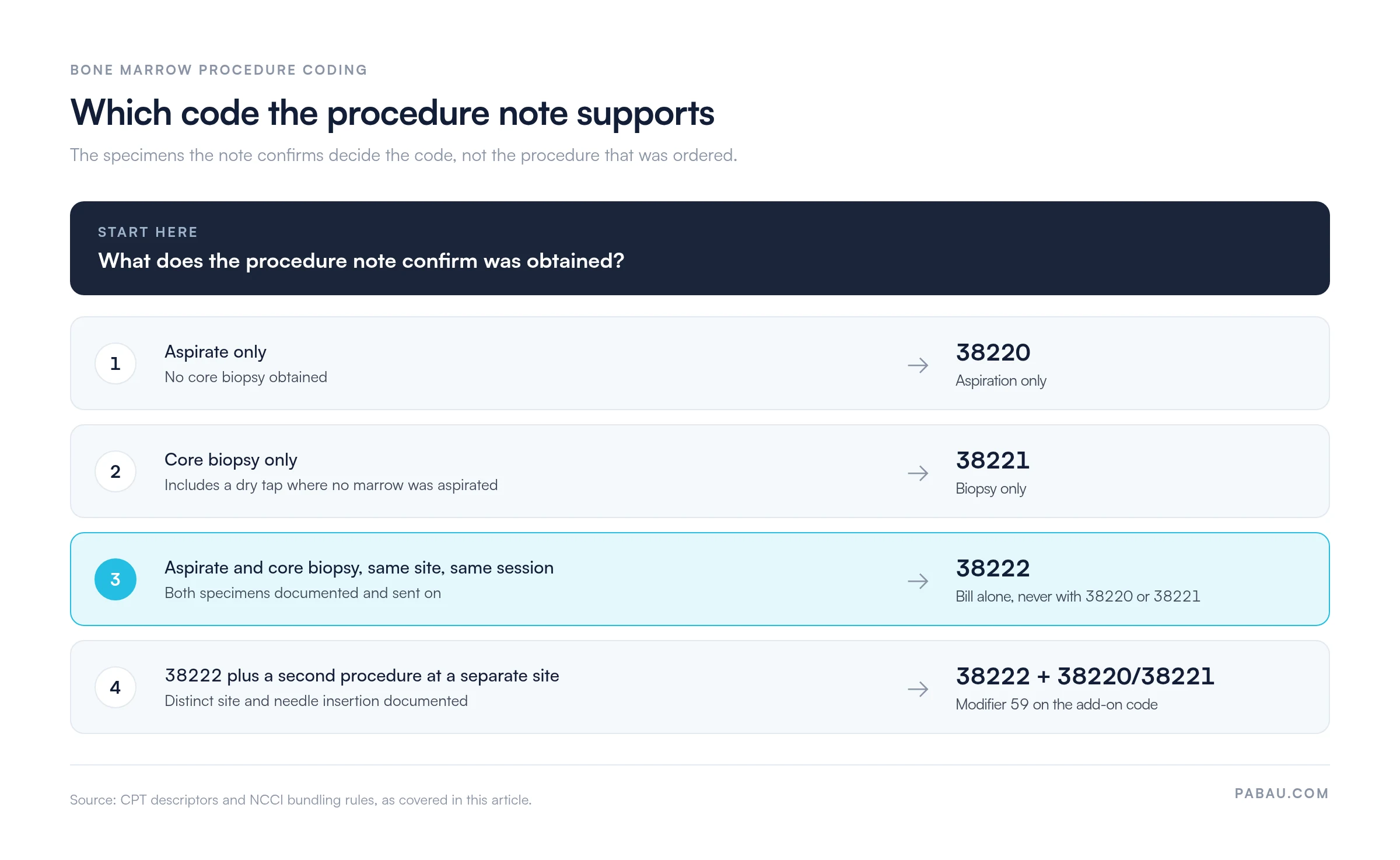
38222 is the CPT code for bone marrow biopsy and aspiration performed at the same site in one session, officially "Bone marrow; biopsy(ies) and aspiration(s)." It applies only when the procedure note confirms both a core biopsy and an aspirate were obtained.
Because 38222 already bundles both specimen types, adding CPT 38220 or 38221 to the same claim triggers an NCCI bundling edit. The exception is a second procedure at a separately documented site, reported with modifier 59. If only one specimen is obtained, report 38220 for aspiration or 38221 for biopsy instead.
Let Pabau's smart automation suggest the right codes, reduce claim denials, and keep your practice compliant—effortlessly.
Automate repetitive tasks and focus on what matters most—your patients.
Reduce coding errors and ensure compliance with the latest regulations.
Clean claims, fewer denials, and faster reimbursements.
Powerful insights and reporting to help your practice thrive.
HIPAA compliant SOC 2 certified GDPR-compliant Trusted by 4,000+ clinics worldwide

CPT code 38222 covers bone marrow aspiration and core biopsy at the same site in the same session, not either procedure alone.
Billing 38220 or 38221 alongside 38222 on the same date without modifier 59 and a distinct site violates NCCI bundling edits and triggers automatic denial.
Medicare facility and non-facility payment rates for 38222 differ substantially, and place of service is the single largest variable in reimbursement.
Pabau’s claims management software helps hematology practices track 38222 claims, flag denial patterns, and submit electronically via Claim.MD.
The table below summarizes the essential billing facts for CPT code 38222. Use this as your at-a-glance check before submitting a claim.
CPT code 38222 covers one combined procedure in which the clinician obtains two specimens at the same site during the same session. The first is a bone marrow aspirate, a liquid sample drawn by needle suction. The second is a core biopsy, a cylindrical plug of tissue removed with a trephine needle. Both specimen types must be obtained for 38222 to be the correct code.
The posterior iliac crest is the preferred site for most patients because the bone cortex is accessible and the specimen yield is generally consistent. The sternum is an alternative but is used less often in routine practice due to proximity to mediastinal structures.
Clinical indications that typically drive an order for this procedure include:
The aspirate provides a cell suspension used for morphology, flow cytometry, cytogenetics, and molecular studies. The core biopsy preserves tissue architecture and is sent to pathology for histologic review. Both are needed for a complete hematologic diagnosis. That is why CPT created 38222 in 2018, so the combined procedure is reported with one code instead of 38220 and 38221 together.
When the patient proceeds to an allogeneic transplant, that marrow report supplies the diagnosis and remission status a CPT 38240 claim must document.
Choosing between 38220, 38221 and 38222 is where bone marrow claims usually go wrong. Each code describes a distinct scope of work. Picking the wrong one, or billing two together without justification, is the fastest route to an NCCI edit denial.
The most common NCCI edit scenario: A coder sees two procedures documented (aspiration and biopsy) and bills both 38222 and 38221 on the same claim. Because 38222 already includes the biopsy, the pair trips an NCCI edit. It is denied unless modifier 59 and a separate site are both documented. Verify the current quarter’s NCCI table before assuming separability, as CMS updates edit pairs quarterly.
Every one of these decisions comes back to which specimens the procedure note confirms, and at which site.
Adequate documentation is the difference between a paid claim and a medical necessity denial. The procedure note must confirm every element below before a coder can confidently bill 38222. Using a structured superbill documentation checklist at the point of service reduces rework significantly.
If the aspirate was attempted but yielded a dry tap (no marrow obtained), document this explicitly. A dry tap changes the coding: If only the core biopsy was successfully obtained, 38221 is the correct code, not 38222.
Modifier selection for CPT code 38222 depends on the service setting and the number of providers involved. It also turns on whether another bone marrow procedure took place at a distinct site on the same date.
Modifier 59 is the most commonly misapplied modifier on 38222 claims. Appending it tells the payer that two procedures took place at distinct sites, each with its own documentation. Applying modifier 59 without that separate site documentation exposes the practice to audit risk.
Before appending modifier 59 to get past a bundling edit on 38222, check the procedure note. It must document a separate anatomical site with its own needle insertion. If the same puncture site was used, modifier 59 is not defensible and the claim should be corrected to 38222 alone.
The ICD-10-CM diagnosis code on a 38222 claim must establish medical necessity for the procedure. Unspecified codes raise denial risk because they give payers insufficient clinical rationale. According to the CMS ICD-10 coding guidelines, the diagnosis must be coded to the highest level of specificity available.
Local Coverage Determinations (LCDs) issued by Medicare Administrative Contractors (MACs) may restrict which ICD-10 codes support medical necessity for 38222 in a given region. Always verify the applicable MAC’s LCD before finalizing the diagnosis code selection.
Medicare payment for CPT code 38222 follows the Medicare Physician Fee Schedule (MPFS) and varies by place of service. In a physician office, the practice expense part of the relative value unit (RVU) is higher, so the total payment is higher. In a hospital or ambulatory surgery center, CMS pays the facility its practice expense separately, and the physician receives less.
Practices billing 38222 usually submit the claim electronically as an 837P file through a clearinghouse. The electronic remittance advice (ERA, or 835 file) that comes back confirms payment and lists any adjustment reason codes. Checking it against the fee schedule shows quickly whether a 38222 claim was short-paid.
For exact locality-adjusted rates, use the CMS Physician Fee Schedule lookup tool. The 2026 national non-facility rate for 38222 is approximately $160 to $200, and the facility rate approximately $90 to $120. Both figures vary by geographic locality and are revised annually with the MPFS update. Commercial payer rates are negotiated separately and may be substantially higher or lower.
Knowing these rates by setting lets practice managers set collection benchmarks for 38222 and spot where reimbursement falls short.
Medicare Fee-for-Service generally does not require prior authorization for CPT code 38222. Medicare Advantage plans and most commercial payers, by contrast, frequently do. The requirement varies by plan and often by the setting where the procedure will be performed.
Running insurance eligibility verification before scheduling shows which plans require prior authorization (PA) for this code. Confirm PA status at least five business days before the procedure date.
When a PA is required, most payers want the following in the submission:
PA denials for 38222 most often cite insufficient clinical documentation or a diagnosis code that does not meet the plan’s medical necessity criteria. Attaching the relevant clinical notes and lab results substantially improves approval rates. So does a clear statement of the diagnostic question the bone marrow procedure will answer.
The denials that recur on 38222 claims follow predictable patterns. Understanding the cause of each makes the corrective action straightforward. Logging every denial by cause and payer turns repeat rework into a pattern you can fix at the source.
Matching remittance data against medical billing denial codes shows whether 38222 denials stem from documentation, coding errors, or payer-specific policies. Tracking those patterns by payer tells hematology practices which accounts need attention before the next claim goes out. The most effective prevention is still a clean first submission, with every element verified before transmission.
CT guidance (CPT 77012) may be separately reportable with CPT code 38222 when imaging is medically necessary to reach the biopsy site safely. The performing radiologist or physician must also document the image guidance separately. Payer policies on this pairing vary widely, so separate payment is never guaranteed.
For 77012 to be billed separately with 38222, most payers require all of the following:
Some Medicare Administrative Contractors and commercial payers explicitly bundle 77012 with 38222 and will not pay them separately under any circumstances. Others allow separation with modifier 59 when the documentation requirements above are met. Always verify the applicable payer’s LCD or medical policy before billing 77012 alongside 38222. Asserting separability without verifying payer-specific policy is one of the faster ways to generate a targeted audit on hematology claims.
Check the specific MAC’s LCD for 38222 before billing 77012 alongside it. If the policy is silent on this pairing, call the payer’s provider line and document the representative’s name, date, and guidance. That documentation protects the practice in an audit and supports a stronger appeal if the claim is denied.
The denials above start before the claim leaves the practice. An unchecked prior authorization, a note coded from memory, or a stray 38221 on the same claim each cost a resubmission.
Practice management software like Pabau keeps those checks in one place. In the US, Pabau connects to Claim.MD. From the same dashboard, your team can run real-time eligibility checks, submit claims electronically to thousands of payers, and track claim status.
Pabau also posts ERA remittances, so a short-paid 38222 claim surfaces as soon as the remittance arrives. With denial-reducing claims management, your billing team fixes the cause of a 38222 denial once, before it repeats on the next claim.

Pabau’s claims management software connects hematology practices to Claim.MD for electronic 837P submission, real-time eligibility verification, and ERA reconciliation. See how it works for your practice.

Coding 38222 correctly comes down to one question: What did the procedure note confirm? Code to the specimens that were obtained, not the procedure that was ordered, and a dry tap or a single specimen changes the code.
The trade-off worth remembering is modifier 59. It recovers payment for a separately documented second site, but on a single puncture it invites an audit. When the note is unclear, bill 38222 alone and fix the documentation template instead.
Checking eligibility and prior authorization before the procedure date removes most of the remaining denial risk. Book a demo to see how Pabau checks eligibility and tracks your 38222 claims from submission to payment.

Need to understand how claims clearinghouses fit into your billing workflow? Our medical claims clearinghouse guide explains how electronic claim routing works from practice to payer.
Looking to reduce claim rejection rates across all procedure codes? Credentialing with insurance companies covers the provider enrollment steps that prevent front-end claim rejections.
Weighing up Claim.MD as your clearinghouse? Our Claim.MD clearinghouse overview explains how it routes and tracks claims for US practices.
Want a structured approach to appealing denied 38222 claims? Denial management in healthcare sets out how to log, appeal, and prevent recurring denials.
Aiming for first-pass payment on every claim? What makes a clean claim lists the elements payers check before they pay.
CPT code 38222 covers simultaneous bone marrow aspiration and core needle biopsy performed at the same anatomical site in a single session. Both specimen types must be obtained; if only one is obtained, the correct code is 38220 (aspiration only) or 38221 (biopsy only).
CPT 38220 covers aspiration only, 38221 covers core biopsy only, and 38222 covers both procedures performed together at the same site. Billing 38222 alongside 38220 or 38221 at the same site without modifier 59 and a distinct site violates NCCI bundling edits.
Only if a separate anatomical site was used for the second procedure and that distinct site is explicitly documented in the procedure note. Modifier 59 must be appended to signal the distinct service. Without separate site documentation, billing both codes is an NCCI edit violation.
Modifier 59 applies when a distinct site justifies billing an additional bone marrow code on the same date. Modifiers LT and RT indicate laterality when required by the payer. Modifiers 76 and 77 apply to repeat procedures on a later date. Modifier 26 is used on the pathology read (88305), not on 38222 itself.
Medicare Fee-for-Service generally does not require prior authorization for 38222, but Medicare Advantage and most commercial payers often do. Requirements vary by plan; verify with the specific payer at least five business days before the procedure is scheduled.
It depends on the payer. Some MACs and commercial plans allow separate billing of 77012 when imaging is clinically necessary. It must also be separately documented with a radiology report and medical necessity rationale. Others bundle 77012 with 38222 and will not pay them separately. Verify the applicable payer policy before billing both codes.



