CCSD Code D0310: Microtia & anotia ear reconstruction billing guide
CCSD Code D0310: Definition and clinical scope CCSD Code D0310 is defined by the...

Last Updated: Oct 7, 2026
38240 is the CPT code for hematopoietic progenitor cell (HPC); allogeneic transplantation per donor. It covers the infusion of blood-forming stem cells from a matched sibling, an unrelated donor or a haploidentical donor. Each donor's cells are billed as one unit.
The code sits in the 38240-38243 range for transplantation and post-transplantation cellular infusion procedures. Its autologous counterpart, used when the patient's own stored cells are reinfused, is 38241.
Let Pabau's smart automation suggest the right codes, reduce claim denials, and keep your practice compliant—effortlessly.
Automate repetitive tasks and focus on what matters most—your patients.
Reduce coding errors and ensure compliance with the latest regulations.
Clean claims, fewer denials, and faster reimbursements.
Powerful insights and reporting to help your practice thrive.
HIPAA compliant SOC 2 certified GDPR-compliant Trusted by 4,000+ clinics worldwide

CPT code 38240 is billed per donor, so a transplant using cells from two documented donors supports two units.
38240 (allogeneic, donor cells) and 38241 (autologous, the patient’s own cells) are the most commonly confused codes in this family.
Most major commercial payers, including Aetna, BCBS and HealthNet, require prior authorization, and missing it is the leading denial reason.
CMS created a Comprehensive APC specifically for 38240 in the 2017 OPPS final rule, packaging most ancillary services on the same date.
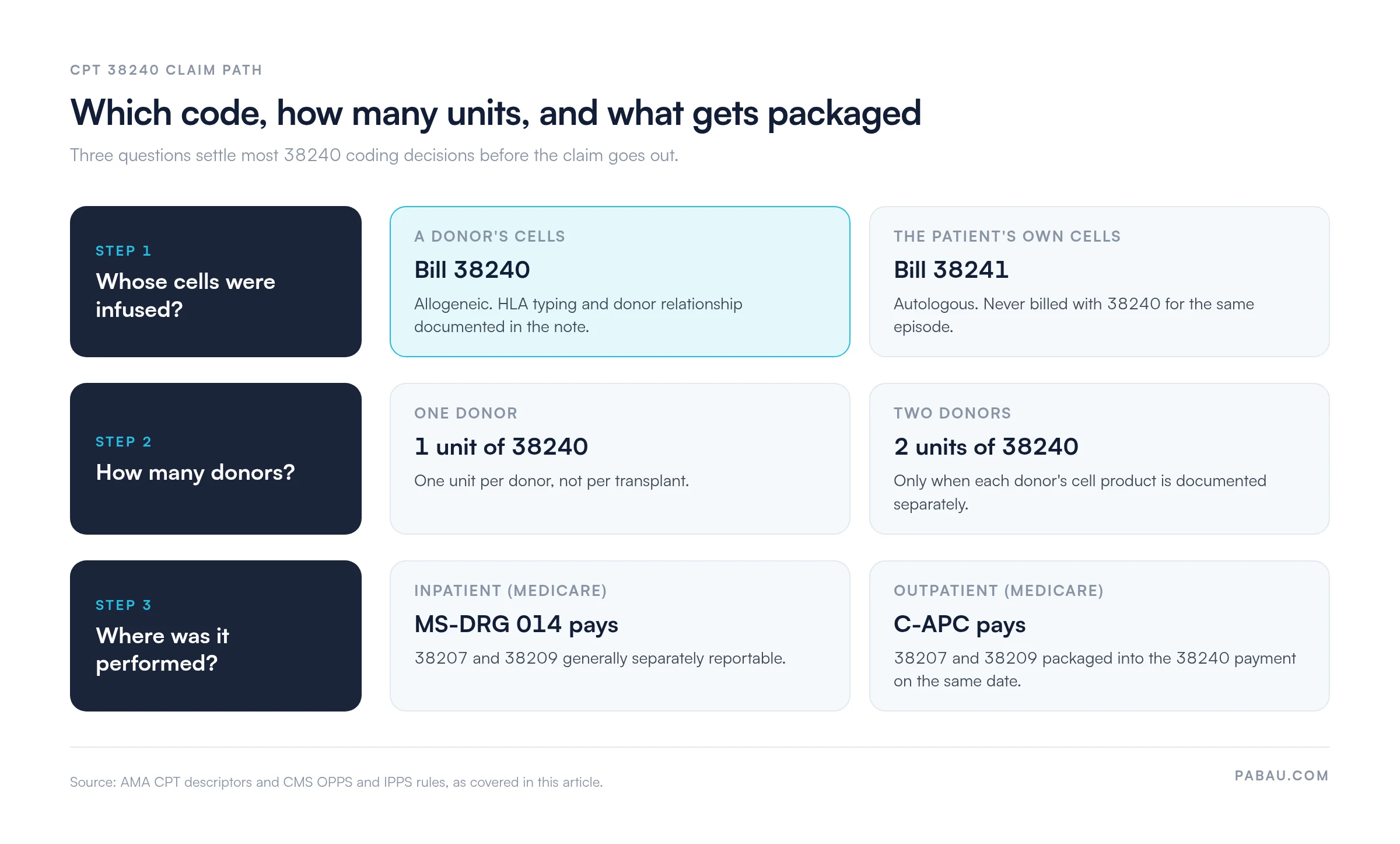
CPT code 38240 is defined by the American Medical Association as: Hematopoietic progenitor cell (HPC); allogeneic transplantation per donor. The “per donor” language is the most billing-critical detail in the descriptor. Two donors used in a single transplant episode generate two billable units of 38240, provided each donor’s cell product is separately documented.
Hematopoietic progenitor cells are the parent blood-forming cells collected from a donor’s peripheral blood or bone marrow. The recipient first goes through a conditioning regimen of chemotherapy, radiation or both to clear the existing marrow. The donor HPCs are then infused intravenously and migrate to the bone marrow to restore blood cell production.
In billing terms, the allogeneic route means the cells come from someone other than the patient. That donor source is what separates 38240 from its autologous counterpart.
The procedure is performed in the inpatient setting for most patients, though outpatient transplants do occur at select high-volume centers. The site of service significantly affects payment, as discussed in the Medicare/OPPS section below.
CPT 38241 covers autologous HPC transplantation, where the patient’s own previously collected and stored cells are reinfused. The two codes are structurally similar but clinically and administratively distinct.
Misassigning 38241 when the record documents an allogeneic source is a frequent audit finding. The distinction depends entirely on whether the cells came from a matched sibling, matched unrelated donor (MUD), or other third-party source. HLA typing documentation in the record is what establishes allogeneic status for 38240.
CPT code 38240 belongs to the 38240-38243 code range, the AMA subheading for transplantation and post-transplantation cellular infusion procedures. That range also includes 38243, the HPC boost code. Several codes in and around it are either separately reportable from 38240 or frequently confused with it.
OPPS C-APC packaging means 38207 and 38209 are bundled into the 38240 payment when billed on the same date at an outpatient hospital facility. In the inpatient setting, these companion codes are generally separately reportable under DRG payment rules. Check the current-year OPPS Addendum B before billing either one separately on an outpatient claim.
Together, the donor source, the donor count and the care setting decide almost every coding choice on a 38240 claim, as the path below shows.
The primary diagnosis must document a condition that medically necessitates an allogeneic approach. Payers use the ICD-10-CM code to confirm that 38240 (not 38241) was clinically appropriate. The table below lists the most common pairings.
Using an ICD-10-CM code that implies autologous intent is a common coding mismatch that triggers automatic denial. A multiple myeloma code on a record documenting an allogeneic procedure is the typical example. The diagnosis code must match the transplant type documented in the operative note.
Document HLA typing results and the donor relationship (matched sibling, matched unrelated donor, haploidentical) in the procedure note. Payers use this information to verify allogeneic status when reviewing 38240 claims. Missing donor documentation is one of the most frequent denial reasons on these claims.
A complete medical record supporting a 38240 claim must contain all of the following. A claim missing any one of these elements can be denied or recovered in a post-payment audit. Ensuring medical billing compliance on high-cost oncology claims requires more rigorous pre-claim documentation review than most other procedure types.
A dedicated pre-claim checklist for 38240, reviewed by both the clinical team and the billing department, catches these misses before submission. Submitting a clean claim on the first pass matters here because appeals on high-cost oncology codes take longer to adjudicate than standard claims.
Nearly all major commercial payers require prior authorization for CPT code 38240, so it belongs at the start of your prior authorization process. Failure to obtain it before the transplant date accounts for the largest share of initial denials on these claims. Payer-specific policies to know include the following.
Not every payer requires prior authorization for 38240, but most commercial plans do, and the cost of these claims makes them a routine target. Automated claims management software can flag procedure codes with known PA requirements before the appointment is confirmed.
In the 2017 OPPS final rule, CMS established a Comprehensive Ambulatory Payment Classification (C-APC) specifically for CPT code 38240. This packaging approach changed how hospitals bill for outpatient allogeneic transplants under Medicare.
Under the C-APC, CMS bundles the payment for most ancillary services provided on the same date as the 38240 infusion into a single prospective payment.
Services that fall within the C-APC’s scope cannot be separately billed on that date at the outpatient facility level. CMS updates this packaging logic every year in the OPPS Addendum. Check the current year’s C-APC assignments before billing companion codes alongside 38240.
Most allogeneic transplants are performed during an inpatient admission, where Medicare pays under the MS-DRG system. The hospital’s charge description master still captures the procedure as 38240. On the inpatient claim, though, the DRG drives the Medicare payment rather than the CPT code.
For outpatient transplants, the C-APC governs payment at the facility level, and 38240 is the primary HCPCS/CPT trigger for C-APC assignment. For the physician’s professional claim, the CMS Physician Fee Schedule lookup lists current RVU values and payment amounts by locality.
Medicare reimbursement for CPT code 38240 depends on the care setting. The table below shows the payment mechanism in each setting and where to look up the current rate.
Medicare rates change annually. Before using any rate figure for contract negotiations or revenue projections, verify it against the current-year CMS CPT/HCPCS code list and OPPS Addendum.
CPT code 38240 denials cluster around a predictable set of causes. Good denial management workflows start by identifying which of these is the root cause before resubmitting.
When appealing a 38240 denial, include the operative note, HLA typing results, conditioning regimen records, and the authorization letter. Payers reviewing these appeals look for the same documentation elements listed in the checklist above.
The CARC and RARC denial codes on the initial electronic remittance advice show which element triggered the rejection. Match the resubmission’s supporting records to that code.
Run a quarterly audit of your 38240 claims by pulling the CARC codes from your ERA files. If CARC 197 (absence of prior authorization) appears on more than 20% of denials, fix the process upstream. Add a PA checkpoint to your transplant scheduling workflow rather than leaning on resubmissions.
When the 38240 checklist lives in a spreadsheet and the auth number sits in an email, the missing piece usually surfaces with the denial. By then the appeal clock on a high-cost claim is already running.
Pabau, the practice management platform we build, keeps the authorization, the donor documentation and the claim in the same patient record. Its claims management tools flag procedure codes with known prior authorization requirements before the appointment is confirmed.
Professional claims then go out as 837P electronic claims through the Claim.MD clearinghouse integration, with eligibility checked before a high-cost procedure is scheduled. Your billing team spends its time on clean first submissions instead of months of appeals.

Pabau’s claims management tools track prior authorization status, flag high-risk codes like CPT 38240 before submission, and send clean claims through the Claim.MD clearinghouse integration.

The coding rules for CPT code 38240 are settled. Denials come from process. The usual culprits are an auth number left off the claim, a note that never says “allogeneic”, or one unit billed for two donors.
Build the pre-claim checklist into the transplant schedule itself, so the authorization and donor documentation are confirmed before the infusion date. Then pull last quarter’s 38240 denials and fix the step behind the most common CARC first.
The trade-off is a few extra minutes per case before submission, set against months of appeals on a high-cost transplant claim. Book a demo to see how Pabau flags prior authorization and documentation requirements on 38240 claims before they go out.

How does the Claim.MD clearinghouse integration work? Claim.MD clearinghouse guide explains the EDI transaction sets, payer enrollment process, and ERA reconciliation workflow supported through Pabau.
What should a clean 38240 claim include? Medical superbill guide walks through the required fields and documentation elements that support accurate billing for complex procedures.
Weighing tools to manage transplant authorizations? Prior authorization software compares the options for tracking requests, approvals and auth numbers in one place.
Want to confirm coverage before the infusion date? Insurance eligibility verification explains what to check before a high-cost procedure is scheduled.
CPT code 38240 is the procedure code for allogeneic hematopoietic progenitor cell transplantation, billed per donor. It is used when a patient receives stem cells from a third-party donor rather than their own stored cells. It applies to transplants using bone marrow, peripheral blood, or cord blood from a matched sibling, matched unrelated donor, or haploidentical donor.
CPT 38240 covers allogeneic transplantation using cells from a donor, while CPT 38241 covers autologous transplantation using the patient’s own previously collected and stored cells. The key billing difference is the unit count. 38240 is billed per donor, so two donors can generate two units. 38241 is billed once per transplant episode, whatever the cell product volume.
Per donor means each individual donor whose cells are used in the transplant generates one billable unit of CPT 38240. A transplant using cells from two separate donors is billed as two units of 38240. Each donor’s cell product must be documented separately in the medical record. Billing two units without documentation to support both donors is an audit risk.
Medicare reimbursement for CPT 38240 depends on the care setting. Inpatient cases are paid under the MS-DRG system, while outpatient cases fall under a Comprehensive APC created in the 2017 OPPS final rule. Physician professional fees are calculated using RVU values from the Medicare Physician Fee Schedule, which change annually. Use the CMS Physician Fee Schedule lookup or FastRVU for current locality-adjusted figures.
Yes, most major commercial payers require prior authorization for CPT 38240. That includes Aetna (CPB 0190, Stem Cells for Hematopoietic Cell Transplant), BCBS Florida, and HealthNet’s clinical policy for stem cell transplantation. Medicare coverage criteria are governed by Local Coverage Determinations from the applicable MAC (Palmetto GBA for Jurisdictions J and M). Not every payer requires PA, but the majority do, making pre-authorization verification a mandatory step in the transplant scheduling workflow.
The ICD-10-CM codes most often paired with CPT 38240 are C91.00 (acute lymphoblastic leukemia), C92.00 (acute myeloblastic leukemia), and D46.9 (myelodysplastic syndrome). D61.09 (aplastic anemia) and C83.39 (diffuse large B-cell lymphoma) are also common. The diagnosis must document a condition that medically requires an allogeneic rather than autologous approach. Payers use the ICD-10-CM code to confirm that 38240 was clinically appropriate.