CPT code 63081: Vertebral corpectomy, cervical spine
CPT code 63081: official descriptor and procedure overview CPT code 63081 descri...

Last Updated: Oct 6, 2026
37766 is the CPT code for stab phlebectomy of varicose veins on one leg when more than 20 incisions are made in a single session. It covers ambulatory phlebectomy of varicose tributaries through small stab incisions, using a phlebectomy hook.
The incision count recorded in the operative note decides between 37766 and its neighbor 37765, which covers 10 to 20 incisions. Payers audit that count, so the note has to state an exact number.
Let Pabau's smart automation suggest the right codes, reduce claim denials, and keep your practice compliant—effortlessly.
Automate repetitive tasks and focus on what matters most—your patients.
Reduce coding errors and ensure compliance with the latest regulations.
Clean claims, fewer denials, and faster reimbursements.
Powerful insights and reporting to help your practice thrive.
HIPAA compliant SOC 2 certified GDPR-compliant Trusted by 4,000+ clinics worldwide

CPT Code 37766 covers stab phlebectomy of varicose veins on one extremity with more than 20 incisions. The count is what separates it from 37765, which covers 10-20 incisions.
The operative note must state an explicit count above 20. Vague wording such as ‘multiple incisions’ is an audit risk and a common denial trigger.
Medicare requires duplex ultrasound documentation and proof that conservative therapy failed before varicose vein procedures qualify for coverage under MAC LCDs.
Medicare has applied a 10-day global period to 37766 since January 1, 2020.
Pabau’s claims management software runs validation checks before submission and sends claims electronically through Claim.MD.
CPT Code 37766 is the code for stab phlebectomy of varicose veins on one leg when more than 20 incisions are made in one session. The American Medical Association (AMA) publishes it with the official descriptor “Stab phlebectomy of varicose veins, 1 extremity; more than 20 incisions.”
It sits in the venous procedures range of the CPT surgery section. The procedure is done under local anesthesia in an office, an ambulatory surgical center (ASC), or an outpatient hospital.
The varicose tributaries are marked before surgery with the patient standing. The surgeon then makes 1-3 mm stab incisions along the marked veins, extracts vein segments with a phlebectomy hook, and applies compression. Each stab incision counts toward the 37766 threshold. When the total exceeds 20 on one extremity in one session, 37766 is the correct code.
The difference between 37765 and 37766 is the incision count. 37765 applies when 10-20 incisions are made. 37766 applies when more than 20 incisions are made on one extremity in one session.
Both codes are per-extremity, per-session codes. Billing 37765 when the operative note documents 23 incisions is an undercoding error. Billing 37766 when only 18 incisions were made is an overcoding risk.
The operative note is the audit trigger. Payers will not accept “multiple stab incisions” as documentation for 37766, because the count has to appear as a number. If the count is not recorded during the procedure, code the claim to 37765 or hold it until a compliant addendum amends the note. The decision below runs per leg, per session.
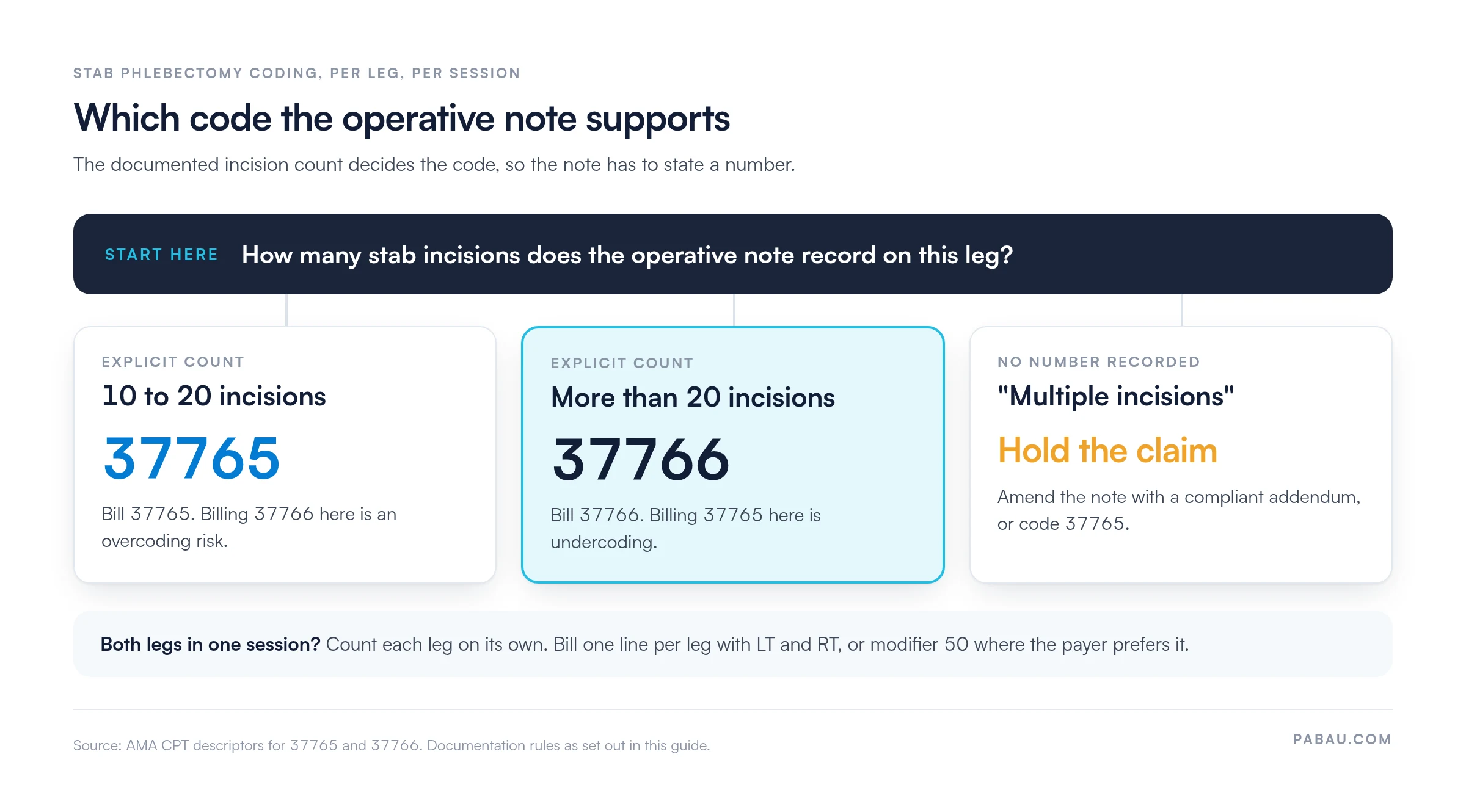
Varicose vein treatment involves several distinct CPT codes depending on technique. Using the wrong code family is a common error when a practice treats both the saphenous trunk and tributaries on the same day.
The operative note is the single most important document for 37766 claims. Payers and Medicare auditors check it against a defined list of required elements. Missing any one of these can trigger a denial or a post-payment audit finding.
A superbill template with an incision-count field, filled in during the procedure, puts the number on record before the claim is submitted.
Modifier selection for 37766 depends on laterality, whether multiple procedures are performed on the same date, and whether an assistant surgeon was involved. Attaching the wrong modifier, or omitting one, is a leading cause of denials on phlebectomy claims.
Confirm bilateral billing rules with each payer before submitting modifier 50. Some commercial plans pay 150% of the single-procedure rate; others require separate line items with LT and RT modifiers and apply their own bilateral reduction. When a bilateral phlebectomy claim is denied, check the modifier format before you appeal on coverage grounds.
Medicare covers stab phlebectomy under CPT Code 37766 when the claim meets the criteria established in the applicable MAC Local Coverage Determination (LCD). Coverage is not automatic.
In Novitas jurisdictions the governing LCD is L34924, “Treatment of Chronic Venous Insufficiency of the Lower Extremities.” CGS, Palmetto GBA, and WPS publish their own equivalents. Each sets out clinical criteria that must be met and documented before the claim can be approved.
MAC LCD policies are jurisdiction-specific. Practices billing to Novitas (jurisdictions H and L) should verify against L34924, and CGS practices should check their equivalent LCD. A Medicare Coverage Database search returns the current LCD and billing article for your MAC.
The 2026 Medicare Physician Fee Schedule rates for CPT Code 37766 are published in the CMS PFS Look-Up Tool. Always verify current-year rates in the CMS Physician Fee Schedule search. Rates change every year and vary by locality through the Geographic Adjustment Factor (GAF).
The figures below represent national non-facility and facility averages for 2026 and should be confirmed for your specific MAC jurisdiction.
For current RVU values by component, use the FastRVU 2026 RVU lookup tool, which reflects the final 2026 CMS PFS data. Commercial payer rates for 37766 typically exceed Medicare rates but vary by contract, so confirm them against each payer’s fee schedule.
Most 37766 denials share a small set of root causes. Each one comes back on the remittance with a reason code, and our guide to denial codes explains how to read them. Fix the cause in the note or the claim template, and the same denial stops recurring.
Effective denial management starts before the claim leaves the office. Check the operative note, the modifiers, and the supporting records against the table above while the procedure is still fresh.
NCCI (National Correct Coding Initiative) edits govern which codes can be billed together on the same date of service. The key bundling scenarios for 37766 involve same-day endovenous ablation and bilateral phlebectomy.
Understanding what makes a clean claim before submission is the most effective way to avoid NCCI-related denials. Build a same-day procedure checklist that cross-checks the NCCI PTP table for every common 37766 pairing your practice bills.
Run a quarterly audit of all 37766 claims billed alongside 36475 or 36471. Pull the EOB denial reason codes and map each one to the NCCI edit or modifier error behind it. A 15-minute review of 90 days of phlebectomy claims usually surfaces one or two systematic errors. Fix those, and a recurring denial pattern disappears.
The ICD-10 diagnosis code paired with 37766 directly affects medical necessity review. Payers match the diagnosis to the procedure and apply LCD criteria. Asymptomatic varicose veins coded I83.9x rarely meet Medicare’s coverage threshold without additional documented complications.
The AAPC Codify CPT lookup cross-references CPT codes with the ICD-10 diagnoses that support them. Electronic remittance advice also shows when a denied claim failed medical necessity on the diagnosis code used. Tracking these through ERA management speeds the root-cause identification.
Most phlebectomy billing still runs on a checklist and a clearinghouse portal. Someone reads the operative note, keys the code and modifiers, and learns about a missing authorization when the denial arrives.
Pabau, the practice management platform we build, keeps the appointment, the clinical notes, and the claim in one patient record. Its claims software for phlebologists runs validation checks on membership numbers and authorization codes before a claim goes out. It also runs real-time eligibility checks and submits claims electronically through Claim.MD.
Each claim then moves through a visible status, from pending to submitted, processing, and paid, and ERA remittances post against it. Your team spots a rejected 37766 line within days and corrects it while the operative note is still fresh.

Pabau checks each claim before submission, sends it through Claim.MD, and tracks every 37766 line until it is paid.

Most 37766 denials trace back to the operative note, so the fix starts in the procedure room. Make the exact incision count a required field, and confirm laterality and the duplex report before the claim is submitted.
The trade-off is a minute of extra documentation per leg against a full resubmission cycle. Once the count lives in the note template, the most common phlebectomy denial stops appearing.
Book a demo to see how Pabau checks and tracks vein procedure claims from submission to payment.

Want to understand how claims move from code to payment? Claim.MD clearinghouse guide explains how electronic claims are validated, submitted, and tracked through the payer network.
Looking for a plain-language overview of the billing cycle? Revenue cycle management explained covers the end-to-end process from patient check-in to payment posting.
Planning a phlebectomy for a Medicare Advantage or commercial patient? The prior authorization process walks through what to submit and when.
Billing traditional Medicare for vein procedures? Medicare billing covers enrollment, claim forms, and the rules that decide payment.
CPT code 37766 is used to bill stab phlebectomy of varicose veins on one extremity when more than 20 micro-incisions are made in one session. It covers the removal of varicose tributaries using small stab incisions and hook extraction, performed under local anesthesia in an office, ASC, or outpatient setting.
CPT 37765 applies when stab phlebectomy involves 10-20 incisions on one extremity. CPT 37766 applies when the count exceeds 20. The operative note must document the specific number. Without it, the claim supports 37765 at best and a denial at worst.
Yes, Medicare covers CPT code 37766 when the claim meets LCD criteria. The record must show failed conservative therapy (typically 6-12 weeks of compression), a pre-operative duplex ultrasound confirming reflux or tributary disease, and symptomatic disease. Asymptomatic varicose veins rarely meet Medicare coverage thresholds.
The most common denials for CPT 37766 involve a missing or vague incision count in the operative note, or no laterality modifier (LT or RT). Missing proof of failed conservative therapy and a missing duplex ultrasound report are close behind. Prior authorization not obtained for commercial or Medicare Advantage plans is also a frequent trigger.
Billing 37766 and 36475 on the same date on the same extremity may be subject to NCCI PTP bundling edits. Whether modifier 59 can break the bundle depends on the current edit table. It also depends on whether the procedures treated distinct anatomical segments, documented separately. Verify the current NCCI PTP edit before submitting this combination.
Traditional Medicare does not require prior authorization for CPT 37766, but many Medicare Advantage plans and commercial payers do. Check the plan’s authorization requirements before scheduling the procedure. Send the duplex report and conservative treatment records with the authorization request.