

HCPCS Code G0163: Skilled nursing observation and assessment
What is HCPCS Code G0163? HCPCS Code G0163 is a deleted Level II code for skille...

Last Updated: Oct 15, 2026
36600 is the CPT code for arterial puncture, withdrawal of blood for diagnosis. It covers one percutaneous needle stick into a peripheral artery, usually the radial, to collect a specimen such as an arterial blood gas.
The needle comes out once the specimen is drawn. If a catheter stays in the artery for monitoring or repeated sampling, the service is CPT 36620 instead. 36600 is not billed for that access event.
Let Pabau's smart automation suggest the right codes, reduce claim denials, and keep your practice compliant—effortlessly.
Automate repetitive tasks and focus on what matters most—your patients.
Reduce coding errors and ensure compliance with the latest regulations.
Clean claims, fewer denials, and faster reimbursements.
Powerful insights and reporting to help your practice thrive.
HIPAA compliant SOC 2 certified GDPR-compliant Trusted by 4,000+ clinics worldwide

CPT code 36600 describes a single percutaneous arterial puncture to withdraw a blood specimen, not catheter insertion or continuous monitoring.
It pairs most often with J96.xx (respiratory failure) and E87.x (acid-base disorder) ICD-10-CM codes. The physician note must state the clinical indication explicitly.
NCCI bundles 36600 with 36620, so only one code applies per arterial access event. Modifier 59 does not override this when the same site is used.
At 2026 national Medicare rates, 36600 pays about $13 in a facility and about $27 in an office setting.
Pabau’s claims management software checks each claim for missing details before it reaches the clearinghouse, so fewer 36600 claims come back rejected.
CPT code 36600 is the code for a single arterial puncture to draw blood for diagnosis, most often an arterial blood gas (ABG). It sits in the Surgery section of the AMA CPT code set, within the Arterial Procedures subsection (range 36600-36660) of the Cardiovascular System.
Its short AMA descriptor, “Withdrawal of arterial blood,” condenses the official long descriptor, “Arterial puncture, withdrawal of blood for diagnosis,” into four words. AAPC’s CPT range listing places the code under Arteries and Veins, next to the other arterial access codes.
The clinician inserts a needle percutaneously into a peripheral artery, most often the radial artery at the wrist. The brachial or femoral artery is used less often. After the specimen is withdrawn, pressure is applied until hemostasis is achieved.
The needle comes out once the specimen is collected and does not stay in place. That single-act scope is what separates 36600 from its most common coding neighbor.
The most common clinical reasons for ordering 36600 are:
The ABG panel drawn from this puncture measures pH, PaO2, PaCO2, and bicarbonate, which a venous draw cannot provide. In the CMS Physician Fee Schedule, 36600 carries a global period of XXX (not applicable). The global surgery rules don’t apply to it, so no pre- or post-operative days are bundled into the payment.
Knowing where 36600 stops prevents the two most common errors on arterial access claims. Those are upcoding to 36620 and billing a venipuncture code for the same draw. The table below shows what 36600 includes and excludes.
A bedside ABG draw by a nurse or respiratory therapist is coded as 36600. If the same encounter ends with an arterial line placed for hemodynamic monitoring, only 36620 is billable for that access event. A separately documented venous draw is reported with 36415 instead.
CPT 36620 describes arterial catheterization for sampling, monitoring or transfusion. The needle enters the artery, a catheter is threaded over a wire or directly, and the catheter stays in place. A puncture-and-withdraw encounter leaves no device behind, which is why the two codes never share one access event.
The “what stops the clock” row is the practical coder’s test. If the procedure ends when the specimen is in the tube and the needle is out, bill 36600. If it ends when the catheter is secured and connected to a transducer, bill 36620. The decision path below adds the venous branch, so one check covers all three draw codes.
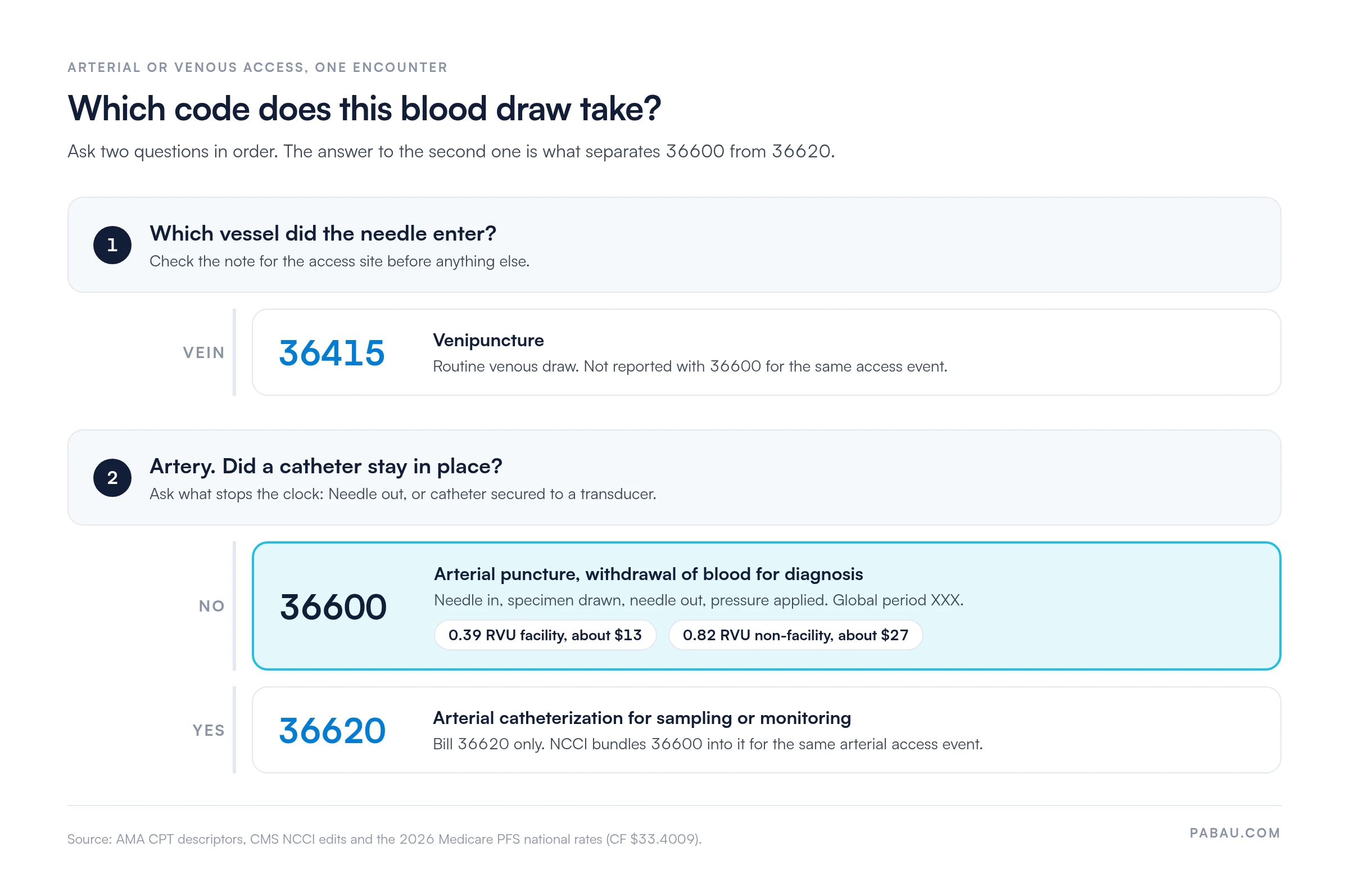
When reviewing ICU operative notes, search for the phrase ‘arterial line placed’ or ‘A-line inserted.’ If either appears alongside an ABG order for the same encounter, 36620 is the correct code and 36600 is not billed. Billing both creates an NCCI conflict that triggers an automatic denial.
Every CPT 36600 claim needs a linked ICD-10-CM diagnosis that establishes medical necessity for the arterial draw. Payers check whether that diagnosis supports the clinical reason for the procedure. Vague or missing diagnosis links are the second most common 36600 denial cause after bundling errors.
Avoid pairing 36600 with a symptom code such as R09.02 on its own, unless no more specific diagnosis is documented. MAC auditors often flag symptom-only diagnoses as weak medical necessity support for ABG draws outside the emergency setting. For a condition outside this table, search the ICD-10-CM code library for the most specific billable code.
Three modifiers apply to 36600, each in specific, defensible circumstances. Appending them anywhere else increases audit exposure.
The place-of-service (POS) code changes how Medicare calculates the practice expense component. With a facility POS, such as 21 for inpatient or 22 for outpatient hospital, CMS applies the lower facility rate. An office setting (POS 11) earns the non-facility rate, which is about twice the facility payment for 36600.
The National Correct Coding Initiative (NCCI) bundles CPT 36600 with several commonly co-billed codes. Submitting both codes of a bundled pair without a valid modifier override leads to a denial. These are the 36600 bundle conflicts that come up most often under CMS NCCI policy.
If 36600 denials are already piling up, a structured denial management process sorts them by cause before anyone appeals. Checking each claim against the clean claim standard before submission prevents most of these scenarios at the source.
Medicare covers CPT code 36600 when the clinical record supports medical necessity. Coverage is governed at the MAC level through Local Coverage Determinations (LCDs), which vary by jurisdiction. Running insurance eligibility verification before an outpatient ABG draw confirms which payer and LCD apply before the claim goes out.
Medicare generally expects at least one of these indications in the record.
Frequency limits vary by MAC jurisdiction. Serial ABG monitoring may need each draw’s medical rationale documented, rather than a single standing order.
The table below shows 2026 national figures from the CMS Physician Fee Schedule, at a conversion factor of $33.4009. Verify current-year rates with the PFS Look-Up Tool, because values update every January 1. Geographic Practice Cost Index (GPCI) adjustments apply by MAC locality.
Commercial payers usually follow Medicare coverage logic for 36600. They may still set different frequency limits or require prior authorization for outpatient ABG monitoring, so check at the plan level before submitting repeat draws.
Most 36600 denials fall into five categories. Each has a specific prevention step a coder can take before the claim leaves the practice. Holding every arterial access claim to medical billing compliance standards reduces audit exposure and lifts first-pass acceptance.
The following checklist captures what coders need to find in the clinical record before assigning CPT 36600. This can be handed directly to clinical staff as a documentation guide.
Run a quarterly audit of 36600 claims that were paid on the first pass alongside the claim’s linked ICD-10 code. A pattern of first-pass claims with a symptom-only diagnosis (R09.02, R06.00) means the documentation standard is too loose. A post-payment audit could reverse those claims as overpayments, so tighten the standard before the MAC finds it.
In many billing teams, a 36600 problem surfaces only when the denial arrives. Someone pulls the note, finds the missing indication or the wrong POS, and resubmits weeks later.
Pabau, the practice management platform we build, moves those checks to the moment of sending. Its claims software for practices builds each claim from the patient record and the invoice, so insurer and policy details aren’t re-keyed. Validation checks run every time you send, and the Send button stays disabled until a required detail is in place.
In the US, Pabau connects to Claim.MD, a clearinghouse that sends claims electronically to thousands of payers. Run a real-time eligibility check before an outpatient ABG draw, then track the claim and post the ERA remittance from the same dashboard.
For 36600, the payoff comes upstream. A claim that leaves with the right POS, a linked diagnosis and complete insurer details seldom needs an appeal.

Pabau builds each claim from the patient record, checks for missing details before you send, and submits through Claim.MD with real-time eligibility checks. See how the billing workflow runs for arterial access codes.

CPT code 36600 pays little, at about $13 to $27 nationally, yet it turns up every day in ICU, emergency and respiratory therapy work. That volume is why its bundling rules with 36620 and critical care deserve a code-specific check rather than a general claim review.
The trade-off favors prevention. A short documentation check covering site, indication, Allen’s test, hemostasis and the ordering provider costs less than one appeal on a $13 claim. Confirm no catheter placement is documented, and the 36620 conflict goes away too.
Book a demo to see how Pabau checks claims for missing details and tracks arterial access claims from submission to payment.

Need to understand denial codes on a rejected 36600 claim? Denial codes in medical billing covers CARC reason codes and how to action each one.
Looking for clearinghouse options for CPT claim submission? How a medical claims clearinghouse works explains the 837P transaction flow and what to check before choosing a clearinghouse.
Want to understand how ERA remittances map back to 36600 payments? Electronic remittance advice (ERA) explains how 835 files carry denial reason codes back to your billing system.
Pairing 36600 with a COPD diagnosis? ICD-10 code J44.1 covers COPD with acute exacerbation and the documentation it needs.
Was the draw venous but needed a physician’s skill? CPT code 36410 explains when a venipuncture moves beyond routine 36415 billing.
CPT code 36600 covers a single percutaneous arterial puncture performed to withdraw blood for diagnostic testing, most commonly an arterial blood gas (ABG). The code includes needle insertion into a peripheral artery, specimen collection, needle removal, and post-draw hemostasis. It does not include catheter placement, arterial line insertion, or blood gas interpretation.
CPT 36600 is a puncture-and-withdraw. The needle enters the artery, a specimen is collected, and the needle is removed. CPT 36620 is arterial catheterization, where a catheter stays in the artery for continuous monitoring or repeated sampling. When 36620 is performed, 36600 cannot be billed for the same arterial access event, because 36620 includes the puncture.
Modifier 59 applies when 36600 is a distinct procedural service, documented at a different time or site from another co-billed procedure. Modifier 76 applies to a repeat arterial puncture by the same provider on the same date. Modifier 77 applies when a different provider performs the repeat draw. Modifier 26 is not appended to 36600, because the code describes the procedure rather than the interpretation of results.
Yes, Medicare reimburses CPT code 36600 when the record documents a covered indication such as respiratory failure, COPD exacerbation, or an acid-base disorder. At 2026 national rates, the non-facility payment is about $27 and the facility payment is about $13. Both change with annual PFS updates and GPCI locality adjustments, so verify current rates in the CMS Physician Fee Schedule Look-Up Tool.
Yes. In the outpatient setting, 36600 can be billed separately from a same-day E/M service when the note documents a distinct reason for the arterial puncture. Modifier 25 goes on the E/M when documentation supports a significant, separately identifiable service. In an inpatient or critical care setting, NCCI edits may bundle the draw into the E/M or critical care code. Clearly documented time separation can keep it separately billable.
Yes. CPT 36600 is bundled with CPT 36620 under NCCI edits when both are billed for the same arterial access event. Modifier 59 cannot override that pair. It may also be bundled with critical care codes 99291/99292 when the draw counts as part of the critical care service. When 36600 is billed with a same-day E/M, modifier 25 goes on the E/M if documentation supports a significant, separately identifiable service.




