

HCPCS Code Q4185: Cellesta flowable amnion billing guide
HCPCS Code Q4185: definition and official descriptor HCPCS Code Q4185 is the Lev...

Last Updated: Nov 20, 2026
36248 is the CPT add-on code for each additional second-order, third-order, or higher selective catheter placement in an abdominal, pelvic, or lower extremity arterial family. It is reported in addition to 36246 or 36247, the code for the first selective vessel at that order.
Because it carries the + add-on designation in the AMA CPT codebook, 36248 never stands alone on a claim. A claim that lists 36248 without one of those primary codes is denied. This reference covers catheter order classification, add-on rules, documentation, modifiers, Medicare reimbursement, co-billed codes, and common denial patterns.
Let Pabau's smart automation suggest the right codes, reduce claim denials, and keep your practice compliant—effortlessly.
Automate repetitive tasks and focus on what matters most—your patients.
Reduce coding errors and ensure compliance with the latest regulations.
Clean claims, fewer denials, and faster reimbursements.
Powerful insights and reporting to help your practice thrive.
HIPAA compliant SOC 2 certified GDPR-compliant Trusted by 4,000+ clinics worldwide

CPT Code 36248 is an add-on code (+36248) that is reported with CPT 36246 or 36247 as the primary code. It is never billed alone.
It covers each additional second-order or higher selective catheter placement in one abdominal, pelvic, or lower extremity vascular family. One session can carry several units.
Only the highest-order vessel reached first in a family takes 36246 or 36247. The lower-order vessels the catheter passed through are included in that code.
Procedure notes must name every vessel catheterized, document the order reached for each, and confirm catheter position by imaging to survive payer audit.
Pabau’s claims management software submits 36248 claims through the Claim.MD clearinghouse and receives ERA remittances back. Its claim validation checks each claim for missing or invalid details before it goes out.
CPT Code 36248 is the add-on code for each additional second-order or higher selective catheter placement within one abdominal, pelvic, or lower extremity arterial family.
AAPC’s code entry for 36248 files it under intra-arterial catheter procedures 36245-36299, as an additional branch within a vascular family. The + symbol before it in the codebook marks it as an add-on, reported after 36246 or 36247.
The full descriptor in the AMA’s CPT code set reads as follows.
Selective catheter placement, arterial system; additional second order, third order, and beyond, abdominal, pelvic, or lower extremity artery branch, within a vascular family (List in addition to code for initial second or third order vessel as appropriate)
In practice, interventional radiologists report this code when a catheter goes beyond the vessel level the primary code already captures in the same session. For example, after 36247 for a third-order hepatic branch, each further second- or third-order celiac branch adds one unit of 36248.
The specialties most commonly reporting 36248 are interventional radiology (IR), vascular surgery, and interventional cardiology. Procedures include visceral angiography (mesenteric, renal, celiac), peripheral vascular interventions, and preoperative mapping of tumor-feeding vessels.
Catheter order classification determines which code in the 36245-36248 family applies. The hierarchy counts how far from the aorta the catheter tip has advanced, using the vessel branching structure as the measurement unit.
Order resets with each vascular family. The celiac axis and the superior mesenteric artery (SMA) are separate vascular families. Branching from the celiac into the hepatic artery is a second-order placement within the celiac family. Advancing from the aorta into the SMA is a first-order placement within the SMA family, coded independently.
Within one family, only the highest-order vessel reached first is coded, as 36245, 36246 or 36247. The lower-order vessels the catheter passed through on the way are included in that code. Every further selective vessel of second order or higher in the same family then adds one unit of 36248.
CPT 36248 must be reported with a primary code from the selective catheter placement series. The AMA codebook parentheticals following 36248 specify exactly which primary codes are acceptable.
The + designation always signals dependency on a listed primary code. The instruction inside the 36248 descriptor names the initial second- or third-order vessel code, 36246 or 36247, as its primary. Check that one of them sits on the same claim before 36248 goes out.
The four selective catheter placement codes cover every combination of vessel order and session position. Use this table to select the correct code at the point of coding.
36247 and 36248 describe two different positions within the same procedure. 36247 covers the initial third-order (or higher) selective catheter placement in a vascular family. CPT Code 36248 covers each additional second- or third-order vessel accessed after that first placement.
The confusion arises because both codes involve third-order (or higher) vessels, but position in the session determines which applies. Only one 36247 is reportable per session per vascular family. Every subsequent qualifying vessel is 36248.
Documentation requirements for CPT Code 36248 center on proving each vessel order reached. Payers audit catheter placement claims for vessel specificity, so a vague operative note is a common denial trigger.
The procedure note (or operative report) must contain all of the following for each vessel where 36248 is claimed. Solid medical billing fundamentals start with documentation that ties each coded service to a specific procedural event.
Audit your operative reports against the vessel list before coding. If the report names the celiac artery but not the second- or third-order branches catheterized, ask the physician to amend it before submitting. A denial corrected on resubmission costs more time than an amendment before first submission.
Modifiers applied to CPT Code 36248 primarily address NCCI bundling edits and bilateral procedure scenarios. The table below shows the most commonly required modifiers.
NCCI edit pairs are updated quarterly by the Centers for Medicare & Medicaid Services (CMS). Always verify the current NCCI table before submitting 36248 alongside angiography supervision codes. A valid combination one quarter may be bundled the next.
Medicare covers CPT Code 36248 when the service is medically necessary and documentation supports the vessel order claimed. Coverage is not unconditional. Medicare Administrative Contractors (MACs) publish Local Coverage Determinations (LCDs) for vascular procedures that set medical necessity criteria, and those criteria vary by jurisdiction.
Medicare reimbursement for 36248 is calculated from the Medicare Physician Fee Schedule (MPFS). RVU values change annually with each MPFS update, so treat the figures below as directional. Verify them against the current year’s fee schedule in the CMS Physician Fee Schedule lookup tool.
Use the FastRVU lookup tool to retrieve the current year’s exact wRVU, PE RVU, and malpractice RVU values with geographic adjustment applied for your locality. Commercial payer rates vary significantly from MPFS. Most commercial contracts pay a percentage of MPFS (typically 110% to 150% for interventional procedures).
Several angiography supervision and interpretation codes are frequently reported alongside 36248. One of them is code 75774, which reports each additional vessel studied selectively after the basic examination. Each requires its own documentation and must clear current NCCI edit pairs before billing. Verify the NCCI table quarterly.
CPT Code 36248 denials cluster around five root causes. Each is cheaper to fix before submission than on appeal. A denial management workflow catches these patterns before they reach the payer.
A clean claim for 36248 passes three pre-submission checks. The primary code is present, the units match the documented vessels, and no active NCCI edit blocks a co-billed code. When a claim still comes back, its remittance carries a reason code, which the guide to denial codes maps to a fix.
Run a quarterly NCCI edit review for the top 10 code pairs your practice bills alongside 36248. NCCI updates take effect January 1, April 1, July 1, and October 1. A code combination that cleared edits in Q1 may be bundled by Q2 without an alert from the payer.
Scenario-based coding is the clearest way to understand CPT Code 36248 in practice. The four scenarios below cover three correct reporting situations and one common over-coding mistake.
Procedure: Femoral access → celiac axis (first order) → common hepatic artery (second order) → right hepatic artery (third order, initial). The catheter then selects the left hepatic artery (third order, additional).
Codes: 36247 for the right hepatic artery, plus one unit of 36248 for the left hepatic. The celiac and common hepatic placements are included in 36247, because only the highest order reached in a family is coded. Documentation must still name all four vessels and state the order reached at each. If the patient goes on to Y-90 treatment, the microsphere delivery itself is billed separately with CPT code 79445.
Procedure: Aorta → right renal artery (first order, 36245) → left renal artery (first order, a separate first-order branch of the aorta, coded independently).
Codes: 36245 for the right renal artery and 36245 again for the left, with -RT and -LT where the payer requires them. Each renal artery is its own first-order branch of the aorta, so each is coded independently. 36248 does not apply, because neither vessel is a second- or third-order branch.
Procedure: Aorta → SMA (first order) → middle colic artery (second order) → right branch of middle colic (third order, initial). The catheter then selects the left branch of middle colic (third order, additional) and the ileocolic artery (second order, additional).
Codes: 36247 + 36248 ×2, with one unit for the left middle colic branch and one for the ileocolic artery. The SMA and middle colic placements are included in 36247. Report both units of 36248 on a single claim line, with documentation naming all five vessels. The chart below walks the same run vessel by vessel.
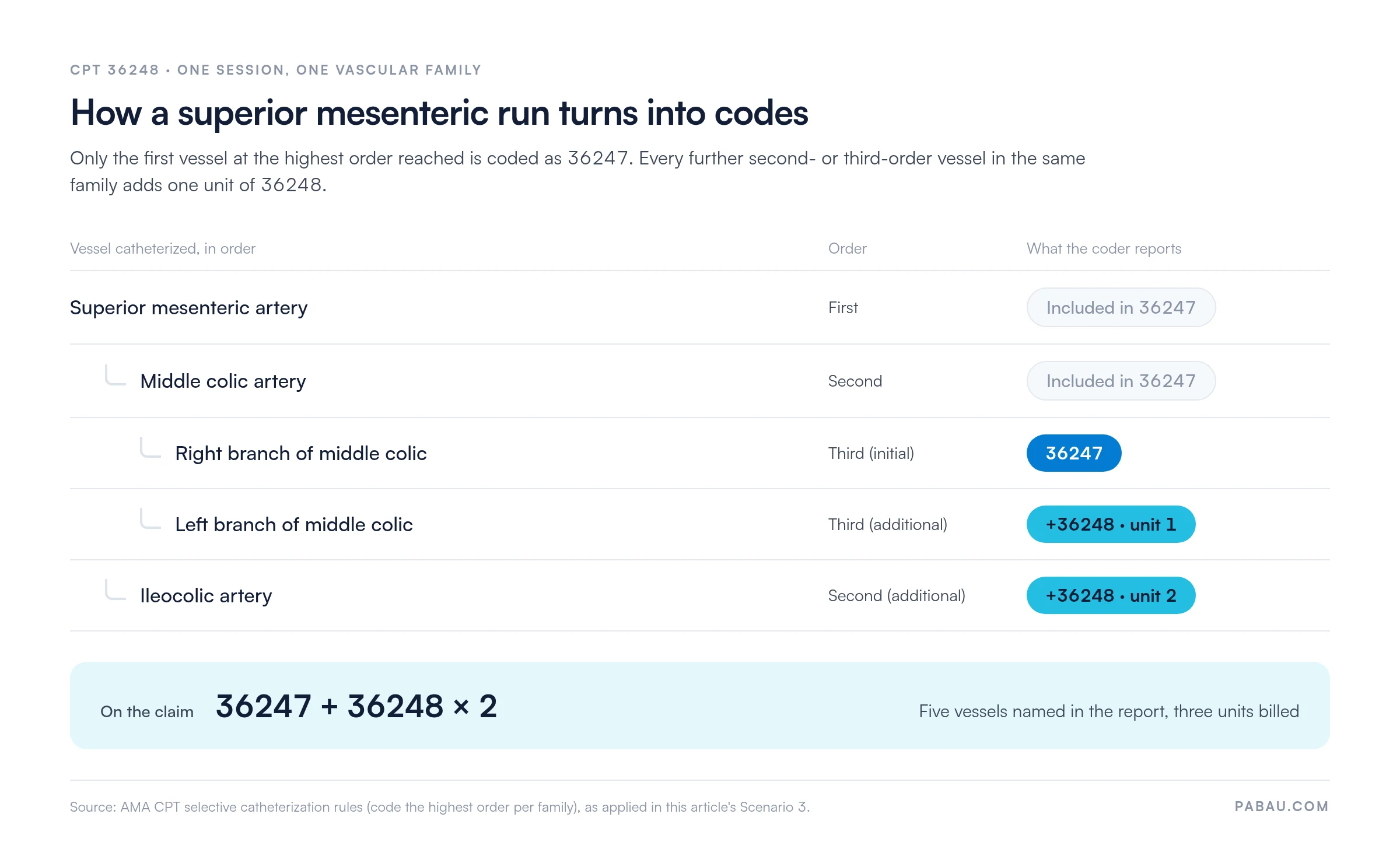
The procedure note carries the count the claim depends on, so code from the named vessels rather than from the procedure title.
A coder reports 36247 + 36248 when the physician accessed only one third-order vessel. The procedure note says “right hepatic artery” but does not mention any additional vessel. 36248 is not supported.
The physician advanced to a third-order branch once, which is 36247 alone. Reporting 36248 without documentation of an additional vessel is over-coding and will trigger an audit or denial when units exceed documented vessels.
A 36248 claim is only as accurate as the vessel count behind it. When the billing team re-keys an operative report into a separate system, a primary code or a unit can drop off along the way.
Pabau, the practice management and billing platform we build, keeps the procedure record and the claim in one place. Its claims software for practices checks every claim for missing or invalid details before it leaves Pabau. Claims then go out through Claim.MD, Pabau’s US clearinghouse partner, which connects to thousands of US payers.
Eligibility checks, claim status updates, and ERA remittances come back against the same patient record. A rejected claim is flagged as needing action, with the payer’s reason attached. The coder can then correct it while the operative report is still fresh.

Pabau checks every claim for missing or invalid details before submission and sends it through the Claim.MD clearinghouse to thousands of US payers. ERA remittances come back to the same patient record.

CPT Code 36248 rewards a coder who counts carefully. Code the first vessel at the highest order as 36246 or 36247. Then add one unit of 36248 for each further selective vessel in that family. A vessel the operative report does not name gets no unit.
The trade-off is a few minutes at the front of the process. Matching the report to the claim line before submission costs far less than a denial, an addendum, and a resubmission. Book a demo to see how Pabau checks interventional radiology claims before they reach the payer.

Need to understand how clearinghouse submission works? Medical claims clearinghouse guide explains how claims flow from practice to payer and where edits catch errors before adjudication.
Seeing ERA remittances you cannot match to claims? Electronic remittance advice explained breaks down 835 transaction segments and CARC denial reason codes so your team can action remittances faster.
CPT Code 36248 is an add-on procedure code for each additional second-order or third-order (or higher) selective catheter placement within a vascular family. It is reported alongside a qualifying primary code (36246 or 36247) during the same session. It carries the + designation in the AMA CPT codebook, meaning it cannot be billed as a standalone code.
Yes. CPT 36248 is an add-on (+) code that must be reported with CPT 36246 or 36247 as the primary procedure code. It cannot appear on a claim without one of those primary codes on the same date of service.
CPT 36247 covers the initial third-order (or higher) selective catheter placement in a session. CPT 36248 covers each additional second- or third-order vessel accessed after that first placement. Only one 36247 is reportable per vascular family per session, while 36248 may be reported multiple times as the procedure warrants.
CPT 36248 may be billed once for each additional qualifying vessel catheterized during the session beyond the vessel covered by the primary code. If two additional vessels meet the criteria, report two units of 36248 on a single claim line, with documentation naming both vessels.
Medicare covers CPT Code 36248 when the service is medically necessary and documentation supports the vessel order claimed. Coverage is subject to the applicable MAC’s Local Coverage Determination for vascular procedures, which specifies medical necessity criteria that vary by jurisdiction. Verify the current LCD for your MAC before billing.
The operative report must name every vessel catheterized, state the branching order reached at each one, and confirm catheter position by imaging. It must also give the clinical indication for each additional vessel and carry physician attestation. Generic phrases like “additional vessels catheterized” are insufficient and will not survive payer audit.
The most common denial reasons are a missing primary code, with 36248 submitted without 36246 or 36247, and insufficient documentation of vessel order. Others are an NCCI edit conflict with a co-billed angiography supervision code, and more units billed than vessels documented in the procedure note. Each has a specific resolution step detailed in the denial table above.





