ICD-10 code S90.475A: Other superficial bite of left great toe
What is ICD-10 code S90.475A? ICD-10 code S90.475A is the billable diagnosis cod...

Last Updated: Nov 18, 2026
Billable Code Specific Code
I63.9 is the billable ICD-10-CM code for cerebral infarction, unspecified.
It is the residual code in category I63, used when the record confirms an acute ischemic stroke but names no mechanism or vessel. Coders most often go wrong in three places. They code a suspected outpatient stroke rather than its symptoms. They skip the query that would support a specific subcode, or they keep I63.9 past the acute phase.
Let Pabau's smart automation suggest the right codes, reduce claim denials, and keep your practice compliant—effortlessly.
Automate repetitive tasks and focus on what matters most—your patients.
Reduce coding errors and ensure compliance with the latest regulations.
Clean claims, fewer denials, and faster reimbursements.
Powerful insights and reporting to help your practice thrive.
HIPAA compliant SOC 2 certified GDPR-compliant Trusted by 4,000+ clinics worldwide

I63.9 is the residual code for an acute ischemic stroke when the record names no mechanism or affected vessel.
No official guideline bars I63.9 from outpatient claims, but a stroke that is only suspected at an outpatient visit is coded by its symptoms.
After the acute phase, residual deficits move to I69.3- codes and a stroke with no deficits moves to Z86.73.
In Pabau’s claims management software, every claim is scrubbed for missing or invalid details before it goes to the payer.
ICD-10 Code I63.9 is a valid, billable ICD-10-CM diagnosis code for cerebral infarction, unspecified, and its tabular entry lists “Stroke NOS” as an inclusion term. It appears in CMS’s FY2027 ICD-10-CM code files, effective for discharges and encounters from October 1, 2026, to September 30, 2027.
The I63 block covers all cerebral infarctions and is broken into subcodes by mechanism and affected vessel. I63.9 is the residual, used only when documentation supports none of the more specific options. The CDC/NCHS ICD-10-CM web tool lists the full I63 hierarchy with annual updates.
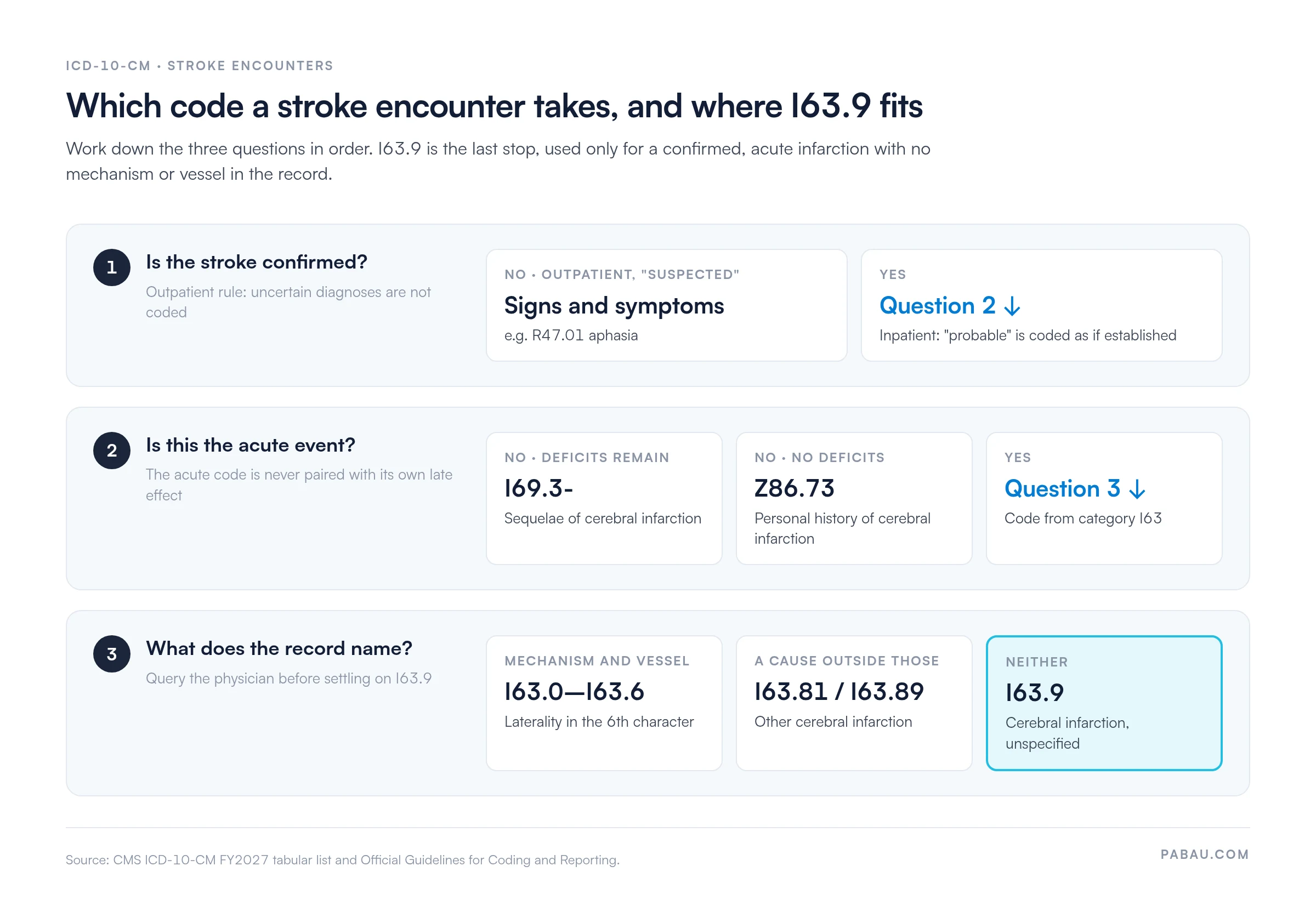
Laterality sits in the 6th character of the specific I63 subcodes, so I63.011 is thrombosis of the right vertebral artery. I63.9 has no laterality character, because the side is part of what the record leaves out. The chart below puts the whole decision in order, from a suspected stroke to the last-resort code.
Two kinds of exclusion notes attach to the I63 category and flow down to I63.9. Misreading these is a common reason for incorrect code combinations on inpatient claims.
The Excludes2 note for I69.3- matters most for readmission coding. A patient may return with a new acute stroke while carrying deficits from an earlier one. Both I63.9 (the new event) and the relevant I69.3- code (the existing residual) may then be reported together.
The ICD-10-CM Official Guidelines do not bar I63.8 or I63.9 from outpatient claims. Guideline I.B.18 says unspecified codes have “acceptable, even necessary” uses when the record supports nothing more specific. What changes between settings is how an uncertain diagnosis is handled.
In the outpatient setting, Section IV.H says not to code a diagnosis documented as “probable,” “suspected” or “rule out.” The coder reports the presenting sign or symptom instead, such as R47.01 for aphasia. Inpatient coders, by contrast, code an uncertain diagnosis at discharge as if it were established.
Flagging I63.9 on routine office claims is still sound practice, even though no rule requires it. A stroke patient seen in the office weeks later usually needs I69.3- or Z86.73, not the acute code.
Under the UHDDS definition, the principal diagnosis is the condition established after study to be chiefly responsible for the admission. For most acute ischemic stroke admissions, I63.9 sequences as principal diagnosis. Two situations change that sequencing.
Understanding medical billing workflows that integrate clinical documentation review with coding reduces sequencing errors before the claim reaches the payer.
Run a physician query when imaging shows a focal infarction but the attending’s notes say only ‘stroke’ with no mechanism documented. The imaging report alone does not give the coder authority to assign a more specific I63.x code. That detail must come from the physician.
Several codes sit close to I63.9 and are often miscoded. The costliest mix-up is keeping I63.9 on claims after the acute phase, when an I69.3- sequela code or Z86.73 should take over. I64, “Stroke, not specified as hemorrhage or infarction,” is a WHO ICD-10 code that ICD-10-CM never adopted. In ICD-10-CM, “Stroke NOS” sits under I63.9 itself.
Hemorrhagic stroke (I61.-) is not interchangeable with I63.9, because ischemic and hemorrhagic strokes carry separate code families. Both still group to the same MS-DRG family as a principal diagnosis. For the codes on either side of I63.9, our diagnostic code library keeps a page per code.
I63.9 rarely stands alone on an inpatient claim. The I63 category carries two “use additional code” notes. R29.7- reports the NIH Stroke Scale score, and Z92.82 applies when tPA was given at another facility within the last 24 hours. Comorbidities such as hypertension (I10) and atrial fibrillation (I48.91 when the type is unspecified) are coded alongside.
When I63.9 is the principal diagnosis on an inpatient claim, it usually groups to MS-DRG 064, 065 or 066, “Intracranial hemorrhage or cerebral infarction.” DRG 064 requires an MCC. DRG 065 takes a CC, or tPA given at another facility within 24 hours, and DRG 066 carries neither.
When a thrombolytic agent is given during the stay itself, the case groups to MS-DRGs 061-063 instead. Those three DRGs follow the same MCC, CC and no-CC split.
Moving from I63.9 to a specific subcode rarely changes the DRG, because every I63 principal diagnosis groups to the same families. The case for specificity is an accurate record that holds up in an audit. Coders should query physicians when imaging reports describe the mechanism but the attending notes do not.
Once the acute phase of the cerebral infarction has resolved, I63.9 is no longer the correct code. Under the Official Guidelines, a sequela is the residual effect left after the acute phase ends, and there is no time limit on sequela coding. A patient seen 18 months after a stroke with persistent hemiplegia is still coded to I69.35-.
Most I69.3- codes are combination codes that name the deficit, such as I69.320 for aphasia following cerebral infarction. One code then covers both the deficit and its cause. Common I69.3- subcodes include the following.
Most I63.9 denials fall into five patterns, and each one has a fix the coding team can build into its workflow.
Effective denial management workflows catch these patterns in aggregate. Tracking I63.9 denial rates by payer shows which edits to build first.
Build an edit that flags I63.x on office claims (place of service 11) for coder review. Most office visits after a stroke belong to I69.3- or Z86.73, and the flag catches the acute code before the payer does.
The documentation a physician provides decides whether I63.9 is appropriate or a more specific I63.x subcode is required. I63.9 is legitimate only when the elements below are still missing after a query.
AHIMA and the CMS ICD-10-CM Official Guidelines both support physician query when the clinical indicators in the record are consistent with a more specific diagnosis. The vessel often surfaces first in imaging, from CT angiography or a catheter study billed as 36223.
Capturing these elements at discharge reduces reliance on I63.9. A clean claim submission depends on this information being present before the coder begins.
A stroke admission reaches billing with a lot riding on a few fields: the principal diagnosis, the NIHSS score and the comorbidities. A mistyped code or a blank field sends the claim back, and the fix then waits in a rework queue.
Pabau, the practice management platform we build, keeps the patient record and the claim in one system. Its claims management software scrubs every claim for missing or invalid details before it goes out through the Claim.MD clearinghouse. A claim that needs fixing links straight to the field at fault.
Once submitted, each claim is tracked from Pending to Paid, with the days overdue shown on every row. Eligibility checks run before the visit, and ERA files settle payments against the claim. A short-paid stroke admission is visible the day the remittance lands.
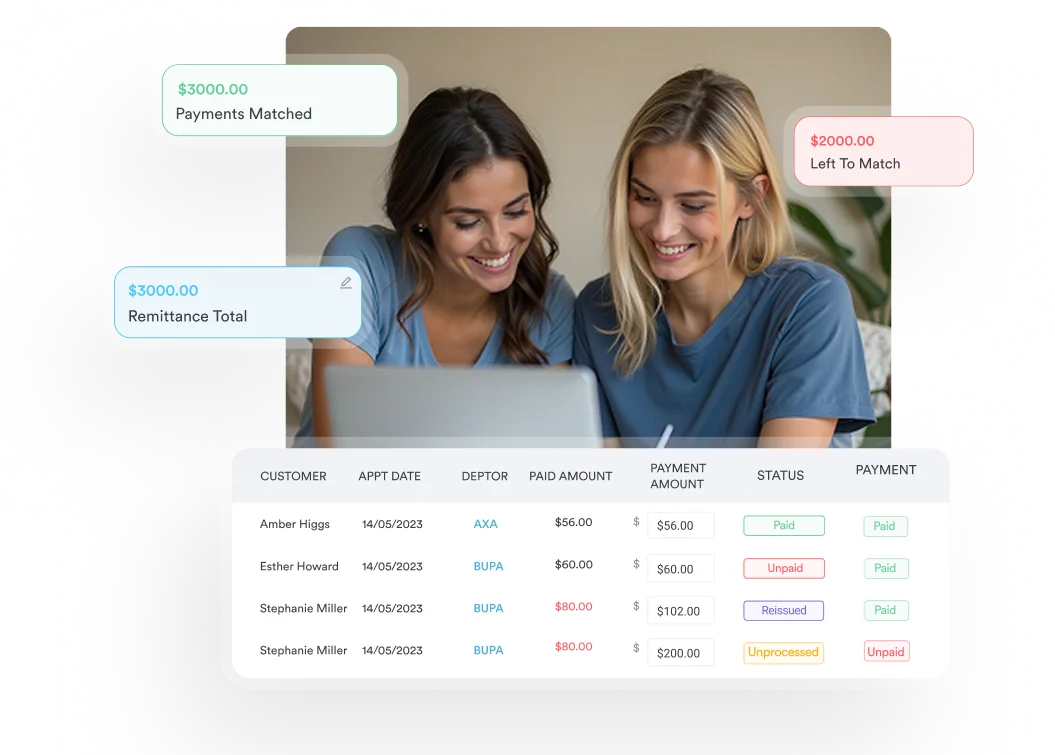

Pabau’s claims management software scrubs each claim for missing or invalid details before it goes out through Claim.MD. It then tracks every claim from Pending to Paid.

Treat I63.9 as the answer only when a query has come back empty. A record that names the vessel or the mechanism earns a specific subcode. That change rarely moves the DRG, but it decides how the claim reads in an audit.
The bigger risk sits at the edges of the stay. A suspected stroke in the office is coded by its symptoms, and a patient seen after discharge moves to I69.3- or Z86.73. Book a demo to see how Pabau checks each stroke claim for missing or invalid details before it reaches the payer.

Need to stop claim errors before submission? Claims management software from Pabau scrubs each claim for missing or invalid details before it leaves the practice.
Looking for denial code guidance? Denial codes in medical billing covers the most common CARC and RARC codes that follow stroke claim rejections.
Want to understand the clearinghouse layer? Claim.MD clearinghouse overview explains how electronic claims route from the practice to the payer.
ICD-10 Code I63.9 is the billable ICD-10-CM diagnosis code for cerebral infarction, unspecified. It is assigned to ischemic stroke encounters where the documentation does not specify the mechanism or the affected vessel. It is valid for FY2026 and FY2027, and its tabular entry includes “Stroke NOS.”
Yes, once the infarction is confirmed. The Official Guidelines do not bar I63.9 from outpatient claims. While a stroke is only suspected, outpatient coders report the presenting sign or symptom, such as aphasia or hemiplegia, under Section IV.H.
More specific I63.x subcodes (I63.0-I63.6) identify the mechanism (thrombosis, embolism) and the affected vessel (precerebral vs. cerebral artery). I63.9 applies only when the record documents none of that information and a physician query has not produced a more specific diagnosis.
Switch to I69.3- when the acute phase has resolved and the patient has residual neurological deficits from the prior stroke. The guidelines set no time limit on sequela coding. If the stroke left no deficits, use Z86.73 instead.
Yes. ICD-10-CM has no combination code linking hypertension and ischemic stroke. I10 is coded additionally alongside I63.9 when hypertension is documented as a comorbidity. The two codes are always reported separately.
The five most common triggers are coding a suspected outpatient stroke as I63.9 and omitting companion codes such as I10 or I48.x. The others are keeping I63.9 past the acute phase, wrong principal diagnosis sequencing, and skipping a physician query that could support a specific subcode.