CCSD Code V2543: Revision posterior disc excision with facetectomy
What is CCSD Code V2543? CCSD Code V2543 is the Clinical Coding and Schedule Dev...

Last Updated: Nov 25, 2026
Billable Code
34701 is the CPT code for endovascular repair of the infrarenal aorta with an aorto-aortic tube endograft, for other than rupture. The tube graft starts and ends in the aorta, below the renal arteries and above the aortic bifurcation.
The landing zones decide the code. A graft into one common iliac artery is 34703, and a bifurcated graft into both is 34705. A ruptured case repaired with a tube graft is 34702.
Let Pabau's smart automation suggest the right codes, reduce claim denials, and keep your practice compliant—effortlessly.
Automate repetitive tasks and focus on what matters most—your patients.
Reduce coding errors and ensure compliance with the latest regulations.
Clean claims, fewer denials, and faster reimbursements.
Powerful insights and reporting to help your practice thrive.
HIPAA compliant SOC 2 certified GDPR-compliant Trusted by 4,000+ clinics worldwide

CPT code 34701 covers endovascular repair of the infrarenal aorta with an aorto-aortic tube endograft, for other than rupture.
The tube graft starts and ends in the aorta, below the renal arteries and above the aortic bifurcation, with no iliac limb.
A graft landing in one common iliac artery is 34703, and a bifurcated graft landing in both is 34705.
Rupture moves the claim to 34702. Aneurysm, pseudoaneurysm, dissection and penetrating ulcer without rupture stay on 34701.
Sizing, nonselective catheterization, imaging supervision and aortic extensions down to the bifurcation are bundled. Extensions outside that zone use add-on 34709.
34701 carries a 90-day global period, and prior authorization depends on each payer’s own policy.
CPT code 34701 is the code for endovascular repair of the infrarenal aorta with an aorto-aortic tube endograft, for other than rupture. AAPC’s summary of CPT 34701 describes a tube endograft placed to repair the infrarenal aorta for reasons other than rupture.
The full descriptor in the American Medical Association (AMA) CPT code set reads:
Endovascular repair of infrarenal aorta by deployment of an aorto-aortic tube endograft including pre-procedure sizing and device selection, all nonselective catheterization(s), all associated radiological supervision and interpretation, all endograft extension(s) placed in the aorta from the level of the renal arteries to the aortic bifurcation, and all angioplasty/stenting performed from the level of the renal arteries to the aortic bifurcation; for other than rupture (eg, for aneurysm, pseudoaneurysm, dissection, penetrating ulcer)
CPT 34701 long descriptor, AMA CPT code set
Two phrases in that descriptor carry the coding decision. “Aorto-aortic” means the graft starts and ends inside the aorta, between the renal arteries and the aortic bifurcation. No limb lands in an iliac artery. “Other than rupture” means the record shows no acute hemorrhage.
The surgeon reaches the aorta through femoral access, percutaneous or open. The tube endograft is delivered under fluoroscopy and sealed above and below the diseased segment. Completion angiography then confirms that the lesion is excluded. Tube grafts are usually chosen for focal disease with enough healthy aorta above the bifurcation to seal the lower end.
The descriptor bundles the following work into 34701, so none of it is reported as a separate line:
The EVAR code family is organized by endograft type, treatment zone and rupture status. CPT guidelines define the treatment zone as the vessels that contain an endograft. Read the distal landing zone in the operative report first, then check rupture status. Each construct pairs one code without rupture and one with it.
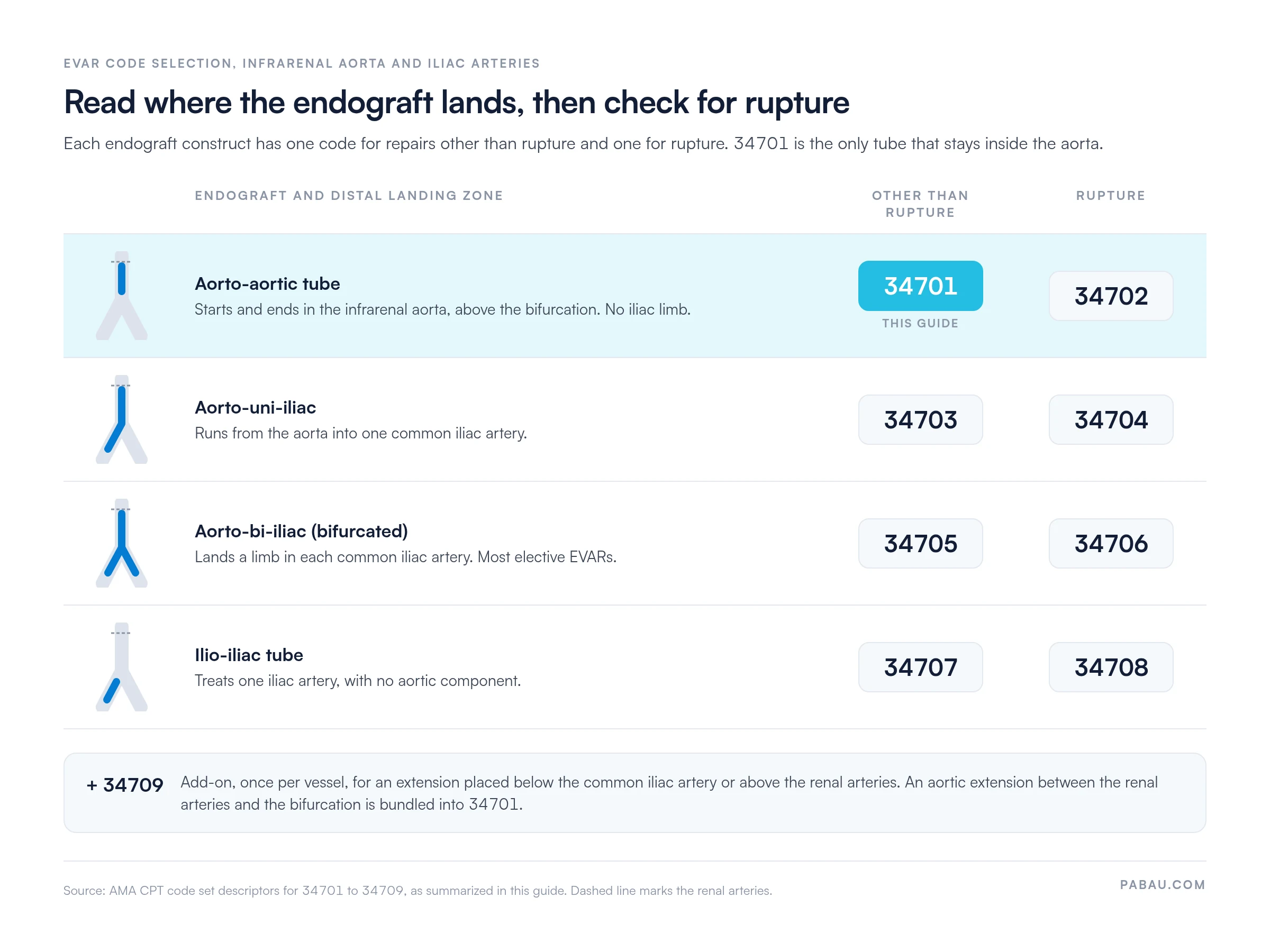
34701 is the first code in the family, so it is easy to pick from a code list by default. Most elective EVARs use a bifurcated graft, which is 34705. If the operative report names an iliac limb, the repair is not aorto-aortic and the claim does not belong on 34701.
A uni-iliac graft runs from the aorta into one common iliac artery, which is 34703. A bifurcated graft lands a limb in each common iliac artery. Our CPT 34705 guide covers that repair in detail. 34707 treats an iliac artery alone, with no aortic component.
34701 and 34702 describe the same aorto-aortic tube repair, and rupture status is the only difference. 34701 is for other than rupture, with aneurysm, pseudoaneurysm, dissection and penetrating ulcer as the examples. 34702 is for rupture. It includes temporary aortic or iliac balloon occlusion when performed, and it lists traumatic disruption among its examples.
AAPC’s General Surgery Coding Alert defines rupture as clinical or radiographic evidence of acute hemorrhage. It also treats a chronic contained rupture as a pseudoaneurysm, which keeps that case on 34701.
Code from the documented hemorrhage, not from how urgent the case was. An urgent repair of a symptomatic, intact aneurysm is still 34701. If the note says “rupture” without imaging or clinical evidence of acute bleeding, query the surgeon before you choose 34702.
Some work in the same session goes on its own line when the operative note supports it. The table shows which codes apply and which services stay bundled.
Access codes are reported per side. Percutaneous access with 34713 and open exposure with CPT 34812 do not go on the same groin. Our CPT 34713 guide covers the access rules.
CMS updates the National Correct Coding Initiative (NCCI) edits every quarter. Check the current version before you add a line next to 34701.
The diagnosis must name the lesion and its site, and it must match the imaging in the record. I71.4 and I71.3 became non-billable header codes on October 1, 2022. A claim that still carries either one will reject.
Payers also check that the repair meets clinical criteria. The 2018 Society for Vascular Surgery guideline recommends elective repair at 5.5 cm or larger. It suggests considering repair from 5.0 cm in women. A symptomatic aneurysm generally qualifies at any size.
The CT angiography report belongs in the record before the procedure date. It should state the maximum diameter, the neck anatomy and the distal landing zone.
Open repair of the abdominal aorta uses a different code family. The operative approach decides which family applies.
The two families do not go on one claim for the same vessel in the same session without documentation of two distinct procedures.
Medicare pays the surgeon for CPT 34701 under the Medicare Physician Fee Schedule (MPFS). Relative value units (RVUs) are multiplied by the annual conversion factor, then adjusted for the payment locality.
Check the current year in the CMS Physician Fee Schedule lookup tool, because the values change with each annual rule. FastRVU’s RVU lookup breaks out work, practice expense and malpractice RVUs by locality.
34701 carries a 90-day global period. Related visits in the 90 days after surgery are part of the payment. Report an unrelated E&M visit with modifier 24, and a related return to the operating room with modifier 78.
EVAR takes place in a hospital, so the surgeon is paid at the facility rate. The hospital bills its own claim, as an inpatient stay or under the Outpatient Prospective Payment System. Check the current CMS Inpatient-Only list and the MPFS status indicator for 34701 before you advise on site of service.
Prior authorization for CPT 34701 depends on the payer’s policy. 34701 is not on the CMS prior authorization list for hospital outpatient department services. Medicare Advantage and commercial plans set their own rules, and many require approval before an elective EVAR.
Ask each plan before scheduling. Payers that require approval typically want the following:
An approval for 34705 followed by a claim for 34701 is a mismatch that payers deny. Medical billing compliance for EVAR starts with matching the approved codes to the planned repair.
The operative report carries the 34701 claim. Check each element below before the code is assigned, and query the surgeon if one is missing.
A vascular superbill should carry graft type and landing zone as separate fields. A generic “EVAR” line leaves the coder to choose between 34701, 34703 and 34705 from a narrative.
Before you assign 34701, search the operative report for the word “iliac.” If an iliac limb or iliac landing zone appears, the repair is not aorto-aortic. Query the surgeon, then code 34703 or 34705 from the documented landing zones.
Most 34701 denials trace back to code selection, rupture status, bundling or authorization. Each one has a fix before the claim goes out. The remittance names each reason with a claim adjustment reason code (CARC), which our denial codes guide decodes.
Track 34701 denials by reason and payer each quarter. A reason that repeats points to a workflow fault rather than a one-off error. Denial management in healthcare covers how to route and work these claims.
Modifiers explain a departure from the standard 34701 case. A wrong or missing modifier causes denials that are preventable at submission.
Modifier 62 carries the most risk. Check the MPFS co-surgery indicator and the payer’s policy before two surgeons bill 34701.
In many vascular practices, a coder reads the operative note days after the case and picks a code from a generic EVAR line. The difference between 34701 and 34705 is whether an iliac limb was placed. That detail is easy to miss in a long narrative.
Pabau, a practice management platform with built-in claims tools, keeps the CPT code, add-ons and diagnosis on the same patient record as the clinical note. Its claims management tools send US claims through the Claim.MD clearinghouse, which reaches thousands of US insurance payers.
Eligibility checks and electronic remittances (ERAs) come back to the same record, so each denial reason sits beside its claim. Your billing team can confirm the landing zone against the note and work appeals without switching systems.


Pabau keeps the operative note, CPT code and diagnosis on one patient record. Claims go out through Claim.MD, and denial reasons come back to the same record.

Code 34701 from the landing zones, never from the word “EVAR.” It fits one construct: A tube graft that starts and ends in the infrarenal aorta, with no rupture. Any iliac limb moves the claim to 34703 or 34705, and documented acute hemorrhage moves it to 34702.
The fix belongs upstream of the coder. Add graft type, landing zone and rupture status to the superbill as separate fields, and query the surgeon when one is missing. Book a demo to see how Pabau carries those details from the operative note to a clean 34701 claim.

Need to understand clearinghouse submission for CPT claims? Our Claim.MD clearinghouse guide explains how 837P claims are checked and routed to US payers.
Tracking denials across multiple surgical codes? Electronic remittance advice (ERA) explained covers how to read 835 remittances and match CARC denial codes to your claim workflow.
Need to check coverage before an EVAR case is scheduled? Insurance eligibility verification outlines the checks that catch coverage problems before a high-value procedure.
CPT code 34701 covers endovascular repair of the infrarenal aorta with an aorto-aortic tube endograft, for other than rupture. The graft starts and ends in the aorta, with no iliac limb. Sizing, nonselective catheterization, imaging supervision and aortic extensions down to the bifurcation are bundled into the code.
Rupture status is the only difference. Both codes describe an aorto-aortic tube endograft repair of the infrarenal aorta. 34701 is for other than rupture, such as aneurysm, pseudoaneurysm, dissection or penetrating ulcer. 34702 is for rupture and includes temporary balloon occlusion when performed.
No. A bifurcated graft with a limb in each common iliac artery is 34705, or 34706 for rupture. A graft from the aorta into one common iliac artery is 34703. 34701 applies only when the tube graft stays inside the aorta.
Yes, when an extension prosthesis is placed distal to the common iliac artery or proximal to the renal arteries. 34709 is an add-on reported per vessel treated. An extension placed in the aorta between the renal arteries and the bifurcation is bundled into 34701.
They report delayed placement of a distal or proximal extension prosthesis, at a session after the original repair. 34710 covers the initial vessel, and add-on 34711 covers each additional vessel. Open artery exposure uses different codes: 34812, 34714 or 34820.
It depends on the payer. 34701 is not on the CMS prior authorization list for hospital outpatient services. Medicare Advantage and commercial plans set their own rules, and many require approval before an elective EVAR. Confirm the approved codes before the case.
CPT 34701 carries a 90-day global period under the Medicare Physician Fee Schedule. Related postoperative visits in that window are included in the payment. Report an unrelated E&M service with modifier 24, and a related return to the operating room with modifier 78.
I71.43, infrarenal abdominal aortic aneurysm without rupture, is the usual diagnosis. Use I71.02 when a dissection of the abdominal aorta drives the repair. I71.4 has been a non-billable header code since October 1, 2022, so it will not support the claim.
Open repair of an abdominal aortic aneurysm is 35081, or 35082 when the aneurysm has ruptured. When the repair involves the iliac vessels, use 35102, or 35103 for rupture. 34701 covers only the endovascular approach.