

HCPCS code E0198: Water pressure pad billing guide
HCPCS code E0198 is a water pad for a standard mattress HCPCS code E0198 is the ...

Last Updated: Oct 13, 2026
33990 is the CPT code for percutaneous insertion of a left heart ventricular assist device through arterial access only, including radiological supervision and interpretation. It covers pumps such as the Impella 2.5 and Impella CP, placed for cardiogenic shock or high-risk PCI support.
33991 is also a left heart insertion code, but it adds venous access and a transseptal puncture. Right heart insertion through venous access is reported with 33995, so the documented access route decides the code.
Let Pabau's smart automation suggest the right codes, reduce claim denials, and keep your practice compliant—effortlessly.
Automate repetitive tasks and focus on what matters most—your patients.
Reduce coding errors and ensure compliance with the latest regulations.
Clean claims, fewer denials, and faster reimbursements.
Powerful insights and reporting to help your practice thrive.
HIPAA compliant SOC 2 certified GDPR-compliant Trusted by 4,000+ clinics worldwide

CPT Code 33990 reports percutaneous insertion of a left heart ventricular assist device through arterial access only, including radiological supervision and interpretation.
33990 and 33991 are both left heart codes. 33991 adds venous access and a transseptal puncture, so the access route decides the code.
Biventricular support pairs 33990 or 33991 with 33995 for the right heart device, never 33990 with 33991.
The Impella 2.5 and Impella CP, made by Abiomed, part of Johnson & Johnson MedTech, report under 33990. Surgical cutdown models do not.
R57.0 (cardiogenic shock) is the most common paired ICD-10-CM code, and vague diagnosis codes are a leading medical necessity denial trigger.
Pabau, the practice management platform we build, checks membership numbers and authorization codes before each claim is sent.
CPT Code 33990 reports insertion of a percutaneous ventricular assist device in the left heart, through arterial access only. The American Medical Association’s CPT code set descriptor reads: “Insertion of ventricular assist device, percutaneous, including radiological supervision and interpretation; left heart, arterial access only.” It sits in the cardiac assist procedures range of CPT, alongside 33991, 33992, 33993, 33995, and 33997.
The clinical context is almost always urgent: cardiogenic shock, acute MI with hemodynamic collapse, or planned support for a high-risk percutaneous coronary intervention. The pump is advanced through femoral or axillary arterial access into the left ventricle. It unloads the ventricle by pumping blood across the aortic valve into the aorta.
Radiological supervision and interpretation is written into the 33990 descriptor. Imaging used to guide and position the device is therefore part of the code, and billing it separately triggers an unbundling edit.
Knowing the bundling rules for 33990 prevents the most common unbundling denials. The services below are either included in the code or reportable on their own.
Bundled into 33990 (not separately reportable):
Separately reportable (when performed and documented):
The intra-aortic balloon pump (IABP) is a distinct device with its own code family (33967-33974). Do not report 33990 for IABP insertion. The device and its mechanism of support differ clinically, and payers audit this substitution.
33990 and 33991 are both left heart insertion codes, so the access route decides between them. 33990 covers arterial access only. 33991 covers combined arterial and venous access with a transseptal puncture.
In practice, an Impella 2.5 or Impella CP placed through the femoral or axillary artery is a 33990 case. A left atrial-to-femoral artery system such as TandemHeart needs venous access and a transseptal puncture, so it reports under 33991. The operative note should state the access route in plain words, because the coder picks the code from it. The diagram below maps each access route and session to its code.
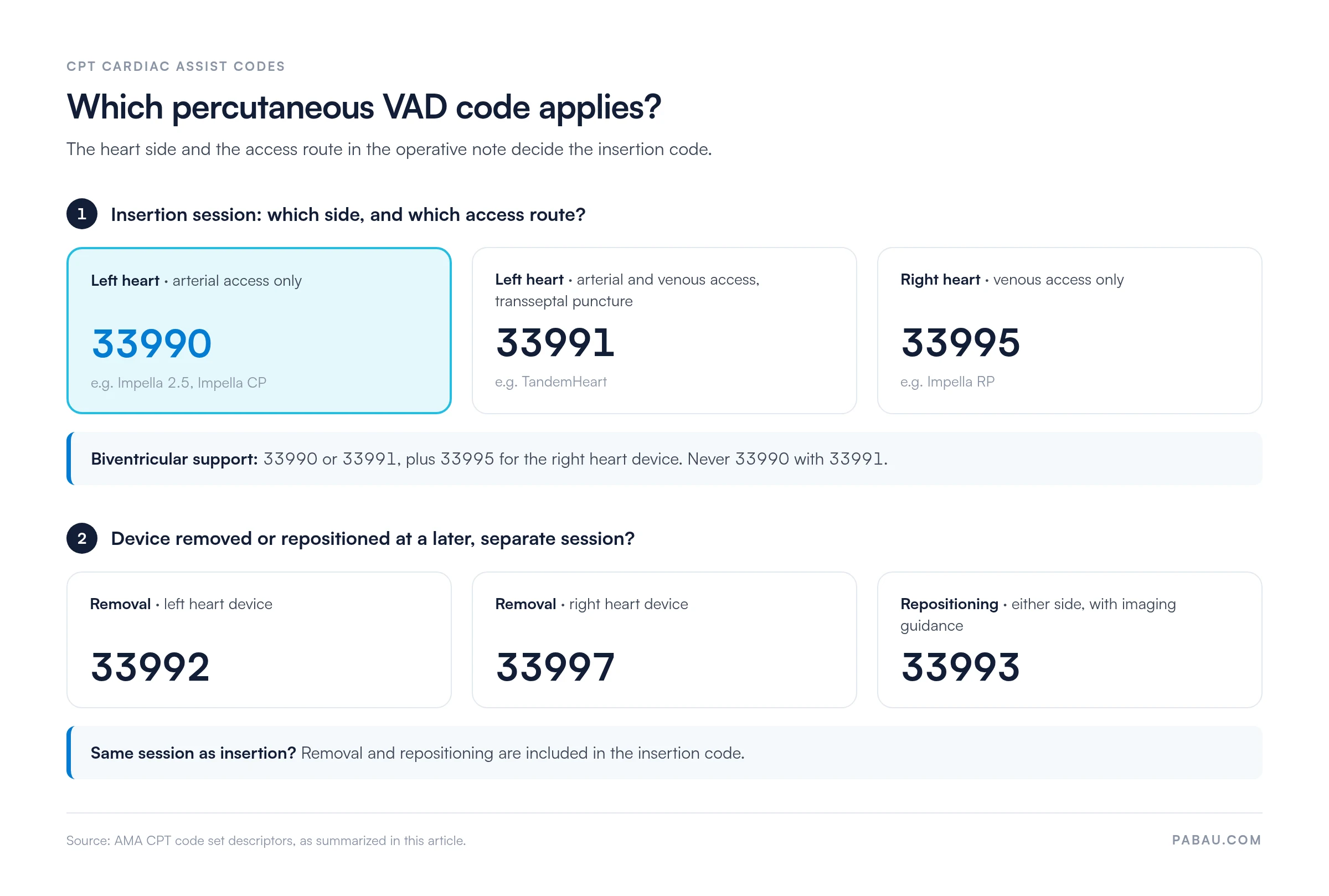
The rest of the family covers the right heart and later sessions:
Removal or repositioning during the insertion session is included in the insertion code. Report 33992, 33993, or 33997 only for a later, separately documented session.
Biventricular support never pairs 33990 with 33991, since both describe a left heart device. It pairs one left heart code (33990 or 33991) with 33995 for the right heart device, following payer rules. Document each device, its access site, and its cannulation separately in the operative note.
Impella devices, made by Abiomed, part of Johnson & Johnson MedTech, are the most widely used percutaneous left heart pumps in the United States. They are the devices most often billed under 33990.
Only the percutaneous, arterial-access models report under 33990: the Impella 2.5 and the Impella CP. The Impella 5.0 and Impella LD are placed through a surgical cutdown, so they fall outside this percutaneous code. The right heart Impella RP is a venous-access device and reports under 33995.
The operative note should name the device and model, because reviewers use it to confirm medical necessity. The claim itself is adjudicated on the CPT code and the diagnosis. If the note gives only a trade name, the coder still assigns the code from the access route and the procedure performed.
Medical necessity for 33990 is established by the paired ICD-10-CM diagnosis code. A vague or unspecified diagnosis is a common reason for medical necessity denials on this code. Payers want documented hemodynamic compromise, not a generic “heart disease” code.
Payer policies may narrow the approved ICD-10 list beyond the examples above. Medicare Administrative Contractors (MACs) publish their own LCDs and billing articles on percutaneous VADs. Confirm which MAC covers your facility and review its current policy before submitting claims.
33990 is a surgical procedure code, so modifiers on it signal distinct or multiple procedures rather than a component split. Applying the wrong modifier, or omitting a needed one, leads to denials and take-back audits.
For biventricular support, 33990 and 33995 describe two separate devices. Check the current NCCI edits before submission. Append 59 or XS to 33995 only when an edit pairs the two codes and the note documents each device and access site.
Most 33990 procedures happen in hospital cath labs. The hospital bills its facility claim on a UB-04, and the physician bills 33990 on a CMS-1500 form with the facility place of service.
CPT Code 33990 is a hospital procedure, so the facility rate is the one billing teams encounter. The CMS Physician Fee Schedule lookup tool lists the current RVUs, global period, and payment amounts by locality. Check it before quoting a rate, because the fee schedule is updated every year.
The work RVU for 33990 reflects the complexity of placing a percutaneous pump in an unstable patient. Pull the current figure from the fee schedule rather than relying on a prior year’s value.
Commercial payer variation is significant. UnitedHealthcare maintains a formal medical policy for percutaneous ventricular assist devices. Aetna and BCBS plans may apply stricter clinical criteria for elective high-risk PCI support. Verifying benefits before the procedure is the most reliable way to estimate expected payment.
Submitting 33990 claims through a medical claims clearinghouse adds eligibility checks before submission. Benefit mismatches then surface before the claim goes out, not as denials.
Check the current Medicare Physician Fee Schedule for your locality using the CMS lookup tool before quoting reimbursement rates to your facility’s finance team. National rates are a baseline, and geographic adjusters mean your payment may be higher or lower. Bookmark the locality-specific rate for your MAC jurisdiction.
Medicare coverage for percutaneous VADs is set at the MAC level. Check your MAC’s LCDs and billing articles on percutaneous VADs for covered indications, documentation elements, and the codes in scope, including 33990.
These MAC policies typically address:
UnitedHealthcare and other major commercial payers have parallel medical policies for pVAD procedures. These can differ from MAC policy, with stricter clinical criteria, different ICD-10 code lists, or authorization rules for emergent cases. For elective cases, pull the payer-specific policy and run it through your prior authorization process before the procedure.
A complete operative note is the first line of defense against a 33990 denial. Auditors and payer reviewers look for specific elements. A note that describes the procedure in general terms without them invites a denial or a post-payment audit.
Required elements for a defensible 33990 operative note:
Building these elements into a structured cath lab documentation template reduces the risk of omission. Practices with a clean claim submission workflow verify documentation completeness before the claim leaves the facility.
Most 33990 denials are preventable. The pattern repeats across cath labs: documentation omissions and coding errors that a structured pre-submission review would catch. Robust denial management workflows treat each denial pattern as a process problem rather than a one-off error.
Tracking denial codes by root cause shows revenue cycle teams which failure pattern is most common at their facility. Medical billing denial codes map each payer rejection to a corrective action, so prevention becomes systematic rather than claim-by-claim firefighting.
Set up a denial tracking report filtered to CPT 33990 claims for the last 90 days, sorted by denial reason code. Watch for CARC 197 (precertification absent) and CARC 15 (authorization missing or invalid). If either appears more than twice, add a mandatory auth step before high-risk PCI cases.
Cardiology billing staff working high-complexity codes like 33990 need checks inside the workflow, not a manual review at the end. Pabau’s claims management software runs validation checks every time a claim is about to be sent. Missing membership numbers or authorization codes get caught before submission, not after a denial arrives.
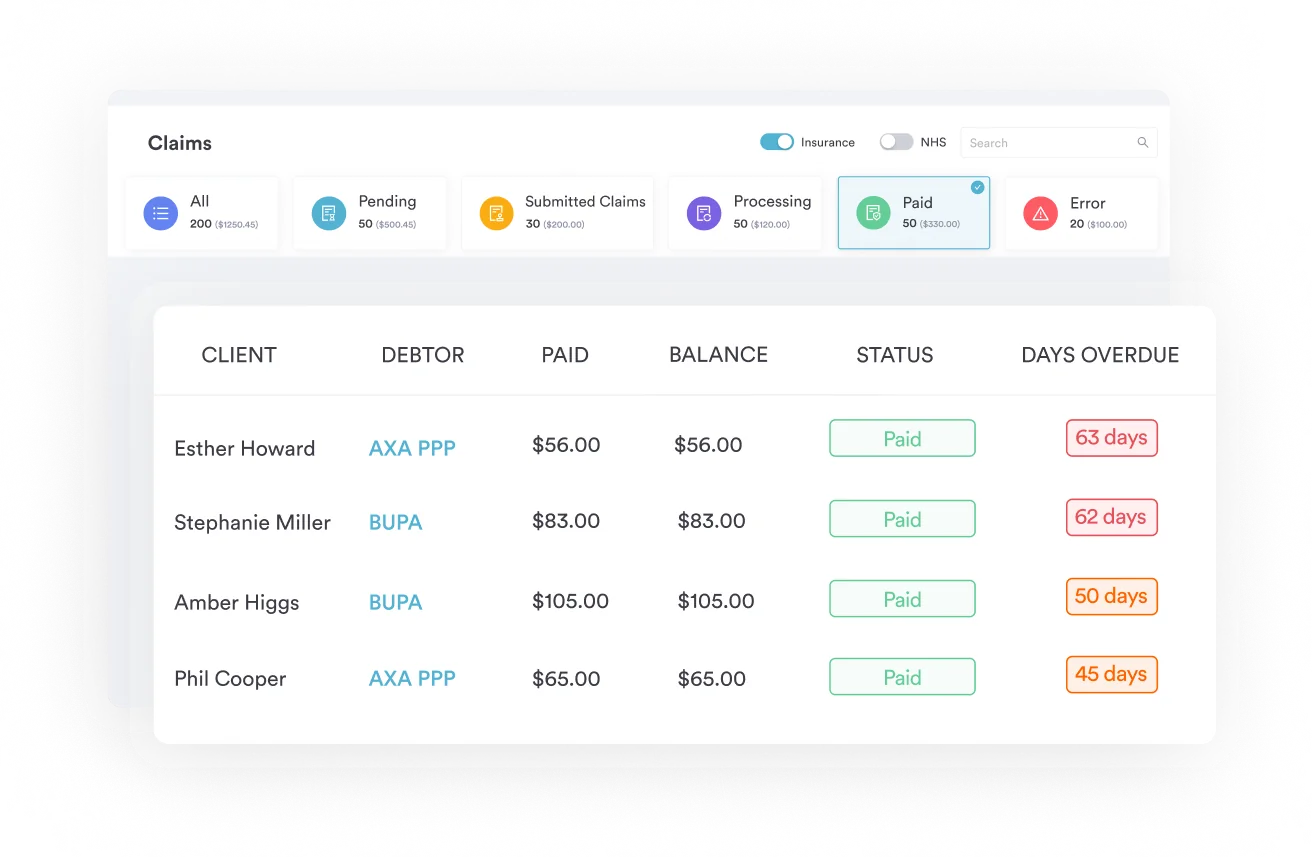
Pabau also integrates with Claim.MD, which sends electronic claims to thousands of US payers. Eligibility checks show coverage and benefits before the procedure. Remittance advice then comes back matched to the claims it settles, so staff can verify, submit, and reconcile 33990 claims in one platform.

Pabau checks membership numbers and authorization codes before each claim is sent. Claims then go through Claim.MD to thousands of US payers, so your 33990 claims go out clean.

CPT Code 33990 rewards precise documentation of one detail above all: the access route. Arterial access only means 33990. Venous access with a transseptal puncture means 33991, and a right heart device adds 33995.
Build that check into the operative note template, keep imaging off the claim, and tie every insertion to a specific shock or high-risk PCI diagnosis. Those three habits remove most preventable denials on this code. Book a demo to see how Pabau catches missing authorization details before your cardiology claims go out.

Need to understand how clean claims reduce rejection rates? Clean claim submission explains what makes a claim pass first-pass adjudication and how to build those checks into your billing process.
Struggling with payer denial patterns across your cardiology claims? Denial management in healthcare covers how to categorize, track, and resolve claim rejections systematically.
Want to understand how clearinghouse submission works? Medical claims clearinghouse explains the role of clearinghouses in claims routing, scrubbing, and ERA processing.
CPT Code 33990 covers percutaneous insertion of a left heart ventricular assist device through arterial access only, including radiological supervision and interpretation. It is used for emergent support in cardiogenic shock and for planned support during high-risk PCI.
Both codes report insertion of a percutaneous left heart VAD. 33990 uses arterial access only, while 33991 uses both arterial and venous access with a transseptal puncture. The access route documented in the operative note decides which code applies.
R57.0 (cardiogenic shock) is the diagnosis most often paired with 33990. Supporting codes include I21.x for acute MI with hemodynamic compromise and I50.x for heart failure, paired with R57.0 where shock is present. Payer policies may narrow the approved list, so confirm with your MAC before submitting.
Emergent cases such as cardiogenic shock are usually handled without advance authorization, though many payers require notification or retrospective review afterward. For elective high-risk PCI support, commercial payers including UHC and Aetna generally require pre-authorization. Verify the payer’s policy before the scheduled procedure.
Medicare reimbursement for 33990 varies by locality and is updated each year in the Physician Fee Schedule. Use the CMS fee schedule lookup tool to find the current rate for your MAC jurisdiction. The facility rate applies in practice, because the procedure is performed in a hospital cath lab.
No, not for biventricular support. Both codes describe a left heart device, so biventricular support pairs 33990 or 33991 with 33995 for the right heart device, following payer rules. Document each device, access site, and cannulation separately in the operative note.



