

CPT Code 52352: Ureteroscopic stone removal billing guide
CPT Code 52352: Official descriptor and procedure overview CPT Code 52352 descri...

Last Updated: Oct 30, 2026
33517 is the CPT add-on code for a single vein graft in a combined arterial-venous CABG. Its official descriptor reads: Coronary artery bypass, using venous graft(s) and arterial graft(s); single vein graft (List separately in addition to code for primary procedure).
It is always billed with an arterial graft primary code, 33533 through 33536. Billed alone or with the wrong graft count, the claim is likely to deny.
Let Pabau's smart automation suggest the right codes, reduce claim denials, and keep your practice compliant—effortlessly.
Automate repetitive tasks and focus on what matters most—your patients.
Reduce coding errors and ensure compliance with the latest regulations.
Clean claims, fewer denials, and faster reimbursements.
Powerful insights and reporting to help your practice thrive.
HIPAA compliant SOC 2 certified GDPR-compliant Trusted by 4,000+ clinics worldwide

CPT code 33517 reports one venous graft added to a combined arterial-venous CABG. It is never billed without a primary arterial graft code (33533, 33534, 33535, or 33536).
Graft count drives code selection: 33517 = 1, 33518 = 2, 33519 = 3, 33521 = 4, 33522 = 5, and 33523 = 6 or more venous grafts.
Don’t append modifier 51 to 33517. It is an add-on code (CPT Appendix D), and add-on codes are not subject to modifier 51.
Pabau, the practice management platform we build, submits CMS-1500 claims through Claim.MD, then tracks denials and posts electronic remittance advice (ERA).
CPT code 33517 is the AMA’s designated add-on code for one venous graft in a combined arterial-venous coronary artery bypass procedure. The official descriptor reads: Coronary artery bypass, using venous graft(s) and arterial graft(s); single vein graft (List separately in addition to code for primary procedure). In short, that closing parenthetical sets the code’s status. 33517 is an add-on code (CPT Appendix D), and add-on codes are not subject to modifier 51. Moreover, it cannot appear on a claim without a qualifying arterial graft code on the same date of service.
The arterial graft is the primary procedure. Also, the venous graft reported with CPT code 33517 is performed in the same operative session, and the claim must carry both codes. In particular, AMA parenthetical instructions name the qualifying primary codes, from 33533 for a single arterial graft up to 33536 for four or more.
No other primary code unlocks 33517. However, if the surgeon performed only venous grafts with no arterial conduit, the correct codes are 33510-33516 (venous-only CABG), not 33517. In fact, submitting 33517 without one of the four codes above is one of the most reliable denial triggers in cardiac surgery billing.
The number of venous grafts is the one variable that decides which venous add-on code applies. First, count the venous conduits documented in the operative note, then match that count to the code.
Billing 33518 when only one vein was grafted is upcoding. Conversely, billing 33517 when two were performed underreports the surgeon’s work. Therefore, the operative note must state the number of venous conduits so the count can be audited. Finally, the chart below puts both counts side by side, including the add-ons for four to six veins.
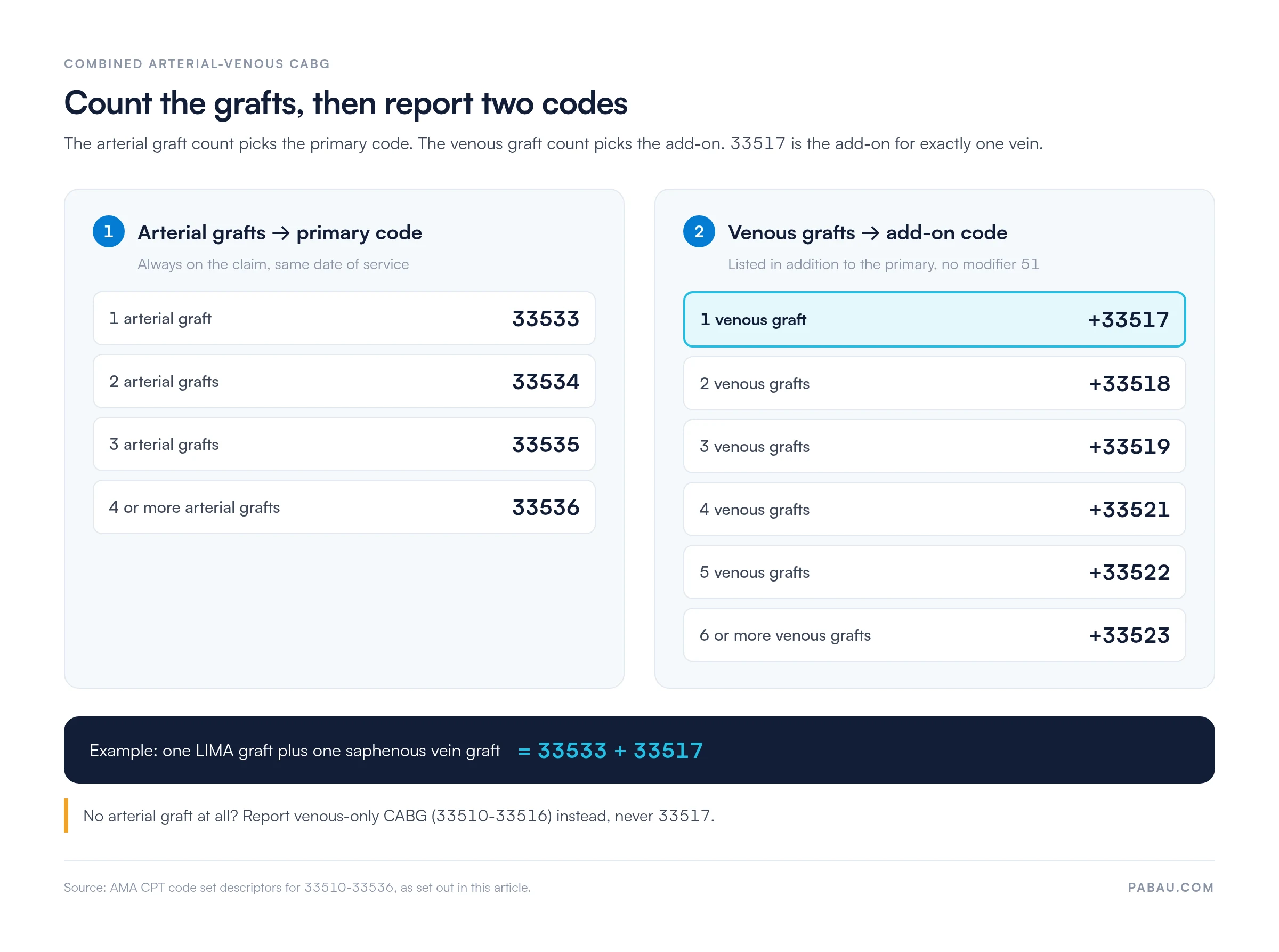
CPT code 33511 covers a standalone two-venous-graft CABG performed without any arterial conduit. By contrast, CPT code 33517 is never billed on its own. It is the venous add-on to an arterial primary, used when the surgeon chose a combined approach. In short, the two procedures are clinically distinct and coded in entirely different ways.
Confusing the two is especially common when an operative note describes a LIMA plus saphenous vein graft procedure. In that case, the LIMA is the arterial graft (coded as 33533), and the saphenous vein is the single venous component (coded as +33517). Consequently, using 33511 in that scenario reports the wrong procedure category entirely.
Add-on status settles the most common modifier question: do not append modifier 51 to CPT code 33517. It is an add-on code (CPT Appendix D), and add-on codes are not subject to modifier 51. Therefore, payers reimburse it alongside the primary arterial graft code without the multiple-procedure reduction that modifier 51 signals.
When modifier 22 is appended, send documentation that supports it, usually the operative note plus a cover letter. However, payers rarely pay the increased complexity adjustment without an explanation of what made the surgery harder than the base code assumes.
Flag operative notes that describe complications during vein harvesting or unexpected conduit changes before the claim goes out. Modifier 22 is defensible in these situations only if the surgeon documented the extra time and difficulty specifically, not in boilerplate procedure language.
A complete operative note is the difference between a clean claim and a medical records request that holds up payment. Payers reviewing a 33517 claim need to see four elements in the note.
Missing any of these elements gives a payer auditor grounds to deny or request more documentation. Moreover, a note the surgeon completes at the time of surgery is easier to defend than a queried addendum added weeks later.
Medicare pays 33517 through the CMS Physician Fee Schedule as an add-on code. Because CABG is performed in a hospital operating room, the facility rate is the one that applies. In addition, rates update each January 1 under the annual MPFS final rule, so any figure published mid-year may already be outdated.
33517 carries its own RVUs and is paid in addition to the primary code (global ZZZ). For current payment amounts, use the CMS MPFS lookup tool. Then, enter code 33517, select the current year, and choose your MAC jurisdiction. Finally, verify the figure annually before using it in budget projections or contract negotiations.
Commercial payer rates for CPT code 33517 typically follow Medicare relativity but can vary significantly by contract. Also, some payers bundle the add-on payment into the primary arterial code and do not adjudicate 33517 separately. Therefore, cardiac surgery practices should review each contract before assuming the Medicare rate applies to commercial patients.
Elective CABG procedures typically require prior authorization from commercial payers. However, the add-on code 33517 is generally covered by the overall CABG authorization, with no separate request. Still, this varies by payer and plan year.
Therefore, contact the payer’s provider services line or check its online portal to confirm current authorization requirements before scheduling elective CABG. Requirements shift with plan year changes. They can also differ between individual and group plans under the same carrier name.
Claims for CPT code 33517 deny for a predictable set of reasons. In fact, most are preventable at the coding stage, before an appeal is ever needed. However, when one slips through, the remittance carries a reason code, and our guide to medical billing denial codes explains what each one means.
Pabau submits cardiac surgery claims as CMS-1500s through Claim.MD and runs eligibility checks through the same clearinghouse before the surgery date. Then, when a payer denies a 33517 line, Pabau tracks the denial against the claim and posts the ERA. Your team can then see which errors keep coming back.
The diagnosis codes on a 33517 claim must establish medical necessity for both the arterial graft (primary code) and the venous component. Atherosclerotic heart disease of native coronary artery is the most common underlying condition. The specificity level matters, because payers and Medicare use diagnosis codes to check that the indication meets coverage criteria.
Select the most specific code the clinical documentation supports. Using I25.10 when the record clearly documents unstable angina (I25.110) is a missed specificity opportunity that can weaken a medical necessity review. Additionally, where the record documents ischemic cardiomyopathy, I25.5 can be added to support the indication. Finally, coders should query the attending physician when the angina status is ambiguous.
For cardiac surgery billing teams with high claim volumes, run a monthly audit of 33517 claims using your ERA data. Review recurring CARC codes, e.g. CO-4 (modifier issue), CO-97 (bundled into another service), and CO-50 (not medically necessary). They often trace back to the pairing and documentation errors in the denial table above. ERAs received through Claim.MD carry these codes, so the pattern shows up without manual chart pulls.
In many cardiac surgery practices, the coder works from the operative note, keys the claim into a clearinghouse portal, and tracks denials in a spreadsheet. A denied 33517 line is easy to miss in that setup, because the primary arterial code on the same claim often pays.
Pabau’s surgical practice claims software submits CMS-1500 claims through its Claim.MD integration, using the codes your coder has entered. In addition, eligibility checks run before the surgery date, so a coverage problem shows up while there is still time to resolve it.
When the remittance comes back, Pabau posts the ERA and tracks any denial against the claim. As a result, your team sees a rejected add-on line next to the paid primary. The vein-count query then goes back to the surgeon while the case is still fresh.

Pabau submits CMS-1500 claims through Claim.MD, runs eligibility checks, tracks denials and posts ERAs. Denied add-on lines show up next to the paid primary instead of going unnoticed.

CPT 33517 rewards one habit: count the arterial and venous grafts in the operative note before choosing any code. Overall, that count settles the primary code, the add-on, and most of the denial risk in a single step.
If your operative notes don’t state the vein count, fix the note template before fixing claims. For instance, a note that reads “SVG x1” makes 33517 defensible on audit. By contrast, a note that says “venous conduits were used” leaves the coder guessing.
The medical billing workflow behind the claim matters too. Pabau submits your CMS-1500s through Claim.MD, then tracks denials and posts ERAs, so add-on rejections surface quickly. Book a demo to see how Pabau handles complex surgical claims for your practice.

Need a primer on how medical claims clearinghouses work? Medical claims clearinghouse overview explains how claims are validated, scrubbed, and transmitted before reaching payers.
Managing CABG claim denials? Denial management in healthcare covers systematic approaches to working denial queues and reducing rework.
Want to understand ERA posting and 835 remittance files? Electronic remittance advice guide breaks down how ERA data maps to payment posting in surgical billing workflows.
CPT code 33517 describes a single venous graft performed as part of a combined arterial-venous coronary artery bypass procedure. It is an add-on code (+33517), listed in addition to the primary arterial graft code, and cannot be billed alone.
Yes. CPT code 33517 is an add-on code, marked with a plus symbol (+33517) in the AMA CPT codebook. It appears in Appendix D, the CPT list of add-on codes, and add-on codes are not subject to modifier 51. It must always appear on a claim with a qualifying primary arterial graft code (33533, 33534, 33535, or 33536).
Yes. CPT 33533 (arterial CABG, single graft) is one of the four allowable primary codes for 33517. When a surgeon performs one LIMA or radial artery graft plus one saphenous vein graft in the same session, the code pair is 33533 + 33517.
CPT 33517 covers one venous graft in a combined arterial-venous CABG, and CPT 33518 covers two. Both are add-on codes that require a primary arterial graft code from 33533-33536. The operative note must state the vein count to support whichever code is reported.
Typical causes are a missing primary arterial graft code, an add-on that doesn’t match the operative note’s vein count, and modifier 51 appended in error. Missing diagnosis specificity and NCCI bundling conflicts with other procedure codes also trigger denials.



