CCSD Code D1010: Radical mastoidectomy including meatoplasty
CCSD Code D1010: Definition and clinical scope CCSD Code D1010 is the UK private...

Last Updated: Nov 25, 2026
31526 is the CPT code for diagnostic direct laryngoscopy, with or without tracheoscopy, using an operating microscope or telescope. The surgeon examines the larynx through a rigid scope under magnification and takes no tissue.
The optics decide the code. The same look without a microscope or telescope is 31525. Once the surgeon takes a biopsy or removes a lesion, an operative code such as 31536 or 31541 applies instead. Getting that split right keeps the claim in line with the operative note, which payers audit. Below are the code family, documentation, modifiers, common denials and a pre-submission checklist.
Let Pabau's smart automation suggest the right codes, reduce claim denials, and keep your practice compliant—effortlessly.
Automate repetitive tasks and focus on what matters most—your patients.
Reduce coding errors and ensure compliance with the latest regulations.
Clean claims, fewer denials, and faster reimbursements.
Powerful insights and reporting to help your practice thrive.
HIPAA compliant SOC 2 certified GDPR-compliant Trusted by 4,000+ clinics worldwide

CPT code 31526 reports a diagnostic direct laryngoscopy, with or without tracheoscopy, done with an operating microscope or telescope.
The operative note has to name the microscope or telescope, or the case codes to 31525.
Biopsy, excision, foreign body removal and dilation each have their own codes, so 31526 never covers treatment.
Report one diagnostic direct laryngoscopy code per session, because 31525 and 31526 describe the same look with different optics.
The microscope is included in 31526, so CPT 69990 is never added on top of it.
CPT code 31526 reports a diagnostic direct laryngoscopy, with or without tracheoscopy, performed with an operating microscope or telescope.
The descriptor comes from the AMA’s CPT code set, which an AMA-appointed panel maintains. It reads: Laryngoscopy, direct, with or without tracheoscopy; diagnostic, with operating microscope or telescope.
The surgeon passes a rigid laryngoscope through the mouth, usually under general anesthesia. The scope is often suspended so both hands stay free. Then the microscope or telescope magnifies the vocal cords, subglottis and supraglottis for inspection.
Tracheoscopy is optional. If the surgeon also inspects the trachea through the same approach, the code stays 31526.
Direct laryngoscopy codes sit in the 31505-31579 range of endoscopy procedures on the larynx. Two questions settle almost every case. What did the surgeon do once the scope was in, and were the optics magnified?
The matrix below answers both at once. Read across the row that matches the note.
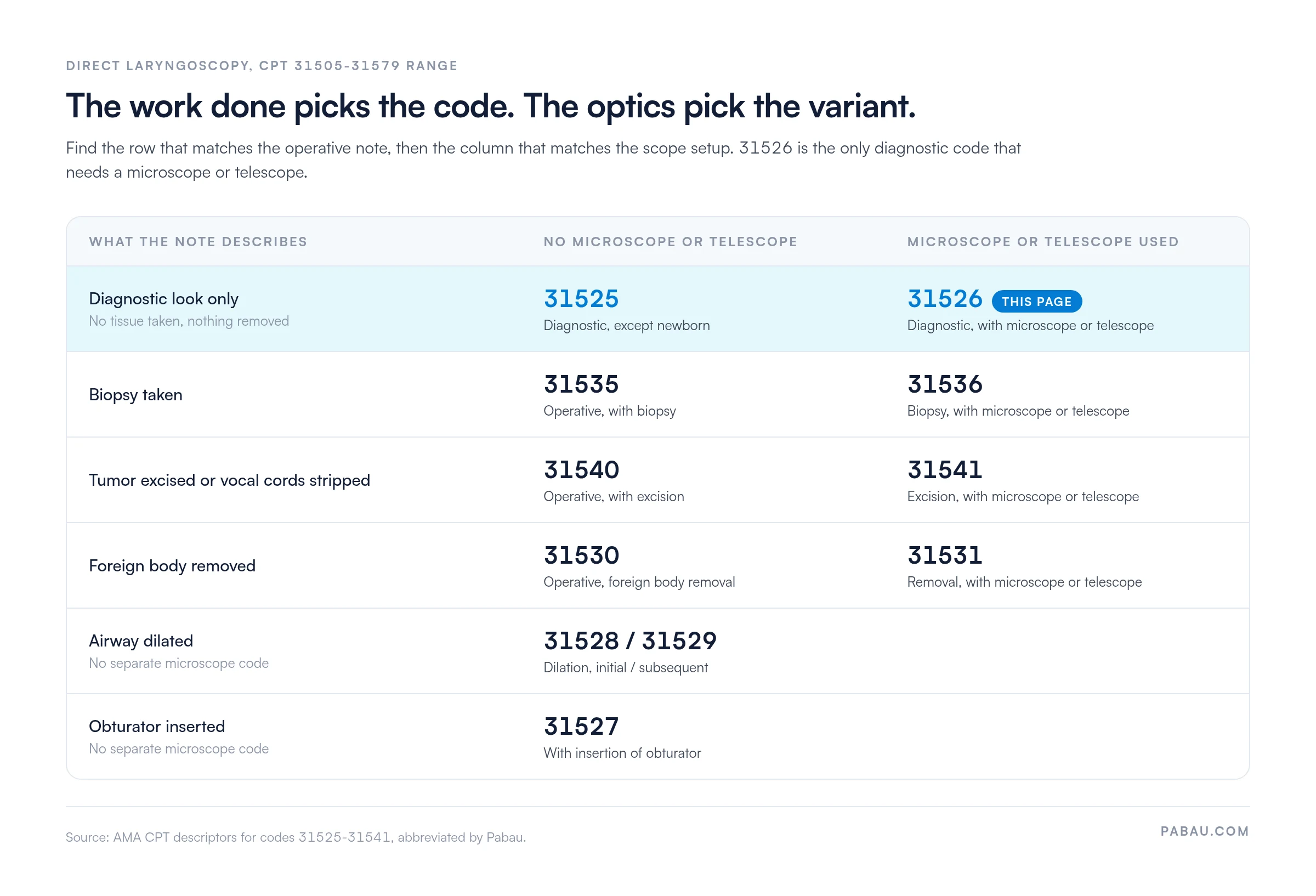
The descriptors make 31525 and 31526 alternatives for the same diagnostic look. Pick one per session, based on the optics the note records. When the surgeon dilates a stenosis instead, the claim goes out as 31528 for the first session.
Watch for the case that starts diagnostic and turns operative. If the surgeon biopsies a suspicious lesion under the microscope, report 31536 rather than 31526. An excision under magnification goes to 31541.
Surgeons choose 31526 when they need a magnified view that a flexible or indirect exam couldn’t give. The code covers the evaluation itself. Any treatment that follows in the same session is coded separately.
Typical indications include:
Medical necessity rests on the note as much as the diagnosis code. A vocal cord polyp (ICD-10-CM J38.1) supports 31526. However, the note must still confirm that a microscope or telescope was used.
Most problems with this code start long before the claim is built. Here is the path a typical case takes, and where each step can stall it.
Steps two and three cause most of the rework. A clear dictation template fixes both, because the coder can then code what the note says.
Ask your ENT surgeons to name the optics in every direct laryngoscopy dictation, such as ‘operating microscope used’ or ‘0-degree telescope used’. One standard phrase stops correct 31526 cases from being coded down to 31525.
Run through these checks before the claim leaves the practice. Each one maps to a denial pattern covered further down.
Several of these checks overlap with general clean claim rules. The code-specific ones are the optics and the diagnostic-only test.
Most 31526 claims need no modifier. When one applies, the operative note has to explain why.
Traditional Medicare generally doesn’t require prior authorization for 31526. Its contractors still decide which diagnoses support medical necessity. Many commercial and Medicare Advantage plans do want authorization for an OR laryngoscopy, and Medicaid rules vary by state.
A strong request includes the diagnosis and its narrative, the planned procedure with microscope use, and prior findings such as a flexible laryngoscopy report. Keeping those steps documented is part of wider billing compliance work.
Payment amounts change every year with the Medicare Physician Fee Schedule. Most 31526 cases happen in a hospital or ASC, so the facility rate usually applies to the surgeon’s claim. Check current values in the CMS Physician Fee Schedule lookup tool or the FastRVU 2026 RVU lookup.
A missing microscope in the note is a common denial reason for this code. The table pairs each mistake with its fix. If a denial still lands, the medical billing denial codes guide explains what each reason code means.
For a medical necessity denial, build the appeal around four documents. Send the operative note, the referring provider’s notes, any flexible laryngoscopy report and a letter from the surgeon. A steady denial management routine keeps those appeals moving on time.
Once a quarter, pull your recent 31526 claims and check that every operative note names the microscope or telescope. If some don’t, update the dictation macro with your surgeons before the next audit.
In many ENT practices, the operative note sits in one system and the claim gets built in another. Authorization numbers live in email threads. Coders then chase surgeons for missing details after the case.
Pabau, a practice management platform with built-in insurance billing, keeps those steps on one patient record. Digital forms hold your operative note template, so the optics and tracheoscopy lines are there on every case. Prior authorizations are tracked on the case, with a warning when one is missing.
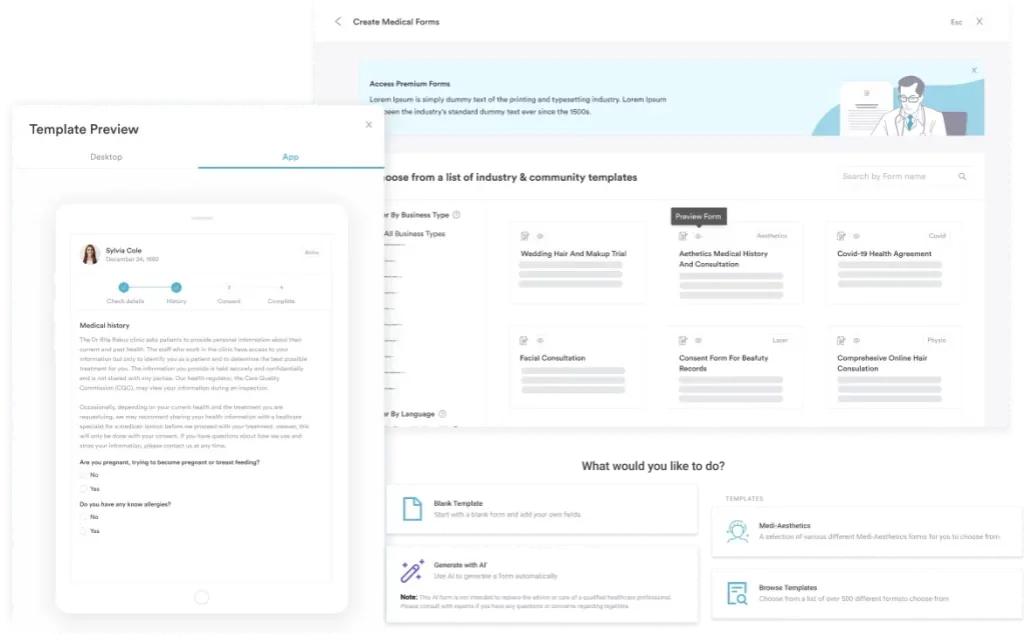
In the US, claims go out through Claim.MD as CMS-1500 or 837P submissions. The same claims software for practices runs eligibility checks before the visit and posts ERA remittances when payers respond. The coding decision stays with your coder, but every document they need is in one place.

Pabau submits claims through Claim.MD, checks eligibility before the visit and posts ERA remittances, with operative notes and authorizations on the same patient record.

Coding 31526 well comes down to two questions about the note. Was the look purely diagnostic, and did the surgeon use a microscope or telescope? If both answers are yes, 31526 is the code.
The fix worth making this month is upstream, in the dictation template. A required optics line protects correct claims from downcoding. A diagnostic-only check stops biopsies from going out under the wrong code.
If notes, authorizations and claims still live in separate places, that is where errors creep in. Book a demo to see how Pabau keeps ENT operative notes, authorizations and claims on one record.

Coding a biopsy taken during the same scope? CPT code 31536 covers direct operative laryngoscopy with biopsy under a microscope or telescope.
Adding stroboscopy to a voice workup? CPT code 31579 explains how laryngoscopy with stroboscopy is billed.
Need a structured approach to reducing claim denials? Denial management in healthcare covers the workflow for tracking, appealing and preventing denied claims.
Submitting clean claims from the first attempt? Clean claim submission breaks down every element a claim needs before it leaves the practice.
Choosing how your claims reach payers? Medical claims clearinghouse explains how clearinghouses work and what to look for in one.
Yes. The descriptor says operating microscope or telescope, so a rigid telescope used through the laryngoscope qualifies. Have the note name the telescope and its angle, such as 0 or 70 degrees.
Medicare assigns 31526 a 0-day global period. Routine same-day care around the procedure is included. Visits on later days are billed separately when they’re medically necessary.
Anesthesia providers usually report 00320 for procedures on the larynx in patients aged 1 year or older. For infants younger than 1 year, the code is 00326. The surgeon bills 31526 on a separate claim.
Common examples are J38.1 for a vocal cord polyp, J38.2 for vocal cord nodules and J38.3 for other vocal cord disease, such as leukoplakia. R49.0 covers dysphonia, and D14.1 a benign laryngeal neoplasm. Always code the documented finding.