HCPCS Code G0163: Skilled nursing observation and assessment
What is HCPCS Code G0163? HCPCS Code G0163 is a deleted Level II code for skille...

Last Updated: Oct 15, 2026
P2028 is the HCPCS Level II code for cephalin floculation, blood. The test is a colloidal-precipitation blood assay, once used to screen for hepatocellular disease.
The code sits in the P-series that CMS maintains for pathology and laboratory services. Its sub-range, P2028 through P2038, covers laboratory tests of blood and hair. Modern liver function panels replaced the test decades ago, so most payers now treat P2028 as experimental or non-covered.
Let Pabau's smart automation suggest the right codes, reduce claim denials, and keep your practice compliant—effortlessly.
Automate repetitive tasks and focus on what matters most—your patients.
Reduce coding errors and ensure compliance with the latest regulations.
Clean claims, fewer denials, and faster reimbursements.
Powerful insights and reporting to help your practice thrive.
HIPAA compliant SOC 2 certified GDPR-compliant Trusted by 4,000+ clinics worldwide

HCPCS code P2028 covers cephalin flocculation, blood, a P-series laboratory test rather than a CPT procedure.
Many commercial payers, including some Blue Cross Blue Shield plans, treat P2028 as experimental or non-reimbursable.
A defensible claim needs an ordering physician’s clinical indication, a linked ICD-10-CM code, and current CLIA certification.
Pabau’s claims management tools let billing teams track claim status and denial codes in one place.
HCPCS code P2028 is the Level II alphanumeric code for cephalin flocculation, blood. It reports a single unit of service, billed by a CLIA-certified laboratory from a blood specimen.
Level II codes open with a letter, while CPT codes run five digits. The lettered set reports services and supplies that CPT leaves out, and the P-series handles pathology and laboratory work. That structure is set out in the CMS HCPCS overview.
The quick-reference table below carries the code details a coder needs before submitting any P2028 claim.
The test is a colloidal-precipitation assay. It measures how far a patient’s serum destabilizes an emulsified cephalin-cholesterol mixture.
In a healthy patient, serum proteins hold that emulsion stable. Hepatocellular disease shifts the ratio of albumin to globulin, and the emulsion then flocculates, meaning it clumps and precipitates. Results were graded by the turbidity read at 24 and 48 hours after incubation.
Physicians used it to screen for acute and chronic hepatitis, cirrhosis, and obstructive jaundice. Blood is the required specimen, drawn from a vein and processed as serum in a CLIA-certified laboratory.
No. Modern liver function panels replaced it decades ago. Hepatic assessment now runs on alanine aminotransferase (ALT), aspartate aminotransferase (AST), alkaline phosphatase (ALP), total bilirubin, and albumin assays. Those are more specific, more reproducible, and far easier to standardize.
Colloidal flocculation predates enzyme-based chemistry analyzers, and clinical practice abandoned it through the 1970s and 1980s.
That history shapes the billing. A P2028 claim carries a heavier medical necessity burden. The ordering physician has to record why this test was chosen over a standard hepatic panel. Most payers read the order as unusual, so the documentation set out below decides whether the claim gets paid.
HCPCS code P2028 sits first in the P2028 through P2038 sub-range for blood and hair tests. Knowing the neighbors keeps a coder from billing the wrong one.
The table below maps each code in the sub-range with its descriptor and specimen. Descriptors follow the AAPC HCPCS code range reference.
P2033, thymol turbidity, blood, draws the most confusion. Both tests read colloidal turbidity, and both carry similar historical indications. Choose P2028 only where the laboratory performed cephalin-cholesterol flocculation.
Build the record before the claim goes out. Many payers flag P2028 as experimental or non-covered, so a thin file is the fastest route to a denial.
Treat the list below as a before-you-submit checklist. A payer can deny the claim as not medically necessary when any single item is missing.
Verifying each element before the claim leaves the billing department is what turns it into a clean claim. Repairing it after the remittance arrives costs several times as much.
Run a pre-submission audit on every P2028 claim. Check that the ordering physician’s note says in plain words why cephalin flocculation was chosen over a standard hepatic panel. One sentence of clinical rationale in the record often decides a payer review.
No universal coverage determination applies to P2028. Commercial insurers and government programs each set their own position. Verify eligibility and plan policy before the test is ordered.
The table below summarizes where the main payer groups stand today.
Medicare holds no National Coverage Determination (NCD) for P2028. Coverage falls instead to the Local Coverage Determination (LCD) issued by the Medicare Administrative Contractor (MAC) for the laboratory’s jurisdiction.
Because the test is clinically obsolete, many MACs never list it as a covered service. Check the MAC’s own site before you bill.
Coverage can still be argued as reasonable and necessary. That needs a specific physician rationale, plus a MAC that does not exclude the test. Issue an Advance Beneficiary Notice before the draw in that situation. The patient then knows in advance that the cost may land with them.
For 2025 and 2026, P2028 carries no widely published national rate. That holds in the Clinical Laboratory Fee Schedule (CLFS) and the Physician Fee Schedule (PFS). Rarely billed codes often sit at $0, or at a non-payable designation, rather than at a listed allowable amount.
Confirm the current position through two channels before billing.
Settle payability before the draw rather than after the remittance. A non-payable code billed without the patient’s written self-pay consent creates two problems at once, one revenue and one compliance.

A P2028 claim passes through four sets of hands before anyone gets paid. The ordering physician creates the record, and the laboratory performs and reports the test. The billing team then builds the CMS-1500, and the payer adjudicates the line.
Every hand-off adds a requirement, and every requirement can end the claim. The visual below maps the seven stop points in the order a claim meets them.
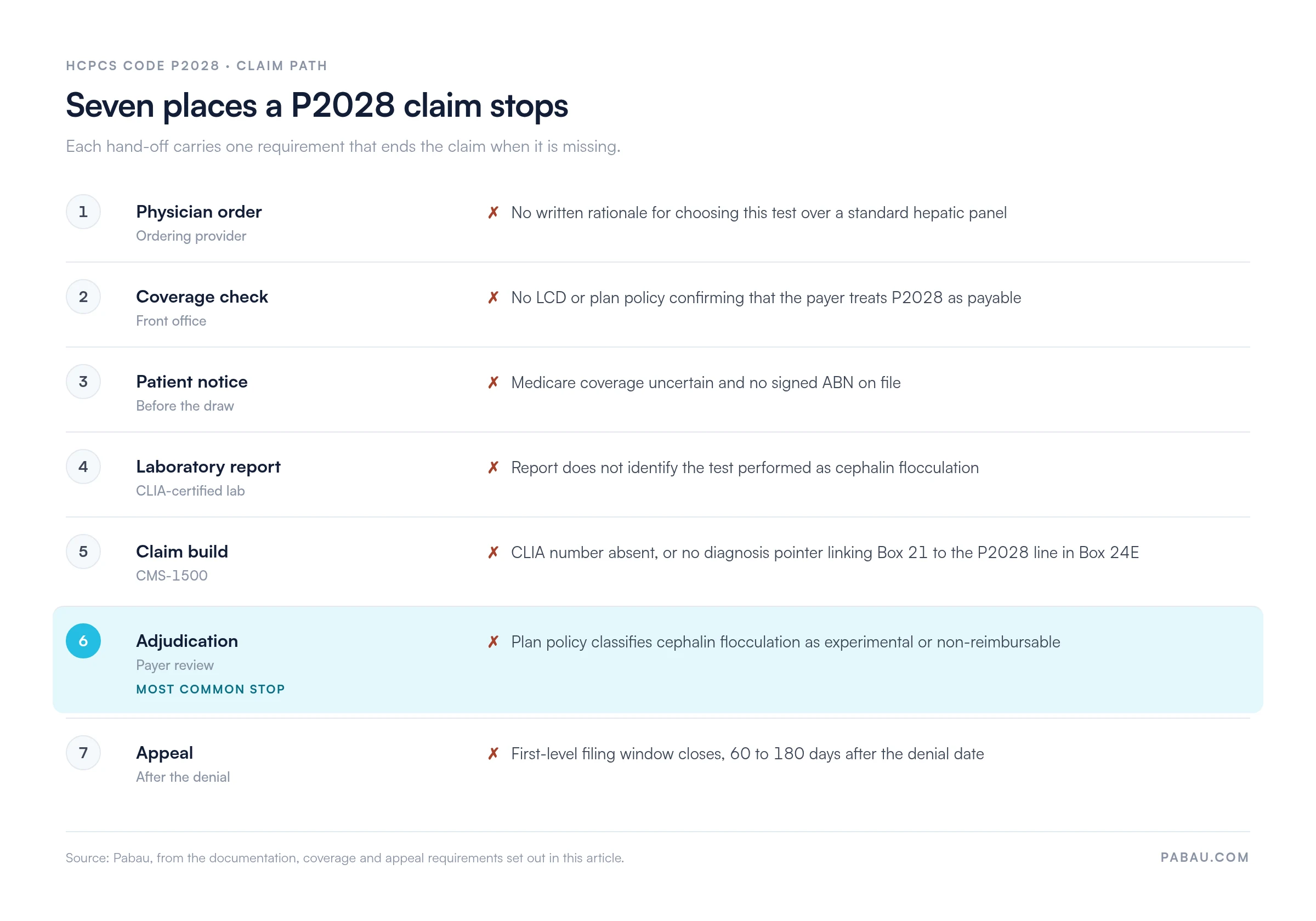
Stage six accounts for most of the losses. A plan that calls cephalin flocculation experimental denies the line however complete the record is. So the coverage check at stage two earns more attention than the paperwork at stage five.
Most P2028 denials fall into a short list of predictable categories. Anticipating them before submission works better than reacting once the remittance lands, and the table gives the fix for each.
P2033 and the CPT hepatic panels cause most wrong-code denials on this test. Reading the remittance against a list of medical billing denial codes tells you which category you landed in. That decides whether you correct and resubmit, or appeal.
A denied P2028 claim can still be overturned. A structured appeal, filed inside the payer’s deadline, wins where the clinical record is strong.
Most billing teams follow a code like this across three places. The claim sits with the clearinghouse, the denial sits in a remittance file, and the follow-up date sits in somebody’s calendar. A low-volume code is the one that slips.
Practice management software like Pabau holds that sequence together. Our claims management software submits the claim and records the status that comes back. It files the denial code against the patient the specimen came from.
The order, the clinical note, and the invoice stay on that same patient record. Assembling an appeal then means opening one file instead of three systems. Every Pabau subscription includes the full feature set, so claim tracking never sits behind a higher tier.

Pabau submits your claims, records the status that comes back, and keeps each denial code on the patient’s record. Your billing team works from one file rather than three systems.

P2028 is a valid code attached to a test almost nobody orders, and that pairing is what makes it risky. Getting the descriptor right is the easy part. Establishing that a payer will actually pay for it is the work.
So the decision belongs before the draw, not after the denial. Check the plan policy, get the rationale into the order, and obtain an ABN where Medicare coverage is unclear. Where none of that lands, price the test as self-pay and tell the patient first.
The trade-off worth remembering is small revenue against serious audit exposure. One P2028 line rarely pays enough to justify a thin record. Book a demo to see how Pabau keeps the order, the claim, and the denial on one patient record.

Need a framework for managing denied laboratory claims? Denial management in healthcare covers the workflow from denial identification through appeal resolution.
Want to see how HCPCS claims reach the payer? Medical claims clearinghouse explains how a claim moves from the billing system to adjudication.
Looking for compliance guidance on laboratory billing? Medical billing compliance outlines the documentation and regulatory duties that apply to CLIA-certified facilities.
No modifier is specific to P2028. On a Medicare claim, the liability modifiers apply instead. Use GA where the patient signed an Advance Beneficiary Notice. GZ applies where you expect a denial and obtained no ABN. Commercial payers set their own modifier rules, so read the plan policy first.
Yes, provided the patient agreed to pay before the test. On Medicare that agreement is the signed ABN, and without one the practice usually absorbs the cost. Commercial plans need an equivalent written notice. Quote the self-pay price at booking, so the balance surprises nobody at checkout.
It can be submitted, but expect a medical necessity review. Both tests answer the same clinical question, so the payer will ask why each was ordered. Document a separate reason for both, or plan on the second line being denied.
Yes. P2028 remains a valid Level II code, so a claim will not reject as an invalid code. Payability is the separate question, and that is where most claims fail. Re-check the payer’s position each year, because plan policies on obsolete tests change quietly.