

HCPCS code E0198: Water pressure pad billing guide
HCPCS code E0198 is a water pad for a standard mattress HCPCS code E0198 is the ...

Last Updated: Oct 13, 2026
Billable Code Specific Code
K0807 is the HCPCS Level II code for a power operated vehicle, group 2 heavy duty, patient weight capacity 301 to 450 pounds. Medicare pays it under the Part B durable medical equipment benefit when the patient cannot use a cane, walker, or manual wheelchair safely at home.
Above 450 pounds the device moves to K0808, and a scooter built to group 1 performance specifications bills as K0801. CMS also requires prior authorization before delivery, so the claim carries a unique tracking number.
Let Pabau's smart automation suggest the right codes, reduce claim denials, and keep your practice compliant—effortlessly.
Automate repetitive tasks and focus on what matters most—your patients.
Reduce coding errors and ensure compliance with the latest regulations.
Clean claims, fewer denials, and faster reimbursements.
Powerful insights and reporting to help your practice thrive.
HIPAA compliant SOC 2 certified GDPR-compliant Trusted by 4,000+ clinics worldwide

HCPCS code K0807 covers a group 2 heavy duty power operated vehicle with a patient weight capacity of 301 to 450 pounds.
Medicare requires prior authorization for K0807, so an affirmed decision and a unique tracking number have to exist before delivery.
CMS eliminated the certificate of medical necessity in 2023, so the face-to-face exam note and the written order now carry the file.
A patient above 450 pounds moves to K0808, and a device built to group 1 performance specifications bills as K0801.
Most K0807 denials trace back to a missing document rather than to a coverage exclusion.
HCPCS code K0807 is the Medicare billing code for a group 2 heavy duty power operated vehicle. The device must carry a patient weight capacity of 301 to 450 pounds. CMS maintains it as a permanent HCPCS Level II code, and suppliers bill it under the Part B durable medical equipment benefit.
The weight band is what separates K0807 from the codes either side of it. A scooter for a patient at or below 300 pounds bills as K0806 in group 2. Above 450 pounds, the code moves to K0808.
Group assignment itself turns on the device’s performance specifications, verified by the Pricing, Data Analysis and Coding (PDAC) contractor. Weight then narrows the code inside the group.
CMS splits power operated vehicles into two groups, then three weight tiers inside each group. Group 1 runs from K0800 to K0802 and reaches 600 pounds at its top tier. Group 2 runs from K0806 to K0808 across the same three weight bands.
K0807 sits in the middle tier of group 2. K0808 is the very heavy duty code above it, and K0806 is the standard code below. The grid below shows which code each weight band points to.
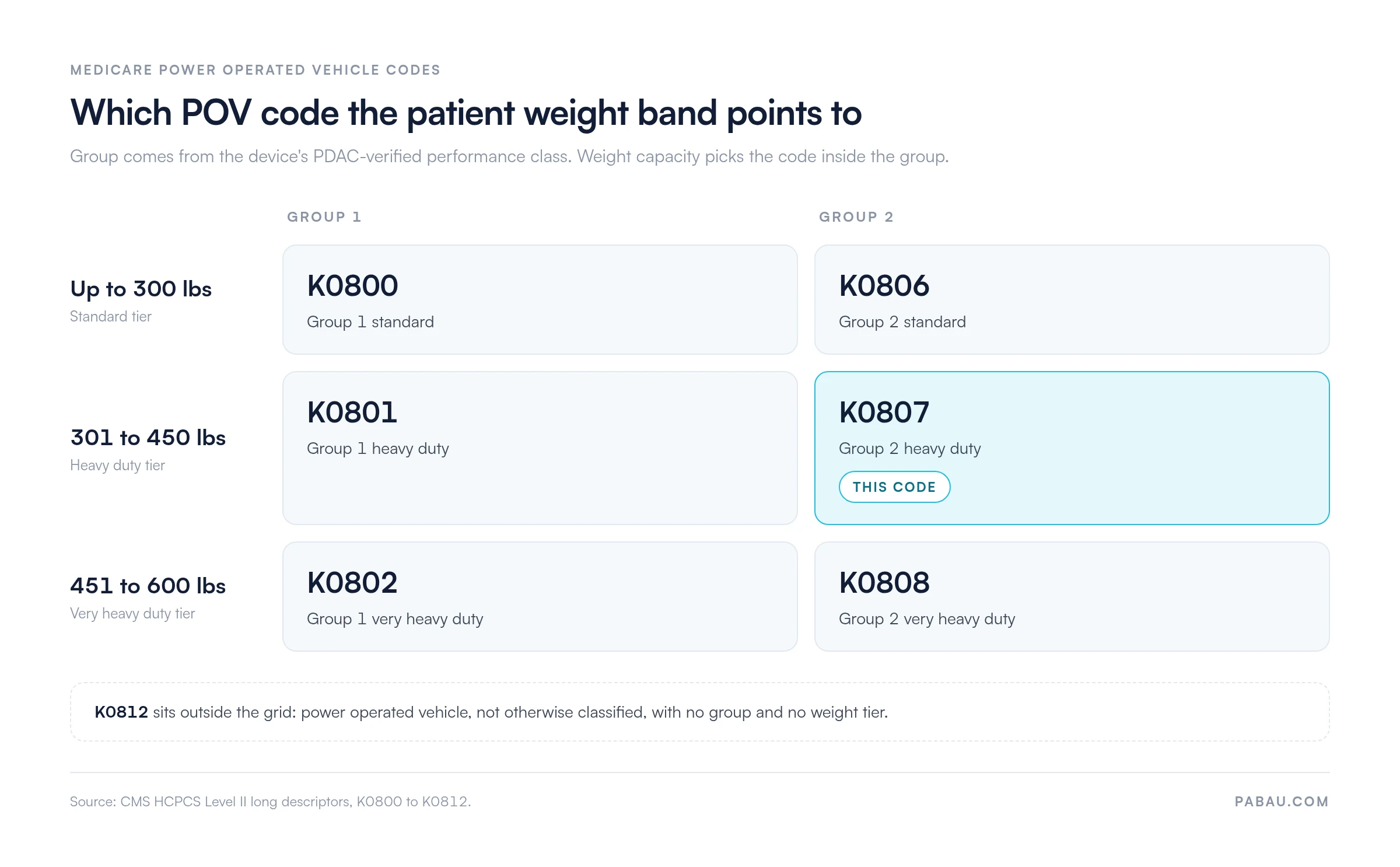
Choosing the wrong group or the wrong tier is an avoidable denial. The device’s PDAC-verified classification and the patient’s documented weight both have to point at the same code.
Medicare Part B covers power operated vehicles under the durable medical equipment benefit when the patient meets specific medical necessity criteria. CMS also lists K0807 on the DMEPOS Master List, so documentation must substantiate every coverage criterion before the supplier files the claim.
A beneficiary who misses any of the criteria below will not have a covered claim, however complete the paperwork is. Checking eligibility before you order the device saves the back-office effort of unwinding a denial.
Prior authorization has applied nationwide to K0807 since April 13, 2022, alongside K0800, K0801, K0802, K0806, and K0808. The supplier submits the request with the supporting medical record, and the DME MAC returns an affirmed or non-affirmed decision. Delivering before an affirmed decision arrives puts the whole claim at risk.
Local Coverage Determinations issued by the DME Medicare Administrative Contractors (DME MACs) carry the controlling clinical criteria. Verify the LCD for the beneficiary’s jurisdiction before billing, because the wording on mobility documentation varies by contractor.
Incomplete documentation is the largest single driver of K0807 denials. CMS expects a defined set of records to exist before the supplier submits the claim. Both the treating provider and the supplier have to retain them.
One document that used to sit on this list no longer does. CMS eliminated the Certificate of Medical Necessity and the DME Information Form for claims with dates of service on or after January 1, 2023. The face-to-face examination note and the standard written order now carry the medical necessity record on their own.
Document the patient’s measured weight in the face-to-face examination notes, not a weight the patient reported. Auditors look for the measurement date next to the figure. A self-reported weight has triggered denials on patients who clearly qualified for K0807.
K0807 payment rates under Medicare Part B vary by locality. CMS updates the DMEPOS fee schedule annually, and the allowed amount in one state can differ from another after regional adjustment.
CMS prices power operated vehicles from the DMEPOS fee schedule, not the physician fee schedule. Verify the current amount in the CMS DMEPOS fee schedule files at the time of submission, because third-party rate lists lag behind CMS updates.
Medicare pays 80% of the allowed amount once the patient meets the Part B deductible. The beneficiary or a secondary payer covers the remaining 20% coinsurance.
Medicare may pay items supplied in a competitive bidding area at the DMEPOS Competitive Bidding Program rate instead of the fee schedule amount. Check whether the beneficiary’s zip code falls inside a competitive bidding area before you quote a figure to a patient.
Modifiers tell the DME MAC something the code itself does not. A missing or incorrect modifier on a K0807 claim is a frequent cause of denials and payment delays.
Never put KX and GY on the same claim line. KX affirms that the LCD criteria are met, and GY says the item is not covered at all. GA and GY can appear together in specific circumstances, so check your contractor’s guidance first.
K0807 denies at a higher rate than most DMEPOS items, because CMS layers prior authorization on top of the usual power mobility documentation. Most of those denials trace back to a missing document rather than a coverage exclusion. Knowing which one is missing shortens the correction cycle.
Reading the remittance is the fastest way to tell which of these happened. Our reference on denial codes in billing groups and explains the adjustment codes that come back.
A pre-submission checklist that catches these before the claim leaves the billing department is cheaper than an appeal. Correcting a denial after adjudication adds weeks to the payment cycle.
The K0800 to K0812 range covers power operated vehicles under Medicare. Picking the right code means matching the device’s PDAC-verified specifications to the patient’s documented weight. The AAPC HCPCS code lookup is a quick way to read the adjacent descriptors.
K0807 and K0808 are not two ways of coding the same device. K0807 stops at 450 pounds, and K0808 begins at 451. The device also has to carry the PDAC-verified classification for the code you bill, so a K0807-class scooter billed as K0808 is an upcoding error.
K0812 is the not otherwise classified code for a POV that no other K-code describes, and it carries no group or weight tier at all. Use it only when the device genuinely fits no other code in the range.
A clean K0807 claim follows the same sequence every time, from assessment through remittance. Building that sequence into a checklist is what keeps denials down.
Volume is what makes this fragile. One skipped step in a batch of forty claims surfaces weeks later on a remittance. Suppliers who track the sequence per patient tend to land a clean claim on the first pass.
Give K0807 its own pre-submission checklist, separate from the rest of your DMEPOS work. Eight items decide the claim: the exam note, the written order, the affirmed authorization, and the measured weight. Then the PDAC classification, proof of delivery, KX, and the purchase or rental modifier. Any unchecked box holds the claim.
Most suppliers assemble a K0807 file by hand. The exam note sits in the clinical system and the written order in a scanned PDF. The authorization decision is in somebody’s email, and the delivery receipt is in a folder at the front desk.
Practice management software like Pabau keeps those records against the patient rather than across four systems. Notes, signed forms, and uploaded documents attach to the patient file, so the file an auditor asks for is already assembled.
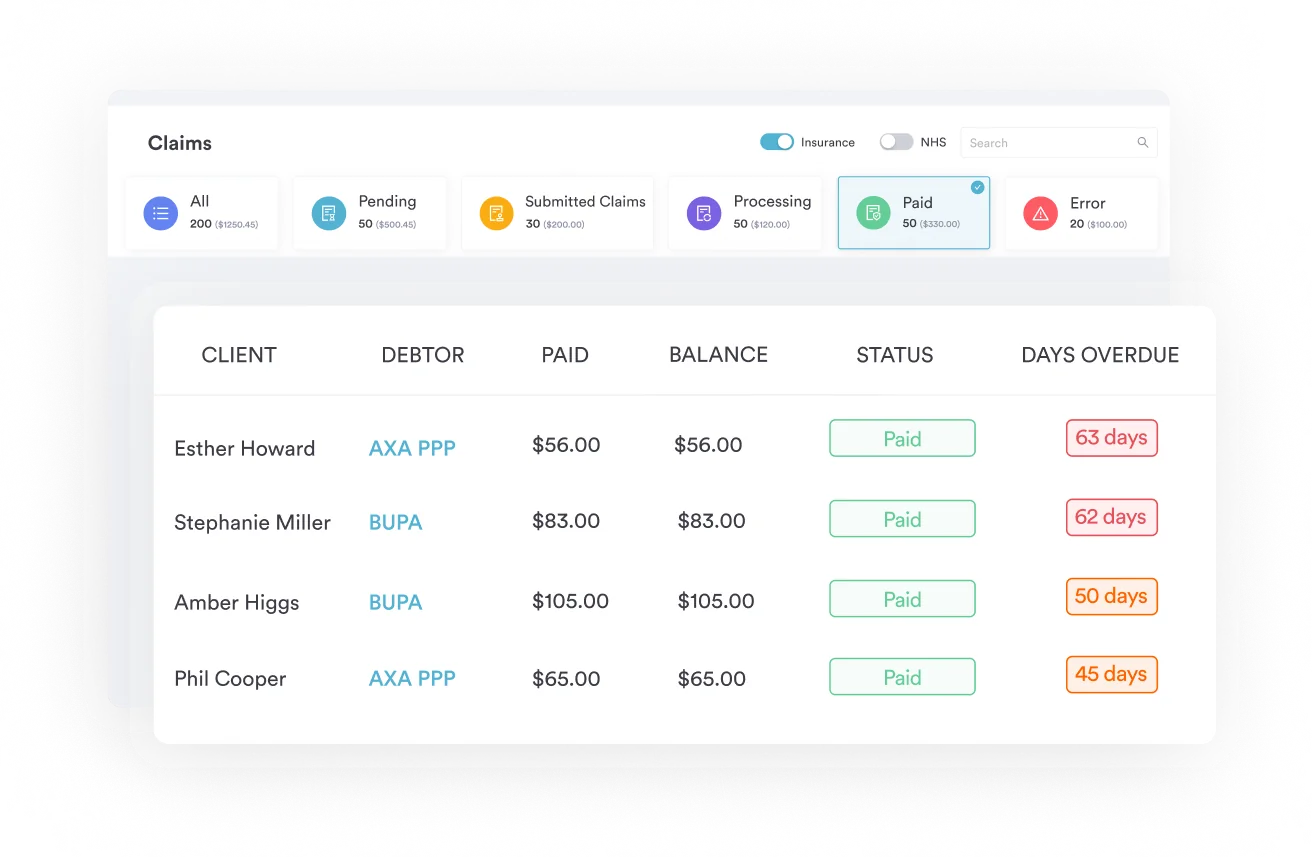
Pabau’s claims management software then submits the claim from that record and tracks what comes back. Your team sees which claims are paid, pending, or denied without opening a payer portal. A K0807 claim stops going quiet for a month at a time.

Pabau stores exam notes, signed orders, and delivery receipts on the patient file, then submits and tracks the claim. Your billing team can see what is outstanding without leaving the system.

K0807 is a code where the sequence matters more than the coding. Get the exam, the order, and the authorization in the right order and the claim is ordinary. Get one of them out of order and no amount of documentation saves it.
Two rules changed recently, and older billing guides still carry the old version. The certificate of medical necessity is gone, and prior authorization is mandatory nationwide. Billing from the old checklist costs a delivery you cannot invoice.
If your K0807 file lives across four systems, moving the documents onto one record does more than pushing the billing team harder. Book a demo to see how Pabau keeps the exam note, the order, and the claim on one patient record.

Need to understand how denial codes affect your DMEPOS claims? Denial codes in medical billing explains the most common remittance adjustment codes and how to act on them.
Looking to tighten your overall billing compliance posture? Medical billing compliance covers the regulatory framework DMEPOS suppliers need to stay audit-ready.
Want to reduce the time between claim submission and payment posting? Revenue cycle management breaks down the end-to-end process from eligibility check through final payment.
HCPCS code K0807 covers a power operated vehicle, group 2 heavy duty, with a patient weight capacity of 301 to 450 pounds. Medicare pays it under the Part B durable medical equipment benefit, once the mobility criteria are documented and prior authorization is affirmed.
The allowed amount for K0807 comes from the DMEPOS fee schedule and varies by locality. In competitive bidding areas, the competitive bidding amount applies instead. Check the current CMS files at the time of billing, because the schedule is updated each year.
K0807 needs a face-to-face examination note, a standard written order dated on or after the exam, and an affirmed prior authorization with its tracking number. It also needs a measured patient weight with a date, PDAC verification of the device, and signed proof of delivery. The certificate of medical necessity was eliminated for claims dated January 1, 2023 and later.
The frequent ones are a thin face-to-face examination note, no measured patient weight in the record, and delivery before authorization was affirmed. A written order dated before the exam and a missing KX modifier also deny. So does a device coded to another group, or a file with no proof of delivery.
KX, GA, GY, NU, RR, and UE are the modifiers that come up on K0807 claims. KX says the LCD requirements are met, and GA says an Advance Beneficiary Notice is on file. NU and RR separate a purchase from a rental, and UE marks used equipment. Never put KX and GY on the same claim line, because they contradict each other.



