



CCSD code G5100: Bypass of duodenum billing guide
CCSD code G5100 bills a bypass that leaves the duodenum in place CCSD code G5100...

Last Updated: Oct 16, 2026

CPT Code 29828 covers arthroscopy, shoulder, surgical, with biceps tenodesis. It is the arthroscopic reattachment of the biceps tendon to the humerus.
Medicare’s 2026 national payment for CPT Code 29828 is about $843.71, and it does not change between facility and non-facility settings.
Total RVUs of 25.26 multiplied by the 2026 conversion factor of $33.40 produce the national payment before GPCI adjustment.
Modifiers -LT and -RT for laterality are required on nearly every claim, and modifier -59 is the one auditors scrutinize most.
Pabau’s claims management software submits CMS-1500 and 837P claims through Claim.MD, with built-in CPT and ICD-10 catalogs.
CPT Code 29828 is arthroscopy, shoulder, surgical, with biceps tenodesis. It covers arthroscopic reattachment of the long head of the biceps tendon to the proximal humerus. Medicare’s 2026 national payment is about $843.71, the same in a facility and a non-facility setting.
This reference covers the official descriptor, the 2026 RVU build-up, ICD-10 pairings, modifiers, and CCI edit rules. It also covers related shoulder arthroscopy codes and the operative documentation that supports medical necessity.
Official CPT descriptor: Arthroscopy, shoulder, surgical; with biceps tenodesis.
CPT Code 29828 sits in the Endoscopy/Arthroscopy subsection of the Musculoskeletal System chapter of the AMA CPT code set. Surgeons report it when the tendon has torn, thickened, or become a source of chronic anterior shoulder pain.
The procedure addresses the long head of the biceps tendon, which originates at the superior glenoid tubercle and travels through the bicipital groove.
When conservative management fails, surgeons reattach the tendon distal to the groove. Fixation uses an interference screw, a suture anchor, or a cortical button, placed entirely through arthroscopic portals.
Common clinical indications:
Arthroscopic vs. open tenodesis: CPT Code 29828 is the arthroscopic approach. CPT 23430 (tenodesis of long tendon of biceps) covers the open approach. Payers treat these as distinct procedures.
If the surgeon converts an arthroscopic attempt to an open procedure, the correct code is 23430, not 29828. This distinction causes post-claim audit questions whenever the operative note language is ambiguous.
Medicare pays a single national amount for CPT Code 29828 in 2026, regardless of whether the surgery happens in an office or a facility.
The code carries no practice expense differential between the two settings. Geographic practice cost index (GPCI) adjustments still apply, so your locality rate will sit above or below the national figure.
Verify the figure for your locality with the CMS Physician Fee Schedule lookup tool before billing.
Rates change each January 1 with the final Medicare Physician Fee Schedule rule. GPCI multipliers apply to all three RVU components: work, practice expense, and malpractice. Run the lookup by provider ZIP code to get the locality figure your claim will be paid at.
Relative Value Units (RVUs) determine the Medicare payment before GPCI and the conversion factor are applied. The finalized 2026 national conversion factor is $33.40 for clinicians who are not qualifying APM participants. Clinicians who qualify as advanced APM participants are paid on a conversion factor of $33.57.
Physician work accounts for just over half of the total. The build-up below shows how the three components combine into the 2026 national payment.
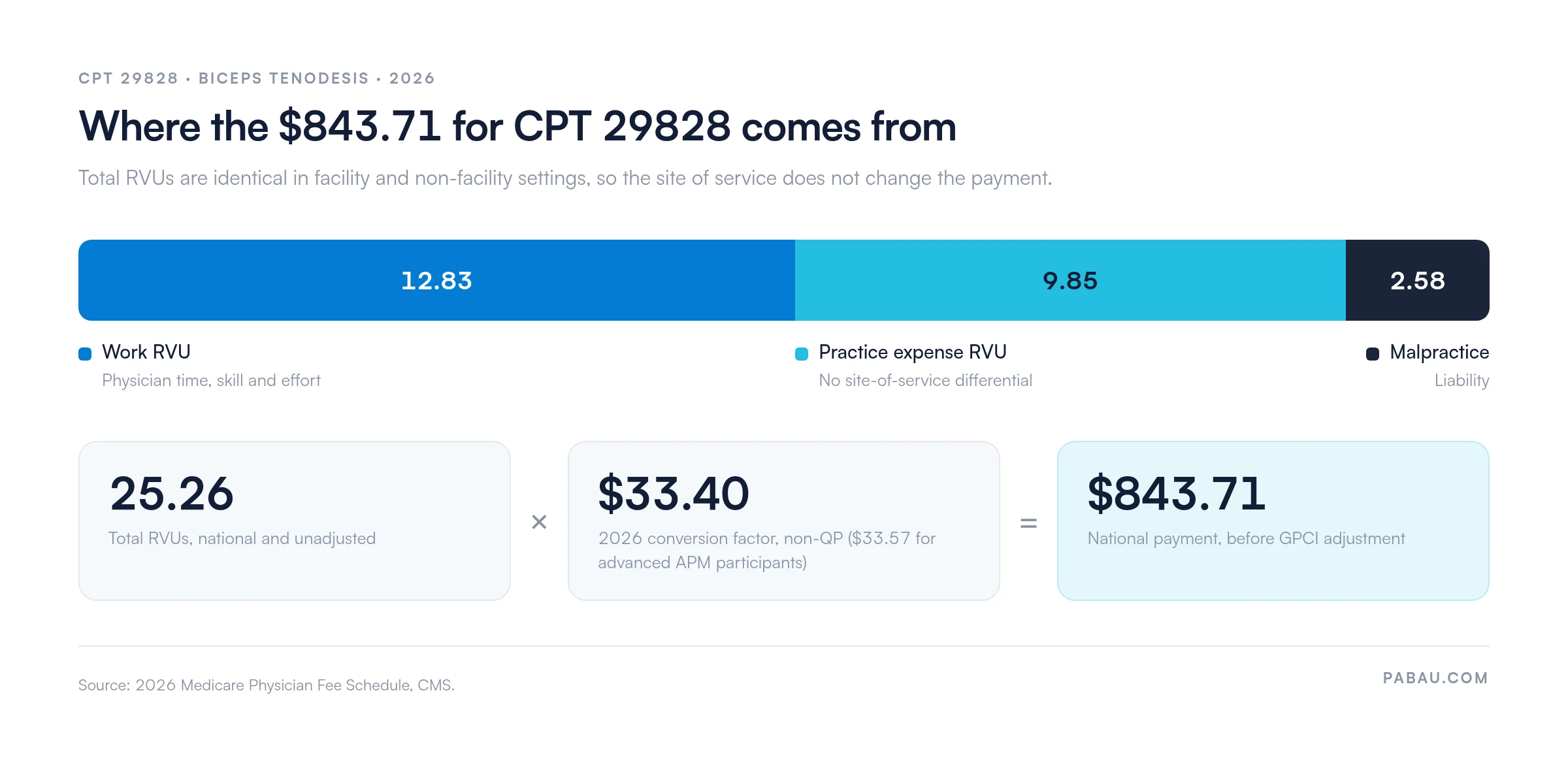
These figures come from the 2026 Medicare Physician Fee Schedule and are national, unadjusted values. Apply your locality’s GPCI before using them in financial modeling.
Payers require an ICD-10-CM diagnosis code that directly supports the biceps tenodesis. A tangentially related diagnosis, or a code for a condition the operative note never describes, is a fast route to a medical necessity denial.
If the documented diagnosis is not in the table below, check the full ICD-10-CM diagnosis codes index before you submit.
The diagnosis code must match the laterality of the surgical side and be supported by operative findings documented in the report. Submitting M75.10 (unspecified shoulder) when the procedure is clearly right-sided may trigger a soft edit or a denial from payers who require laterality specificity.
A missing laterality modifier gets CPT Code 29828 rejected before the claim reaches clinical review. The table below covers the modifiers commercial and Medicare payers most often require on this code.
The AAPC coding guidelines and the National Correct Coding Initiative agree on one point. Modifier -59 belongs on a claim only when no other modifier describes the relationship more precisely.
CMS has since introduced the X modifiers (XS, XE, XP, XU) as more specific alternatives. Routinely using -59 to unbundle codes that share a CCI edit creates liability under the False Claims Act.
The National Correct Coding Initiative (NCCI) bundles certain procedure codes together, preventing separate billing unless the clinical situation warrants unbundling. For CPT Code 29828, several shoulder arthroscopy codes sit in column 2. A column-2 code cannot be billed separately when it is performed with 29828 in the same session, on the same side.
Knowing which edits apply before submission is where denial management in healthcare starts for an orthopedic billing team.
Common CCI bundling patterns with CPT 29828:
CPT 29826 (subacromial decompression) and CPT 29827 (complete rotator cuff repair) carry a different edit status. Both may be billed alongside 29828 in some circumstances, subject to payer-specific CCI edit tables. Always verify current NCCI edit tables before assuming any code pair is or is not bundled, as edits are updated quarterly.
Arthroscopic capsulorrhaphy for shoulder instability, reported under CPT 29806, is separately billable alongside 29828 where the operative note documents it as distinct work. Modifier 51 then goes on the secondary line.
Run a CCI edit check on every shoulder arthroscopy claim before submission. Check CPT 29828 against every companion code billed in the same session, on the same date and side. That catches most bundling denials before they happen. Your billing software should flag CCI conflicts in real time. If it does not, add a manual pre-submission review step.
CPT Code 29828 belongs to the arthroscopy, shoulder, surgical code family (29819-29828). Knowing the full family matters when multiple procedures are performed in the same session.
CPT 29827 covers complete arthroscopic rotator cuff repair and carries a higher work RVU than 29828. The two are sometimes performed together, when a patient has both a significant cuff tear and biceps pathology. When billed together, 29827 is typically the primary code and 29828 is reported with modifier -51.
Verify the current CCI edit status for the pairing before billing, since edit status can change between fiscal years. Practices running multi-procedure shoulder sessions save verification time with orthopedic claims management software that carries code-pairing logic.
Documentation failures cause more CPT 29828 denials than coding errors do. The operative note has to give the payer enough clinical detail to confirm three points. The procedure was arthroscopic, the biceps tendon was the structure addressed, and a recognized indication exists.
Operative note elements that support CPT 29828 medical necessity:
A note that satisfies these five points also gives the appeals team something to work with when a payer questions medical necessity.
Medicare and commercial payers do not uniformly cover arthroscopic biceps tenodesis. Coverage policies vary by plan and region, and prior authorization requirements are increasingly common even for established surgical codes.
Key payer-specific considerations:
Submitting a clean claim costs less than appealing a denied one. A short pre-submission checklist per payer covers prior authorization status, the laterality modifier, the diagnosis code, and CCI conflicts.
Drug codes on the same account are judged by a separate coverage test. HCPCS code J1645 is generally excluded from Part B as a self-administered drug for home use. A POS 12 line without a documented qualifying exception is a known audit trigger.
Orthopedic billing teams usually work the claim after the fact. The coder reads the operative note, picks the codes, and appends modifiers by hand. A CCI conflict then surfaces weeks later, when the remittance arrives.
Practice management software like Pabau moves those checks in front of submission. Pabau’s claims management holds built-in CPT and ICD-10 catalogs, so the coder picks 29828 and its diagnosis from maintained lists rather than memory.
Claims go out as CMS-1500 or 837P files through our Claim.MD integration, which reaches thousands of US payers.
Real-time eligibility checks run before the patient is scheduled, so a missing prior authorization shows up while it can still be obtained. ERA remittances post back automatically, which means your team sees a denial on the day it lands instead of at month end.
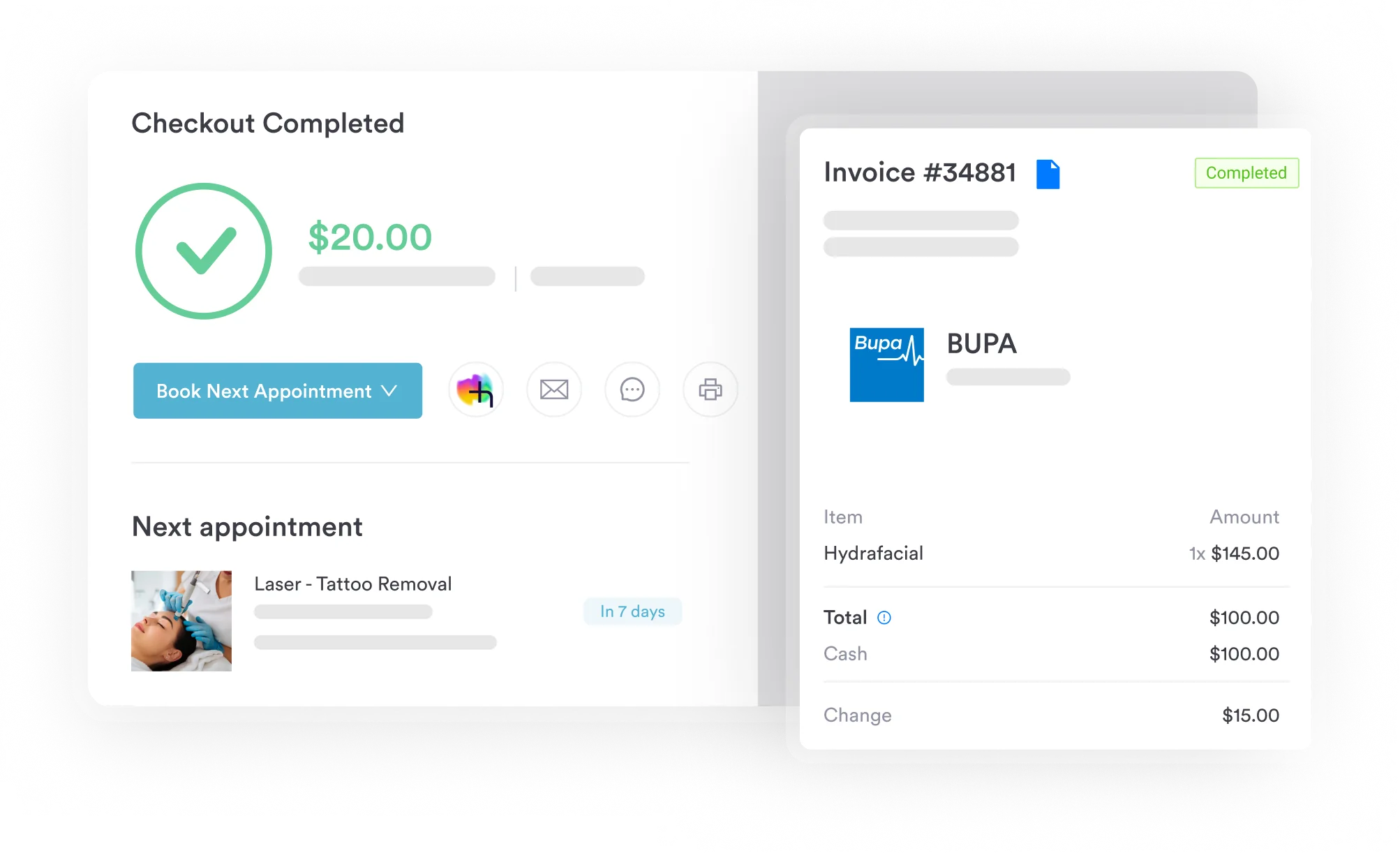

Pabau integrates with Claim.MD to submit CMS-1500 and 837P claims with built-in CPT and ICD-10 catalogs. Real-time eligibility checks and ERA remittance processing help orthopedic and sports medicine practices reduce claim denials on shoulder arthroscopy codes.

The payment for CPT Code 29828 is fixed and public. What varies is whether your claim survives the edits between submission and remittance.
The laterality modifier, the ICD-10 pairing, the CCI status of each companion code, and the operative note’s approach language decide the outcome. Run those four checks before submission rather than after a denial, and far fewer shoulder arthroscopy claims come back.
The trade-off is a few minutes of pre-submission review against weeks of rework on a denied surgical claim. Book a demo to see how Pabau flags CCI conflicts and validates ICD-10 pairings before a claim leaves your practice.

Managing denials on surgical claims? Denial codes in medical billing explains the most common CARC denial reason codes and how to respond to each.
Need authorization on file before surgery? Prior authorization process walks through getting approval before the procedure is scheduled.
Need to verify insurance eligibility before surgery? Insurance eligibility verification covers how real-time eligibility checks prevent authorization-related denials on surgical procedures.
CPT Code 29828 is arthroscopy, shoulder, surgical, with biceps tenodesis. It covers arthroscopic reattachment of the long head of the biceps tendon to the proximal humerus. Surgeons use it when the tendon has torn, subluxed, or caused chronic pain that conservative treatment has not resolved. That includes SLAP lesions with biceps anchor involvement.
Medicare’s 2026 national payment for CPT 29828 is about $843.71. The rate is the same in facility and non-facility settings, because the code has no practice expense differential. GPCI adjustments still change the figure by locality, so check the CMS Physician Fee Schedule lookup tool before submitting.
Laterality modifiers -RT (right) and -LT (left) are required on nearly every CPT 29828 claim. Modifier -51 applies when 29828 is a secondary procedure billed in the same session as a higher-value code such as CPT 29827. Modifier -59 may be used when a companion code is genuinely distinct, with clinical justification on file. Misusing it to unbundle CCI-restricted codes is improper billing.
Yes. CPT 29828 and CPT 29827 (complete rotator cuff repair) may be billed together when both are performed in the same session on the same shoulder. CPT 29827 is typically the primary code because it carries the higher RVU. CPT 29828 is reported with modifier -51. Always verify current NCCI edit status for this pair before billing, as edits are updated quarterly.
CPT 29828 covers the arthroscopic approach to biceps tenodesis. CPT 23430 covers the open, non-arthroscopic approach. If the surgeon begins arthroscopically and converts to an open procedure, the correct code is 23430, not 29828. Using 29828 for a procedure documented as open misrepresents the surgical technique and creates audit exposure.
The codes most often paired with CPT 29828 are M75.21 and M75.22 for bicipital tendinitis. M66.211 and M66.212 cover spontaneous rupture of the long head of biceps. S43.431A and S43.432A cover a superior glenoid labrum lesion. Laterality must be specified in the diagnosis code to match the operative site.



