CPT code 41115: Lingual frenectomy billing and denial guide
CPT code 41115 covers removal of the lingual frenum CPT code 41115 is the Americ...

Last Updated: Oct 20, 2026
29819 is the CPT code for arthroscopy, shoulder, surgical; with removal of loose body or foreign body. It covers arthroscopic retrieval of loose cartilage, bone chips or implant debris from inside the glenohumeral joint.
Orthopedic billers often confuse 29819 with adjacent synovectomy and debridement codes, which invites NCCI bundling denials on shoulder arthroscopy claims. The code carries a 90-day global period and is usually paired with a loose-body diagnosis such as M24.011 or M24.012.
Let Pabau's smart automation suggest the right codes, reduce claim denials, and keep your practice compliant—effortlessly.
Automate repetitive tasks and focus on what matters most—your patients.
Reduce coding errors and ensure compliance with the latest regulations.
Clean claims, fewer denials, and faster reimbursements.
Powerful insights and reporting to help your practice thrive.
HIPAA compliant SOC 2 certified GDPR-compliant Trusted by 4,000+ clinics worldwide

CPT 29819 describes surgical shoulder arthroscopy with removal of a loose body or foreign body. Synovectomy, debridement and acromioplasty each have their own codes.
M24.011 (loose body, right shoulder) and M24.012 (loose body, left shoulder) are the primary ICD-10-CM diagnosis codes. The operative report must document the type and location of the body removed.
CPT 29819 carries a 90-day global surgery period, and most payers require modifier RT or LT. Modifier 59 unbundles NCCI-paired codes only when distinct procedures are separately documented.
Acromioplasty (+29826) is an add-on code reported with 29819, so it takes no modifier 51 and no multiple endoscopy reduction.
Pabau’s claims management software submits 29819 claims electronically, runs real-time eligibility checks, tracks claim status and posts ERAs.
CPT Code 29819 is published by the American Medical Association (AMA). Its official descriptor is Arthroscopy, shoulder, surgical; with removal of loose body or foreign body. It sits within the Endoscopy/Arthroscopy subsection of the Musculoskeletal System chapter (range 29800-29999). It is a surgical arthroscopy code, not a diagnostic one.
For 29819, “foreign body” covers a broader category than many coders expect. Clinically acceptable foreign bodies include:
The code applies specifically to the glenohumeral joint. Removal from the subacromial space alone does not support 29819. The operative note must confirm intra-articular access and retrieval.
CPT 29819 bundles the standard components of any surgical shoulder arthroscopy: patient positioning, portal placement, scope insertion, joint irrigation, visualization, and routine closure. These are not separately billable.
Procedures beyond foreign body retrieval sit outside 29819 and carry their own codes. Whether each one pays on the same claim varies:
CPT 29805 (diagnostic arthroscopy) is never separately reportable on the same day as 29819. AMA coding guidelines state that a surgical arthroscopy includes the diagnostic component. Billing both is an NCCI violation.
The operative report is the billing record for CPT 29819. An audit reviewer or payer medical director reads it to confirm the foreign body was present, identified and retrieved. They also check it was clinically distinct from any other procedure in the same session.
Every 29819 operative note must document:
Missing any of these elements gives a payer a defensible basis for denial on medical necessity grounds, even when the procedure was clinically appropriate.
The diagnosis code must specifically document the presence of a foreign body or loose body in the shoulder joint. General shoulder pain codes (M25.511, M25.512) do not support medical necessity for 29819 and are a primary denial trigger.
Verify ICD-10-CM codes against the current fiscal year codebook. Codes are updated annually on October 1. The code set active on the date of service governs, not the one active on the date of billing.
Code to the highest specificity available. If the operative report specifies right shoulder, use M24.011 and never default to the unspecified M24.019 variant. Payers check laterality against the modifier on the CPT code. A mismatch between the ICD-10 laterality and the RT/LT modifier is a fast path to denial.
The correct code in the 29805-29827 family depends on what the surgeon performed and documented, not on the approach or the incision count. Each code covers a distinct clinical service.
When a surgeon performs CPT 29819 alongside another shoulder arthroscopy code in the same session, Medicare’s multiple endoscopy rule (indicator 3) applies. The highest-valued endoscopy pays in full. Each other endoscopy in the family pays its own value minus the value of the family’s base endoscopy, 29805. The 50% reduction many billers expect belongs to the general multiple surgery rule instead.
For most combined sessions, 29819 is not the highest-valued code. When a surgeon removes a loose body and repairs the rotator cuff, 29827 is the base procedure at 100% and 29819 is reduced. The biller’s job is to sequence correctly on the claim, and the chart below shows how each common pairing is treated.
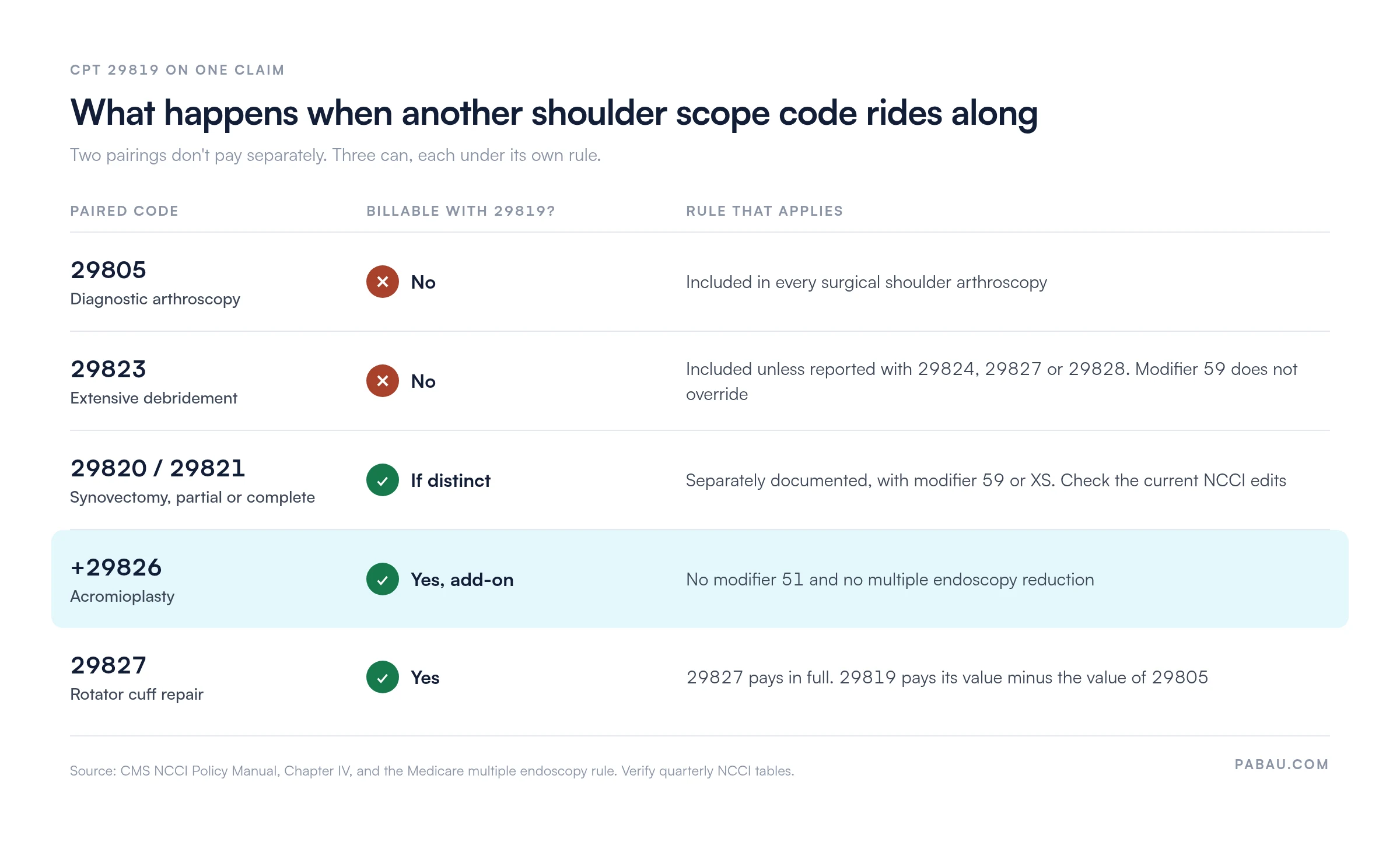
Common pairings and their billing treatment in detail:
NCCI bundling edits change quarterly. Always check the current CMS NCCI table for the specific code pair before assuming a combination is or is not bundled. Static references go stale fast in this area.
Modifier selection for 29819 affects both payment rate and audit risk. A wrong or missing modifier is the fastest route to a payer rejection or post-payment audit.
CMS has clarified that modifier 59 should be used only when no more specific X-modifier (XE, XS, XP, XU) applies. When unbundling 29819 from a synovectomy code because the synovectomy involved a distinct compartment, XS (separate structure) is more precise than the generic 59. Verify your compliance officer’s guidance before adopting the X-modifier preference. Some MACs still accept 59 without issue.
CPT 29819 carries a 90-day global surgery period, which classifies it as major surgery under the CMS global package. The single payment covers pre-operative visits the day before and the day of surgery, plus routine follow-up visits within 90 days of the procedure date.
What falls outside the global package and is separately billable during the 90-day period:
Billing a routine 2-week or 6-week post-op visit during the 90-day global results in denial. That visit is already paid through the global payment.
CPT 29819 reimbursement rates under the Medicare Physician Fee Schedule differ by place of service. Facility rates (ASC or hospital outpatient) are lower than non-facility rates because the facility separately receives payment from CMS for overhead costs.
CMS updates the conversion factor and RVU values annually. Use the CMS Physician Fee Schedule lookup tool to retrieve the current year’s payment rates for your MAC locality. Dollar figures in a static reference go out of date the moment the annual rule takes effect. For a fast RVU breakdown, the FastRVU lookup tool mirrors current CMS MPFS data and shows facility vs non-facility rates by code.
Traditional Medicare fee-for-service generally does not require prior authorization for CPT 29819, though this may vary by MAC and local coverage determination. Medicare Advantage plans operate independently and commonly require pre-authorization for elective shoulder arthroscopy. Treat each MA plan as a separate payer with its own policies.
Good insurance eligibility verification before scheduling the procedure surfaces prior auth requirements before the patient reaches the OR. The clinical documentation package typically required for a 29819 prior auth request includes:
Never assume authorization carries over from a prior procedure. Say the patient has an authorized 29827 rotator cuff repair and the surgeon also removes a loose body in the same session. The payer may treat 29819 as a separately authorized service. Verify the auth scope before the date of service.
Most 29819 denials cluster around three root causes: wrong diagnosis code, missing modifier, or inadequate documentation. Robust denial management workflows track these patterns and close the loop before the same error recurs on the next claim. The most common specific denial reasons:
Run a quarterly audit of your 29819 claims. Pull every remittance with CO-4 (modifier required), CO-97 (included in another service) or CO-119 (benefit max). These three codes identify the most common 29819 failure patterns. Address the root cause in your charge capture workflow rather than appealing individual claims after the fact.
Manual charge entry for shoulder arthroscopy cases is high-risk. A single-session claim can carry three or four codes, two modifiers, a POS code and an ICD-10 link. One wrong element can cost the practice the whole claim payment.
Pabau’s claims management software builds the claim in the system that holds the patient record and appointment. Billing staff don’t re-key details into a separate tool. Your coders still choose the codes and modifiers. Pabau handles getting the claim to the payer and the payment back:
For orthopedic and sports medicine practices running high volumes of shoulder arthroscopy, the payoff is staff time. Fewer claims get re-keyed, coverage problems surface before surgery, and denials show up as soon as the ERA lands.

Pabau submits 29819 claims electronically, checks patient eligibility in real time and posts ERAs against each claim. Your orthopedic billing team spends less time chasing shoulder arthroscopy payments.

CPT 29819 has a narrow clinical scope, and its billing risk sits in the codes around it. Before a claim goes out, confirm a loose-body or foreign-body diagnosis with matching laterality. Then check how each paired code is treated, and that the operative note names what was removed.
If CO-97 denials keep returning on these claims, fix the coding upstream instead of appealing one claim at a time. Sequence the endoscopy family correctly, report +29826 as an add-on, and keep 29805 off the claim.
A clean claim still needs a quick route to the payer and back. Book a demo to see how Pabau handles submission, eligibility checks and ERA posting for your orthopedic billing team.

Need to understand how clean claims reduce your AR cycle? Revenue cycle management guide walks through the end-to-end billing process from charge capture to payment posting.
Want to benchmark your denial rate against industry patterns? Medical billing compliance covers the audit risk areas and documentation standards that keep shoulder arthroscopy claims defensible.
Looking for a structured approach to claim scrubbing? Electronic 837 claim file guide explains how clearinghouse submission works and what pre-submission edits catch before payer adjudication.
Billing a stabilization procedure in the same shoulder? CPT code 29806 covers arthroscopic capsulorrhaphy and the documentation payers expect.
Did the surgeon also excise the distal clavicle? CPT code 29824 explains the distal claviculectomy code and how it changes debridement billing.
CPT 29819 is the procedure code for arthroscopy of the shoulder, surgical, with removal of a loose body or foreign body. It covers arthroscopic retrieval of intra-articular debris from the glenohumeral joint, including loose cartilage fragments, bone chips, broken hardware, and calcific deposits.
Yes. For CPT 29819 coding purposes, “loose body” and “foreign body” are interchangeable. Both are covered by the code’s official descriptor. A loose osteochondral fragment from degenerative or traumatic joint disease supports 29819. So does a metallic implant fragment from prior surgery, provided the operative note documents intra-articular retrieval.
Yes. 29826 is an add-on code reported with 29819 when both are documented in the operative report. Modifier 51 does not apply and the add-on is not reduced. Confirm current NCCI edits for the pair.
No. AMA coding guidelines state that a surgical arthroscopy inherently includes the diagnostic component. Billing 29805 and 29819 together on the same claim is an NCCI bundling violation and will result in denial of the diagnostic code.