

CCSD code G5100: Bypass of duodenum billing guide
CCSD code G5100 bills a bypass that leaves the duodenum in place CCSD code G5100...

Last Updated: Oct 16, 2026
28740 is the CPT code for arthrodesis, midtarsal or tarsometatarsal, single joint. It reports surgical fusion of one midfoot joint, such as the talonavicular, calcaneocuboid or a single tarsometatarsal (Lisfranc) joint.
The joint count decides the code. Fusing two or more of these joints, or the whole transverse tarsal joint, moves the claim to 28730. Great toe fusions belong to 28750 and 28755.
Let Pabau's smart automation suggest the right codes, reduce claim denials, and keep your practice compliant—effortlessly.
Automate repetitive tasks and focus on what matters most—your patients.
Reduce coding errors and ensure compliance with the latest regulations.
Clean claims, fewer denials, and faster reimbursements.
Powerful insights and reporting to help your practice thrive.
HIPAA compliant SOC 2 certified GDPR-compliant Trusted by 4,000+ clinics worldwide

CPT code 28740 reports fusion of one midtarsal or tarsometatarsal joint, such as an isolated talonavicular, calcaneocuboid or single Lisfranc joint fusion.
Fusing two or more of these joints, or the whole transverse tarsal joint, is reported with 28730. Code 28735 adds an osteotomy to that fusion.
Great toe fusions are not 28740: the first MTP joint is 28750 and the great toe interphalangeal joint is 28755.
The 2026 Medicare file gives 28740 a 90-day global period, 9.06 work RVUs and 17.29 total facility RVUs.
Medicare applies the 150% bilateral payment rule and standard multiple-procedure reductions, and an assistant at surgery may be paid.
CPT code 28740 is the procedure code for arthrodesis, midtarsal or tarsometatarsal, single joint, in the American Medical Association’s CPT code set. It reports surgical fusion of one joint in the midfoot, where the tarsal bones meet each other or the metatarsal bases.
The code sits in the Surgery section, under the Musculoskeletal System subsection for the foot and toes (28001-28899). Within that range, it belongs to the arthrodesis family that runs from 28705 to 28760.
The surgeon exposes the joint, removes the remaining cartilage from both surfaces and brings the prepared bone ends together. Screws, plates or staples then hold the joint while it fuses into one solid segment.
CPT 28740 covers a single joint in one of two midfoot regions. The descriptor names them both, so the joint’s location and the joint count decide whether the code fits.
Before you pick a code, count the joints named in the operative note, not the bones or the screws. One prepared joint points to 28740. Two or more midtarsal or tarsometatarsal joints point to 28730.
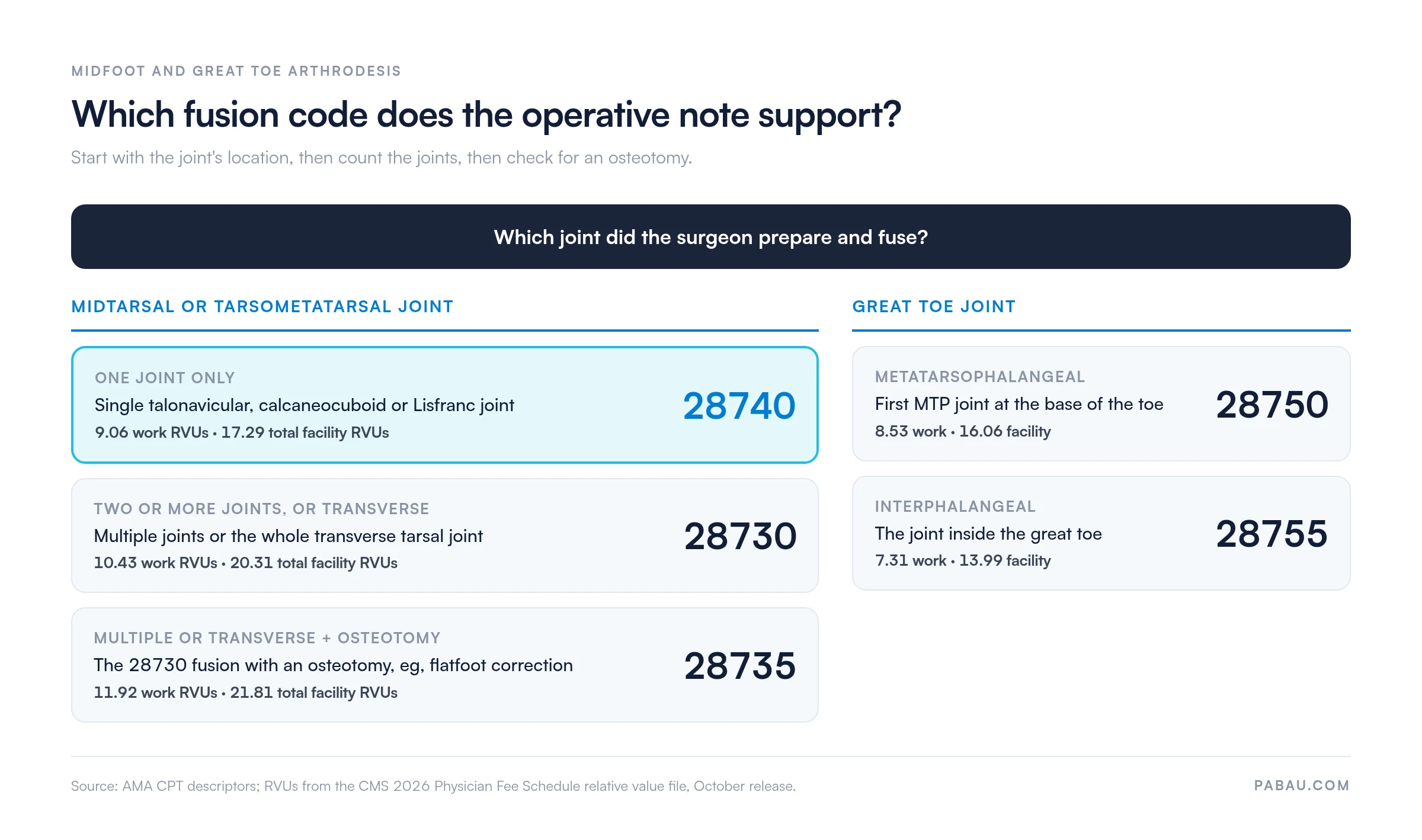
The coding rule follows from the word “single.” An isolated talonavicular fusion, or a fusion of the first tarsometatarsal joint alone, fits 28740. Once the operative note lists two or more of these joints, the descriptor for 28730 is the closer match. The chart below adds the two other exits that catch miscoded fusions: an added osteotomy and a great toe joint.
Surgeons bill CPT 28740 when one midfoot joint is painful, unstable or deformed and conservative care has not helped. The diagnosis on the claim has to explain why that one joint needed fusing.
Payers expect the record to show the conservative care tried before surgery. That usually means orthotics or bracing, activity changes, medication and injections, with the dates and the response to each.
Every 28740 claim needs an ICD-10-CM code that supports fusing that joint. Most foot codes carry laterality, so match the right or left foot to the operative note.
Injury codes take a seventh character for the encounter. A fusion done months after a Lisfranc injury may call for the sequela character S on the injury code rather than A, the initial-encounter character. For example, S93.324S would go on the claim with an M19.x arthritis code as the other diagnosis. Check the ICD-10-CM update each October 1 before you rely on a pairing.
Most coding errors on 28740 come from three questions: how many joints, which region and whether an osteotomy was added. The table sets 28740 against the codes it is most often confused with.
A first MTP fusion for hallux rigidus is never 28740, however close the code numbers look. Our guide to CPT code 28750 covers that fusion’s descriptor, payment and documentation.
Medicare pays CPT 28740 from the relative value units in the CMS Physician Fee Schedule relative value files. The figures below come from the 2026 October release, before any geographic adjustment.
The $33.4009 conversion factor applies to clinicians who are not qualifying APM participants. Qualifying participants use $33.5675, which lifts the national facility amount to about $580.38.
Midfoot fusions are done in a hospital or surgical center, so the facility column applies to the surgeon’s fee. Use the CMS Physician Fee Schedule lookup tool to see your locality’s rate after the GPCI adjustment.
Coding 28740 when the note supports 28730 underpays the case, and the reverse overpays it. Both are compliance problems, so the code has to match the joint count in the record.
CPT 28740 carries a 090 global period. The global covers the day before surgery, the day of surgery and 90 days after it, including routine postoperative visits.
The 2026 Medicare file sets four payment indicators that shape how you bill the code:
Toe modifiers (TA and T1 to T9) describe toes, so they do not identify a midfoot joint. For split care, the 2026 file divides 28740 into 10% preoperative, 69% intraoperative and 21% postoperative work.
CPT 28740 is subject to the National Correct Coding Initiative edits, which CMS updates every quarter. Check the current procedure-to-procedure table before adding a second code from the same session. Add 59 or XS only when the record proves a separate procedure.
Original Medicare does not require prior authorization for CPT 28740 at the time of writing. Medicare Advantage and commercial plans often do, and their rules vary by plan.
A complete prior authorization request for 28740 usually includes:
The operative report has to show a fusion of one named joint. A note that says only “midfoot fusion” leaves the coder unable to choose between 28740 and 28730.
A clean claim for 28740 starts with these elements. Checking them before submission prevents most of the denials in the next section.
Most 28740 denials trace back to the joint count, the joint location or the paperwork. Matching each denial to its cause shows whether to correct the claim or appeal it. Our denial management guide covers the wider workflow.
Remittance advice codes tell you which row applies. Our list of denial codes in medical billing explains the reason codes that come back on a rejected 28740 claim.
Midfoot fusion claims fail on small details, such as a joint count, a side or a missing signature. Many practices catch these by hand, after the payer has already rejected the claim.
Pabau, the practice management platform we build for specialty practices, moves those checks before submission. Its denial-reducing claims software turns the invoice into an electronic CMS-1500 claim. Through the Claim.MD clearinghouse integration, it checks eligibility in real time before surgery day.

Claim statuses update from the payer, and electronic remittance advice posts back against the invoice. Your billing team sees which 28740 claims were paid, which were denied and why, without a second spreadsheet.

Pabau checks eligibility, sends electronic claims through Claim.MD and tracks every 28740 denial by reason. Your team fixes the cause before the next claim goes out.

CPT 28740 rewards precise operative notes. When the note names one midfoot joint, the side and the fixation, the code choice is simple and the claim holds up in an audit.
The risk sits at the edges of the code. A second prepared joint moves the case to 28730, and a great toe fusion belongs to 28750 or 28755. Build those two checks into coding review before claims leave the practice.
Book a demo to see how Pabau helps your billing team catch coding and eligibility errors before a 28740 claim reaches the payer.

Need a reference for clearinghouse claims submission end to end? Claim.MD clearinghouse overview explains how electronic claim routing and ERA posting work for surgical practices.
Want the full path from encounter to payment? Revenue cycle management fundamentals covers each step from scheduling to final payment for procedure-heavy practices.
New to billing surgical codes like 28740? What is medical billing explains how claims, codes and payer rules fit together.
CPT code 28740 covers arthrodesis of one midtarsal or tarsometatarsal joint. Typical cases are an isolated talonavicular, calcaneocuboid or single Lisfranc joint fusion. Fusions of two or more of these joints are reported with 28730 or 28735.
No. CPT 28740 is a midfoot code. Fusion of the first metatarsophalangeal joint is reported with 28750, and fusion of the great toe interphalangeal joint is reported with 28755.
CPT 28740 reports fusion of a single midtarsal or tarsometatarsal joint. CPT 28730 reports fusion of multiple joints in those regions, or of the whole transverse tarsal joint. The joint count in the operative note decides between them.
CPT 28740 has a 90-day global period. It covers the day before surgery, the day of surgery and 90 days of routine postoperative care.
In the 2026 Medicare Physician Fee Schedule, CPT 28740 carries 9.06 work RVUs. Total RVUs are 17.29 in a facility and 25.40 in a non-facility setting.
Yes. Medicare applies the 150% bilateral payment rule to CPT 28740. Some payers want modifier 50 on one line, while others want two lines with RT and LT, so check the payer’s format first.



